Magento as an alternative for smaller companies
Many shop owners ask whether they need an ERP of their own next to Magento. This guide shows when an ERP for an online shop makes sense, what Magento can do in the admin itself and where the limits lie.
Table of contents
- 1. What an ERP for an online shop actually does
- 2. What Magento already brings in the admin
- 3. Extend Magento or connect an ERP: a comparison
- 4. When an external ERP is better
- 5. When Magento is enough as an alternative
- 6. What does the way through Magento cost?
- 7. What the way looks like in practice
- 8. How we support you
- 9. Summary
- 10. FAQ
1. What an ERP for an online shop actually does
An ERP system brings the processes of a company together: customers, quotes, orders, invoices, stock, purchasing and often accounting too. An ERP for an online shop is meant above all to prevent the same data from being maintained in several places and drifting apart.
The question is therefore not whether an ERP is good but whether your company needs the range of functions you pay for. Whoever has many orders daily, several warehouses and complex processes benefits from an ERP. Whoever has a manageable process often pays for much they never use.
This guide is aimed at smaller companies with a Magento shop that face this decision. We describe our service on the page Magento as ERP.
2. What Magento already brings in the admin
Magento is more than a shop window. Every order creates a customer, a sales order, an invoice, a shipment and a stock booking. In the admin orders can be processed, invoices and credit memos created, customer groups and prices controlled and, with Multi-Source Inventory, stock kept per warehouse.
This covers a part of what an ERP for an online shop does. What is usually missing are comfort and depth: notes on the customer, responsibilities, manual invoices, quotes, price lists per customer, goods receipt and stocktaking. These gaps can be closed with extensions in the admin.
Which functions your version offers depends on edition and configuration. The open source version, for example, has no quotes, whereas Adobe Commerce B2B contains negotiable quotes and company accounts. Check that before you plan.
3. Extend Magento or connect an ERP: a comparison
| Aspect | Extend Magento | Connect an external ERP |
|---|---|---|
| Systems | One | Two, with an interface |
| Licenses | No second license | License for the ERP, often per user |
| Adaptation | According to your process in the admin | Within the product |
| Accounting, payroll, production | Not included | Included depending on the product |
| Growth | Up to a certain complexity | Scales to larger organizations |
| Risk | The custom development has to be maintained | The interface has to be maintained |
Both ways are legitimate. Whoever connects an ERP for an online shop gets a broad range of functions but pays license and interface. Whoever extends Magento gets a lean solution for their own process but carries the maintenance of the extension.
The intermediate way is to begin with Magento and connect later. Orders, invoices and stock run in the admin, and accounting gets its data through an integration. This keeps growth open.
4. When an external ERP is better
Six signs for an external ERP
- ✓You plan production with bills of materials and multi-stage manufacturing.
- ✓You run payroll in your own house.
- ✓You manage several companies or clients.
- ✓You need batches, serial numbers or bin locations with scanners.
- ✓An ERP is already in use and runs well.
- ✓Your finance department requires accounting in the house.
If several points apply, an ERP for an online shop is the better choice. Then we connect the shop, see the page on the Magento connector and the guide Merchandise management, ERP and PIM.
Honestly, the limit rarely depends on the size of the shop but on the complexity of the processes. A merchant with thousands of simple orders is often better served with Magento than a small business with manufacturing and payroll.
5. When Magento is enough as an alternative
Magento is enough if your processes consist of customers, quotes, orders, invoices, prices and stock and accounting lies with the tax adviser or in a simple program. That applies to many merchants and manufacturers, also in B2B.
It pays off especially if you work today with tables and paper next to the shop or pay for an ERP that you hardly use. Then an extension in the admin replaces the tables, and the ERP for an online shop is no longer needed, without you losing functions you really need.
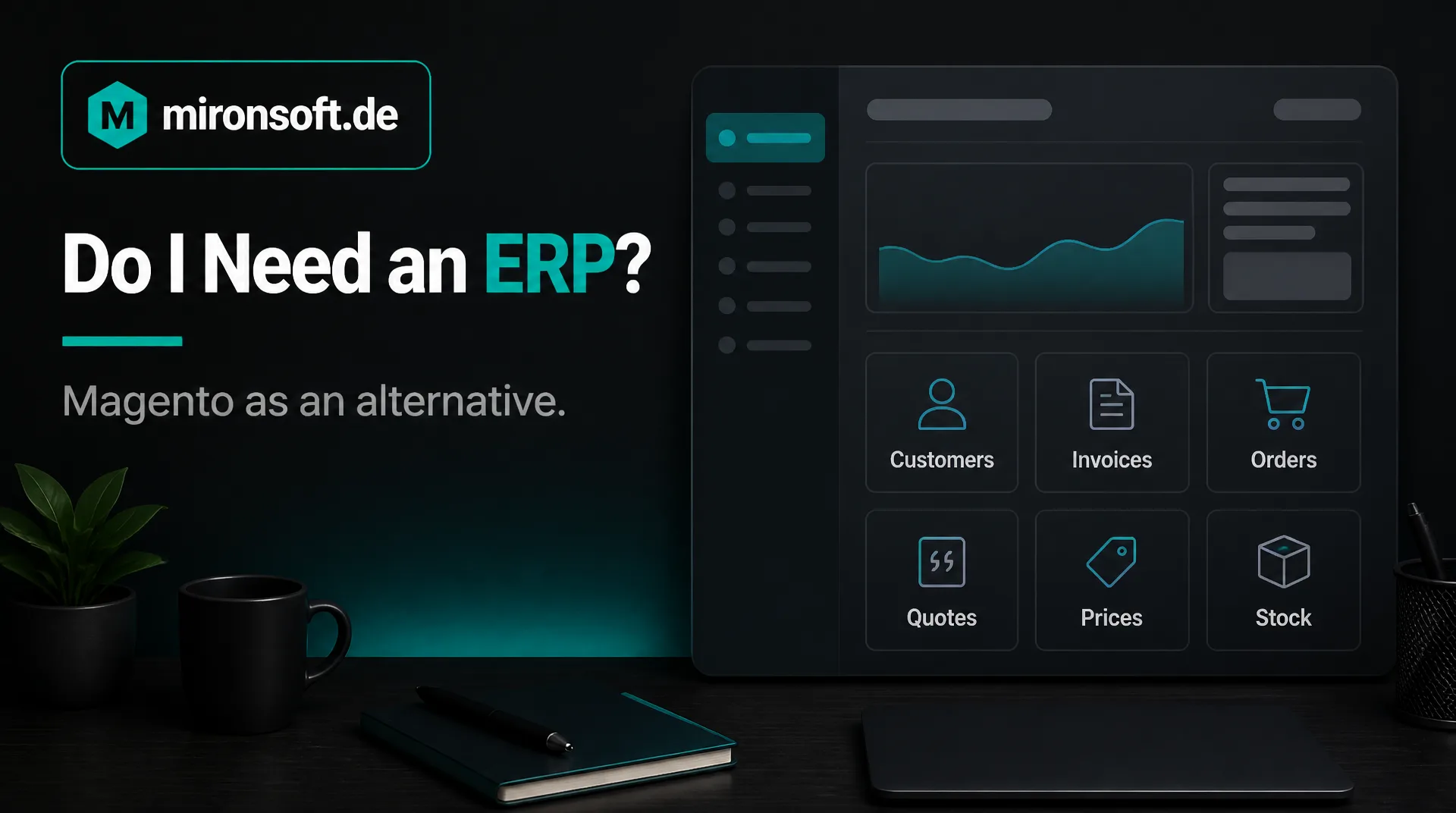
We describe the six areas we typically extend individually: customer management, invoices, orders, quotes, prices and inventory.
6. What does the way through Magento cost?
The costs depend on how many areas you extend and how special your process is. We estimate in writing after an inventory, the hourly rate is 30 euros net, see prices. We have already implemented some of it for customers and adapt it on request.
Compare fairly: what does an ERP for an online shop cost over several years with licenses, interface, care and adaptations, and what does the extension of the admin with care cost? Only this comparison shows which way is cheaper.
We are glad to create the comparison with you, even if the result is to stay with the ERP. An honest recommendation matters more to us than an order.
Include the hidden items as well: time for maintaining the interface, training new employees, updates of the ERP and the integration. An ERP for an online shop often looks cheaper than it is in the fourth year, and an extension looks more expensive than it remains in operation.
In the end an ERP for an online shop is a business decision, not a technical one. Decide on the basis of your processes and your numbers.
7. What the way looks like in practice
The way begins with the inventory: how do you work today, which tables and programs run next to the shop and what of it is to be replaced in the admin? Then we choose the area with the most manual work, for example invoices or stock, and build it first.
Every area is tested with real examples, and your team works in parallel for a few days before the old way is switched off. Whoever wants to replace an ERP for an online shop should not skip this parallel operation because gaps show up early and cheaply this way.
Rights, backups and documentation belong to it. The admin becomes the heart of the business and needs protection accordingly.
8. How we support you
We are a web agency in which permanent freelancers work together, all from home offices. We extend the Magento admin project by project, according to your processes and with documented rules, and we do not sell a ready-made ERP off the shelf. Source code and access stay with you.
This guide gives a general orientation. For a first conversation a short message through our contact page is enough. Describe how you work today, and we tell you honestly whether Magento is enough or an external system fits better.
9. Summary
An ERP for an online shop is not always necessary. For smaller companies with manageable processes the extended Magento admin can cover customers, invoices, orders, quotes, prices and stock.
ERP for an online shop at a glance
Magento can
Orders, invoices, customer groups, prices and several warehouses
Usually missing
Notes, responsibility, manual invoices, quotes, goods receipt, stocktaking
External ERP better
With production, payroll, several companies and batches
Decision
Compare costs over several years, not only the license
Note: This article gives a general orientation. Functions depend on edition and configuration; tax and legal questions you clarify with your adviser.