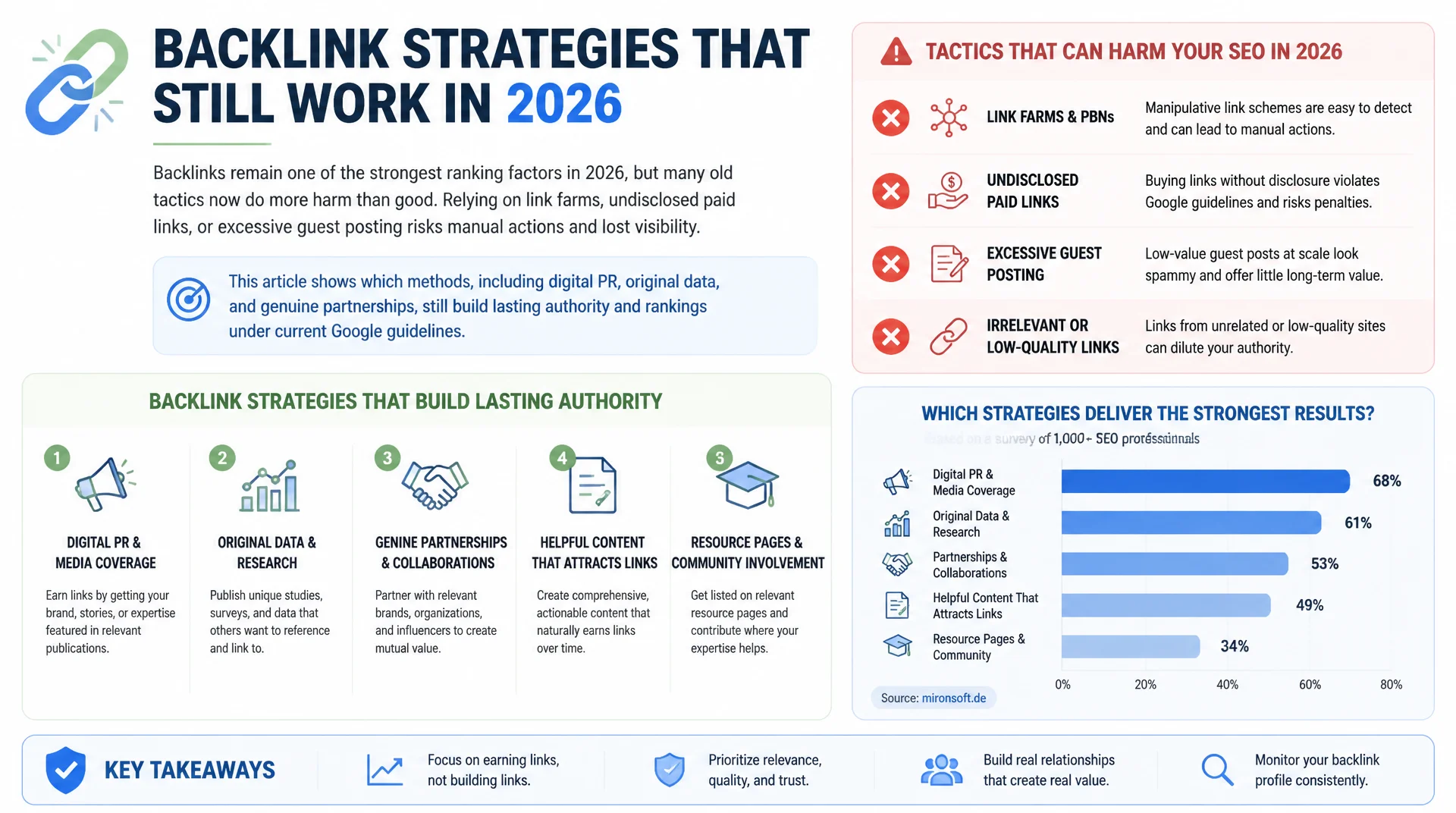
What Google actually still rewards in 2026
Backlinks remain one of the strongest ranking factors in 2026, but many old tactics now do more harm than good. Relying on link farms, undisclosed paid links, or excessive guest posting risks manual actions and lost visibility. This article shows which methods, including digital PR, original data, and genuine partnerships, still build lasting authority and rankings under current Google guidelines.
Table of Contents
- 1. Why backlinks still determine visibility and trust in 2026
- 2. Outdated and risky tactics: link farms, paid links, excessive guest posting
- 3. Digital PR: original research and data as a link magnet
- 4. Tools and resources as link bait
- 5. Genuine partnerships and co-marketing instead of link exchanges
- 6. Quality signals: evaluating relevance, authority, and topical fit
- 7. Anchor text diversity and natural link profiles
- 8. Backlink audit, disavow, and link reclamation
- 9. Outdated vs. current tactics compared side by side
- 10. Summary
- 11. FAQ
1. Why backlinks still determine visibility and trust in 2026
Backlinks remain one of Google's most influential ranking signals, even though the way they get evaluated has changed massively since the major spam updates. A link from a trustworthy, topically relevant domain transfers authority that's hard to reach through content alone, especially in competitive niches like e-commerce consulting or Magento development, where established competitors have been building link equity for years. Businesses that rely exclusively on technical SEO and content often give up decisive ranking points to competitors that actively build links in these markets.
What has changed by 2026 is mainly the consequence of manipulative links: Google's spam detection system, SpamBrain, now mostly nullifies unnatural links automatically instead of triggering a manual penalty. That sounds more relaxed, but it isn't: anyone investing money and time in link farms or paid links often loses that investment entirely without ever achieving a ranking effect. Only especially extreme or systematic patterns still trigger manual actions with noticeable visibility loss.
2. Outdated and risky tactics: link farms, paid links, excessive guest posting
Link farms and private blog networks (PBNs) were long considered a fast way to more link power, but today they're one of the most reliably detectable patterns. Shared hosting, identical analytics IDs, interchangeable templates, and unnaturally regular publishing intervals leave a digital fingerprint that SpamBrain reliably detects and devalues. The budget spent evaporates completely, without ever producing a measurable ranking effect.
Undisclosed paid links directly violate Google's link spam policies. Paid placements aren't fundamentally forbidden, but they must be marked with rel="sponsored" so they're not meant to pass ranking value. Agencies that quietly book link packages on well-known link-selling networks often produce recognizable patterns in the process: identical anchor text distributions across multiple client projects and a suspiciously regular publishing cadence.
Excessive guest posting through generic outreach pitches to hundreds of topically unrelated blogs now causes more harm than good: it creates a profile of irrelevant links that dilutes topical authority rather than strengthening it. Sites that already carry damaged links in their profile should actively devalue them via a disavow file in Search Console instead of hoping for automatic nullification.
# Google Disavow file (upload via Search Console, one domain/URL per line)
# Format: domain:example.com disavows every link from that entire domain

# Known link farm / PBN network flagged during the audit
domain:link-farm-network-example.com
domain:cheap-backlinks-directory-example.net

# Individual spammy URL, not the whole domain
https://spammy-forum-example.org/profile/user12345

# Paid guest post placements without disclosure, no longer worth the risk
domain:link-selling-network-example.com
3. Digital PR: original research and data as a link magnet
Digital PR means producing genuine news or data that trade press and industry sites want to cover on their own. Instead of asking for a link, it gives journalists and editors a concrete reason: an analysis of a company's own customer data, an industry survey, or a benchmark that doesn't exist yet in this form. A practical example: an analysis of checkout load times across 150 Magento stores delivers numbers that trade press can cite because they're not available anywhere else.
The decisive advantage over classic link building: the resulting links are editorially embedded, topically relevant, and practically impossible to fake, because they're based on genuine original data. A cleanly prepared dataset with structured data in the markup additionally makes correct citation easier and increases the chance that search engines correctly attribute the data's origin. The investment in a study often pays off for years, because trade articles and ranking lists keep citing it repeatedly.
{
  "@context": "https://schema.org",
  "@type": "Dataset",
  "name": "Magento Checkout Performance Benchmark 2026",
  "description": "Original benchmark data on checkout load times and conversion impact across 150 Magento 2 stores.",
  "creator": { "@type": "Organization", "name": "Mironsoft", "url": "https://mironsoft.de" },
  "datePublished": "2026-03-01",
  "license": "https://creativecommons.org/licenses/by/4.0/",
  "citation": "https://mironsoft.de/studien/checkout-performance-benchmark-2026",
  "keywords": ["Magento", "Checkout Performance", "Core Web Vitals", "E-Commerce"],
  "distribution": {
    "@type": "DataDownload",
    "encodingFormat": "text/csv",
    "contentUrl": "https://mironsoft.de/studien/checkout-performance-benchmark-2026.csv"
  }
}
4. Tools and resources as link bait
Free, genuinely useful tools are one of the few link building formats that passively generate new backlinks for years without any active outreach. A well-built page speed calculator, a free schema markup validator, or an ROI calculator for store migrations solves a concrete problem once and then keeps getting linked from blog posts, forums, and resource lists, often for years afterward.
In practice, this effect can be amplified by offering the tool as an embeddable widget for other websites, including a built-in attribution line linking back to the source domain. That way, link building scales through the reach of other sites instead of having to acquire every single link individually. It's important not to lazy-load or hide the attribution link via JavaScript, so it's recognized as a full, editorially accepted link.
<!-- Embeddable "Page Speed Budget Calculator" widget with required attribution -->
<div id="mironsoft-speed-budget-calculator"
     data-widget-src="https://mironsoft.de/tools/speed-budget-calculator/embed.js">
</div>
<script src="https://mironsoft.de/tools/speed-budget-calculator/embed.js" defer></script>

<!-- Attribution line ships with the widget, do not remove -->
<p class="mironsoft-attribution" style="font-size:11px;">
  Tool by <a href="https://mironsoft.de/tools/speed-budget-calculator" rel="noopener">Mironsoft</a>
</p>
5. Genuine partnerships and co-marketing instead of link exchanges
Genuine partnerships generate backlinks as a natural byproduct of a real business relationship: joint case studies with clients, listings in official partner directories of technology partners like Adobe Commerce or Hyvä, sponsoring relevant open source projects, or speaking at industry conferences with an author bio and link. These links rarely appear in large numbers, but they're highly relevant and durable, because they're tied to an existing relationship.
The difference from classic link exchange is decisive: Google explicitly lists "excessive reciprocal linking" as an example of manipulative link building practices in its spam policies. Reciprocal networks following the pattern "I link you, you link me" produce recognizable, systematic patterns across many domains. Partnership links differ, because they arise from a small number of topically coherent relationships instead of being scaled across hundreds of websites according to a repeatable scheme.
6. Quality signals: evaluating relevance, authority, and topical fit
Google evaluates the quality of an incoming link based on several signals at once rather than a single metric like raw link count. Relevance measures the topical proximity between the linking and target domains, authority assesses the linking page's own trust profile, and placement distinguishes between a link embedded in editorial body content and an entry in a footer or sidebar link list. An additional, often underestimated signal is real visitor traffic on the linking page, since link farms typically receive almost no organic traffic.
For internal prioritization, it's worth building a simple scoring model that combines these factors and helps both when selecting outreach targets and when evaluating links already acquired. That makes it possible to decide objectively which potential link sources are actually worth the time investment, instead of prioritizing by gut feeling or a raw domain authority number.
// Simple heuristic to score an incoming backlink before deciding on outreach follow-up
function scoreBacklink(link) {
  let score = 0;

  // Topical relevance between linking domain and target niche (0-40 points)
  score += link.topicalRelevance * 40;

  // Authority proxy: normalized referring-domain strength of the linking site (0-30 points)
  score += link.domainAuthority * 30;

  // Editorial context: is the link embedded in real body content, not a footer/sidebar list?
  score += link.isEditorialPlacement ? 20 : 0;

  // Real traffic on the linking page indicates an actual audience, not a link farm
  score += link.linkingPageHasTraffic ? 10 : 0;

  return Math.round(score);
}

// Links below this threshold are candidates for the disavow review queue
const DISAVOW_REVIEW_THRESHOLD = 25;
7. Anchor text diversity and natural link profiles
A natural anchor text profile consists mostly of branded terms and naked URLs, typically 60 to 70 percent, supplemented by topical partial-match anchors in a moderate share. Exact-match commercial anchors like "magento agency berlin" should only make up a small, single-digit percentage. A disproportionately high share of optimized exact-match anchors remains one of the most reliable manual spam signals, because naturally acquired links practically never produce that kind of distribution.
During outreach campaigns, it's best not to dictate exact anchor text wording to partners, but to leave the phrasing to the editor and instead pay attention to topical embedding in the surrounding text. The editorial context around a link, meaning the relevance of the surrounding sentences, acts as a stronger signal for Google than the exact anchor text itself. Regular audits using tools like Ahrefs or Google Search Console reveal early whether a link profile is drifting in an unnatural direction.
8. Backlink audit, disavow, and link reclamation
A regular backlink audit exports the complete link profile, scores every link against the quality signals from section 6, and separates valuable sources from risky or toxic ones, such as expired domains reactivated for spam purposes. Since Google now mostly nullifies unnatural links automatically, the disavow file is no longer a mandatory tool for every single bad link, but it remains useful against systematic negative SEO attacks or clearly toxic link patterns, to proactively prevent manual actions.
Link reclamation is the most underrated part of an audit: site restructures, deleted guide articles, or old campaign pages leave behind backlinks pointing to dead URLs, giving away unused link equity. A systematic broken-link check against a site's own sitemap uncovers these cases, and a simple 301 redirect to the appropriate current page reactivates the lost link equity almost completely, usually within a few crawl cycles.
<?xml version="1.0" encoding="UTF-8"?>
<backlinkAudit generatedAt="2026-06-01">
    <link>
        <sourceUrl>https://industry-magazine-example.com/article/magento-trends</sourceUrl>
        <anchorText>Magento performance benchmark</anchorText>
        <qualityScore>78</qualityScore>
        <placement>editorial</placement>
        <action>keep</action>
    </link>
    <link>
        <sourceUrl>https://link-farm-network-example.com/directory/entry-4471</sourceUrl>
        <anchorText>magento agentur</anchorText>
        <qualityScore>6</qualityScore>
        <placement>footer</placement>
        <action>disavow</action>
    </link>
    <link>
        <sourceUrl>https://old-partner-blog-example.com/2019/tools-review</sourceUrl>
        <anchorText>mironsoft.de</anchorText>
        <qualityScore>54</qualityScore>
        <placement>editorial</placement>
        <action>reclaim-redirect</action>
    </link>
</backlinkAudit>
9. Outdated vs. current tactics compared side by side
Every outdated tactic from the previous sections has a modern counterpart that meets the same underlying need, signaling authority and trust, without the risks of the old method. The table below sets both sides directly against each other.
| Area | Outdated tactic | What works in 2026 | Why |
|---|---|---|---|
| Link networks | Link farms / PBNs | Digital PR with original data | PBN footprints are reliably detected by SpamBrain |
| Paid links | Paid links without rel="sponsored" | Transparent sponsorship cooperation | Violates Google's link spam policies |
| Guest posting | Mass guest posting, generic pitches | Targeted, topically relevant guest posts | Relevance beats raw link count |
| Link exchange | Reciprocal link exchange networks | Genuine partnerships / co-marketing | Excessive reciprocal linking is explicitly listed |
| Anchor text | Exact-match anchor spam | Natural anchor text diversity | Over-optimization is a classic spam signal |
In practice, several of these alternatives combine well: a digital PR campaign often supplies the content for partnership outreach at the same time, and a clean anchor text profile emerges almost automatically when links arise editorially instead of by prescription. Sites that consistently follow the right column of the table build a link profile that stays stable even after the next spam update.
Mironsoft
Digital PR, link building, and off-page SEO for Magento stores
Ready to build a professional backlink strategy?
We analyze your Magento store's backlink profile, separate valuable links from risky ones, and develop a digital PR and outreach strategy that still holds up after the next spam update.
Backlink audit
Quality scoring for every link, disavow recommendation where needed
Digital PR campaigns
Original data, studies, and tools as editorial link magnets
Link reclamation
Broken-link checks and redirects to recover lost link equity
10. Summary
Backlink strategies for 2026 address a simple problem: authority can't be built through content alone, but it has to be earned without the risks of old link building methods. Link farms, undisclosed paid links, and mass guest posting are reliably detected by Google's spam systems and mostly nullified automatically, while extreme patterns still risk manual actions. Digital PR with original data, useful free tools, and genuine business partnerships, on the other hand, generate links that are editorially embedded, topically relevant, and practically impossible to fake.
The decisive difference between a robust and a risky link profile rarely comes from a single campaign, but from consistently evaluating every single link by relevance, authority, placement, and editorial context. Regular backlink audits, active link reclamation, and a natural anchor text distribution additionally protect link equity already earned and prevent a single risky link building attempt from putting the entire profile at risk.
Backlink Strategies 2026 - The Essentials at a Glance
What no longer works
Link farms, undisclosed paid links, and mass guest posting are detected by SpamBrain and mostly nullified automatically.
Digital PR wins
Original data and studies generate editorial links that are practically impossible to fake.
Quality over quantity
Relevance, authority, placement, and editorial context matter more than raw link count.
Audit & reclamation
Regular backlink audits and 301 redirects protect link equity already earned.