Magento Hosting Consulting: The High-Performance Foundation for Your E-Commerce Success
DEEP DIVE
Magento Hosting Consulting
Magento Hosting Consulting: The Foundation of Your E-Commerce Success
A cheap shared hosting plan isn't a way to save money on Magento – it's a revenue killer. Hosting isn't just a monthly fee; it's the single most important strategic asset of your IT.
Anyone running an online store on Magento (Adobe Commerce) knows: this software is a technical heavyweight. It offers endless possibilities, but in return demands infrastructure that goes far beyond what standard web hosts can deliver. A cheap shared hosting plan isn't a way to save money on Magento – it's a revenue killer. If your server takes seconds to compute on every click, if the database buckles under 50 concurrent visitors, or if security updates can't be installed because the operating system is outdated, you're putting your entire business at risk.
As a specialized Magento developer at Mironsoft, I treat hosting not as a mere monthly fee, but as the most important strategic asset of your IT. In this comprehensive guide, you'll learn how modern high-performance hosting for Magento needs to be structured, and why vendor-neutral Magento hosting consulting is the first step toward a stable, scalable store.
01
Why Standard Hosting Is Deadly for Magento
Magento isn't a simple WordPress site. It uses a complex EAV database structure, hundreds of PHP classes per request, and a massive file system. A standard host optimizes its servers for "many customers per piece of hardware." With Magento, though, we need "maximum resources for one customer."
The most common problems with the wrong hosting are:
- High Time to First Byte (TTFB): The server takes too long just to respond. Google mercilessly penalizes this in rankings.
- CPU throttling: During load spikes (e.g., from a newsletter or Black Friday), the server gets throttled, and your store is effectively offline.
- Outdated software stacks: Magento 2.4+ absolutely requires modern versions of Elasticsearch, MariaDB, and PHP. Many standard hosts lag months behind here.
02
The Holy Trinity of Magento Infrastructure
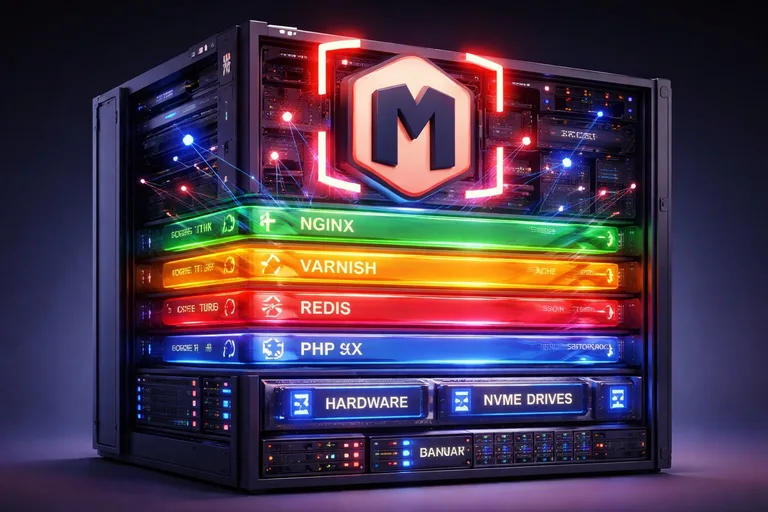
In my consulting work, I keep explaining to clients that three components determine success: CPU single-core performance, RAM latency, and disk I/O speed.
A. CPU: Clock Speed Beats Core Count
PHP is largely a single-threaded process. That means a store benefits more from two extremely fast CPU cores than from 16 slow ones. We advise you on choosing servers with high turbo-boost frequencies, to reduce PHP processing time to a minimum.
B. RAM: The Lungs of Your System
Magento loves memory. But it's not just the amount that counts – speed matters too. We make sure services like Redis and Varnish have enough room in RAM to serve data directly from memory instead of from disk. That's the difference between milliseconds and seconds.
C. NVMe Instead of SSD: The New Standard
Classic SSDs are already fast, but for the thousands of small read and write operations Magento performs, NVMe drives are a must today. They offer significantly lower latency and higher IOPS (input/output operations per second), which is especially noticeable during reindexing and imports.
03
Cloud Hosting vs. Dedicated Server: Where Does Your Store Belong?
Choosing the platform is a strategic decision. We analyze your traffic and your growth plans:
- AWS / Google Cloud / Azure: Ideal for stores with extreme seasonal fluctuations. You only pay for what you use and can scale with a click. Setup complexity, however, is high.
- Dedicated bare metal: The best choice for constant, high traffic. You get full hardware power to yourself, with no "noisy neighbors." Often the most economical solution for large stores.
- Managed Magento hosting: Specialized providers like Maxcluster, NEXCESS, or Hypernode take administration off your hands. You pay a premium for the service, but keep your head free for marketing.
04
The Software Setup: The Turbo Stack
Hardware without software optimization is like a Ferrari stuck in first gear. We advise you on configuring the perfect stack:
- Varnish Cache: Essential for TTFB under 50ms. It serves pages directly from memory.
- Redis: We use separate Redis instances for the cache and for user sessions, to avoid collisions.
- Elasticsearch / OpenSearch: Mandatory since Magento 2.4 for search. A misconfigured search node makes the entire store slow.
- RabbitMQ: For asynchronous processes like sending emails or ERP sync, so the user never has to wait.
05
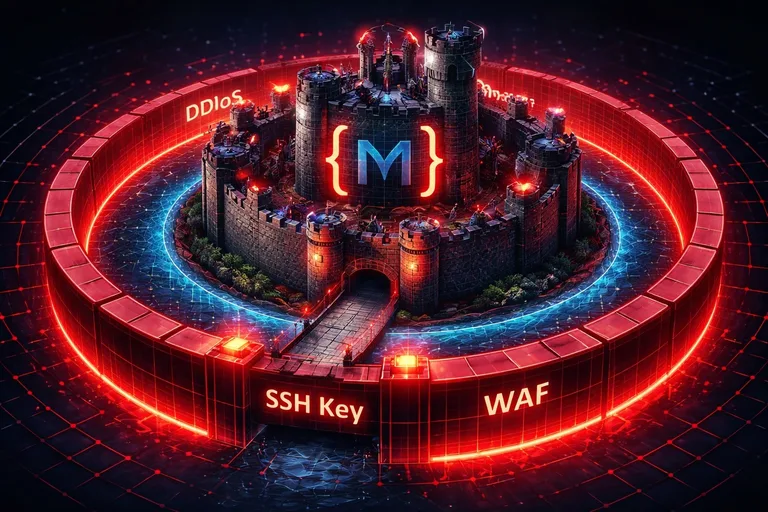
Infrastructure-Level Security
A hacked store is often the result of careless hosting. Our consulting approach covers:
- Web Application Firewall (WAF): We implement filters that block malicious requests before they ever reach Magento.
- Isolation: Every store should run in its own "chroot" environment or a container (Docker/Kubernetes), to prevent cross-site infections.
- Backup strategy: We plan 3-2-1 backups: three copies, on two different media, one of them at a different location.
- Intrusion detection: Automated systems that raise an alarm when core files are changed.
06
Scalability: Ready for Success
Nothing is worse than a store that collapses under its own load on Black Friday. We design an auto-scaling architecture for you. As load increases, additional web nodes are added automatically. Once the surge is over, capacity scales back down – saving you costs while never missing a single sale.
07
Monitoring and Performance Audits
Hosting isn't a static product. We implement monitoring solutions like New Relic or Blackfire.io. These tools let us look deep into code execution and identify "bottlenecks" in real time. Is an SQL query running too slow? Is a third-party module eating too much CPU time? We make it visible.
08
Why mironsoft Is Your Vendor-Neutral Advisor
Unlike hosts trying to sell you their own packages, as a freelancer I'm independent. My only goal is the optimal performance of your store.
- Vendor neutrality: I find the best offer for you, whether that's AWS, Hetzner, or a specialized managed host.
- Developer perspective: I know exactly what the code needs, and I can talk to sysadmins as an equal.
- Cost transparency: I help you avoid "overprovisioning" and pay only for the resources you truly need.
Conclusion: Don't Cut Corners in the Wrong Place
Your Magento hosting is the engine of your e-commerce business. A first-class setup delivers happy customers, excellent Google rankings, and maximum security. Professional hosting consulting usually pays for itself with the very first prevented downtime, or through the conversion-rate boost from faster load times. Don't leave the foundation of your success to chance. Rely on infrastructure that grows with your ambitions.
How stable is your foundation? Let's analyze your current hosting situation today and build a future-proof concept for your Magento store.
Request a Free Infrastructure CheckFrequently Asked Questions (FAQ) About Magento Hosting Consulting
Is normal web hosting enough for Magento 2?
In the vast majority of cases: no. Normal shared hosting shares resources like CPU and RAM with hundreds of other websites, which is completely inadequate for Magento 2's compute-intensive architecture. Magento also requires special software components like Elasticsearch and Redis, which standard packages often lack or run outdated versions of. We recommend at least a virtual dedicated server (vServer) or specialized managed Magento hosting, to guarantee stability and speed.
What's the most important factor in Magento hosting?
The most critical factor is single-core CPU performance. Since PHP processes many operations sequentially, having many slow cores doesn't help much – you need cores with a high clock speed. Right behind that comes fast NVMe storage for quick loading of Magento's thousands of files, and a perfectly configured caching system with Varnish and Redis. Hosting for Magento is always a combination of specialized hardware and perfectly tuned software.
Is cloud hosting (AWS/Google) worth it for small stores?
For very small stores, classic cloud hosting on AWS or Google is often "over-dimensioned" and, due to high administrative complexity, too expensive. The cloud's main advantage is scalability during extreme load spikes. For most mid-sized stores, well-configured managed hosting from specialized providers is the better choice, since many Magento optimizations are already in place there and maintenance overhead is lower.
Why is Elasticsearch so important for Magento?
Since version 2.4, Elasticsearch (or OpenSearch) is a mandatory requirement to run Magento. It handles catalog search and layered navigation filtering, which massively offloads the SQL database. Without a correctly configured, fast Elasticsearch node, your store gets extremely slow on search queries or, in the worst case, stops functioning altogether. In our consulting, we pay meticulous attention to correctly sizing this service.
How does a CDN (Content Delivery Network) protect my Magento server?
A CDN like Cloudflare acts as a shield. It intercepts malicious bot traffic and DDoS attacks before they ever reach your actual server. It also delivers static content (images, CSS, JS) from servers geographically close to the customer. That massively offloads your main server, saves bandwidth, and noticeably improves load time for customers worldwide – a must for international stores.
What's the difference between managed and unmanaged hosting?
With unmanaged hosting, you (or your developer) are entirely responsible for installing, securing, and updating the operating system and all services (PHP, MySQL, etc.). With managed hosting, the provider takes on these tasks and often guarantees specific SLAs for uptime. For companies without their own sysadmin team, managed hosting is strongly recommended, to avoid security gaps and configuration errors.
Can mironsoft migrate my store to a new host?
Yes, we support the complete migration process. We set up the new system in parallel, migrate the data, run performance tests, and only switch over once everything runs perfectly. We minimize downtime risk along the way and make sure all SEO settings and email configurations are preserved. A smooth server move is one of our core competencies in hosting consulting.
How important is Varnish for Magento hosting?
Varnish is an HTTP accelerator, and it's indispensable for any serious Magento store. It stores finished HTML pages in RAM and serves them in a fraction of a second, without PHP or the database ever having to run. Without Varnish, a Magento store's response time is often 500-1000ms; with Varnish, it drops to under 50ms. That's a decisive advantage for user experience and the Core Web Vitals.
Why does Magento need separate Redis instances?
Redis is an extremely fast in-memory store. In Magento we use it for two things: the application cache and user sessions. We recommend using two separate Redis instances (on different ports), so a massive cache update doesn't slow down or crash user sessions. This separation results in significantly higher stability for your store under load.
What happens if my store gets overloaded on Black Friday?
Without a scaling strategy, the store collapses and you lose valuable revenue. We design architectures for you that support either "vertical scaling" (more power for the existing server) or "horizontal scaling" (adding more server nodes). With forward-looking planning and load testing beforehand, we ensure your store stays stable even at ten times normal traffic.
Does mironsoft also support hosting Adobe Commerce (Enterprise)?
Yes, we advise on both running on the official Adobe Commerce Cloud (PaaS) and on-premise scenarios. For the cloud version, we help you optimally configure specific tools like New Relic and Fastly. We make sure you get maximum value out of Adobe Commerce's high licensing costs through perfectly tuned infrastructure, so enterprise features perform at full capacity.
How safe are my backups with Magento hosting?
We implement an "air-gapped" backup strategy. That means backups aren't just kept on the same server – they're encrypted and transferred to a physically separate system. In the event of a ransomware attack on your main server, backups stay untouched. We also regularly test restores, so we know for certain in an emergency that the data really works.
Does mironsoft help optimize the PHP configuration?
Absolutely. Tuning memory_limit, max_execution_time, and above all opcache is critical for Magento. We tune these values precisely to the needs of your store and your extensions. A misconfigured PHP-FPM environment can cause requests to sit needlessly long in a queue, even when the CPU actually has capacity to spare – we avoid that through precise profiling.
What is a "load balancer," and when do I need one?
A load balancer distributes incoming visitor requests across multiple web servers. You need one as soon as your traffic exceeds the capacity of a single powerful server, or if you're aiming for high availability. If one server fails, the load balancer automatically redirects traffic to the remaining servers. We advise you on building such multi-node clusters for maximum uptime.
How do I get started with hosting consulting at mironsoft?
The best way is with a free infrastructure check. We take a look at your current store, your visitor numbers, and your performance metrics. Then we discuss your goals and show you which hosting strategy best fits your budget and requirements. Just send us a message or give us a call – we're looking forward to giving your store wings!
Cookie-Details
| Name | Anbieter | Laufzeit | Zweck |
|---|---|---|---|
Cookie-Details
| Name | Anbieter | Laufzeit | Zweck |
|---|---|---|---|
Cookie-Details
| Name | Anbieter | Laufzeit | Zweck |
|---|---|---|---|
Cookie-Details
| Name | Anbieter | Laufzeit | Zweck |
|---|---|---|---|