MySQL & MariaDB Optimization: The Architecture of Data Speed
DATABASE OPTIMIZATIONTechnology Hub
MySQL & MariaDB Tuning: Your Shop's Beating Heart
We treat MySQL and MariaDB not as simple storage locations, but as highly complex engines that require precise tuning. We dive deep into InnoDB's layers and optimize the EAV model — for lightning-fast checkouts.
In a high-performance e-commerce system, the database is the beating heart. But in Magento shops, this heart is often burdened by inefficient queries, missing indexes, and wrong server configurations. When the database stutters, the entire shop stands still. At mironsoft we treat MySQL and MariaDB not as simple storage locations, but as highly complex engines that require precise tuning. We dive deep into InnoDB's layers, optimize the EAV model, and make sure your data streams flow at light speed — for lightning-fast checkouts and administration that's finally fun again.
AI generatedChapter 01
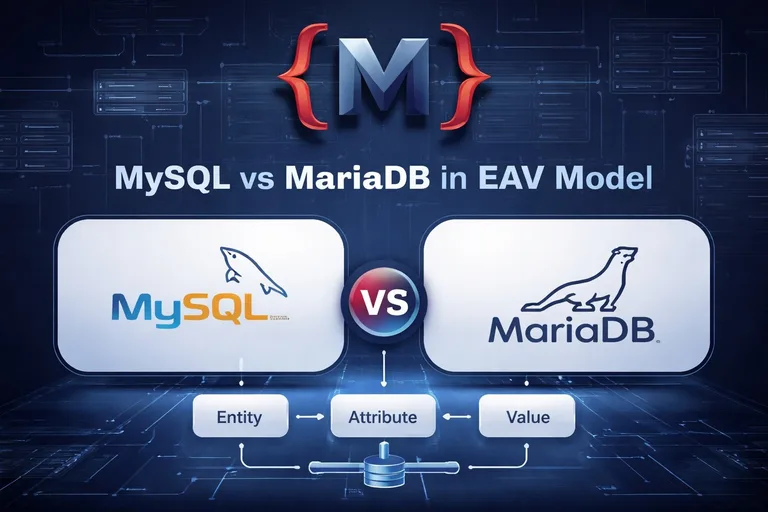
MySQL vs. MariaDB: Choosing the Right Engine for Magento
In modern web development, we're often faced with the choice: stick with classic MySQL, or switch to the community-driven fork MariaDB? For Magento merchants, this decision is often already dictated by Adobe Commerce's technological requirements, but fine-tuning differs massively.
Criterion
Assessment
MySQL
Often scores in the enterprise space thanks to Oracle's backing.
MariaDB
Often offers advantages for extremely write-intensive loads, with features like the Aria storage engine or improved parallel replication.
At mironsoft we analyze your load profile: do you have many concurrent buyers (read-intensive) or massive import processes from the ERP (write-intensive)? We configure your database stack to exactly match your business model.
Chapter 02
The EAV Dilemma: Why Magento Databases Are So Complex
Magento uses the Entity-Attribute-Value (EAV) model. That's the reason for Magento's enormous flexibility, but also its biggest performance killer. Instead of a simple product record, Magento often has to join dozens of tables to display a single item in the frontend.
The Art of Index Tuning
A missing or corrupt index in an EAV structure can cause simple search queries to bring the entire server to its knees. At mironsoft we run regular index audits. We identify unused indexes that only eat storage space, and set targeted "composite indexes" for your most frequently used queries. That's the difference between a database that has to guess and one that knows where the information lives.
AI generatedChapter 03
InnoDB Tuning: The Engine Room of Data
Almost all modern Magento databases use InnoDB as the storage engine. But many hosts' default settings are optimized for small blogs, not a multi-million e-commerce shop. Our optimization package includes:
Buffer pool optimization: We make sure your entire "working set" of data fits into memory. A RAM access is up to 100,000 times faster than a disk access.
Log file management: We optimize innodb_log_file_size to prevent write blocks during massive order volumes.
I/O threads: Adjusting read and write threads to match your server CPU's actual core count.
Chapter 04
Query Analysis: Tracking Down the "Slow Query"
An online shop runs thousands of queries per second. It's often a single, poorly programmed extension that causes a "slow query" and blocks the entire shop. We use tools like the MySQL Slow Query Log and the Performance Schema to identify these culprits. We rewrite queries, eliminate unnecessary "SELECT *" commands, and ensure Magento only queries what it actually needs. This not only relieves the CPU, but also improves scalability during marketing campaigns.
AI generatedChapter 05
High Availability & Replication: No More Downtime
For enterprise shops, a single database server is a risk. We advise you on master-slave replication. Here, one server handles write access (orders, imports), while one or more slave servers handle read access (product pages, searches). If a server fails, another takes over instantly. Combined with a load balancer, we create infrastructure that never sleeps.
Chapter 06
Database-Level Security: Protecting Your Knowledge
The database is the primary target for hackers. We harden your MySQL/MariaDB instance:
Encryption (data-at-rest): So your data stays safe on disk too.
User privileges: We consistently apply the principle of least privilege.
SQL injection protection: Through strict validation in the PHP layer, we prevent malicious commands from reaching the database.
Chapter 07
Database Hygiene: Cleaning Up for More Speed
Over the years, Magento accumulates millions of log entries, old carts, and unused report data. These "data corpses" slow down backups and indexes. We implement automated cleanup scripts that keep your shop permanently lean. A clean shop is a fast shop.
Chapter 08
Why mironsoft Is Your Partner for Database Excellence
We don't look at the database in isolation. We understand how Magento code (PHP) and the frontend (Hyvä) interact with the data.
Holistic profiling: We use tools like Blackfire to measure the entire chain from click to DB response.
Experience with Magento 2.4+: We know the specific requirements of MariaDB 10.6 and higher.
Honest consulting: If your hardware is the problem, we tell you directly and help with the move.
Is Your Shop Too Slow for Your Success?
The cause is often buried deep in the database. Let's run a deep analysis of your MySQL or MariaDB instance together and release the performance brakes.
Frequently Asked Questions About Database Optimization
Is MariaDB really faster than MySQL for Magento?
There's no blanket winner, but MariaDB often offers more modern optimization algorithms and better multi-threaded performance. For current Magento versions, MariaDB is often the community's recommended choice. What matters more than the software's name, though, is precisely tuning configuration parameters to your specific hardware.
What's the most common mistake with Magento databases?
The most common mistake is an undersized innodb_buffer_pool_size. If this value is too small, MySQL constantly has to read data from the slow disk instead of holding it in RAM at light speed. At mironsoft we ideally set this value to 70-80% of available memory, to guarantee maximum speed.
Does database optimization help against slow checkouts?
Yes, massively. The checkout is the moment when most write access to the database happens (order creation, stock update, customer update). If the database is blocked here by locks or inefficient indexes, the checkout aborts or feels sluggish. Clean database tuning ensures a smooth purchase and directly translates into more revenue.
How do I identify inefficient SQL queries?
We use MySQL's "slow query log," which logs every query taking longer than a defined threshold (e.g. 1 second). With the EXPLAIN command we then analyze why the query is slow — often it's missing indexes or too many tables being scanned simultaneously. We optimize these queries specifically to minimize server load.
What does "database replication" mean and do I need it?
Replication means your database runs on multiple servers simultaneously. A "master" handles write operations, while "slaves" handle read operations. This is essential for high-traffic shops, to distribute load and increase fault tolerance. If a server fails, another can take over instantly, keeping your shop online.
Do I have to take the shop offline for optimization?
In most cases, no. We run analyses and preparations on a staging system. The actual configuration changes usually only require a brief restart of the database service (a few seconds). We meticulously schedule bigger changes to table structures during low-traffic periods, reducing your revenue impact to zero.
Do lots of products in Magento slow down the database?
Magento is designed for millions of products, but the complexity of the EAV structure makes queries more demanding with large catalogs. By using Elasticsearch/OpenSearch, we massively relieve the database of search and filter requests. Precise database tuning is still essential for large catalogs though, to keep administrative tasks like product updates or reindexing fast.
What's the advantage of SSD/NVMe for the database?
The database constantly performs small read and write operations (I/O). Classic hard drives are far too slow for this. NVMe storage offers extremely low latency and thousands of operations per second (IOPS). This is the most important hardware upgrade for any Magento shop, since it minimizes time spent on database locks and improves overall system response time.
Can a faulty index crash my server?
Yes, indirectly. If an important index is missing, MySQL has to scan the entire table on every query ("full table scan"). With many concurrent users, CPU load and RAM usage rise so sharply that the server can no longer accept new requests or freezes completely. We identify these risks proactively through continuous monitoring.
How secure is my data in a MariaDB database?
Security is mironsoft's top priority. We configure encryption for data on disk (data-at-rest) and for transmission to the PHP process. We also enforce strict user permissions and regular security audits of the server environment. A well-maintained database is the safest place for your valuable customer and business data.
Does mironsoft also offer backup solutions for databases?
Yes, a professional backup strategy is part of our maintenance service. We implement daily (or even hourly) backups, stored encrypted on geographically separated servers. We also regularly test restores, so in an emergency we know your data is available again within minutes — that's your ultimate safety net.
What's the difference between horizontal and vertical scaling?
Vertical scaling means giving your existing server more resources (RAM, CPU) — this has physical limits. Horizontal scaling means distributing the load across multiple servers (a database cluster). We advise you on which path makes economic and technical sense for your shop, to enable unlimited growth.
Why do log tables slow down my shop?
Magento writes a log entry for almost every action. Over months, these tables can grow to gigabyte sizes. This slows down the entire database, since indexes become huge and backups take forever. We implement automatic cleanup routines that regularly archive or delete this data, keeping your database focused and fast.
How important is the interplay between PHP and MySQL?
The database is only as fast as the PHP application's queries. Poorly written Magento code can send hundreds of small queries in a loop (the N+1 problem), bringing any database to its knees. At mironsoft we optimize both sides: we write efficient code and tune the database to process these queries at light speed.
Does mironsoft also support optimizing cloud databases (AWS Aurora)?
Yes, we have extensive experience with cloud database services like AWS Aurora or Google Cloud SQL. These systems often offer special enterprise features for automatic scaling and high availability. We configure these services to harmonize perfectly with your Magento backend, so you get the most out of cloud technology for your shop.
How often should a database audit be run?
In a dynamic online shop, we recommend a comprehensive database audit at least every 6 months, or before major marketing events like Black Friday. Since data volumes and query patterns constantly change, a regular check helps identify new bottlenecks early and ensure your shop's permanently high speed.
Can you also help recover corrupt databases?
Yes, our team has deep technical expertise in data recovery and forensics. If tables are corrupt or the server no longer starts after a crash, we analyze the binary data and recover as much as possible. What matters more to us, though, is prevention: through our setup and backup strategies, we make sure such an emergency never happens in the first place.
Why is mironsoft cheaper than a large IT consultancy for databases?
As a specialized freelance agency, we have no giant administrative overhead. At mironsoft you pay directly for expert knowledge on code and database. Our communication paths are also extremely short, which accelerates projects and saves costs. You get enterprise quality at a fair price, invested directly into your shop's performance.
Can I run MySQL and MariaDB in parallel?
Technically it's possible to run different instances on one server, but it's not advisable for an online shop. It unnecessarily increases complexity and resource consumption. During the strategy phase, we decide on the system that best fits your goals and then optimize that one instance to perfection, to avoid friction losses.
How do we start optimizing my database at mironsoft?
The first step is a non-binding performance analysis. We take a look at your shop version, your hardware, and your current load times. Then we run an initial database audit and show you in black and white where the brakes are. Just send us a message or give us a call — we'll make your shop fast again!