Magento Headless Commerce: Decoupling the Frontend for Maximum Scalability
ARCHITECTURE GUIDE
Magento Headless Commerce
Magento Headless Commerce: Freedom Beyond the Monolith
Classic, monolithic systems are hitting their limits. Discover why radically separating frontend and backend is the answer to the modern omnichannel world – and why our hybrid Hyvä approach is the most cost-effective form of the headless revolution.
In the rapid evolution of e-commerce, classic, monolithic systems are increasingly reaching their limits. Customer expectations have shifted radically: they demand lightning-fast responses, consistent experiences across every device, and innovative ways to interact with a brand. The traditional Magento frontend (Luma) is often too rigid and technically cumbersome for these demands. This is where Magento Headless Commerce comes in. It is the radical separation of the "head" (the frontend) from the "body" (the backend). As a specialized Magento developer at Mironsoft, I use this architecture to free businesses from the shackles of technical legacy.
In this comprehensive guide you'll learn why headless is the answer to the complexity of the modern omnichannel world, how we create limitless flexibility through APIs, and why our hybrid approach with Hyvä and the Magento PageBuilder represents the most economical form of the headless revolution.
01
What Is Headless Commerce, and Why Is It a Gamechanger?
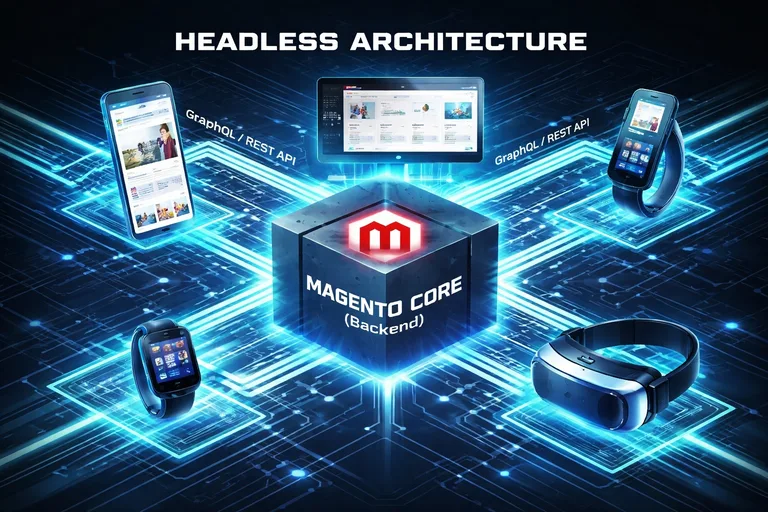
To understand headless commerce, picture the classic "monolith" structure. In Magento (Luma), backend logic and frontend presentation are tightly interwoven, like fused fabric. Every design change often requires deep interventions in the system structure. With headless commerce, this monolith is broken apart. The backend now functions purely as a data engine, managing product information, prices, and customer accounts. The entire visual layer is decoupled from it.
This approach gives you a freedom that was previously unthinkable. Your marketing team can completely rethink your store's design without any risk of damaging the complex B2B logic or your ERP integrations within Magento. You're no longer bound by the technical limitations of the Magento template engine, but can use any conceivable technology to present your brand.
02
The Technical Bridge: API-First and GraphQL
The core of the headless architecture is the API-First principle. Communication between backend and frontend happens exclusively through standardized interfaces. While the slower REST API was often used in the past, GraphQL is today's gold standard for Magento.
GraphQL is a query language for APIs that lets the frontend request exactly the data it needs for the current view. When a customer sees a product tile, the system only asks for the name, price, and image link – not the entire technical description or the shipping dimensions. This massively reduces the data load on the wire and results in load times that feel like "instant loading" to the customer.
”
GraphQL is a query language for APIs that lets the frontend request exactly the data it needs for the current view.
03
The Mironsoft Approach: Hybrid Headless with Hyvä and PageBuilder
A pure headless approach with frameworks like React or Vue is often extremely expensive and complex to maintain. It also usually means losing the ability to use the intuitive Magento PageBuilder. At mironsoft, we take a smarter, hybrid route.
We use Hyvä Themes as an extremely fast frontend framework that technologically feels like headless (lean, modern, API-friendly), yet remains fully integrated. For you, that means:
- PageBuilder support: You can keep designing your pages visually in the Magento backend, while Hyvä ensures blazing-fast rendering behind the scenes.
- Lower cost: We don't have to build everything from scratch, but instead efficiently leverage the Magento power that's already there.
- Tailwind CSS & Alpine.js: We use the most modern design tooling available, which shortens development time and increases maintainability.

04
The Benefits for Your Business: Why Headless Boosts ROI
Headless commerce isn't a purely technical decision – it's a strategic investment in your revenue.
- True omnichannel presence: You maintain your data once in Magento and simultaneously push it out to your store, your mobile app, marketplaces, or even IoT devices (e.g. smart refrigerators).
- Performance boost: Through decoupling and the use of edge computing and CDNs, we achieve load times that leave the competition behind. Higher speed = higher conversion.
- Faster time-to-market: New design trends or marketing features can be rolled out on the frontend without needing a full backend release cycle.
- Security and stability: Since the user never communicates directly with the core system, only with the API layer, the attack surface shrinks dramatically.
”
Higher speed equals higher conversion.
05
SEO in a Headless Setup: Keeping the Crawler Happy
One of the biggest concerns with headless projects is SEO. Because the frontend is often JavaScript-based, there's a risk that search engines can't correctly read the content. At mironsoft we solve this with Server-Side Rendering (SSR) or Static Site Generation (SSG).
We deliver Google a fully rendered HTML document that contains all relevant SEO information, structured data, and text. Combined with the superior speed of a headless architecture, this often leads to a massive jump in rankings, since Google today favors fast, API-driven pages in its evaluation.
06
Composable Commerce: Magento as Part of an Ecosystem
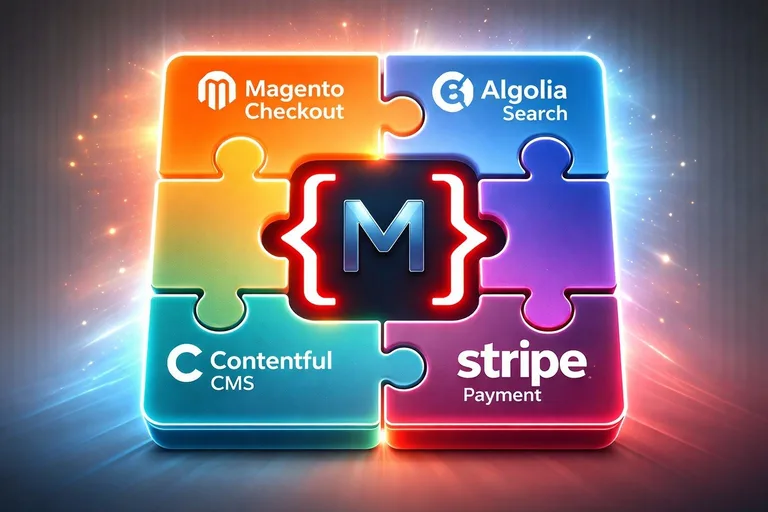
With headless, you lay the foundation for composable commerce. You're no longer reliant on Magento being perfect at everything. You can choose the absolute best solution (best-of-breed) for every area. Magento might handle the cart and customer management, while you use Algolia for search and a headless CMS like Storyblok or Contentful for your blog content. Your frontend seamlessly brings all this data together for the customer.
07
Challenges and Risks: Why You Need an Expert
Headless is complex. Synchronizing state, handling sessions across APIs, and error handling all require highly specialized knowledge. A common mistake is neglecting the middleware layer or building an inefficient GraphQL configuration, which ends up making the store slower than a monolith. As your partner, I ensure a clean architecture that avoids these pitfalls.
08
Why mironsoft Is Your Architect for Headless Projects
I offer you more than just programming – a strategic realignment of your digital presence.
- Tailored API design: We build interfaces that fit your needs exactly.
- Hyvä-first philosophy: We use the most modern Magento frontend technology to deliver headless performance at moderate cost.
- End-to-end support: From the initial process analysis to the stable operation of your API infrastructure.
Conclusion: Freedom Starts in the Head
Magento Headless Commerce is the ultimate step for businesses that no longer want to make technical compromises. It hands you back the power to radically rethink your user experience and scale your business globally. Whether through a progressive PWA, a native app, or a high-performance hybrid approach with Hyvä – headless makes your store future-proof. At mironsoft you get the technical excellence and strategic foresight to make this project a success.
Ready to free your store from the monolith? Let's work out together how headless commerce can revolutionize your business.
Start Your Headless Project NowFrequently Asked Questions (FAQ) About Magento Headless
Does headless commerce only make sense for large enterprises?
No, headless commerce is interesting for any business pursuing a long-term omnichannel strategy or needing maximum design freedom. While the initial development can be more complex, it also gives smaller businesses the advantage of reacting faster to market changes. Thanks to our hybrid approach with Hyvä, we also make the benefits of headless accessible to mid-market budgets, without reaching the cost overhead of a pure headless agency.
Does the Magento PageBuilder still work in a headless architecture?
Yes, at mironsoft we've built solutions that transfer PageBuilder output over the API to your headless frontend. This requires special mapping of the data generated by PageBuilder onto your frontend components. That way your marketing team can keep building pages with the intuitive tools they know, while the frontend enjoys the full performance of the decoupled architecture. It combines enterprise power with maximum usability for your team.
How does headless improve performance compared to a classic Magento theme?
The main advantage lies in the drastic reduction of data transfer and the use of modern client-side caching. A headless frontend loads the app structure on the first visit and afterward only requests tiny content payloads via GraphQL. Since no complete HTML page needs to be re-rendered by the server on every click, page transitions happen almost without delay. This leads to top scores in the Core Web Vitals and delights your customers with a fluid experience.
What's the difference between headless commerce and a PWA?
Headless commerce describes the underlying architecture of separating backend and frontend via APIs. A PWA (Progressive Web App) is a specific frontend technology that uses this headless architecture to enable app-like features such as offline mode and push notifications. Put simply: headless is the foundation, and a PWA is one of the most powerful applications you can build on top of it.
Will I lose my existing Magento SEO rankings by going headless?
There is indeed that risk with an improper migration, but at mironsoft we prevent it with a strict SEO strategy. We use Server-Side Rendering (SSR) to ensure Google sees perfectly rendered HTML. We also migrate all metadata, URL structures, and canonicals one-to-one. Rankings often even rise after the switch, since Google rewards the massively improved performance and clean code structure with better placements.
Can I use headless with Magento Open Source too?
Yes, absolutely. Magento Open Source offers an excellent GraphQL API, which forms the foundation for headless projects. Adobe Commerce does offer additional API features for B2B or Staging, but the core functionality for a decoupled store is present in both editions. We develop any missing API endpoints individually as needed, so you don't have to make compromises with the Open Source version either.
Do I have to rebuild my entire Magento system for headless?
No, that's the big advantage. Your backend, your product data, customer records, and ERP integrations remain untouched. We simply build a new "skin" (the frontend) and the associated API communication layer. This also allows for a step-by-step migration (strangler pattern), where we might headless-enable the blog or specific landing pages first, while the main store still runs classically, to minimize risk.
What is composable commerce in the context of headless?
Composable commerce is the evolution of headless. It means you assemble your store from the best microservices on the market for each function (best-of-breed). You might use Magento for checkout, Algolia for search, and Contentful for the CMS. The headless frontend is the bracket that ties all these services together via APIs into one unified interface for the customer. This gives you maximum flexibility and prevents dependency on a single vendor.
Does running two separate systems make a headless store more expensive to operate?
Infrastructure costs can rise slightly, since alongside the Magento server you often need a Node.js server for the frontend as well. However, maintenance and design-change costs often drop drastically, because both teams (frontend and backend) can work independently of each other without fearing side effects. On top of that, the costs typically pay for themselves quickly through significantly higher conversion rates and better scalability of the overall system.
How secure is the API communication in headless commerce?
Security is the top priority in API-based systems. We use encrypted HTTPS connections, OAuth2 authentication, and JWT tokens to validate every request. A big advantage is that the backend can be hidden completely behind a firewall and only reached through defined, secured endpoints. This often makes headless stores even more secure than classic monoliths, since there is no direct attack surface on the store infrastructure anymore.
Can B2B stores benefit from headless too?
Absolutely, for B2B companies headless is often a blessing. The often extremely complex pricing logic and huge order lists can be displayed far more smoothly in a modern headless frontend. In addition, B2B customers can integrate store functions directly into their own ERP or procurement systems via the API (punch-out). That turns your Magento system into more than just a store – it becomes a valuable service partner for your business customers.
How much maintenance does a headless system require?
Maintenance is often, paradoxically, easier. Because frontend and backend are decoupled, updates to the Magento core less frequently cause problems with the design. We can patch and test both systems independently of each other. Professional API monitoring is essential, however, to ensure communication between the two worlds stays stable at all times. At mironsoft we offer specialized maintenance contracts that cover both worlds.
Can I run multiple frontends against a single Magento instance?
Yes, that's one of the biggest strengths of headless. You could run, for example, a highly optimized web frontend for desktop users, a native app for iOS/Android, and a dedicated storeview for B2B customers – all drawing on the same Magento data foundation. That guarantees consistent prices, stock levels, and customer information across every channel, while you deliver the perfect user experience for each one.
What role does GraphQL play in performance?
GraphQL is the "efficiency turbo" of the API world. Unlike REST, it avoids transferring unnecessary data (over-fetching) and making multiple requests for related information (under-fetching). With a single request, the frontend can retrieve all the data it needs for a complex product page. That conserves your customers' mobile data connection and reduces load on your server, adding up to a massively better overall performance.
How do I get my headless project started with mironsoft?
It always starts with a strategy conversation. We clarify your goals, your target audience, and your existing infrastructure. We'll honestly show you whether a pure headless system, a PWA, or our hybrid Hyvä approach makes the most sense for your business. Just send us a message or give us a call – we look forward to making your store fit for the future of e-commerce!
Cookie-Details
| Name | Anbieter | Laufzeit | Zweck |
|---|---|---|---|
Cookie-Details
| Name | Anbieter | Laufzeit | Zweck |
|---|---|---|---|
Cookie-Details
| Name | Anbieter | Laufzeit | Zweck |
|---|---|---|---|
Cookie-Details
| Name | Anbieter | Laufzeit | Zweck |
|---|---|---|---|