Knockout.js in Magento: Mastering the Legacy, Shaping the Future
KNOCKOUT.JS & LEGACY
Technology Hub
Knockout.js: Turning Technical Debt Into Digital Value
What was state-of-the-art in 2015 is often today's biggest drag on your performance. We know the architecture of the Magento monolith down to its deepest layers.
There was a time when Knockout.js was the epitome of modern web architecture. In the Magento world (Luma & Blank), it remains to this day the driving force behind the checkout and complex UI components. But what was state-of-the-art in 2015 is often today's biggest drag on your performance and your developer experience. At mironsoft, we understand the architecture of the Magento monolith down to its deepest layers. We maintain, optimize, and refactor your legacy code while paving the way for modern, lightweight alternatives at the same time. Find out here everything about the MVVM pattern, the pitfalls of RequireJS, and how we turn technical debt into digital value.
01. The Era of Knockout.js: A Look Back Into Magento's Engine Room
When Magento 2 hit the market, the goal was clear: move away from static HTML toward a dynamic, reactive user interface. The choice fell on Knockout.js, a framework implementing the MVVM pattern (Model-View-ViewModel). It allowed developers, for the first time, to keep data and UI in sync via so-called "observables". If a price changed in the backend, the display updated automatically in the frontend without reloading the page.
But this flexibility came at a high price. Magento combined Knockout.js with RequireJS for module loading and a highly complex XML structure for the UI components. The result was a "monolith within the monolith" — a system so powerful it could do everything, but so cumbersome that it today drags many shops' Core Web Vitals into the red. At mironsoft, we've mastered this legacy. We know how to tame Knockout observables and track down inefficient subscriptions that block your browser thread.
02. UI Components: The Heart and the Pain of Magento Luma
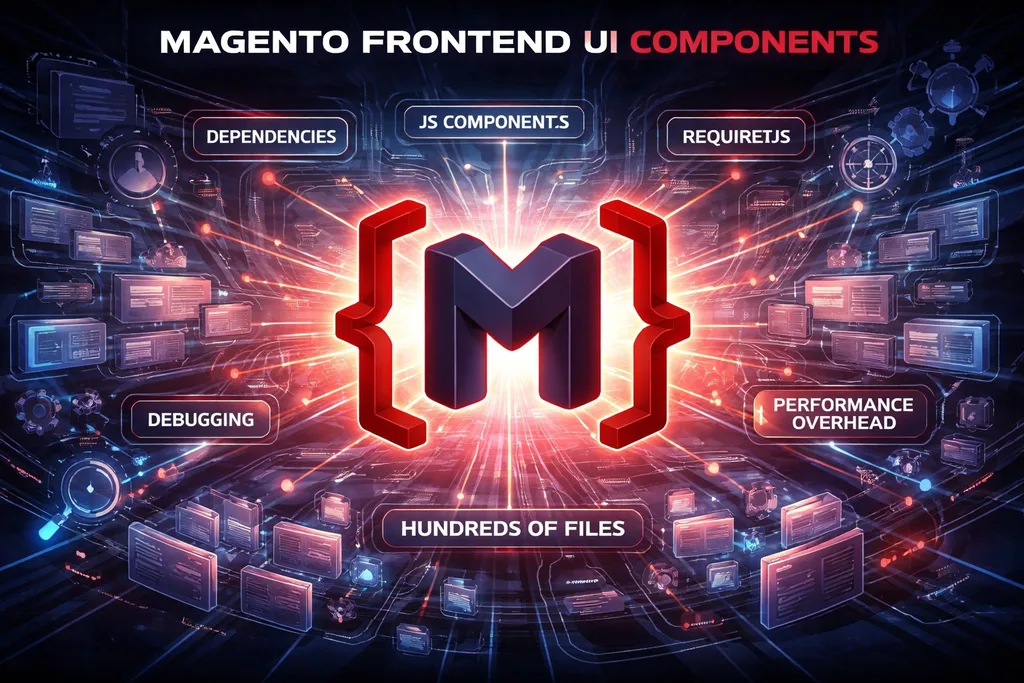
The so-called UI Components are the most complex part of Magento's frontend architecture. They control the cart, checkout, and customer accounts. Each component consists of an XML definition, a JavaScript class, and an HTML template.
Why this is considered "legacy" today:
- Dependency hell: Hundreds of files must be loaded before the first button becomes clickable.
- Heavy debugging processes: Finding errors in the Knockout scope requires hours of analysis in the browser debugger.
- Performance overhead: The framework has to scan the entire DOM on every page view to find bindings.
Despite these challenges, millions in revenue run through this stack. At mironsoft, we offer professional maintenance for these systems. We optimize your existing UI components, clean up inefficient code, and ensure your shop stays stable while you plan the switch to more modern technologies.
03. The Performance Dilemma: Why Legacy JS Costs You Google Rankings
Google today measures interaction speed (INP - Interaction to Next Paint). Knockout.js is a natural enemy here. Since the entire framework stack becomes active on every interaction, millisecond delays accumulate that, in sum, degrade the user experience.
At mironsoft, we run JavaScript profiling. We use tools like Chrome DevTools and Blackfire to identify "long tasks". We often find that unused Knockout bindings are eating up processing power in the background. Through targeted "de-bloating" of UI components, we can extend the lifespan of your Luma shop while improving your SEO values at the same time. We make legacy code competitive again.
04. Strategic Refactoring: The Path From Knockout to Alpine.js
Eventually there comes a point where maintaining legacy code becomes more expensive than modernizing it. That's where we at mironsoft rely on step-by-step refactoring. We don't have to rebuild the entire shop at once.
Our "migration path" often looks like this:
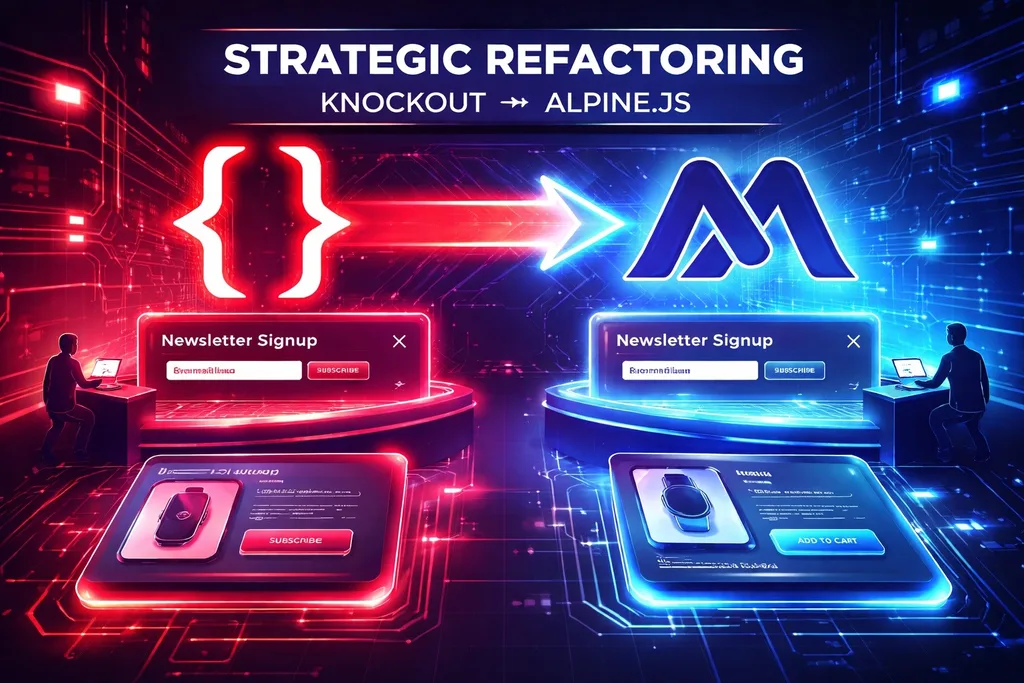
- Isolation: We identify self-contained areas, such as the newsletter sign-up or simple product widgets.
- Replacement: We replace the Knockout logic with Alpine.js or pure Vanilla JavaScript.
- Bundle-size reduction: We remove RequireJS dependencies wherever we can.
This hybrid approach lets you benefit from the speed of modern technologies without taking on the risk of a huge relaunch project. The {M} brand element stands for our guarantee: a clean transition from old to new.
05. The Checkout: The Last Stronghold of Knockout.js
The Magento checkout is the most complex piece of Knockout code there is. Shipping methods, payment providers, taxes, and customer validation all converge here. Many agencies don't dare touch it. At mironsoft, we're not afraid of checkout code. We know how to read checkout_index_index.xml and how to inject custom providers into the JS stack. Whether you need custom shipping logic or want to improve error handling in the checkout — we navigate the Knockout jungle safely. At the same time, we advise you on the Hyvä Checkout, which radically simplifies this complexity.
06. RequireJS & Bundling: Taming the Loading Process
RequireJS is responsible for loading Magento files asynchronously. What sounds good in theory often leads to a "waterfall load" of hundreds of files in practice. We optimize this process through intelligent JS bundling. We use tools like Magepack to combine hundreds of requests into a few optimized packages. This massively reduces HTTP requests and is one of the most effective immediate measures for legacy shops.
07. Developer Experience: Why We Take Legacy Code Seriously
Good developers hate bad code. This makes it increasingly difficult to find staff willing to maintain Magento legacy systems. At mironsoft, we see this as a sporting challenge. We meticulously document our interventions in legacy code and use modern tools (like ESLint and static analysis) to enforce quality standards even in old code. We make your shop attractive for further development again.
08. Why mironsoft Is Your Partner for Magento Legacy
We don't condemn the past — we optimize it. We know that many successful companies run on systems considered "outdated" today. Our goal is to give you the confidence that your technology works while we work together toward the future.
- Deepest understanding of M2 internals: We know every XML node in the UI system.
- Targeted performance fixes: We know exactly where to intervene in Knockout to gain speed.
- Safe migration path: We guide you from Luma to Hyvä without stress.
Tame the Monster in Your Backend
Legacy code doesn't have to be an obstacle to your growth. Let's analyze your Magento stack and turn technical debt into a competitive advantage.
Jetzt SEO-Check anfragenFrequently Asked Questions about Knockout.js & Legacy Code
Is Knockout.js still safe to use in Magento 2?
Yes, Knockout.js itself is safe as long as the Magento installation receives regular security patches from Adobe. The risk in legacy code lies less in the library itself and more in the growing difficulty of maintaining outdated dependencies (like RequireJS) and keeping them compatible with modern browser standards. We make sure your system remains secure and stable against attacks at all times, despite the older technology.
Why does Knockout.js make my shop so slow?
Knockout.js uses a very compute-intensive model for data binding, where the browser has to constantly monitor the DOM. In Magento, this often leads to massive main-thread load, especially when hundreds of UI components load simultaneously. This delays interaction responsiveness (INP) and increases load time, since the browser must process gigabytes of scripts before the user can even use the page.
Can I modernize only the checkout without changing the rest of the shop?
Yes, that's a very popular path for gradual modernization. By using solutions like the Hyvä Checkout, we can completely replace the outdated Knockout architecture in the checkout process while the rest of the Luma theme remains in place for now. This immediately improves the conversion rate at the most critical point in your shop, without you having to bear the cost of a full relaunch right away.
What does "technical debt" mean in the Magento context?
Technical debt arises when short-term fixes ("hacks") or outdated frameworks (like Knockout) aren't modernized in time. In Magento, this often manifests as extremely high development costs for simple changes, since the code has become too complex and inflexible. We help you pay down this debt through targeted refactoring, so you can develop your shop again in an agile, cost-efficient way.
Why is RequireJS a problem for modern websites?
RequireJS loads JavaScript files one after another on demand (asynchronously). In Magento, however, this often leads to a "waterfall effect", where the browser has to make hundreds of requests, massively extending load time. Modern approaches instead rely on static bundling and forgo such loaders to optimize code transfer — a goal we pursue at mironsoft through specialized JS tuning.
Can mironsoft fix bugs in my UI components?
Yes, we're experts in debugging the Magento UI system. We understand the complex relationships between XML layouts, data providers, and Knockout templates. If your cart is glitching or price changes aren't applied correctly, we conduct deep debugging and fix the logic without compromising your system's ability to receive updates.
How do I, as a developer, learn to work with Knockout.js?
Working with Knockout in Magento requires patience and a deep understanding of asynchronous processes. We often recommend accompanying coaching to our partners and customers to truly grasp the structure of Magento UI Components. As experts, we're happy to share our knowledge within joint projects to strengthen your internal capacity for maintaining your legacy systems.
Does it still make sense to invest in developing new Knockout modules today?
We advise against building major new features in Knockout if a switch to Hyvä is planned in the medium term. For existing shops, however, small adjustments may be necessary to keep the business running. We honestly weigh, in every project, whether repairing the old system is economical or whether we should already redevelop the feature as a modern, future-proof component.
What happens to my custom UI components during an update?
If the components were developed according to official Magento best practices, they usually survive updates without issue. It becomes problematic, however, if core files were edited directly ("core hacks"). We run an audit of your custom components before every update to ensure your individual functions keep working flawlessly in the new Magento version.
How can mironsoft improve the load time of Knockout-heavy pages?
We rely on "advanced bundling" and disabling unnecessary components on content pages. Through precise code splitting, we ensure heavy Knockout scripts only load where they're actually needed (e.g. only in the checkout). We also optimize caching of static files to reduce time-to-first-byte and minimize the load on the user's browser.
What's the difference between Knockout.js and Alpine.js?
The main difference lies in simplicity and performance. While Knockout.js is a heavy MVVM framework with high abstraction, Alpine.js is minimalist, declarative, and written directly in the HTML. Alpine.js has a tiny footprint (about 15 KB) and executes many times faster, making it the ideal modern alternative for reactive shop features.
Does mironsoft also support very old Magento 2 installations (e.g. v2.1)?
Yes, we also offer maintenance and rescue services for heavily outdated installations. We know an upgrade often isn't immediately possible. We secure your system as much as possible, fix critical bugs in the Knockout frontend, and technically prepare the shop for a future migration to a current version, to minimize your business risk.
How high is the risk of security vulnerabilities in old JS code?
Outdated JavaScript libraries are a popular target for attacks like Cross-Site Scripting (XSS). In Magento legacy systems, we therefore use Content Security Policies (CSP) to block unauthorized script execution. We also run regular scans to find known vulnerabilities in your extensions and neutralize them through patches or code adjustments.
Can an untrained developer break Knockout code?
Definitely yes. Since Knockout is deeply interwoven with XML layouts and backend data flow in Magento, careless changes often lead to serious errors in the shop's logic. At mironsoft, we therefore work under the four-eyes principle and use automated tests to ensure every change to your legacy code improves system stability rather than endangering it.
What is the "ObjectManager" and why shouldn't it appear in the JS frontend?
The ObjectManager is a backend tool for instantiating classes. In clean Magento JS, we use dependency injection via RequireJS. Directly calling backend logic from the frontend through insecure interfaces is a sign of poor quality. We clean up such unclean implementations as part of our refactoring to increase your shop's security and maintainability.
How do I deal with "deprecation warnings" in the Magento frontend?
These warnings are a sign that functions will no longer be supported in future Magento versions. We take these signals very seriously and use them as the basis for our refactoring plan. By replacing outdated methods early, we prevent your shop from completely breaking down during a future major upgrade (e.g. to Magento 2.5 or higher).
Does the XML configuration of UI components slow down development?
Yes, massively. Debugging deeply nested XML files is one of the most time-consuming tasks in Luma development. At mironsoft, we've developed our own tools and checklists over the years to speed up these processes. We reduce XML complexity wherever possible and favor flatter hierarchies to improve your system's maintainability.
Does mironsoft also provide documentation for old Magento code?
Yes, we often take over projects with no technical documentation whatsoever. We perform reverse engineering of your most important components and create a technical manual. This is the prerequisite for your system becoming controllable again, so you're not dependent on the knowledge of a single, former developer. Knowledge transfer is a core part of our service.
Why should I choose a freelancer for legacy topics?
Large agencies often focus only on new relaunch projects and neglect maintenance of existing systems. As a freelancer, I offer you the attention to detail and staying power that rehabilitating legacy code requires. At mironsoft, you get an expert who isn't too proud for "old technology" but sees it as a chance to increase your company's value.
How do we start the refactoring process with mironsoft?
The first step is a technical audit of your frontend. We identify the biggest performance bottlenecks and security risks in your UI components. We then create a priority list for refactoring — from quick fixes to strategically replacing modules. Just send us a message — we'll bring order and speed back to your Magento shop!
Cookie-Details
| Name | Anbieter | Laufzeit | Zweck |
|---|---|---|---|
Cookie-Details
| Name | Anbieter | Laufzeit | Zweck |
|---|---|---|---|
Cookie-Details
| Name | Anbieter | Laufzeit | Zweck |
|---|---|---|---|
Cookie-Details
| Name | Anbieter | Laufzeit | Zweck |
|---|---|---|---|