Magento Code Audit & Analysis: The In-Depth Inspection for Your Online Shop
DEEP DIVE
Magento Code Audit
Magento Code Audit: A Surgical Assessment of Your Digital Core
A complex web of thousands of files, hundreds of database tables, and years of technical debt. Learn how a structured code analysis brings the stability, security, and performance of your store back to enterprise level.
A Magento-based online store is a complex web of thousands of files, hundreds of database tables, and countless individual customizations. But what's really happening under the hood when the store suddenly slows down, updates keep failing, or inexplicable errors pop up at checkout? Often the root cause is "technical debt" – code that has grown messy over years, inefficient third-party modules, or outdated architectural decisions. A Magento Code Audit is far more than a simple bug hunt; it's a surgical assessment of your entire digital core.
As a specialized Magento developer at Mironsoft, I run deep analyses that pick up exactly where automated tools stop. In this guide you'll learn how a structured code analysis brings your store's stability, security, and performance back to enterprise level.
01
Why a Code Audit Is the Best Insurance for Your Business
Many store owners only contact me once the store is already on fire. But a regular audit is like the annual inspection for your car: it prevents expensive follow-up damage. A Magento system built without following the official coding standards gets more expensive to maintain with every passing month. One hour of development suddenly takes three, because the code is so tangled ("spaghetti code") that every change in one place causes three new bugs somewhere else.
A professional audit at mironsoft uncovers:
- Security risks: Hidden backdoors in modules or unsanitized SQL queries that enable SQL injections.
- Performance drains: Inefficient loops or database queries running inside loops (N+1 problems) that put unnecessary strain on the server.
- Update blockers: Direct edits to the Magento core ("core hacks") that would be overwritten by every system update.
- Database bloat: Superfluous tables and indexes that bloat the database and slow it down.
02
The Anatomy of the Analysis: What We Actually Check
An audit at mironsoft follows a strict protocol. We split the review into four critical dimensions:
A. Architecture & Coding Standards
Magento has very clear guidelines for how code should be structured. We check whether Dependency Injection is used consistently, whether Service Contracts (interfaces) govern communication between modules, and whether PSR standards are followed. We look for the notorious "ObjectManager" — using it directly in code is a sign of poor quality.
B. Extension Quality & Module Audit
Not everything you can buy on the marketplaces is well-coded. Extensions often load huge amounts of unused JavaScript or slow down the backend. We analyze every third-party module: Is it really necessary? Does it conflict with other modules? Does it rely on outdated libraries?
C. Database & EAV Analysis
The database is the heart of Magento. We check the integrity of the EAV structure (Entity-Attribute-Value). We look for orphaned entries, inefficient attribute-set configurations, and analyze the slow-query logs to find bottlenecks in data processing.
03
Performance Profiling: Tracking Down the Bottleneck
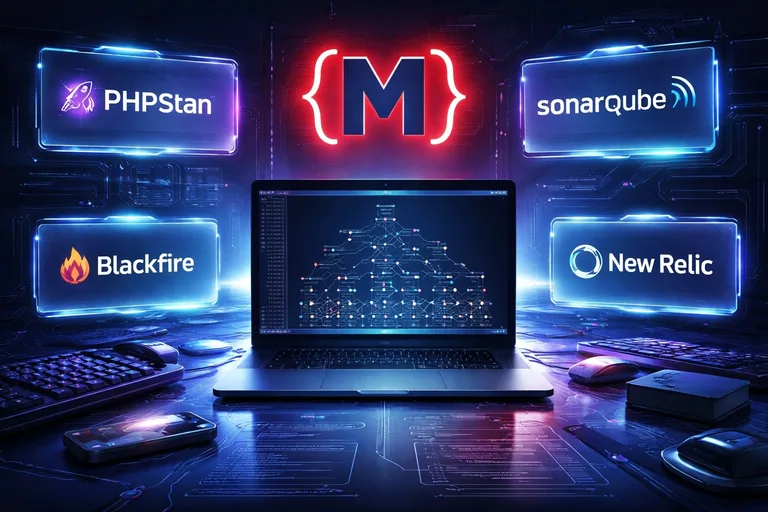
A code audit is inseparable from performance. We use tools such as Blackfire.io or New Relic to observe your code's execution in real time. We can see exactly how many milliseconds a given function consumes and which database call is slowing down checkout.
With a particular focus on our specialty, the Hyvä frontend, we check how much legacy JavaScript (Knockout.js, RequireJS) is still weighing your store down. An audit often reveals that removing just two poorly coded modules can cut load time by 30%.
04
Security: The Penetration Test for Your Code
A hacker rarely breaks in through the front door. They exploit weaknesses in your extensions. As part of our audit, we run security scans and manually inspect critical spots like form processing and API endpoints. We make sure all security patches have been applied correctly and that no unauthorized admin accounts exist.
05
The Mironsoft Audit Report: Your Roadmap to Recovery
An audit without clear recommendations is worthless. You get a detailed report from us, prioritized using a traffic-light system (red, yellow, green):
- Red (critical): Immediate action required due to security vulnerabilities or threat of system failure.
- Yellow (warning): Technical debt that will make operations harder or slow the system down in the medium term.
- Green (optimization): Recommendations for improving maintainability and future scalability.

06
Refactoring: From Diagnosis to Cure
We don't leave you alone after the audit. We offer a matching refactoring service. We clean up the code, replace bad modules with custom-built ones, and bring your store up to the latest state of the art. In doing so we consistently rely on the Magento PageBuilder and Tailwind structures, so that editorial work becomes enjoyable again too.
07
Why mironsoft Is Your Audit Partner
At large agencies, an audit is often carried out by junior developers with automated checklists. At mironsoft, the audit is handled at the top level. As an experienced freelancer, I look at your code with an architect's eye.
- Independence: I'll tell you honestly when a module is junk – even if it cost money.
- Deep expertise: I understand the internals of Magento 2.4+ and the specifics of Hyvä.
- Solution-oriented: I don't just present problems, I deliver the matching code fixes directly.
08
Conclusion: Knowledge Is Power – and Stability
A Magento Code Audit is the most sensible investment for any serious store owner. It turns a "black box" full of technical risk into a transparent, controllable business asset. By identifying weaknesses, you lower your long-term development costs, increase the security of your customer data, and build the foundation for real performance records. Trust technical expertise and protect your most valuable asset: your code.
When was your store last professionally reviewed? Let's schedule your deep-dive audit today.
Book Your Deep-Dive AuditFrequently Asked Questions (FAQ) About Magento Code Audits
How long does a complete Magento Code Audit take?
The duration of an audit depends heavily on the size of your store and the number of installed extensions. As a rule, a thorough analysis including the final report takes between 5 and 10 business days. During this time we run automated scans, manually review the custom code, and analyze server logs to get a complete picture of your technical quality.
Does my store need to go offline during the audit?
No, absolutely not. Most of the analysis takes place on a copy of your store (a staging environment) or through passive observation of live logs. Only for deep performance measurements do we use monitoring tools on the live system, which does not affect operations. Your day-to-day business continues completely undisturbed while we track down weaknesses in the background.
Does an audit help even if my store is actually running well?
Yes, very much so. An audit on a "well-running" store serves prevention and the identification of technical debt before it turns into real problems. We often find hidden inefficiencies or security risks that only become dangerous under rising traffic (e.g. around the holidays) or with future Magento updates. It's the best investment in the long-term stability of your business.
Which tools do you use for the code analysis?
We combine automated tools with a manual expert eye. Our stack includes PHPStan and Psalm for static analysis, SonarQube for code metrics, and Blackfire.io for performance profiling. We also use specialized Magento tools such as the Magento ECG Scan. The most important "tool," however, remains the years of experience of our developer, who spots correlations no algorithm can see.
What's the difference between a code audit and an SEO audit?
An SEO audit focuses on visibility on Google (content, keywords, meta tags, backlinks). A code audit, by contrast, looks under the hood at the technical quality, security, and architecture of the software. The two are related, though: poor code leads to slow load times and technical errors, which in turn ruin your SEO rankings. A code audit is often the necessary groundwork for successful SEO.
Can you also audit Adobe Commerce (Enterprise) installations?
Absolutely. We review Adobe Commerce installations both on-premise and on Adobe Cloud (PaaS). We pay particular attention to the correct use of enterprise features such as Staging, segmentation, and integration of Adobe-specific APIs. We make sure you're getting the most out of the high license costs through a technically clean and performant implementation.
Does the audit also find security vulnerabilities in third-party extensions?
Yes, that's one of our focus areas. We analyze not just your own code but also cast a critical eye over every installed module. We cross-reference them against known vulnerability databases and manually check the quality of the programming. It's often outdated or poorly maintained extensions that pose the biggest security risk for your store.
Does mironsoft also offer refactoring after the audit?
Yes, we don't leave you out in the cold with just the report. Based on the audit findings, we put together a proposal for gradually cleaning up your code. We eliminate technical debt, optimize performance bottlenecks, and make sure your store is future-proof and update-ready again. Our goal is to bring your store to a state that's a pleasure to keep developing long-term.
Can an audit help lower the cost of future development?
Definitely. Clean code that follows Magento standards is far easier and faster to extend than a "hacked-together" system. By uncovering and fixing technical legacy issues, we reduce complexity. That means new features can be implemented much faster going forward, need less bug-fixing, and ultimately massively improve your development ROI.
Do you also check the server configuration during the audit?
Yes, a code audit is only complete once you also look at the environment the code runs in. We check the versions of PHP, MariaDB, and Elasticsearch, as well as the configuration of Redis and Varnish. We often find performance bottlenecks that aren't rooted in the code itself but in a misconfigured server stack. We provide recommendations for the ideal hosting setup.
How confidentially is my code data treated?
Discretion and data protection are top priority at mironsoft. We sign a comprehensive non-disclosure agreement (NDA) before every audit begins. Access to your code happens over secured channels, and we use the data exclusively for the analysis. Your trade secrets and intellectual property are in safe hands with us – that's the basis for our trust-based collaboration.
Does an audit help if my store has been hacked?
Yes, in that case an audit is the first step of forensics. We analyze the code to find the hacker's backdoor and identify the malicious code. An audit after a hack doesn't just help with cleanup – above all, it helps find the original security hole and close it permanently, so your store doesn't get reinfected shortly after.
Can an audit also help with the decision to relaunch?
Absolutely. Merchants often face the question: "Should I fix the old system, or build everything new?" A code audit provides the factual basis for this decision. If we find the technical debt is too massive, we'll honestly recommend a clean relaunch (e.g. with Hyvä). If the foundation is solid, we'll show you the cost-efficient path of gradual modernization instead.
What does a professional Magento Code Audit at mironsoft cost?
The cost of an audit depends on how complex your store is. A standard audit for a mid-market store starts in the low four-figure range. This is an investment that often pays for itself just through the first prevented outage or the reduction in future development costs. After a short initial conversation, I'm happy to put together an individual fixed-price offer for your analysis.
How do I start the audit process for my store?
Just send us a message with your store URL and your biggest current technical challenges. We'll set up a short call to define the scope. After that we only need read access to your repository and your staging environment to begin the deep-dive analysis. We look forward to making your code shine again!
Cookie-Details
| Name | Anbieter | Laufzeit | Zweck |
|---|---|---|---|
Cookie-Details
| Name | Anbieter | Laufzeit | Zweck |
|---|---|---|---|
Cookie-Details
| Name | Anbieter | Laufzeit | Zweck |
|---|---|---|---|
Cookie-Details
| Name | Anbieter | Laufzeit | Zweck |
|---|---|---|---|