Magento PIM Integration: The Control Center for Excellent Product Data and Global Growth
DEEP DIVE
Magento PIM Integration
Magento PIM Integration: One Truth for All Your Product Data
5,000 products, ten languages, three channels – without a Product Information Management system, your data maintenance hits a wall. A PIM creates the "single source of truth" for all your product information.
Imagine managing 5,000 products in ten different languages, selling on your Magento store, on Amazon, eBay, and also supplying your B2B partners with printed catalogs. If you try to wrangle this flood of data directly in the Magento backend or – even worse – in countless spreadsheets, you'll inevitably hit a wall. Data inconsistencies, missing translations, and outdated product images are the result.
The solution to this chaos is a professional Magento PIM integration. A Product Information Management (PIM) system acts as the "single source of truth" for all your product information. As a specialized Magento developer at Mironsoft, I help you integrate this central nervous system into your IT landscape. We build an architecture where data only needs to be maintained once, and appears in perfect form everywhere your customers are. In this guide you'll learn how a PIM integration transforms your business, and why excellent product data is your strongest lever for conversion rate.

01
What Is a PIM, and Why Does Your Magento Store Need One?
A PIM system is specialized software for centrally managing and enriching product information. While an ERP system (like SAP or Microsoft Dynamics) focuses on transactional data such as prices, stock, and logistics, the PIM handles the "emotional" and descriptive data – technical specifications, marketing copy, images, videos, and translations.
Magento is an outstanding sales system, but its backend isn't built for the mass maintenance of highly complex product data. A PIM integration solves this by separating the process of data capture from data output. The result: your team works in an environment optimized for data maintenance, while Magento can focus entirely on selling.
02
The Advantages of a PIM-Magento Coupling, in Detail
Integrating a PIM system like Akeneo or Pimcore into your Magento store offers strategic advantages that go far beyond simply storing text:
- Shorter time-to-market: New products can be listed much faster, since workflows in the PIM (e.g., approval processes for copy and images) are highly efficient.
- Higher data quality: PIM systems offer completeness checks. A product only goes live in the store once all required fields, images, and translations are present.
- Seamless internationalization: Manage dozens of languages and country-specific nuances centrally without losing overview.
- Omnichannel-ready: Once maintained in the PIM, data is available not just for Magento but also for marketplaces, apps, or print media.
- Better SEO: Structured, rich product data is a feast for Google's crawlers and leads to better rankings.
03
The Market Leaders: Akeneo vs. Pimcore
In my daily work as a developer, I mostly encounter two systems that pair perfectly with Magento. Both have their specific strengths.
Akeneo PIM
Akeneo is the "gold standard" for pure product enrichment. It shines with an extremely intuitive interface built specifically for marketing teams. Akeneo offers one of the best standard connectors to Magento 2. It's the ideal choice when the focus is on fast workflows and strong user adoption.
Pimcore
Pimcore is far more than just a PIM. It's a comprehensive data platform that unifies PIM, DAM (Digital Asset Management), CMS, and MDM (Master Data Management). Pimcore is extremely flexible and can model almost any data structure. It's the right choice for complex enterprise projects that need deep data modeling and want to manage image and video assets (DAM) at the highest level.

04
The Technical Architecture: How PIM and Magento Communicate
A stable integration requires smart technical design. At mironsoft we rely on modern API architectures to guarantee smooth synchronization.
A. REST API and GraphQL
Both Akeneo and Pimcore offer powerful REST APIs. We use them to transfer changes to Magento in real time or in batches. For modern frontends (like Hyvä) we increasingly use GraphQL, to fetch data even more efficiently.
B. Message Queues (RabbitMQ)
So your Magento backend doesn't buckle under a massive data import (e.g., an update to 50,000 prices), we use message queues. Data is placed in a queue and processed by Magento asynchronously. That guarantees your store stays lightning fast for customers while data updates happen in the background.
C. Delta Updates
Why transfer the entire catalog every time? We implement "delta syncs." Only the data fields that have changed in the PIM since the last sync are sent to Magento. That saves bandwidth, reduces CPU load, and minimizes the risk of database locks.
05
Data Modeling: The Foundation of Success
The most common mistake in PIM projects is a poor data model. In Magento we work with the EAV structure (Entity-Attribute-Value), which is very flexible but also complex. In the PIM, we need to mirror this structure so it's logical for the editors.
We support you with:
- Attribute sets: Defining logical groups (e.g., technical specs for electronics vs. material specs for textiles).
- Variant management: Modeling complex structures like colors, sizes, or technical configurations.
- Categorization: Syncing the PIM structure with Magento's category hierarchy.
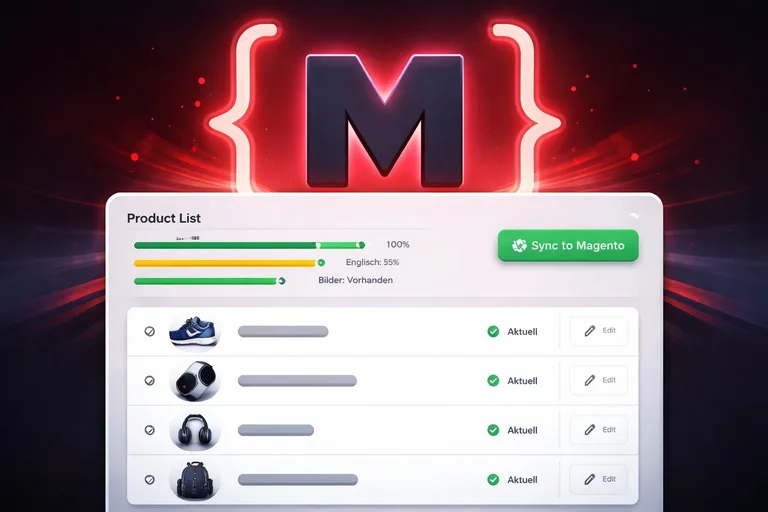
- Assets: Automated assignment of images and documents to the correct products.
06
Digital Asset Management (DAM) in the PIM Context
A picture is worth a thousand words – in e-commerce, it's often the only reason someone buys. A good PIM system integrates DAM functionality, letting you manage images centrally. During integration, we ensure images are automatically converted to the right format (e.g., WebP), cropped, and given SEO-relevant alt tags on export to Magento. No more manual image editing for the store!
07
Avoiding Challenges and Pitfalls
As your technical partner, I'll be honest: a PIM integration is open-heart surgery on your data.
- Mapping conflicts: When attributes in the PIM and Magento have different data types, things break. We ensure clean technical mapping.
- Performance impact: A poorly configured import process can block the Magento index. We optimize the import for maximum speed.
- The human factor: A PIM requires new processes across the team. We support you through the rollout and train your staff.
08
Why mironsoft Is Your Partner in the PIM World
As a freelancer, I offer you an agility and depth of detail that's often missing at large agencies. I'm not just a programmer – I'm your data architect.
- Deep core knowledge: I understand Magento's database structure inside and out.
- Integration experience: Whether it's Akeneo or Pimcore – I know the connectors and their quirks.
- Holistic perspective: I make sure your PIM data performs perfectly in your Hyvä frontend or PWA too.
Conclusion: Free Your Data, Scale Your Business
A Magento PIM integration is the breakthrough every growing e-commerce business needs. It puts an end to manual errors and lays the foundation for genuine omnichannel growth. Your customers expect perfect information across every channel today – with a PIM, you deliver it. At mironsoft you get technically excellent implementation, delivered as a true partner. Let's make your data shine and take your store to the next level.
Ready for perfect product data? Let's discuss in a free consultation how to best connect Akeneo or Pimcore to your Magento store.
Request a Free PIM ConsultationFrequently Asked Questions (FAQ) About Magento PIM Integration
At what point does a PIM system become worthwhile for my Magento store?
A PIM system usually pays off starting around 500 to 1,000 products, especially if those products have a high attribute density or need to be managed in multiple languages. Even if you sell across different channels (store, marketplaces, print), the investment amortizes quickly thanks to the enormous time savings in data maintenance. We're happy to analyze your current data structure and give you an honest assessment of the ROI.
What's the difference between Akeneo and Pimcore?
Akeneo is a specialized PIM focused on usability and marketing workflows, and it's ready to go very quickly. Pimcore, on the other hand, is a comprehensive data platform combining PIM with Digital Asset Management (DAM) and a Content Management System (CMS), which means significantly more flexibility but also a more complex implementation. The choice depends on whether you just want to perfect your product data, or you're aiming for a holistic data strategy across your entire business.
Can I also connect my ERP system directly to the PIM?
Yes, that's actually the best-practice approach. The ERP supplies the technical base data (SKU, price, weight) to the PIM, where your marketing team then enriches it with copy, images, and translations. Only the finished, enriched product is transferred from the PIM to Magento. This workflow ensures no incomplete products ever reach your store.
How does a PIM integration affect my store's performance?
With a professional implementation by mironsoft, your store stays lightning fast. We use asynchronous sync processes via message queues, so data transfer happens in the background without disrupting the store's live operation. Since the PIM also delivers cleanly structured data, we can often even optimize database queries in Magento and improve load times for your customers.
Can images and videos also be synced from the PIM to Magento?
Yes, modern PIM systems come with Digital Asset Management (DAM) features. We configure the interface so media files are automatically optimized for the web, scaled, and assigned to the correct products in Magento on export. That way you ensure your customers always see the latest, highest-quality images, without your team having to manually upload them to the Magento backend.
Does a PIM integration support multilingual stores as well?
Managing multiple languages is one of the absolute core strengths of PIM systems. You can maintain as many language variants of a product as you like side by side, and even connect external translation agencies directly to the PIM. We then map these languages precisely onto the corresponding storeviews in your Magento store, so internationalizing your business runs completely smoothly on the technical side.
How long does implementing a PIM-Magento interface take?
Project duration depends heavily on the complexity of your data model and the system you choose. A standard Akeneo integration can be completed within 6 to 8 weeks, while a highly customized Pimcore solution with complex attribute logic can take 3 to 6 months. Much of that time goes into strategic data modeling, which forms the foundation for a long-term stable solution.
Is my data secure during synchronization?
Security is our top priority. Data exchange happens exclusively over encrypted HTTPS connections and is secured with modern authentication methods (e.g., OAuth2 or API tokens). We also implement IP restrictions, so only your authorized systems can communicate with each other, effectively preventing unauthorized outside access.
Do I have to pay monthly licensing fees for the PIM software?
That depends on the version you choose. Both Akeneo and Pimcore offer powerful open-source versions (Community Edition) with no licensing fees. For larger companies with specific requirements around enterprise features, support, and SLAs, paid versions are available. We give you honest advice on which variant makes the most sense for where you are now and your growth plans.
Can I keep selling while switching to a PIM?
Absolutely. Rolling out a PIM system and the subsequent integration into Magento happen in parallel with live operations, on a staging environment. Only once all data is perfectly mapped and the sync processes are thoroughly tested do we switch the live connection on. Your customers won't notice anything about the technical transition in the background – except that product descriptions suddenly get a lot better.
What happens if attributes change in the PIM?
We build our interfaces flexibly enough that new attributes or changes to existing structures are detected and mapped automatically. Through a central configuration module in Magento, we can control which PIM fields flow into which Magento data fields. That keeps you technologically independent even as your product range grows, and lets you adapt your data model flexibly at any time.
Does the PIM integration also support SEO-relevant metadata?
Yes, this is one of the biggest levers for your organic traffic. In the PIM, you can maintain meta titles, descriptions, and alt tags for every product and every language. We sync this data directly with the SEO fields in Magento. That way, your products don't just show up on Google with generic default text – they appear with optimized content that massively boosts your click-through rate (CTR).
Can a PIM be connected to multiple Magento instances?
Yes, that's a classic scenario for growing companies. A central PIM can supply data to as many Magento installations, marketplaces, or other channels as needed, simultaneously. In the PIM, you can precisely control which products and which language variants go to which channel ("scoping"). That saves massive effort when managing different brands or international store instances.
What happens if the synchronization fails?
We implement detailed error reporting and monitoring. If a data package can't be processed due to an error (e.g., the wrong file format for an image), the incident is logged and your team is notified. Thanks to message queues, failed sync attempts are also automatically retried once the problem is fixed, guaranteeing high data integrity.
How do I get my PIM integration project started with mironsoft?
The first step is a joint workshop where we analyze your current data landscape and define your goals. We review your product data structure and advise you on choosing the right PIM system (Akeneo vs. Pimcore). Just send us a message or give us a call – we're looking forward to making your product data shine and perfecting your omnichannel strategy, technically speaking.
Cookie-Details
| Name | Anbieter | Laufzeit | Zweck |
|---|---|---|---|
Cookie-Details
| Name | Anbieter | Laufzeit | Zweck |
|---|---|---|---|
Cookie-Details
| Name | Anbieter | Laufzeit | Zweck |
|---|---|---|---|
Cookie-Details
| Name | Anbieter | Laufzeit | Zweck |
|---|---|---|---|