Marketplace Integration: Your Omnichannel Hub for Global Growth
MARKETPLACE INTEGRATION
Industries
Marketplace Integrations: Your Omnichannel Hub
Your customers are where reach is biggest: on Amazon, eBay, Zalando, or OTTO. We turn your Magento shop into a highly efficient omnichannel hub.
Inventory Sync
Real-time stock reconciliation between Magento and every marketplace
Order automation
Orders flow directly into the ERP
Fulfillment
FBM & FBA incl. tracking sync
Price management
Dynamic, channel-specific price adjustments directly from Magento
In today's e-commerce world, your own online shop often isn't enough anymore to tap into the full market potential. Your customers are where reach is biggest: on Amazon, eBay, Zalando, or OTTO. But multichannel sales without technical automation inevitably leads to chaos. At mironsoft we turn your Magento shop into a highly efficient omnichannel hub. Find out here how we tear down technical barriers and make your business present worldwide on all relevant platforms.
01
The Omnichannel Reality: Why You Have to Be Where Your Customers Are
The customer journey is more fragmented today than ever. Customers often use marketplaces as a search engine. Whoever isn't present there simply doesn't exist for a large part of the target audience. But the biggest challenge in expanding to Amazon, eBay, or Zalando isn't the listing itself, but data integrity.
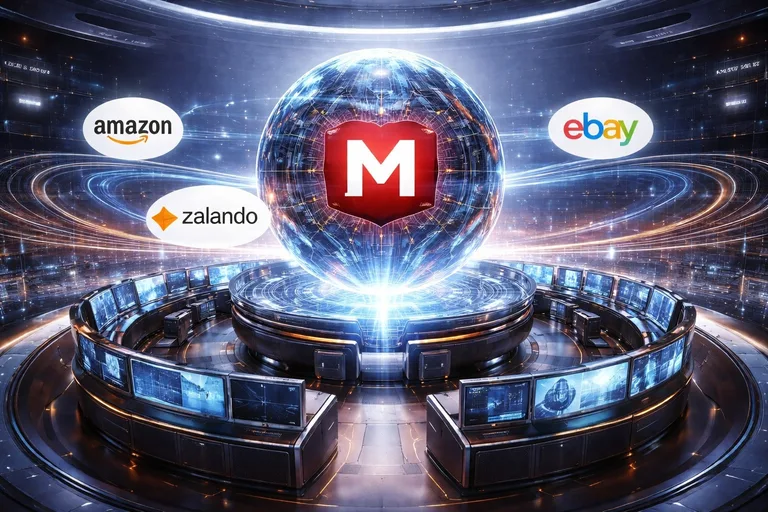
A single overselling incident can lead to harsh sanctions on platforms like Amazon. At mironsoft we build integration solutions that eliminate exactly this risk. The {M} branding here stands for our commitment to absolute synchronicity and process safety.
02
Amazon Integration: The Crown Discipline of Marketplace Connectivity
Amazon is e-commerce's giant. A connection to Amazon Seller Central or Vendor Central requires precision technical craftsmanship. We connect your Magento shop so all processes run automated:
- Inventory sync: Real-time stock reconciliation.
- Order automation: Orders flow directly into the Magento order process.
- Fulfillment connection: FBM and FBA incl. tracking sync.
- Price management: Dynamic price adjustments based on your Magento logic.

03
Zalando & Fashion Marketplaces: Product Data Quality Is Everything
Especially in fashion and lifestyle (Zalando, About You), the requirements for product data quality are extremely high. A wrong attribute or an image in the wrong format leads to your listing being rejected.
Here we use Magento's power in combination with PIM systems (like Akeneo) and specialized middleware solutions. At mironsoft we build "intelligent translators" that ensure your products win the buy box thanks to complete, optimized data.
04
eBay & Specialty Marketplaces: Flexibility for Every Niche
eBay is still a massive channel, especially for spare parts, electronics, and collectibles. Specialty marketplaces like OTTO, Kaufland, or ManoMano are also gaining importance.
Our integration approach is modular. We use proven connectors (like M2E Pro) or build custom API integrations, so your brand identity stays consistent across all platforms — without hundreds of logins.

05
Technical Challenge: Interfaces & Middleware
Why do many multichannel projects fail? Because the interfaces collapse under load. If you run a flash sale and thousands of orders come in simultaneously, API communication can't break.
At mironsoft we rely on asynchronous data processing. We use message queues (RabbitMQ) to buffer orders and stock updates. This is enterprise architecture for the mid-market.
06
Internationalization: Marketplaces as an Export Turbo
Marketplaces are the easiest way to test international markets. With Magento Multistore we can run individual strategies for each country (e.g. Amazon.fr, eBay.it).
We make sure your French marketplace customer gets a French invoice, while stock is managed centrally in your German warehouse. mironsoft makes global trade technically simple.
07
Performance & SEO: The Indirect Advantage
A good marketplace integration indirectly improves your shop's SEO. Why? Because automation increases your data consistency. Google notices when the information on Amazon and in your shop matches, strengthening your brand authority. At mironsoft, marketplace integration is always part of your overall marketing strategy too.

08
Why mironsoft Is Your Partner for Marketplace Integration
We don't just connect interfaces — we understand the business behind them. We know what a "buy box" is and how important the "late shipment rate" metric is on Amazon.
- Expertise in Magento & M2E Pro: We master the market-leading tools.
- Custom API development: We build connectors for niche platforms.
- Process automation: From warehouse to returns — all from one source.
- Honest consulting: We tell you which marketplace truly makes sense for your assortment.
Become a Global Player on Every Channel
No more manual data chaos. Let's build your Magento shop into an omnichannel hub — for maximum reach, error-free stock, and delighted customers worldwide.
Request Your Marketplace CheckFrequently Asked Questions About Marketplace Integrations
Which marketplaces can mironsoft connect to my Magento shop?
We can technically connect your shop to nearly every relevant platform worldwide. That includes the big giants like Amazon and eBay, fashion platforms like Zalando and About You, but also marketplaces like OTTO, Kaufland, ManoMano, or international players like Walmart and Allegro. Thanks to flexible middleware solutions and custom API programming, we face no technological limits here.
How is inventory synced between the shop and Amazon?
We use automated real-time interfaces. As soon as a product sells in your Magento shop (or a stock change is reported from the ERP), our system immediately sends a signal to Amazon Seller Central to update stock there. This also works bidirectionally: sales on Amazon are instantly reserved in Magento to safely prevent overselling and the resulting bad seller ratings.
Do I have to manually adjust product data for every marketplace?
No, that's exactly the goal of our automation. We define a master profile of your products in Magento or an upstream PIM system (like Akeneo). Through intelligent mappings, this data gets automatically transformed into the specific formats of each marketplace. You maintain information in one place only, and we ensure it appears perfectly and platform-compliant everywhere.
Does mironsoft also support Fulfillment by Amazon (FBA)?
Yes, we connect both FBM (merchant-fulfilled) and FBA (fulfilled by Amazon). For FBA, we sync stock levels from Amazon's warehouses back into your Magento system, so you always have an overview of your total inventory. Orders processed via FBA flow automatically for correct booking into your ERP system, including all necessary shipping information.
How are orders from eBay or Zalando processed in Magento?
Every order on a marketplace is captured by our interface and automatically created as a new order in Magento. Customer data, payment methods, and chosen shipping options are all correctly transferred. From Magento, these orders flow seamlessly into your inventory management, just like an order from your own shop. This enables a unified pick-and-pack process in your warehouse.
Can I set different prices for different marketplaces?
Yes, that's even highly recommended, for example to offset different marketplace fees. We configure pricing rules in Magento that define individual markups or discounts per channel. You can, for instance, set a product 10% more expensive on Amazon than in your own shop while running targeted discount campaigns on eBay — all centrally controlled from your backend.
Does the integration also support international marketplaces (Amazon.com, eBay.co.uk)?
Absolutely. We use Magento's multistore capability to connect international marketplace offshoots. We account for different currencies, country-specific tax rates, and translated product descriptions. This lets you expand worldwide with your existing system without issue, offering your products on global platforms in the respective local language.
How secure is data exchange with the marketplace APIs?
We rely on state-of-the-art security standards. Communication happens exclusively over encrypted TLS tunnels and uses the platforms' official authentication procedures (e.g. Amazon SP-API with OAuth2). Your access credentials are securely managed in your Magento instance or the middleware. We ensure a stable data bridge to your sales portals, protected against unauthorized access.
Can returns from marketplaces be automated too?
Yes, that's an important part of our after-sales automation. We connect the marketplaces' returns interfaces so return requests appear directly in Magento or get forwarded to your ERP. As soon as the goods arrive at your warehouse and are inspected, the credit note can be triggered automatically on the respective marketplace, drastically reducing manual effort for your customer service.
Do I need middleware (like Channable or PlentyMarkets) for the integration?
That depends on the number of your channels and the complexity of your data. For Amazon and eBay, a direct connection via Magento modules (e.g. M2E Pro) is often enough. If you want to be present on ten or more marketplaces simultaneously, though, we recommend specialized middleware solutions. We advise you, vendor-independently, on which architecture makes the most sense for your budget and scaling goals.
How long does implementing a marketplace integration take?
A standard integration with Amazon or eBay can be realized within 2 to 4 weeks. Complex integrations with fashion marketplaces like Zalando usually require 6 to 10 weeks due to strict data validation. Most of the time goes into precisely mapping attributes and coordinating logistics processes, to ensure error-free automated operation from day 1.
Does the marketplace integration slow down my Magento shop?
With a professional implementation from mironsoft: no. We use asynchronous processes and cron jobs that handle synchronization in the background without affecting your frontend's performance for customers. We make sure API calls are bundled efficiently to keep server load minimal, so your shop stays lightning fast despite the omnichannel power.
Can tracking numbers also be automatically transmitted to the marketplace?
Yes, that's a critical factor for your seller performance. As soon as your warehouse marks the shipment in Magento or your ERP and generates a tracking ID, our interface immediately pushes this information to the respective marketplace. This automatically informs the customer, improves your platform ranking, and meets the strict delivery-time requirements of partners like Amazon Prime or eBay Plus.
What happens if a marketplace's API changes?
Marketplace operators update their interfaces regularly (e.g. Amazon's switch from MWS to SP-API). As part of our maintenance contracts we monitor these changes proactively. We adapt your connectors to the new technical requirements in time, before old interfaces get shut down. This guarantees a permanently uninterrupted data flow and protects your omnichannel revenue.
How do I start my omnichannel project at mironsoft?
The first step is an analysis of your current assortment and target markets. We check the quality of your product data and advise you on selecting the most profitable marketplaces. Then we create a technical integration concept for your omnichannel hub. Just send us a message or give us a call — we make your shop ready for worldwide trade on every channel!
Cookie-Details
| Name | Anbieter | Laufzeit | Zweck |
|---|---|---|---|
Cookie-Details
| Name | Anbieter | Laufzeit | Zweck |
|---|---|---|---|
Cookie-Details
| Name | Anbieter | Laufzeit | Zweck |
|---|---|---|---|
Cookie-Details
| Name | Anbieter | Laufzeit | Zweck |
|---|---|---|---|