Magento SAP Integration: The Merging of Enterprise-Power and E-Commerce Flexibility
DEEP DIVEMagento SAP Integration
Magento SAP Integration: When Two Titans Merge
SAP is the backbone of the global economy, Magento sets the standard in e-commerce. The real magic – and the biggest technical challenge – lies in connecting these two worlds.
Anyone operating in the upper mid-market or enterprise sector can't avoid SAP. It's the backbone of the global economy. Anyone who also wants to set the standard in e-commerce chooses Magento (Adobe Commerce). But the real magic – and the biggest technical challenge – lies in connecting these two worlds. A Magento SAP integration is no simple project; it's a strategic transformation of your entire company.
As a specialized Magento developer at Mironsoft, I've learned that a successful SAP connection goes far beyond simply "shoveling data around." It's about translating highly complex business logic, customer-specific pricing structures, and global supply chains into a lightning-fast online experience. In this in-depth guide, we dive deep into the architecture, the pitfalls, and the success factors of an SAP-Magento interface.
AI generated
01
The Starting Point: Why SAP and Magento Are a Dream Team (With Some Friction)
SAP is known for its stability, audit-proof reliability, and its ability to model endlessly complex processes. Magento, on the other hand, shines through frontend flexibility, SEO power, and the ability to create emotional shopping experiences. The problem: these two systems speak different languages. SAP thinks in tables, company codes, and strict validation; Magento thinks in user sessions, fast database reads, and flexible attributes.
My job at mironsoft is to bridge this language barrier. A poorly programmed interface means your store waits seconds on every SAP query – a death sentence for your conversion rate. An excellent integration, on the other hand, uses SAP as the "single source of truth," while Magento caches and prepares the data so efficiently that the customer never feels the complexity happening in the background.
02
The Many Faces of SAP: From Business One to S/4HANA
Before we talk about the technology, we need to clarify which SAP system you're running. Each requires a different integration approach.
SAP Business One (B1)
The solution for the upper mid-market. Here we often use the Service Layer (REST-based) or the DI-API. Integration is usually direct and focused on automating stock levels, orders, and simple B2B price lists.
SAP ECC and S/4HANA
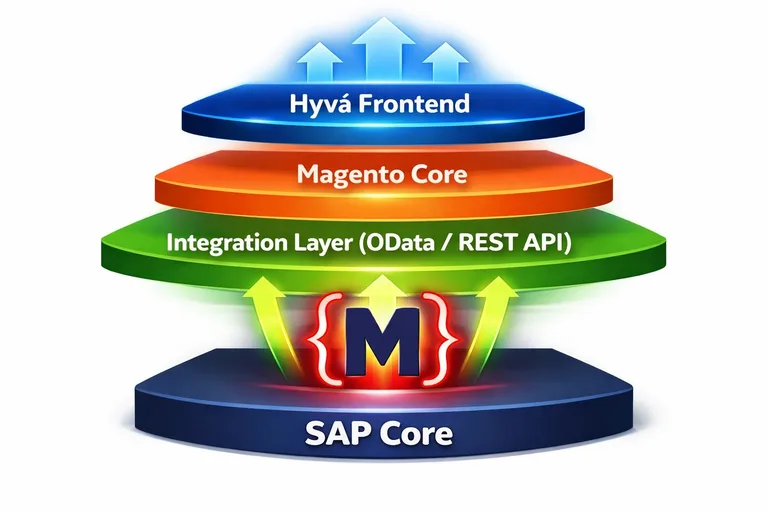
The heavyweights. Here we operate in a world of OData services, IDocs, or RFC calls. For S/4HANA we consistently rely on the modern SAP Business Technology Platform (BTP) to enable clean communication via cloud connectors. Here, data mapping complexity is often ten times higher than with Business One.
03
Architecture Decisions: Middleware vs. Direct Integration
One of the first questions in my consultations is: do we need middleware?
Direct integration (point-to-point): We build a custom connector directly into Magento that talks to the SAP APIs. Advantage: Lean, cost-effective, no additional software subscriptions. Disadvantage: Higher maintenance effort when either system is updated.
Middleware (e.g., SAP PI/PO, Dell Boomi, Celigo): An intermediate layer handles data transformation. Advantage: Decouples the systems, pre-built mappings, better scalability for multichannel (Amazon, eBay, etc.). Disadvantage: Additional licensing costs and infrastructure complexity.
At mironsoft we evaluate your case neutrally. For many mid-sized businesses, a tailor-made direct connector is often the more efficient choice, while large corporations almost always go with middleware.
Criterion
Direct Integration
Middleware
Cost
Lean, cost-effective, no software subscriptions
Additional licensing costs
Maintenance effort
Higher when either side updates
Lower, since systems are decoupled
Multichannel capability
Limited to Magento ↔ SAP
Pre-built mappings for Amazon, eBay, etc.
Typical use
Efficient for many mid-sized businesses
Mostly used by large corporations
Assessment based on the statements in this chapter.
AI generated
04
The B2B Challenge: Pricing Logic and Quotas
In 90% of SAP projects, pricing is the most critical issue. In B2B, there are no static prices. A customer might have tiered pricing, customer-group-specific discounts, or even individual contracts calculated in the SAP SD (Sales and Distribution) module.
It would be fatal to send a live request to SAP on every single product view in the store. That would bring the store to its knees. We solve this with a hybrid approach:
1Asynchronous price import: We import base price lists and simple discount rules into the Magento index.
2Live price simulation: For the final prices in the cart and checkout, we call an SAP function (BAPI_SALESORDER_SIMULATE). This guarantees the customer the exact SAP price without hurting catalog performance.
05
Data Objects in Detail: What We Synchronize
A complete integration at mironsoft covers the following entities:
Master data (material master): SAP provides the technical foundation (SKU, weight, EAN). Magento enriches it with SEO copy, images, and videos.
Stock (inventory): We support Multi-Source Inventory (MSI). Stock from various SAP warehouses is reconciled in real time or at fast intervals.
Customer master (debtor): New registrations in the store are created as prospects or debtors in SAP. Address changes in SAP flow back to Magento.
Order processing (sales orders): Orders are handed off to SAP as a "sales order." Status changes (shipped, invoiced) are reported back to Magento to automatically notify the customer.
AI generated
06
Performance Strategies: Avoiding the "SAP Bottleneck"
SAP is built for a lot of things, but not for 10,000 simultaneous web requests per second. We protect your SAP system with intelligent protective layers in Magento:
Message queues (RabbitMQ): We don't send orders directly – we place them in a queue. If SAP doesn't respond momentarily, Magento retries automatically. Nothing gets lost.
Redis caching for API responses: We cache the results of complex SAP queries in memory for a short time. When the same customer refreshes the page, the answer comes back from the cache in milliseconds.
Bulk updates: Instead of sending 1,000 individual price updates, we bundle them into a single, efficient data package.
07
Security: Protecting SAP Data on the Web
Your SAP system contains your entire company's knowledge. Securing the interface is therefore our top priority. We rely on:
API gateway protection: Communication only happens over encrypted TLS tunnels.
OAuth2 authentication: Every request must authenticate via modern token-based methods.
IP whitelisting: Only the defined Magento and SAP servers are allowed to communicate with each other.
Sanitizing: We validate every data package for malicious content before it passes the SAP firewall.
08
Why mironsoft Is the Right Partner for Your SAP-Magento World
Most SAP consultants don't understand e-commerce performance, and many web agencies are intimidated by SAP's complexity. I close that gap. As a freelancer, I offer you:
Holistic understanding: I understand both SAP's OData structures and Magento's GraphQL world.
Pragmatism over overhead: We don't build oversized solutions – we build what keeps your store fast and your process secure.
Hyvä compatibility: We make sure your complex SAP data (like custom price tables) renders perfectly in a lightning-fast Hyvä frontend.
AI generated
Conclusion: Master the Titans
A Magento SAP integration is the ultimate stage of digitizing your trading business. It ends the era of manual data maintenance and error-prone processes. Yes, the road there is technically demanding, but the gains in scalability, precision, and customer satisfaction are priceless. At mironsoft you get the technical expertise and the strategic foresight to make this project a success. We don't just make your store "pretty" – we make it an integral part of your enterprise IT.
Ready for a seamless enterprise experience? Let's clarify in a workshop how to optimally connect your SAP system with Magento.
Frequently Asked Questions (FAQ) About Magento SAP Integration
Which SAP versions does Magento support?
Magento can technically be connected to any SAP version that offers an electronic interface. We have experience with SAP Business One (SQL & HANA), SAP ECC 6.0, and the modern SAP S/4HANA (on-premise and cloud). Depending on the version, we use different technologies such as the Service Layer, OData services, or classic data exchange via IDoc through a middleware.
Does an SAP connection slow down my Magento store's performance?
With a bad implementation: yes, massively. But if we follow our best-practice approach, the store stays lightning fast. We use intensive caching, asynchronous data processing via message queues, and pre-computed price indexes, so customers almost never have to wait directly on a response from the SAP system. Your store's speed stays top-tier even with enterprise-level integration.
Can customer-specific prices from the SAP SD module be shown in real time?
Yes, that's a core requirement for many B2B projects. Since SAP owns the pricing procedure, we simulate a customer order in SAP via the API right in the cart or at checkout. The result is returned to Magento immediately. For catalog pages, we often use pre-calculated price mirrors to minimize load on the SAP system and keep load times extremely short.
How do we handle errors during synchronization?
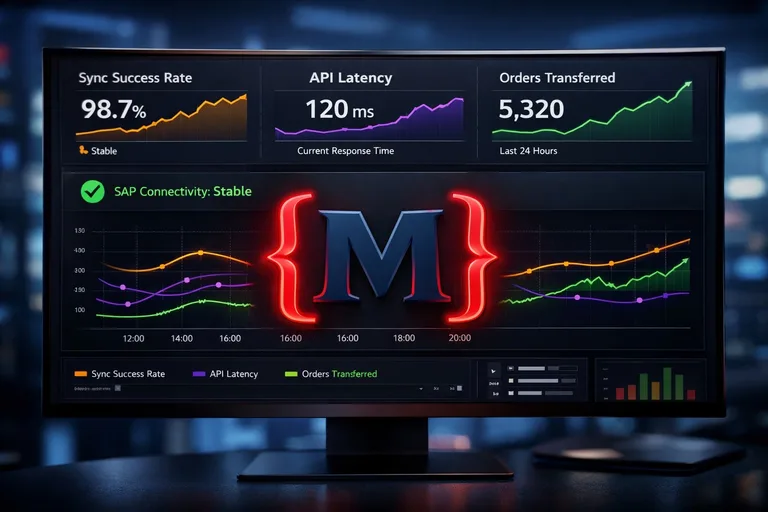
We implement multi-tier error management. By using message queues (RabbitMQ), failed transfers are automatically retried after a certain time. We also build a detailed logging dashboard in Magento that immediately notifies your administrators via email or Slack when a critical error occurs – including a clear description of the cause so it can be fixed quickly.
Is middleware absolutely required for the integration?
No, it's not mandatory. For many projects, a direct "point-to-point" connection via OData or REST APIs is leaner and more cost-effective. Middleware like SAP CPI or Celigo makes sense if you have a very complex system landscape or want to transform data for many different channels (store, POS, marketplaces) in one central place. We give you honest advice on which solution best fits your budget and strategy.
How well is my SAP system protected against attacks from the web?
The security of your core IT is an absolute priority for us. We deploy SAP cloud connectors that establish a secure connection without you having to open outbound ports in your firewall. Authentication happens via modern standards like OAuth2 and JWT tokens. We also validate all incoming data in Magento before passing it on to SAP, to effectively block attacks like injection attempts.
Can the integration also handle complex B2B processes like credit limits?
Yes, this is exactly where an SAP connection shows its strength. We can check the customer's credit limit and account balance in SAP in real time before an order is placed. If the limit is exceeded, Magento can automatically hide certain payment methods (like "buy on account") or flag the order for manual review by your inside sales team. That minimizes payment defaults and automates your risk management.
How long does an integration project typically take?
Given the high complexity and the necessary coordination between the web world and the SAP world, you should plan a timeframe of 4 to 8 months for such a project. A large part of that time goes into process definition, precise data mapping, and very extensive testing phases (integration tests & user acceptance tests) to guarantee an error-free live environment.
Are product images and documents also pulled from SAP?
Technically possible, but often not the recommended path. SAP isn't a media server. We usually advise maintaining product images and PDF data sheets in Magento or a dedicated PIM (Product Information Management) system, and only using SAP to manage the links or technical metadata. If you absolutely need all assets stored in SAP, we build appropriate connectors that prepare this data efficiently for the web.
Can we connect multiple Magento stores to one SAP instance?
Yes, Magento's multistore concept works beautifully with SAP. We can map different storeviews (e.g., for different countries or brands) to different company codes, sales organizations, or plants in SAP. This allows highly centralized control of your global e-commerce activities while still accounting for local tax and logistics requirements.
What happens if the API structure in SAP changes with an update?
By using service contracts in Magento, we decouple the store's core logic from SAP's technical API structure. If something changes in SAP, we only need to adapt the connector portion of the interface. We also strongly recommend API versioning, so the store can keep working on the old stable version during an SAP upgrade until the new interface is fully tested.
Can return processes also be automated via the interface?
Absolutely. We can implement an "RMA process" where the customer registers a return in the store. This information gets sent to SAP, where a return document is created. Once the goods are scanned in the warehouse, SAP reports this back to Magento, which can automatically trigger the refund or voucher process for the customer. That saves your customer service team enormous manual effort.
How much do ongoing maintenance costs for the interface run?
Maintenance costs depend on whether a middleware with monthly fees is in use or a direct connection was chosen. Regardless, we recommend a technical retainer for monitoring log files, regular security updates to the interface, and small adjustments as processes change. Compared to manual data maintenance, automated maintenance is still a fraction of the cost.
Does the integration support different VAT rates by country?
Yes, here we usually rely on SAP's powerful tax logic. Magento passes the customer's address data at checkout, and SAP calculates the correct amount for that country based on the stored tax codes. This is especially important under the EU's OSS (One-Stop-Shop) scheme, to guarantee legally compliant invoicing and accounting.
How do we get the process for a Magento SAP integration started with mironsoft?
The first step is a joint workshop (discovery phase). Here we bring your IT leads, your SAP consultants, and our Magento experts together at one table. We analyze your business processes and create a technical blueprint. Send us a message – we'll accompany you from the initial feasibility study all the way to a successful go-live and beyond.