Why less search volume can mean more revenue
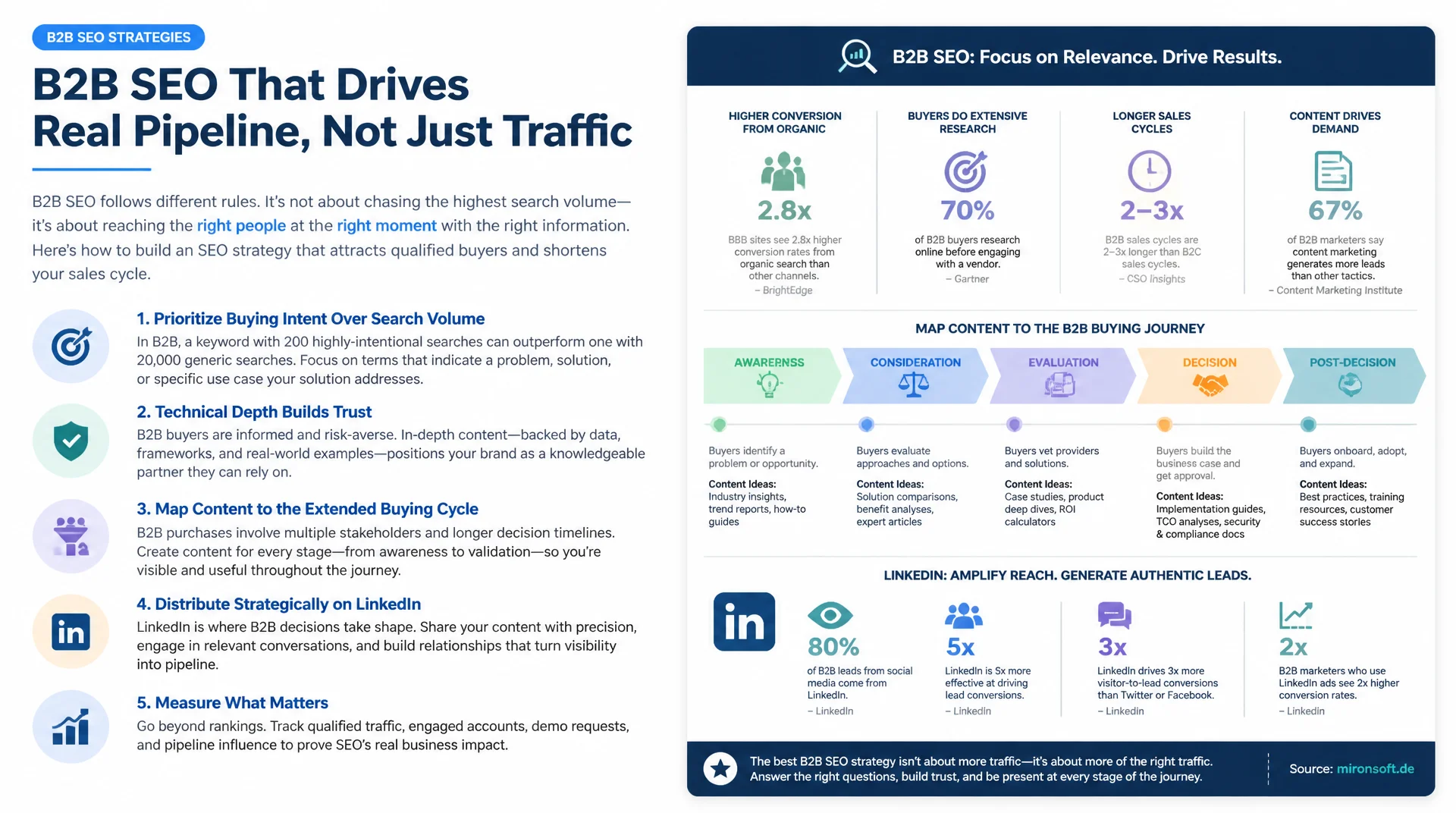
B2B blog SEO follows its own rules. Instead of high search volume, precise buying intent counts, technical depth builds trust with a specialist audience, and every article gets deliberately mapped to a stage in the long B2B buying cycle. Combined with targeted LinkedIn distribution, this creates a content strategy that generates real leads instead of anonymous traffic and makes expertise visible.
Table of Contents
- 1. Why B2B blog SEO needs different rules than mass-market SEO
- 2. B2B keyword research: weighing search volume against buying intent
- 3. Technical depth as differentiation and a trust signal
- 4. Content-to-funnel-stage mapping for long B2B buying cycles
- 5. Topic clusters and pillar content for a niche audience
- 6. LinkedIn and niche communities as amplifiers
- 7. Lead magnets and content gating without alienating specialists
- 8. Structured data for technical B2B articles
- 9. B2B specialist content compared side by side with mass-market SEO
- 10. Summary
- 11. FAQ
1. Why B2B blog SEO needs different rules than mass-market SEO
B2B blog SEO follows a different logic than classic e-commerce SEO for mass markets. In B2C, targeting a keyword like "buy running shoes" with tens of thousands of monthly searches means betting on high reach and low per-click buying intent. In the B2B segment, this ratio flips: a specialist term like "Magento 2 headless migration cost" might get 30 to 80 searches a month, but every single one comes from a decision maker actively preparing a purchase decision. For a B2B agency like Mironsoft, that means a single well-placed article on a niche topic can generate more qualified leads than ten generic guide articles with high search volume but a diffuse audience.
The mistake many B2B companies keep repeating: they copy B2C content strategies onto their specialist audience and then wonder why conversion rates stay low despite rising traffic. Mass-market keywords like "what is SEO" or "e-commerce trends 2026" attract visitors, but rarely decision makers with budget and mandate. Successful B2B blog SEO instead prioritizes search terms that precisely match the information need of a specific role in the buying process, such as a CTO preparing a migration decision or an e-commerce manager evaluating agencies. That precision requires a content strategy optimized for intent depth rather than reach.
2. B2B keyword research: weighing search volume against buying intent
Classic keyword research tools like Ahrefs or Sistrix often show sobering low search volumes for B2B niche terms, sometimes in the low double digits. Filtering only by search volume means missing the terms that actually matter. A more useful approach is an intent score that weighs search volume against buying intent, competition density, and relevance to the target role. A term like "Hyvä Theme agency Germany" has low volume but an extremely high intent score, because the search intent is almost entirely commercial and close to a decision. A term like "what is a Magento module" has higher volume but a low intent score, because it mostly comes from beginners with no buying intent.
[
  {
    "keyword": "Hyva Theme agency Germany",
    "search_volume_monthly": 20,
    "competition": "low",
    "commercial_intent": 9,
    "funnel_stage": "decision",
    "intent_score": 9.2
  },
  {
    "keyword": "Magento 2 headless migration cost",
    "search_volume_monthly": 40,
    "competition": "low",
    "commercial_intent": 8,
    "funnel_stage": "consideration",
    "intent_score": 8.4
  },
  {
    "keyword": "what is a Magento module",
    "search_volume_monthly": 880,
    "competition": "medium",
    "commercial_intent": 2,
    "funnel_stage": "awareness",
    "intent_score": 2.6
  },
  {
    "keyword": "Magento 2 multi source inventory B2B wholesale",
    "search_volume_monthly": 10,
    "competition": "low",
    "commercial_intent": 9,
    "funnel_stage": "decision",
    "intent_score": 8.9
  }
]
In practice, a table with four columns is worth building: search volume, competition density, estimated intent score, and funnel-stage assignment. Terms with a score above 7 out of 10 get prioritized for production, regardless of absolute search volume. This method prevents editorial resources from flowing into topics that generate traffic but no leads. For Mironsoft, that means an article on "Magento 2 multi-source inventory for B2B wholesalers" gets prioritized even though search volume is single-digit, because the few readers who find it are exactly the target audience.
3. Technical depth as differentiation and a trust signal
A specialist audience recognizes shallow content within seconds. An article claiming "performance optimization is important for your store" without naming concrete thresholds, code examples, or version numbers gets filed by a technical decision maker as marketing noise and abandoned. Technical depth works the opposite way, as a trust signal: explaining concretely how db_schema.xml secures declarative migrations compared to classic InstallScripts, or which Varnish VCL rule solves a specific caching problem, demonstrates real competence instead of a bare claim. For an agency like Mironsoft, that is exactly the lever: the blog becomes proof of its own expertise, not just a traffic source.
This depth has a measurable side effect on SEO itself: Google tends to rate specialist articles with concrete details, code examples, and precise terminology better under the E-E-A-T criteria (Experience, Expertise, Authoritativeness, Trustworthiness) than generic overview articles. An article showing a real configuration file or describing an actual error case with its fix signals practical experience that is hard to copy. That makes technical depth a double lever: it convinces human specialist readers and simultaneously strengthens ranking ability against interchangeable, AI-generated mass content.
4. Content-to-funnel-stage mapping for long B2B buying cycles
B2B buying cycles for enterprise software or agency services often run between six and eighteen months and pass through several decision layers: the department, IT, procurement, executive management. A single blog article cannot cover this entire process, so every article must be deliberately assigned to a funnel stage. Awareness content answers fundamental questions like "What is headless commerce" without naming a vendor yet. Consideration content compares solution approaches, such as "Hyvä Theme vs. Luma: a performance comparison for Magento 2". Decision content addresses concrete buying criteria like "What does a Magento 2 agency cost per project" and already contains clear calls to action.
{
  "content_funnel_map": [
    {
      "stage": "awareness",
      "keyword_intent": "informational, broad",
      "content_type": "foundational-article",
      "internal_link_target": "pillar-page",
      "cta": "related-article-link"
    },
    {
      "stage": "consideration",
      "keyword_intent": "comparative, evaluative",
      "content_type": "comparison-article",
      "internal_link_target": "case-study",
      "cta": "checklist-download"
    },
    {
      "stage": "decision",
      "keyword_intent": "transactional, buy-ready",
      "content_type": "service-article",
      "internal_link_target": "contact-page",
      "cta": "book-consultation"
    }
  ]
}
This assignment also determines tone of voice and where calls to action get placed: awareness articles link to related foundational articles, decision articles link directly to the contact page or a quote request form. Without this mapping, a blog ends up covering many topics but never structurally guiding a reader from the first question to actual contact. A simple editorial tag system per article that explicitly labels the funnel stage makes this assignment immediately visible in the content calendar and prevents a pile-up of pure awareness articles with no conversion path.
5. Topic clusters and pillar content for a niche audience
For a niche audience with few but high-value searches per topic, a topic cluster structure is more effective than isolated standalone articles. A pillar article like "Magento 2 B2B commerce: the complete guide" covers the topic broadly and links deliberately to deeper cluster articles on subtopics such as tiered pricing, customer-group price lists, approval workflows, or quote management. This structure signals topical authority to Google across the whole subject area, while giving specialist readers a clear entry point from which to dig deeper along their own information needs.
It matters to avoid keyword cannibalization between cluster articles: each article should serve a clearly delineated search intent, while internal links consistently point from the specific sub-articles back to the pillar article and laterally between topically related cluster articles. For Mironsoft, that means an article about "B2B price lists in Magento 2" does not target the same core keywords as an article about "configuring customer-group discounts", but instead the two cover clearly separated search intents and link to each other as a further resource.
6. LinkedIn and niche communities as amplifiers
At search volumes in the low double digits per month, organic search alone often isn't enough to build relevant reach within a reasonable timeframe. LinkedIn and topic-specific communities like the Hyvä Slack, the Magento forum, or specialist groups for e-commerce decision makers act as amplifiers here: a B2B article shared via a personal LinkedIn post with a well-argued take often reaches more qualified readers in a few days than three months of organic ranking would. On top of that, active distribution generates early backlinks and mentions that in turn help the article's organic ranking.
// Build a UTM-tagged link for LinkedIn distribution of a B2B article
function buildLinkedInShareUrl(articleUrl, campaign) {
  const params = new URLSearchParams({
    utm_source: 'linkedin',
    utm_medium: 'social',
    utm_campaign: campaign,
    utm_content: 'b2b-blog-post'
  });
  return `${articleUrl}?${params.toString()}`;
}

// Attribute inbound leads to the originating distribution channel
document.addEventListener('DOMContentLoaded', () => {
  const params = new URLSearchParams(window.location.search);
  const source = params.get('utm_source') || 'organic';
  const leadForm = document.querySelector('#lead-form');
  if (leadForm) {
    const hiddenField = document.createElement('input');
    hiddenField.type = 'hidden';
    hiddenField.name = 'lead_source';
    hiddenField.value = source;
    leadForm.appendChild(hiddenField);
  }
});
Clean attribution via UTM parameters is essential for identifying which channel actually drives leads, not just traffic. LinkedIn traffic often converts noticeably better than anonymous Google traffic in B2B contexts, because the recommendation already carries a social trust signal. A consistent tracking structure across all distribution channels makes it visible whether an article generates its leads primarily via organic search, LinkedIn, or a newsletter list, and allows targeted adjustments to the editorial plan.
7. Lead magnets and content gating without alienating specialists
A common mistake in B2B content strategies: hiding the entire article behind a form. That destroys the SEO effect completely, because Google cannot crawl and index the content, and it scares off specialist readers who first want to check, with no strings attached, whether the content answers their question. The better strategy: the full article stays freely accessible and fully indexable, while supplementary deep-dive materials like a checklist, a configuration template, or a calculator tool are offered specifically in exchange for an email address. This preserves SEO value while still generating real leads.
<!-- Hyva phtml: gate a supplementary asset, keep the article body fully indexable -->
<div class="not-prose" x-data="{ unlocked: false }">
    <div class="prose max-w-none">
        <!-- Full article text stays in the initial HTML, always crawlable -->
        {{$block->getArticleBodyHtml()}}
    </div>

    <div class="mt-8 border rounded-xl p-6" x-show="!unlocked">
        <p class="font-semibold mb-2">Configuration checklist as PDF</p>
        <button type="button" class="btn-primary" @click="unlocked = true">
            Request by email
        </button>
    </div>

    <form x-show="unlocked" x-cloak method="post" action="{{$block->getFormActionUrl()}}">
        <input type="email" name="email" required placeholder="you@company.com">
        <button type="submit">Get the checklist</button>
    </form>
</div>
Technically, this pattern can be implemented cleanly in a Hyvä theme with Alpine.js: an x-show block only reveals the form after a click on the download call to action, without affecting the surrounding body copy or hiding it via JavaScript. It matters that the entire article text remains present in the initial HTML and isn't loaded only after an interaction, so search engines and fast readers alike get immediate access to the full content.
8. Structured data for technical B2B articles
For technical B2B articles, schema.org's TechArticle schema fits better than the generic Article schema, because it supports additional fields like proficiencyLevel and dependencies that explicitly indicate the required expertise level and prerequisites. Adding a Person schema for the author with jobTitle and a link to a LinkedIn profile noticeably strengthens the E-E-A-T signal toward Google, because actual subject-matter authorship becomes machine-readable instead of merely being claimed in the body copy.
{
  "@context": "https://schema.org",
  "@type": "TechArticle",
  "headline": "Multi Source Inventory in Magento 2 for B2B Wholesalers",
  "proficiencyLevel": "Expert",
  "dependencies": "Magento 2.4, MSI module enabled",
  "author": {
    "@type": "Person",
    "name": "Author Name",
    "jobTitle": "Magento 2 Solution Architect",
    "sameAs": "https://www.linkedin.com/in/author-profile"
  },
  "publisher": {
    "@type": "Organization",
    "name": "Mironsoft",
    "url": "https://mironsoft.de",
    "sameAs": "https://www.linkedin.com/company/mironsoft"
  },
  "datePublished": "2026-07-11"
}
It's also worth adding a sameAs reference from the Organization schema to the company profile on LinkedIn and relevant industry directories, since this strengthens the entity connection in the Google Knowledge Graph. For niche providers like a Magento Hyvä agency, this connection is especially valuable, because the absolute search volume for the brand name is low, and every additional machine-readable trust signal increases the likelihood of appearing prominently in specialist searches.
9. B2B specialist content compared side by side with mass-market SEO
Mass-market SEO and B2B specialist content differ across almost every strategic dimension, from keyword selection to success measurement. The table below sets both approaches side by side.
| Dimension | Mass-market SEO approach | B2B specialist approach |
|---|---|---|
| Keyword search volume | High volume, broad terms | Low volume, precise specialist terms |
| Search intent | Mostly informational, far from purchase | Mostly transactional, close to purchase |
| Content depth | Shallow overview articles | Technically deep articles with code examples |
| Distribution channel | Organic search only | Organic search plus LinkedIn/communities |
| Success measurement | Traffic and rankings | Qualified leads and sales influence |
In practice, the two approaches aren't mutually exclusive, they serve different goals: mass-market SEO builds general brand awareness, while B2B specialist content deliberately reaches decision makers with concrete buying interest. For an agency with limited editorial resources, the second strategy is usually the more efficient lever, because each individual article has a higher probability of actually leading to a qualified initial conversation.
Mironsoft
B2B content strategy, topic clusters, and specialist-audience SEO for Magento and Hyvä projects
Ready for a B2B content strategy that brings leads, not just traffic?
We build topic clusters, intent-based keyword prioritization, and funnel-stage mapping for your specialist audience, including LinkedIn distribution and technically grounded articles that make your expertise visible.
Content cluster audit
Analysis of existing content and prioritization by intent score instead of search volume
Funnel-stage mapping
Assigning every article to awareness, consideration, or decision with clear CTAs
LinkedIn distribution setup
Editorial plan and tracking structure for specialist communities and LinkedIn
10. Summary
B2B blog SEO for a specialist audience works by different rules than mass-market SEO: low search volume is not a warning sign, it is often an indicator of high buying intent when the search term precisely matches a decision maker's question. Intent scoring instead of pure volume optimization, technical depth as a trust signal, consistent funnel-stage mapping, and a topic cluster structure together form the foundation of a content strategy that actually generates leads instead of just traffic.
On top of that, targeted distribution via LinkedIn and specialist communities amplifies organic reach far faster than pure search-engine ranking could at low search volume, while thoughtful content gating preserves the SEO value of the main article and still generates real leads. Combining these building blocks consistently builds a blog perceived as a subject-matter authority, one that actively supports long, multi-step B2B buying cycles instead of just accompanying them on the sidelines.
B2B Blog SEO for Specialist Audiences - The Essentials at a Glance
Intent over volume
Low search volume with high buying intent beats high volume with a diffuse audience. Prioritize by an intent score built from buying intent, competition, and funnel relevance.
Technical depth as a trust signal
Concrete code examples, version numbers, and real configurations convince specialist readers and strengthen E-E-A-T with Google.
Funnel-stage mapping
Every article gets explicitly assigned to awareness, consideration, or decision, with matching internal links and CTAs.
Multi-channel distribution
LinkedIn and specialist communities accelerate reach at low search volume and deliver above-average converting traffic.