API-First
API-FIRST ARCHITECTURE
Technology Hub
API-First Architecture: The Digital Foundation for Boundless Scalability
We build systems where the interface (API) isn't bolted on afterward, but is the primary product. We separate logic from presentation, creating a highly flexible ecosystem ready for tomorrow's challenges.
In a world where customers no longer shop only through a web browser, but through apps, voice assistants, social media, and IoT devices, classic "all-in-one" systems hit their limits. The solution is a radical paradigm shift: API-First Architecture. Find out here how consistent API-first design shortens your time-to-market and transforms your Magento shop into a universal data hub.
Chapter 01
What Does API-First Really Mean? A Technological Liberation
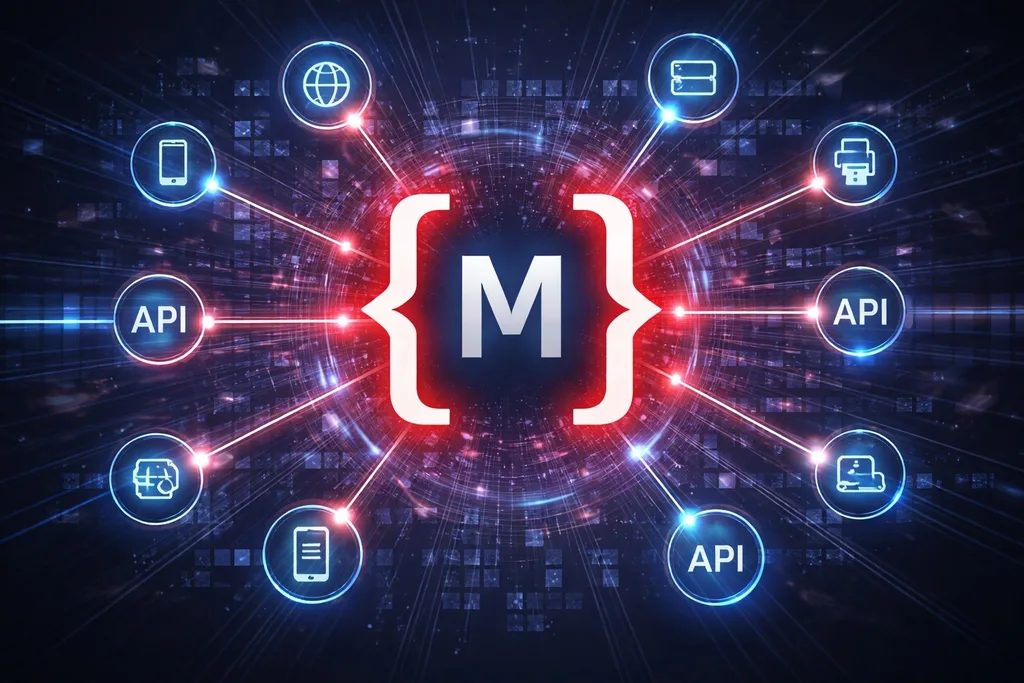
Traditional web development followed this principle: "We build a website and figure out later how to export the data for other purposes." API-first reverses this process. Before we think about design or the first page, we define the interfaces. The API is the contract that the entire system dances to. Every function, every price lookup, every customer interaction is first conceived as a universally usable endpoint.
For you as a business, that means technological freedom. You're no longer tied to a specific frontend. Your business logic lives securely and centrally in your backend (e.g. Magento), while your frontend team simultaneously works on a lightning-fast PWA, a native app, or a B2B customer portal — all using the exact same, validated data source. At mironsoft, API-first isn't a buzzword, but the basis of professional software engineering in the enterprise segment.
Chapter 02
Decoupling Head and Body: The Path to Headless Commerce
The term "headless" is inseparable from API-first. In a monolithic architecture, backend and frontend are fused like siamese twins. A design change can affect database logic and vice versa. At mironsoft we separate the "head" (the frontend) from the "body" (the backend).
This decoupling gives us enormous agility. We can use the most modern technologies like React, Vue.js, or Alpine.js for the frontend without endangering the stable Magento core. This enables iteration cycles unthinkable in classic development. While your competition is still tinkering with template files, we're already rolling out the third design update for your mobile app — all controlled through your central API-first infrastructure.

Chapter 03
GraphQL & REST: The Duo of Modern Interfaces
In our projects, we rely on the two most powerful protocols of our time. While REST is the proven standard for system-to-system communication (e.g. your ERP sync with SAP), GraphQL is the star for your user experience.
GraphQL lets the frontend request exactly the data it needs. This prevents data waste on the wire and makes your shop unbeatably fast on mobile devices. At mironsoft we design schemas so intuitive that developers understand them without lengthy documentation study. We use typing and validation to ensure only clean data enters your systems. With the {M} branding, we guarantee interfaces that don't buckle even under high load.
”
"GraphQL lets the frontend request exactly the data it needs. This prevents data waste on the wire."
Chapter 04
Omnichannel Excellence: Your Data, Everywhere
Today's customer starts their search on Instagram, compares prices on desktop, and finally buys through a mobile app. With an API-first architecture at mironsoft, this scenario is no longer a problem. Since all channels access the same API, stock levels, prices, and customer information stay in real-time sync everywhere.
We don't build isolated shops for you, but a unified commerce hub. Imagine your field sales team using a tablet with a custom app to place orders directly at the customer's site, while your online shop customer sees the exact same stock level at the same time. That's the power of the API-first strategy: one system, infinite possibilities.

Chapter 05
Composable Commerce: Best-of-Breed Instead of Compromises
API-first is the trailblazer for composable commerce. You're no longer forced to get every function from a single vendor. You can use Magento for checkout, Algolia for search, Contentful for your blog, and Stripe for payments. All these specialized services are unified via APIs in your frontend.
At mironsoft we act as your system architect. We orchestrate these various microservices into a seamless unit. If a service becomes outdated tomorrow, we simply swap it out without affecting the rest of the system. That's the ultimate form of future-proofing. You're not investing in a dead end, but in a living, adaptable infrastructure.
Chapter 06
Performance Advantages in Depth
Why is API-first faster? Because we intelligently distribute the computational load. The backend only delivers raw data (JSON), while the frontend (on the user's device) handles rendering. Combined with modern edge computing solutions and CDNs like Cloudflare or Fastly, we can deliver API responses worldwide in milliseconds. We minimize "overhead" and maximize "throughput." For your customers that means: no loading bars, just instant interaction. That's the foundation for excellent Core Web Vitals and high conversions.
Chapter 07
Security and Versioning: Stability by Design
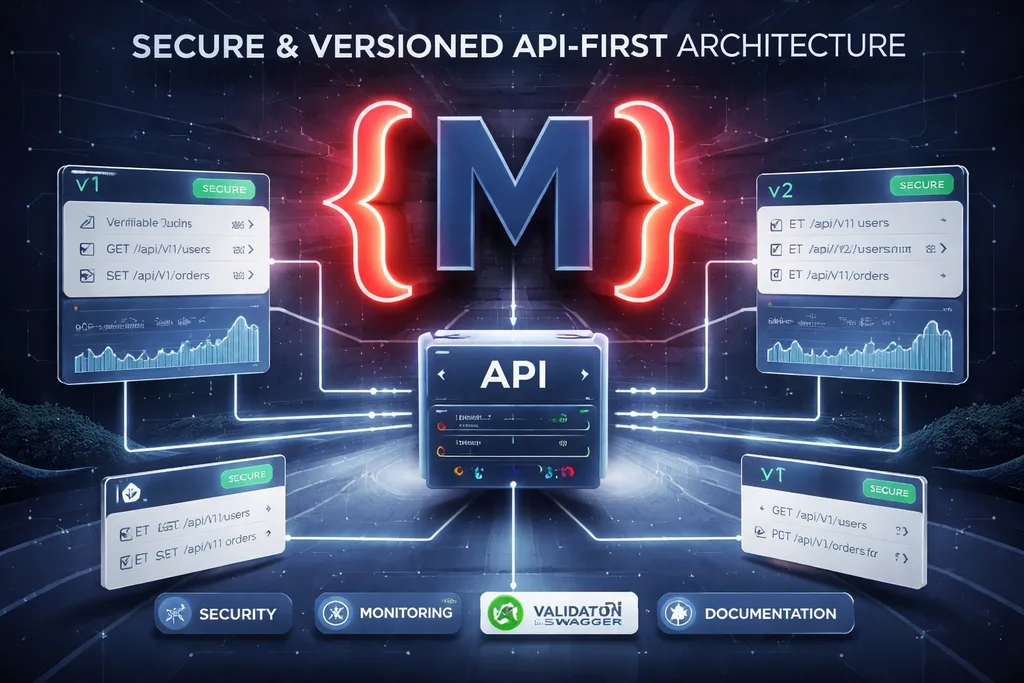
An API-first architecture at mironsoft is trimmed for security. We use modern standards like OpenAPI (Swagger) for documentation and validation. Since every access happens through defined endpoints, we can secure and monitor them with pinpoint precision. We also implement clean API versioning. When we update your backend, we make sure your old apps or interfaces keep working. We don't break existing systems — we ensure a gentle evolution of your technology.
”
"We don't break existing systems — we ensure a gentle evolution of your technology."
Chapter 08
Why mironsoft Is Your Partner for API Architecture
We understand APIs not just as a technical endpoint, but as a business enabler. As your technical partner, we offer you:
Strategic consulting
We clarify which API strategy fits your business model.
Deep Magento know-how
We optimally leverage Magento 2.4+'s GraphQL power.
Modern frontend integration
Whether Hyvä, PWA, or custom apps — we build the bridge.
Long-term scalability
We build systems that grow with your success.
Free Your Business From Technical Boundaries
Choose an architecture built for the omnichannel world. Let's move your project to API-first together — for maximum flexibility, speed, and future-proofing.
Jetzt SEO-Check anfragenFrequently Asked Questions About API-First Architecture
What's the difference between API-first and a normal API?
With a "normal" API, the interface is often bolted onto an existing website afterward, leading to messy structures. API-first means the interface is the central product. Everything is built around the API, guaranteeing significantly higher data quality, better performance, and support for countless output channels from the start.
Does API-first make my shop slower?
Quite the opposite. By using GraphQL and modern caching layers (like Varnish), we reduce the transferred data volume to an absolute minimum. Since the frontend is also decoupled, we can handle many processes asynchronously in the background. A well-optimized API-first system is usually significantly faster than a classic monolith.
Does API-first require a complete relaunch?
Not necessarily. We often use the "strangler pattern" approach. We build new features as API-first modules and gradually integrate them into your existing shop. This modernizes your infrastructure step by step, without endangering ongoing operations or having to commit a huge relaunch budget all at once.
What role does GraphQL play in API-first architecture?
GraphQL is the preferred technology for modern frontends. It enables highly efficient data queries, since the frontend precisely defines which fields it needs. This prevents "overfetching" and makes your website or app especially fast on mobile devices. For mironsoft, GraphQL is the enabler for an excellent search experience and high conversions.
How secure are APIs against outside attacks?
Security is "built-in" with us. We use encrypted HTTPS connections, OAuth2 authentication, and JWT tokens for every API access. Since the backend is hidden behind the API layer, there's no direct attack surface on the business logic. We also implement rate limiting and web application firewalls (WAF) to effectively block malicious bot attacks.
Can I also connect marketplaces like Amazon with API-first?
Yes, absolutely. An API-first architecture is the perfect prerequisite for multichannel sales. Since your data is already available via standardized interfaces, marketplaces, price comparison portals, or social commerce channels are much easier and more stably connected than with a closed system. Your shop becomes the central data hub for all your sales activities.
What is "headless commerce" compared to API-first?
Headless commerce is the result of an API-first strategy. It describes the technological separation of backend (the body) and frontend (the head). API-first is the mindset in development, headless is the resulting architecture. Together they give you the freedom to manage and optimize your design completely independently of your shop logic.
How much maintenance effort do API-first systems require?
Long-term, maintenance effort drops significantly. Since the systems are decoupled, backend updates less often break the frontend. APIs are also much easier to test and monitor thanks to their typing and documentation (OpenAPI). Professional monitoring of the interfaces is essential though, which we implement as standard at mironsoft.
Can B2B companies benefit from API-first?
API-first is a huge advantage especially in B2B. You can grant your customers direct API access to your stock and prices, so they can integrate your catalog into their own procurement systems (ERP) via punch-out. This creates extremely high customer retention and fully automates ordering processes between you and your business partners.
Does Magento Open Source support all API-first features?
Yes, Magento Open Source offers an excellent foundation with a comprehensive GraphQL and REST API. Adobe Commerce offers some additional enterprise features for B2B or staging via the API, but the core functionality for a modern, decoupled architecture is present in both versions and can be extended individually by us.
What is "composable commerce"?
Composable commerce is the evolution of API-first. It means you assemble your shop from the best available services in the market (best-of-breed). You might use Magento for checkout, Algolia for search, and Contentful for the CMS. The API-first frontend seamlessly unifies all these specialized services for the customer.
Does API-first need a special hosting setup?
Yes, we recommend a setup designed for API performance's high requirements. That includes fast NVMe storage, optimized Redis caching for API responses, and a global CDN (like Cloudflare) to answer requests worldwide in milliseconds. We advise you, vendor-independently, on choosing the best infrastructure for your hub.
How important is API documentation?
In an API-first world, documentation is the law. We use automated tools like OpenAPI (Swagger) so every developer (internal or external) instantly understands how to fetch the data. Excellent documentation massively shortens development time for new features and ensures your system stays extensible for decades.
Do I have to rewrite the logic for every frontend (app, web)?
No, that's exactly the point! All logic (calculations, validations, processes) lives centrally in the backend behind the API. The frontend is only responsible for display. When you introduce a new feature, you only implement it once in the API, and it's immediately available to your shop, your app, and all your other channels.
How does API-first help with internationalization?
With an API-first architecture you can easily run different country shops with different currencies and tax rates, all accessing the same data base. You can build country-specific frontends perfectly tailored to cultural nuances, while your central logic stays consistent worldwide. This saves massively on costs when scaling your business globally.
Can I connect third-party tools via API too?
Yes, that's a standard scenario. Whether it's AI services for image recognition, automated translations, or complex fraud-detection systems — everything gets integrated via standardized API calls. Your shop becomes a highly networked platform that combines the best technologies on the market in real time, to give your customers the best experience.
What is "API versioning" and why do I need it?
API versioning lets us make changes to the interface without breaking existing frontends (e.g. an older app version on your customers' phones). We run different versions of the API in parallel until all channels have moved to the new standard. This guarantees uninterrupted operation and maximum stability during your technological evolution.
How does API-first improve team collaboration?
Through clear separation via the API, backend and frontend teams can work completely independently (parallel development). Once the "contract" (the API schema) is set, the frontend can work with dummy data while the backend programs the real logic. This massively shortens project timelines and eliminates implementation misunderstandings.
Why should I choose mironsoft for API projects?
At mironsoft we're not pure web designers — we're software architects. We master the mathematical precision that highly efficient API design requires. We combine deep Magento knowledge with the most modern standards like GraphQL and Docker, to build systems that are technologically unbeatable and make your business scalable long-term.
How do I start my API-first project at mironsoft?
The first step is a technical strategy workshop. We analyze your channels, your data flows, and your growth goals. Then we create an architecture concept for your API hub and show you the most profitable path to decoupled freedom. Just send us a message — we look forward to recreating your digital nervous system!
Cookie-Details
| Name | Anbieter | Laufzeit | Zweck |
|---|---|---|---|
Cookie-Details
| Name | Anbieter | Laufzeit | Zweck |
|---|---|---|---|
Cookie-Details
| Name | Anbieter | Laufzeit | Zweck |
|---|---|---|---|
Cookie-Details
| Name | Anbieter | Laufzeit | Zweck |
|---|---|---|---|