OpenAPI Documentation: The Digital Blueprint for Your System Integration
OPENAPI
Technology Hub
OpenAPI: The Golden Law of Interface Communication
An API without documentation is like a labyrinth without a map. We build interfaces that explain themselves.
In modern software development, an API without documentation is like a labyrinth without a map. It's useless, error-prone, and a massive cost driver. At mironsoft, we treat the OpenAPI Specification (formerly Swagger) as the golden law of communication. We build interfaces that explain themselves. Through precise API design, we create the foundation for smooth integrations, fast developer onboarding, and system stability that meets enterprise standards. Find out here how we bring order to your data chaos with OpenAPI.
01. What Is OpenAPI, and Why Is It the "Contract" of Your Software?
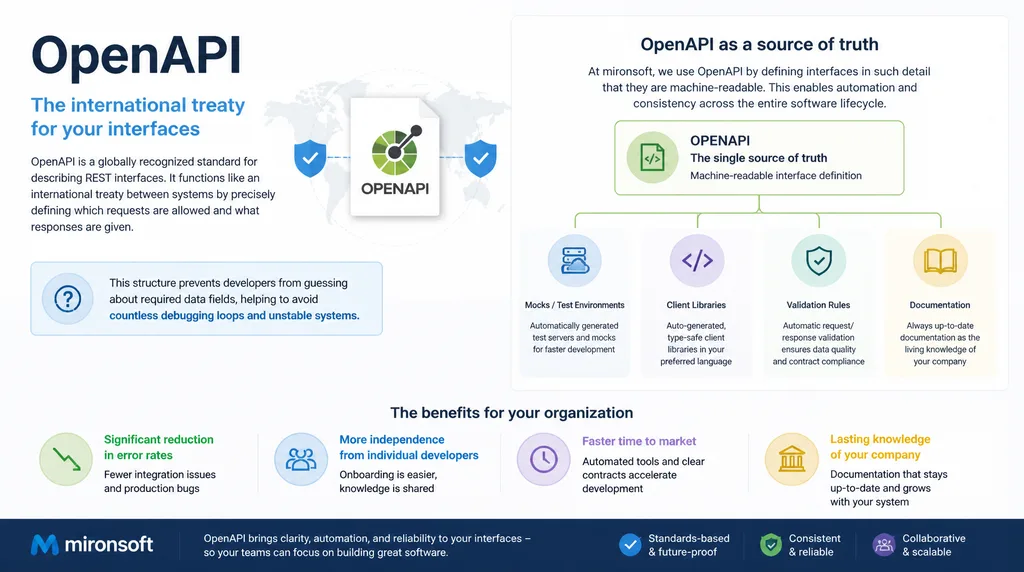
OpenAPI is a globally recognized standard for describing REST interfaces. Think of it like a treaty between two systems: it defines exactly which questions (requests) are allowed and which answers (responses) get delivered in return. Without this standard, developers would have to guess which data fields are needed, leading to endless debugging loops and unstable systems.
At mironsoft, we use OpenAPI as the source of truth. We define your interfaces in such detail that they're machine-readable. That means: we can automatically generate test environments (mocks), client libraries, and validation rules straight from the documentation. For you as a company, that means a massive reduction in error rate and independence from individual developers. The documentation is your company's lasting knowledge.
| Term | Meaning |
|---|---|
| Swagger | The original name of the tool and specification. Today refers to a collection of tools (e.g. Swagger UI, Swagger Editor) that use the OpenAPI standard. |
| OpenAPI | Since 2015, the official, open standard (the rules) for describing REST APIs, maintained by an independent foundation. |
02. Design-First vs. Code-First: Our Strategy for Quality
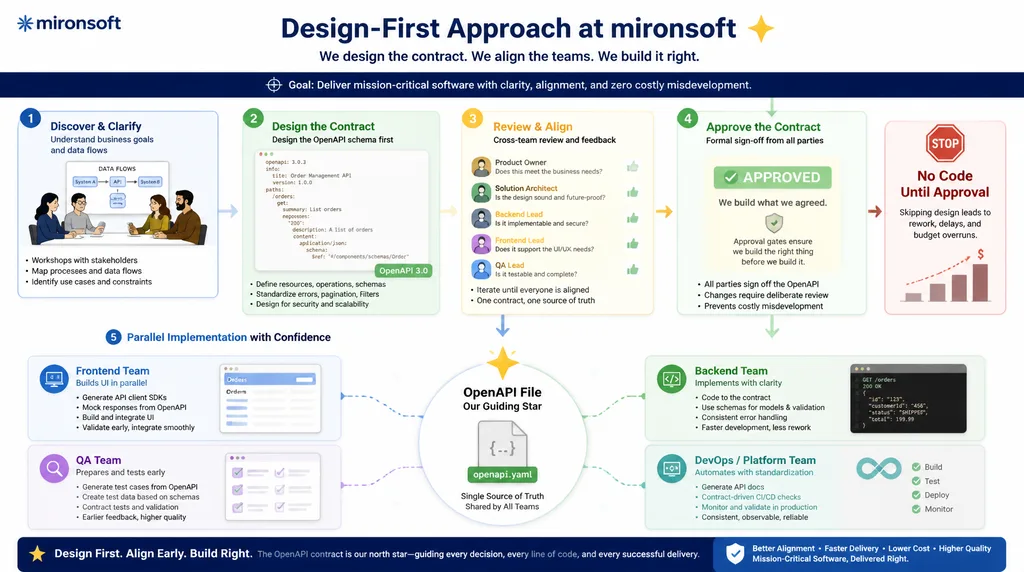
The industry often debates: do you write the code first and generate the docs from it (code-first), or plan the docs first and then write the code (design-first)? At mironsoft, we're advocates of the design-first approach for business-critical projects.
Before we write a single line of PHP or JavaScript, we design the OpenAPI schema. We clarify with your stakeholders which data needs to flow. Only once the design is perfect and all parties have agreed does implementation begin. This prevents expensive missteps and allows frontend and backend teams to work in parallel. The OpenAPI file is the north star everyone orients by. With the {M} brand, we guarantee a process programmed for success from the very start.
03. Swagger UI & ReDoc: Your API's Business Card
Nobody wants to read 5,000 lines of YAML code. That's why we refine our OpenAPI specifications with modern interfaces like Swagger UI or ReDoc. These tools transform the technical code into an interactive, beautiful website.
Your developers or partners can try out the API directly in the browser there. They see instantly which error messages appear on invalid input, and what the data structure looks like on success. At mironsoft, we make sure this documentation matches your corporate design visually too. A well-designed API doc is a sign of professionalism that will impress your partners and customers. We make technology tangible.
04. OpenAPI in Magento: Order in Enterprise Chaos
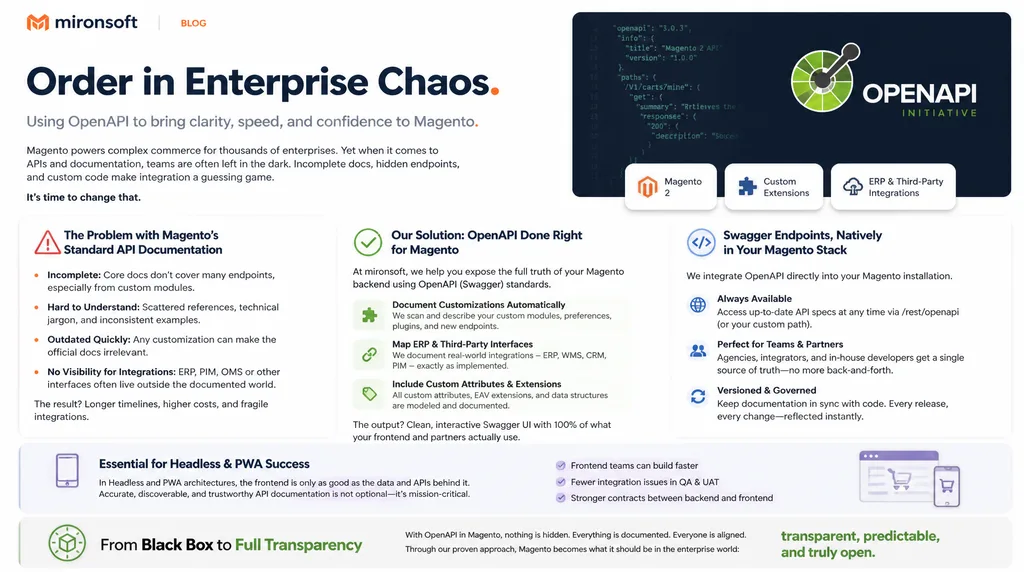
Magento (Adobe Commerce) is notorious for its enormous complexity. Magento's standard API documentation is often incomplete or hard to understand. At mironsoft, we clean this up. We use OpenAPI to properly document your custom adjustments, your ERP interfaces, and your custom attributes.
We integrate Swagger endpoints directly into your Magento stack. This way, your agency partners or in-house team can access the latest specifications at any time. This is especially important for headless projects or PWAs, where the frontend constantly depends on correct data from the backend. With our help, Magento turns from a "black box" into a transparent, perfectly documented system.
05. Automation & Testing: OpenAPI as a Quality Guarantee
An OpenAPI file at mironsoft is not a "dead document" — it's an active tool in Quality Assurance (QA). We use the specification to drive automated tests.
- Contract testing: We automatically check whether the delivered code still exactly matches the documentation. Any deviation triggers an alarm immediately.
- Mock servers: We provide your frontend team with simulated APIs before the backend is even finished being programmed. This halves the development time.
- SDK generation: We automatically generate program libraries in various languages (PHP, JS, Swift) that talk to your API. This saves hundreds of hours of manual coding.
06. Versioning: Evolution Without System Breaks
Nothing is more frustrating than an API change that breaks existing apps or partner systems. Thanks to OpenAPI, we implement clean API versioning at mironsoft. We document parallel versions (v1, v2, v3) and transparently show which fields are "deprecated" and when they'll be shut down. This gives your partners planning certainty and ensures a professional, world-class release cycle.
07. Security: Documentation as a Shield
In the OpenAPI specification, we define not just data but also security schemas. We document exactly which endpoints require OAuth2, API keys, or JWT tokens. This forces us developers to think about security from the start (security by design). Unauthorized access to your data is nipped in the bud by a strict specification. We protect your most valuable asset: your company data.
08. Why mironsoft Is Your Partner for OpenAPI Design
We don't build interfaces nobody understands after three months. As a technical partner, we offer you:
- Standardization: We bring your entire IT landscape up to the OpenAPI standard.
- Developer focus: We build documentation that developers love and that makes integrations a pleasure.
- Long-term maintainability: We ensure your APIs stay documented and extensible even in five years.
Bring Order to Your Digital Interfaces
A system is only as strong as its connectivity. Let's create your digital blueprint together — for APIs that scale, delight, and future-proof your business.
Jetzt SEO-Check anfragenFrequently Asked Questions about OpenAPI
What's the difference between Swagger and OpenAPI?
Swagger was originally the name of the tool and specification. In 2015, the specification was renamed to "OpenAPI" and handed over to a foundation as an open standard. Today, "OpenAPI" refers to the technical standard (the rules), while "Swagger" refers to a collection of tools (like Swagger UI or Swagger Editor) that use this standard.
Why is good documentation important for my company?
Good documentation massively saves costs when integrating third-party systems (e.g. ERP or apps). Without it, developers spend countless hours trial-and-erroring and debugging. An OpenAPI specification serves as a binding contract that rules out misunderstandings, increases security, and ensures your knowledge stays within the company even if a developer leaves.
Can OpenAPI documentation be generated automatically?
Yes, in many modern frameworks (including Magento), documentation can be generated directly from code annotations. However, at mironsoft, we often prefer the "design-first" approach, where we write the docs first. This guarantees higher architectural quality, since you think through the structure before the code sets the facts.
What is a "mock server" and how does it help me?
A mock server simulates the API based on the OpenAPI specification, without the real logic having to be programmed yet. This lets your frontend team (e.g. for a mobile app) start development immediately, while the backend team is still working on the database connection. This massively shortens project timelines and enables early testing of the user experience.
Can OpenAPI also help secure my API?
Yes, indirectly. In the specification, we define exactly which authentication methods (e.g. OAuth2) are needed for which endpoints. We also use the OpenAPI file to automatically validate incoming data on the server. If an attacker tries to send malformed code or overly long text to a field, it's blocked right at the API layer since it doesn't match the specification.
Does Magento 2 support OpenAPI?
Yes, Magento 2 offers built-in support for Swagger/OpenAPI. At a special URL, you can view and try out your shop's entire REST API. At mironsoft, we often optimize this standard output, since it can be very confusing, and enrich it with your custom extensions and ERP interfaces, so your entire documentation lives in one place.
What is a "typed interface"?
Typing means every data field in the API has a fixed type (e.g. integer, float, text, or date). OpenAPI enforces this structure. This prevents a system from accidentally sending text when another system expects a number for calculation. This strictness is the best insurance against system crashes and unexpected behavior in your software landscape.
Can I share my API documentation with external partners?
Yes, that's one of the main purposes. We can host the OpenAPI documentation on a protected developer portal. Your partners get a login there and can immediately see how to connect their systems to your shop. This massively reduces the support burden on your internal IT, since partners find all the information they need directly in the documentation.
How does OpenAPI help with versioning my software?
OpenAPI lets you document and run different versions of your API (e.g. v1 and v2) in parallel. We can mark in the specification which fields are deprecated and will be removed in the next version. This gives your partners and your own team enough time to adjust their systems without endangering ongoing operations.
What's the difference between JSON and YAML in OpenAPI?
Both are formats for representing structured data. YAML is significantly easier for humans to read and write, which is why we use it at mironsoft for creating documentation. JSON, on the other hand, is the format computers prefer. OpenAPI tools can losslessly convert between both formats, so we get the best of both worlds: easy editing and perfect machine readability.
Can I use OpenAPI for GraphQL too?
No, OpenAPI is specifically designed for REST interfaces. GraphQL has its own built-in documentation system (introspection). Nonetheless, we often apply similar design principles to both worlds. If you use a mix of REST and GraphQL, we at mironsoft ensure both sets of documentation stay consistently maintained so your developers always have full clarity.
How much effort does creating OpenAPI documentation take?
The effort usually pays for itself with the very first partner project or app integration. Initial creation does require time to precisely define all data fields, but it saves countless hours of manual support and debugging in the following phase. We don't see documentation as extra overhead, but as an integral part of a professional software architecture that makes your project more profitable long-term.
What is a "contract test" and how does mironsoft use it?
A contract test automatically checks whether your server's API responses still exactly match what was promised in the OpenAPI file. If a backend developer accidentally renames a field or changes the data type, the test fails immediately. This prevents "breaking changes" and guarantees your apps and interfaces keep working smoothly even after a backend update.
Can OpenAPI help improve my shop's load time?
Yes, quite significantly and indirectly. Through a clean OpenAPI definition, we often identify redundant data transfers. We can design interfaces to send only the truly necessary information. A lean API design leads to faster response times and lower server load, which positively affects the overall user experience and your Core Web Vitals.
What are "tags" and "summaries" in the documentation?
These are descriptive elements we use to structure your API clearly. We use tags to group endpoints thematically (e.g. "customers", "orders", "products"). Summaries provide a short, understandable explanation of what an endpoint does. This lets even non-developers or project managers quickly navigate the documentation and understand your interfaces' functionality.
Can you also document existing interfaces retroactively?
Yes, that's a common use case. We perform "reverse engineering" of your existing interfaces and convert them into the OpenAPI standard. This is often the first step of a technical cleanup, making legacy baggage visible and restoring the system to a manageable, maintainable state. We shed light on your technical past to secure your future.
Does OpenAPI also support documenting webhooks?
Yes, since version 3.0, OpenAPI also supports describing callbacks and webhooks. We can precisely define which data your server sends to external systems when a specific event occurs (e.g. a new order). This allows your partners to prepare their receiving systems exactly for your data streams, massively increasing integration quality.
How does OpenAPI help with GDPR compliance?
Good documentation makes transparent which personal data flows through which interface. In the OpenAPI specification, we can flag sensitive fields. This helps your data protection officer create a precise record of processing activities. Transparency in the API is the technical prerequisite for compliance and legal certainty in your digital business.
Why should I choose a freelancer over an agency for API topics?
At mironsoft, you work directly with the architect of your interfaces. At large agencies, documentation is often delegated to juniors as an "annoying side task". For us, API design is a core part of our quality philosophy. You get senior-level technical craftsmanship, short paths, and personal responsibility for the longevity of your system architecture.
How do we start documenting my interfaces with mironsoft?
The first step is a joint audit of your current system landscape. We identify the most important data hubs and create a priority list for the specification. Afterward, we develop a technical blueprint for your OpenAPI strategy. Just send us a message or give us a call — we'll get your interfaces ready for the enterprise age!
Cookie-Details
| Name | Anbieter | Laufzeit | Zweck |
|---|---|---|---|
Cookie-Details
| Name | Anbieter | Laufzeit | Zweck |
|---|---|---|---|
Cookie-Details
| Name | Anbieter | Laufzeit | Zweck |
|---|---|---|---|
Cookie-Details
| Name | Anbieter | Laufzeit | Zweck |
|---|---|---|---|