With Long Buying Cycles
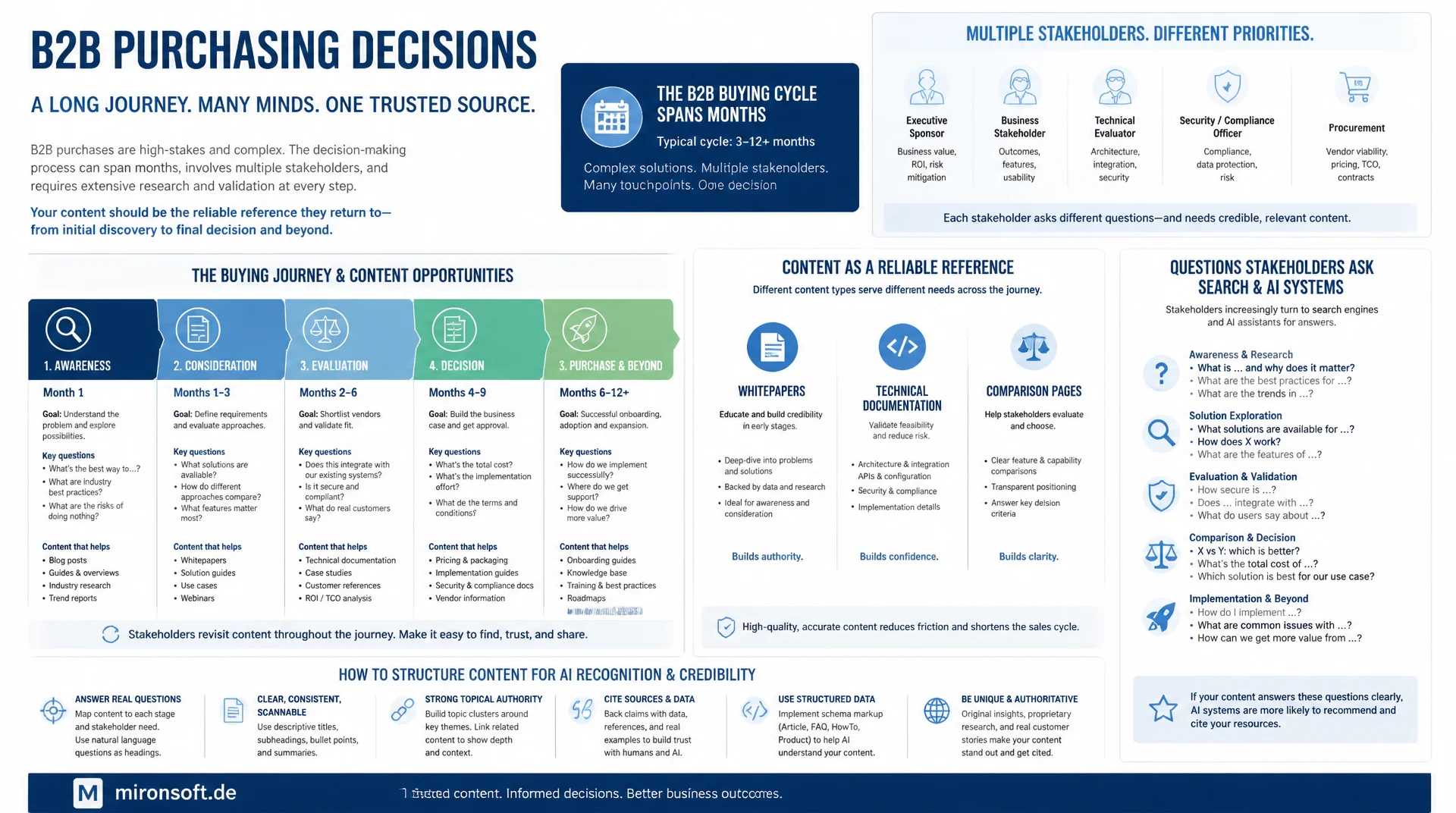
B2B purchasing decisions often stretch across months and involve multiple stakeholders, each asking search systems and AI assistants their own set of questions. B2B content that gets cited as an AI source therefore does not need to convince a single audience, it needs to stay recognizable as a reliable reference across the entire buying cycle. This article shows how whitepapers, technical documentation and comparison pages get structured strategically for exactly that.
Table of contents
- 1. Why B2B buying cycles demand a different GEO approach
- 2. The buying committee and its different questions
- 3. Structuring whitepapers as a citable knowledge source
- 4. Technical documentation as a GEO asset
- 5. Comparison pages for the evaluation phase
- 6. Building topic clusters instead of standalone articles
- 7. Credibly demonstrating subject matter authority
- 8. Maintaining content across the whole cycle
- 9. Measuring success realistically over long cycles
- 10. Summary
- 11. FAQ
1. Why B2B buying cycles demand a different GEO approach
B2B content differs fundamentally from B2C content because the purchase decision is rarely made by a single person and rarely in a single sitting. Studies on B2B buying behavior have shown for years that typically six to ten people are involved in a larger purchase decision, and each of them researches with their own questions, their own prior knowledge and their own concerns. For a GEO strategy this means: B2B content must not address a single persona, it needs to function as a credible source for AI assistants across multiple roles.
The buying cycle itself often stretches across weeks or months, with clearly distinguishable phases: problem recognition, research, vendor comparison, internal alignment, final negotiation. In every phase, participants ask different questions of search systems, and a language model potentially draws on different content types as a source for each phase. A technical evaluator searches for API documentation and benchmark data, a buyer searches for contract details and TCO comparisons, leadership searches for ROI arguments. B2B content that takes GEO seriously needs to cover this range with different content formats.
The second difference from B2C: B2B content gets consulted more often for specific, technically narrow questions that are asked far less frequently than generic consumer questions, but with higher purchase relevance. A language model answering a niche question about a specific integration requirement often has only a handful of citable sources to choose from, which gives niche B2B vendors with solid subject matter content a disproportionate chance at citation compared to heavily contested B2C topics.
2. The buying committee and its different questions
A GEO strategy for B2B content starts with a clean mapping of the roles on the buying committee and their respective information needs. Technical evaluators ask about architecture, scalability, API limits and integration effort. These questions are precise and technical, and they get answered best by technical documentation, architecture diagrams and concrete performance data, not by marketing whitepapers.
Procurement and compliance ask about different things: contract models, data protection, certifications, exit clauses. Content for this audience needs precise, verifiable statements about security standards and legal frameworks, because a language model will preferentially cite pages that state these details concretely rather than promotionally on a compliance question. Leadership and budget owners, in turn, ask about business impact, usually phrased as ROI, efficiency or risk questions, and case studies with a traceable methodology suit these better than pure product descriptions.
The strategic core: instead of a single "about us" heavy piece of content, B2B content needs several parallel content tracks, each tailored to the questions of one buying committee role, but consistent with each other in substance. Contradictory statements between technical documentation and sales material get noticed quickly by generative search systems, because a model can evaluate multiple sources from the same domain at once.
3. Structuring whitepapers as a citable knowledge source
Whitepapers are traditionally treated as a lead magnet behind a form gate, but that exact gate makes them invisible to language models and therefore worthless for GEO. A whitepaper meant to appear as a citation source in AI answers needs to be freely accessible at least in excerpts, ideally as a full HTML version alongside the PDF download. The PDF download can stay in place as a lead magnet for deeper prospects, while the HTML version opens up the core statements for crawlers and language models.
Structurally, whitepapers benefit enormously from clear subheadings that already phrase a question or key finding, instead of generic chapter names like "Introduction" or "Conclusion." A heading like "How much implementation time does an API-first architecture typically save?" gives a language model a direct anchor point for extraction, while "Chapter 3: Technical Considerations" carries no usable information.
In terms of content, B2B whitepapers should make their methodology transparent: how was data collected, what assumptions underlie it, what are the limits of the statement. This transparency raises perceived credibility with a language model, which favors fact based, traceable sources over whitepaper content that only reproduces general trend statements with no recognizable basis.
<!-- Whitepaper section pattern: heading states a concrete finding,
     not a generic chapter label -->
<h2 id="implementation-time">
  How much implementation time does an API-first architecture save?
</h2>
<p>
  Based on 40 evaluated B2B integration projects, an API-first architecture
  needed a median of 6 weeks less implementation time than a monolithic
  alternative with comparable feature scope.
</p>
<h3>Methodology</h3>
<p>
  Project durations were collected from internal delivery logs between 2024
  and 2026, filtered to projects with comparable scope.
</p>
4. Technical documentation as a GEO asset
Many B2B companies treat technical documentation as a pure support resource, not as marketing content. For GEO, that exact documentation is often the most valuable asset, because it delivers precise, fact based answers to concrete technical questions, exactly the format language models tend to cite for problem solving questions. A well maintained API reference or integration guide answers questions like "How do you authenticate with API X?" or "What rate limits apply for provider Y?" more directly and verifiably than any marketing page.
For technical documentation to work as a GEO asset for B2B content, it needs to be publicly accessible, not hidden behind a customer login, at least for the parts relevant to pre-sales questions. Structured markup such as TechArticle or HowTo schema also pays off, so search systems can clearly classify the documentation as a technical reference rather than a generic blog post.
{
  "@context": "https://schema.org",
  "@type": "TechArticle",
  "headline": "API authentication: setting up the OAuth2 client credentials flow",
  "proficiencyLevel": "Expert",
  "dependencies": "API key from the partner portal, HTTPS-capable client",
  "about": "Technical integration guide for B2B expert users",
  "datePublished": "2026-03-10",
  "dateModified": "2026-07-20"
}
5. Comparison pages for the evaluation phase
In the evaluation phase of a B2B buying cycle, users ask AI assistants explicit comparison questions: "What differentiates provider A from provider B on requirement X?" These questions are especially valuable for B2B content, because a well built, neutrally phrased comparison page gets used disproportionately often as an AI citation, provided it actually presents both sides fairly instead of promoting one-sidedly.
The practical setup: a table with concrete, verifiable criteria instead of vague ratings, complemented by context on when which solution makes sense. Phrasing like "for companies with fewer than 50 employees, solution X tends to fit better, above 200 employees the scaling architecture of solution Y becomes more relevant" delivers nuanced, credible statements that a language model is more likely to cite than a blanket recommendation without context.
| Content type | Buying committee audience | Typical question phase |
|---|---|---|
| Technical documentation | Technical evaluators, developers | Deep research, feasibility check |
| Whitepapers | Subject matter teams, strategy leads | Early problem recognition, trend assessment |
| Comparison pages | Procurement, technical evaluators | Vendor comparison, shortlisting |
| Case studies | Leadership, budget owners | ROI justification, internal approval |
| Compliance pages | Legal, data protection, procurement | Final contract review |
6. Building topic clusters instead of standalone articles
Isolated single articles rarely suffice for B2B content, because a long buying cycle produces several interrelated questions over weeks. A topic cluster with a pillar page and several in depth subpages covers that range and simultaneously signals subject matter depth that isolated individual articles cannot convey. Language models that find several related pages on the same domain as a source tend to weight that domain's subject matter authority more highly.
In practice this means: the pillar page answers the broad core question of a topic thoroughly and links in a structured way to deeper subpages covering detail questions, technical aspects and use cases. This structure pays off especially for B2B content with long cycles, because different buying committee members enter the cluster at different points and still find a consistent, coherently building information base.
{
  "cluster": "b2b-integration-architecture",
  "pillar_page": "/resources/b2b-integration-architecture",
  "sub_pages": [
    { "url": "/resources/api-first-vs-monolith", "audience": "technical evaluators" },
    { "url": "/resources/tco-comparison-integration-models", "audience": "procurement" },
    { "url": "/resources/data-protection-b2b-interfaces", "audience": "legal, compliance" },
    { "url": "/resources/roi-api-first-case-study", "audience": "leadership" }
  ],
  "review_cycle_months": 3
}
7. Credibly demonstrating subject matter authority
For B2B content with a high explanatory burden, visible subject matter authority plays a bigger role than for simpler B2C topics, because decision makers hold statements to a higher standard of rigor. Concrete author bylines with traceable subject matter qualification, clear sourcing for cited figures, and a transparent handling of the limits of your own claims all increase credibility, both for human readers and for language models that increasingly evaluate trustworthiness signals.
One pattern that stands out in practice: B2B content that openly states what a solution is not suited for tends to be rated as more credible than content phrased with unqualified positivity. This honesty about limits and trade-offs is a signal that both technically savvy readers and language models classify as more nuanced and therefore more citation worthy.
#!/usr/bin/env bash
# content-audit-b2b.sh: quick check for authority signals across a
# B2B content cluster before publishing

set -euo pipefail

readonly CONTENT_DIR="./content/whitepaper"

for file in "$CONTENT_DIR"/*.html; do
  echo "Checking: $file"
  grep -q 'author' "$file" || echo "  [WARN] No visible author byline"
  grep -q 'dateModified\|date-modified' "$file" || echo "  [WARN] No update date found"
  grep -qi 'methodology' "$file" || echo "  [INFO] No methodology section detected"
done
8. Maintaining content across the whole cycle
Long buying cycles mean a prospective customer encounters the same piece of B2B content repeatedly over weeks or months, directly, through an AI summary, or through a colleague who shared the page. Inconsistencies between the state from three months ago and the current state stand out especially negatively in this context, because they sow doubt about the vendor's reliability.
In practice this means: a fixed editorial schedule for updating technical figures, pricing models and product descriptions, with a visible change date. Technical documentation in particular ages quickly, and a language model that delivers visibly outdated information does not just harm your own domain, it also affects the purchase decision if an evaluator plans based on stale figures.
9. Measuring success realistically over long cycles
Measuring the success of GEO efforts for B2B content is harder than for short B2C purchase cycles, because months and several further touchpoints often lie between an AI citation and the actual deal close. Directly attributing a closed deal to a single AI answer is not cleanly possible in most cases, which is why indirect but reliable metrics are worth relying on.
Sensible indicators are how often your own domain appears as an AI citation for relevant B2B questions, referral traffic from AI platforms where analytics capture it, and qualitative signals from sales, for example when prospects already reference specific whitepaper or documentation content in the first conversation. This combination of visibility measurement and sales feedback gives a more realistic picture than any single metric.
// referral-check.js: minimal filter for AI-platform referral traffic
// in a generic analytics export (adapt selector to your tool of choice)
const aiReferrers = [
  "chat.openai.com",
  "perplexity.ai",
  "claude.ai",
  "gemini.google.com",
];

function filterAiReferrals(sessions) {
  return sessions.filter((s) => aiReferrers.some((ref) => s.referrer.includes(ref)));
}

// sessions: [{ referrer: "chat.openai.com", landingPage: "/resources/api-first-vs-monolith" }, ...]
const aiSessions = filterAiReferrals(sessions);
console.log(`AI-platform referrals this month: ${aiSessions.length}`);
Mironsoft
GEO strategy, technical documentation and B2B content from a single source
B2B content that carries across the whole buying cycle?
We structure whitepapers, technical documentation and comparison pages so they work as a credible source for every buying committee role, including as an AI citation.
Content clusters
Building pillar pages and subpages along the buying cycle
Whitepaper opening
Making core findings from PDFs available as crawlable HTML
Documentation audit
Structuring and maintaining technical docs as a GEO asset
10. Summary
A GEO strategy for B2B content has to reflect the reality of long, multi-stage buying cycles with multiple roles involved. Technical documentation, whitepapers, comparison pages and case studies address different questions from different buying committee members, and all of them benefit from clear structure, transparent methodology and visible freshness. Whitepapers locked behind form gates stay invisible to language models, which is why an open HTML version alongside the classic lead magnet pays off.
Topic clusters instead of isolated single articles signal subject matter depth and raise the odds of being used as a source across several related questions. Measuring success for B2B content naturally stays more indirect than for short purchase cycles; a combination of visibility tracking and sales feedback gives the most realistic picture of GEO impact.
GEO for B2B content at a glance
Buying committee
Six to ten roles with different questions, tailor content formats to them instead of one generic audience.
Open the whitepaper
Core findings as a freely accessible HTML version, PDF form stays as an additional lead magnet.
Topic clusters
Pillar pages with in depth subpages instead of isolated articles, signals subject matter authority.
Maintenance
Fixed editorial schedule against outdated technical figures, freshness is especially visible over long cycles.