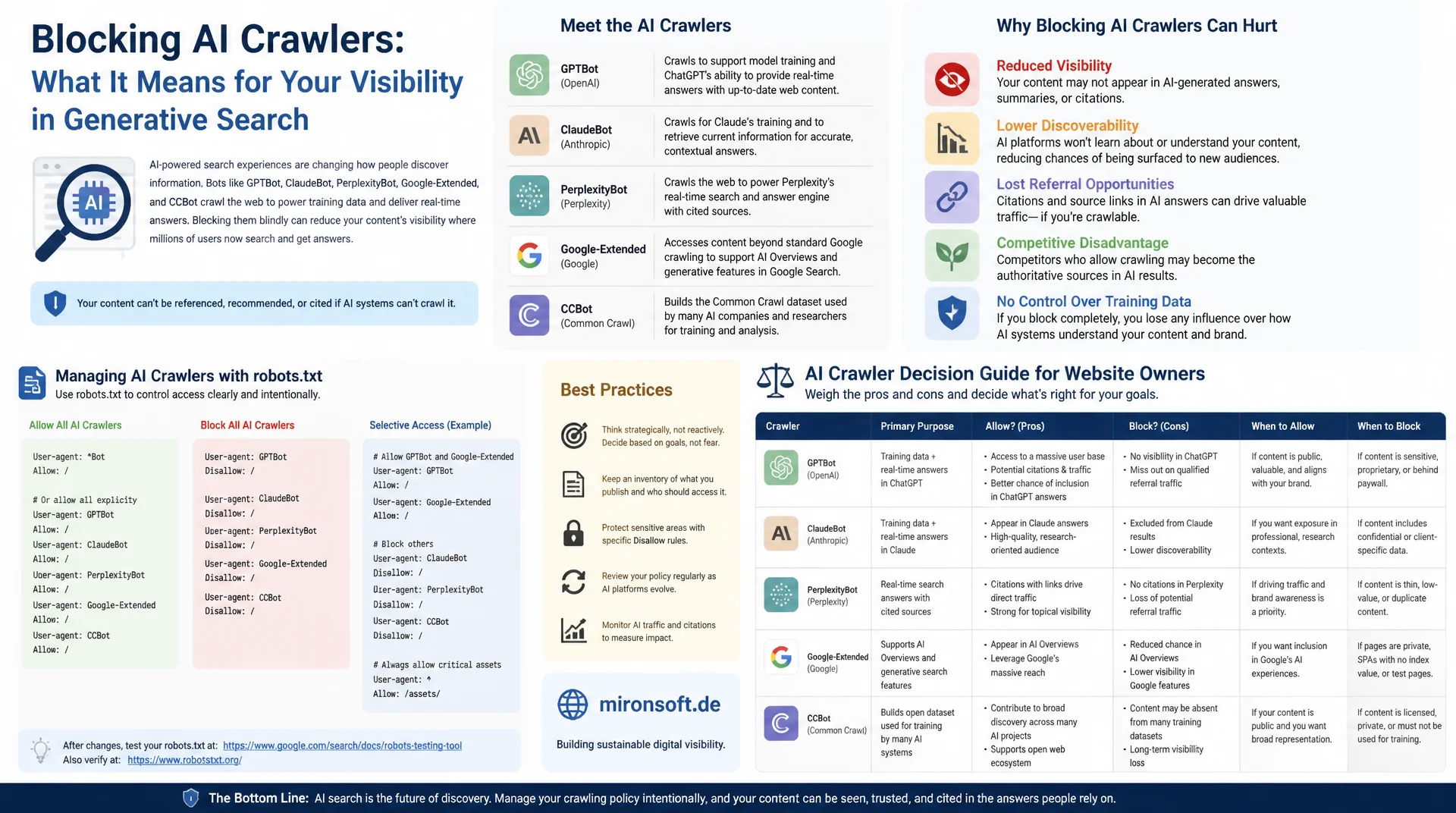
Through robots.txt: Allow or Block
GPTBot, ClaudeBot, PerplexityBot, Google-Extended and CCBot crawl websites for different purposes, some for training data, some for real time answers, some for both. Blocking these AI crawlers indiscriminately risks invisibility in generative search systems. Allowing all of them without distinction means losing control over what your content actually gets used for. This article gives concrete robots.txt directives and a reasoned decision guide for each individual AI crawler.
Table of contents
- 1. Why AI crawlers need their own control layer
- 2. Training crawlers versus retrieval crawlers
- 3. robots.txt basic syntax for AI user agents
- 4. The most important AI crawlers in detail
- 5. Practical robots.txt examples for different strategies
- 6. Weighing visibility against content protection
- 7. llms.txt: a new, complementary standard
- 8. Checking and verifying crawler access
- 9. Limits of robots.txt as a control instrument
- 10. Summary
- 11. FAQ
1. Why AI crawlers need their own control layer
Classic robots.txt configurations usually only distinguish between "all bots" and a handful of individual search engines like Googlebot or Bingbot. With the rise of generative AI systems, a new category of crawlers has emerged, each carrying its own, clearly named user agent: GPTBot from OpenAI, ClaudeBot from Anthropic, PerplexityBot from Perplexity, Google-Extended for training data at Google, and CCBot from the Common Crawl project, whose datasets are in turn used by many AI providers as a training source. Each of these AI crawlers serves a different purpose and has different consequences depending on whether you grant or deny it access.
The core difference from classic search engine crawlers: an AI crawler that collects data for training a language model has a different effect than an AI crawler that fetches and cites content in real time for a specific user question. The former category influences what a model eventually "knows," the latter influences whether your page shows up as a source in the current answer. An undifferentiated robots.txt rule that blocks all AI crawlers indiscriminately cuts off both effects at once, including the one you actually wanted.
The decision about which AI crawlers to allow is therefore not a purely technical question, it is a strategic one: do you want to appear in AI training data? Do you want to be cited in real time answers? Is both desired, only one, or neither? The following sections lay out the technical foundations and concrete robots.txt directives needed to implement that decision precisely, instead of leaving it to a blanket all-or-nothing rule.
2. Training crawlers versus retrieval crawlers
For sensible AI crawler control, you have to distinguish two fundamentally different categories. Training crawlers collect content that later feeds into a language model, often with a considerable time gap between crawling and actual model training. GPTBot and CCBot fall primarily into this category. Blocking these AI crawlers prevents your content from serving as training material for future model versions, but has no immediate effect on current citations.
Retrieval crawlers, by contrast, fetch content in real time or near real time, usually triggered by a specific user query, to produce a current, fact based answer. PerplexityBot operates mostly in this mode, as does the retrieval component behind ChatGPT with web search enabled. Blocking these AI crawlers has direct consequences: your page can no longer serve as a source for up to date AI answers, which directly hurts visibility in generative search.
Some AI crawlers serve both purposes or shift their function over time, which complicates classification. Google-Extended, for instance, controls specifically whether content gets used to train Gemini and other generative AI features at Google, independent of classic Googlebot crawling for search. This separation lets you keep being found classically on Google without automatically supplying training data for generative Google products, provided you block Google-Extended specifically.
3. robots.txt basic syntax for AI user agents
The robots.txt file lives in a domain's root directory and gets fetched by well behaved AI crawlers before actual access. Each rule consists of a User-agent block followed by Allow or Disallow lines. What matters for controlling AI crawlers: each provider defines its own specific user agent string, which you have to reference exactly. A generic User-agent: * block does not automatically cover all AI crawlers with the same intent once specific blocks also exist.
Robots.txt is a voluntary convention, not a technical access control. Reputable AI providers like OpenAI, Anthropic and Perplexity have been shown to respect the file, publicly document their user agents, and sometimes even offer more granular control via HTTP headers. Less reputable scrapers, which falsely claim to be a known AI crawler or simply ignore robots.txt, cannot be stopped through this file; that requires server side measures like IP or user agent filtering at the infrastructure level.
# robots.txt syntax basics for AI crawler control
# Location: https://example.com/robots.txt

# Specific blocks take precedence over generic User-agent: * blocks
User-agent: GPTBot
Disallow: /internal/
Allow: /

User-agent: *
Disallow: /admin/
Allow: /
4. The most important AI crawlers in detail
GPTBot is OpenAI's training crawler and collects web content for future model versions. A separate user agent, OAI-SearchBot, is used for real time web search within ChatGPT and should be considered separately when making a decision, since both serve different purposes. Anyone who wants to appear as a source for current ChatGPT answers without necessarily contributing training data can block GPTBot and allow OAI-SearchBot.
ClaudeBot from Anthropic crawls primarily for training purposes, while different mechanisms handle real time web search within Claude, and the associated user agent documentation keeps evolving alongside product updates, which is why it pays to consult Anthropic's official documentation before finalizing a robots.txt configuration. PerplexityBot is mostly a retrieval crawler that works directly for user queries within Perplexity; blocking it affects your own visibility in AI answers particularly directly.
Google-Extended, as described above, controls exclusively the use of content for Google's generative AI features, separate from the classic search index. CCBot belongs to the nonprofit Common Crawl project, whose datasets get used as training material by numerous AI providers, including smaller ones and research institutions. Blocking CCBot therefore potentially affects more models than blocking a single commercial AI crawler, because you are excluding your content from an entire chain of downstream uses.
| User agent | Operator | Primary purpose | Effect when blocked |
|---|---|---|---|
| GPTBot | OpenAI | Model training | No impact on ChatGPT web search |
| OAI-SearchBot | OpenAI | Real time web search in ChatGPT | No more citations in search answers |
| ClaudeBot | Anthropic | Model training | No contribution to training data |
| PerplexityBot | Perplexity | Real time retrieval | No citation on Perplexity |
| Google-Extended | Training for Gemini & AI features | Classic Google index stays unaffected | |
| CCBot | Common Crawl | Open training dataset | Affects many downstream models |
5. Practical robots.txt examples for different strategies
For companies aiming for maximum visibility in AI answers and accepting use for model training, an open configuration that explicitly allows all known AI crawlers fits well. This strategy suits B2B providers whose content marketing goal is precisely to be cited in as many AI answers as possible, and who view the training data contribution as an acceptable price for reach.
For companies with sensitive or monetized content, publishers with a subscription model for example, a more differentiated strategy fits: allow retrieval crawlers like PerplexityBot and OAI-SearchBot to stay present in current AI answers, while blocking pure training crawlers like GPTBot, ClaudeBot and CCBot to avoid providing your content as training material without compensation.
# robots.txt: Strategy A, maximum AI visibility, training allowed
User-agent: GPTBot
Allow: /

User-agent: ClaudeBot
Allow: /

User-agent: PerplexityBot
Allow: /

User-agent: Google-Extended
Allow: /

User-agent: CCBot
Allow: /

# ---

# robots.txt: Strategy B, allow real-time retrieval, block training crawlers
User-agent: GPTBot
Disallow: /

User-agent: ClaudeBot
Disallow: /

User-agent: CCBot
Disallow: /

User-agent: Google-Extended
Disallow: /

User-agent: OAI-SearchBot
Allow: /

User-agent: PerplexityBot
Allow: /
6. Weighing visibility against content protection
The choice between openness and content protection is not a purely technical question, it is a business decision with real trade-offs. Blocking all AI crawlers protects your content maximally from uncompensated reuse, but risks your brand simply disappearing from generative answers in your own industry, while competitors who allow AI crawlers fill that visibility space instead.
For purely informational marketing content that is freely accessible anyway and whose purpose is reach and brand awareness, the benefit of visibility usually outweighs the protection argument in most cases. For premium editorial content with a direct monetization model, expert articles behind a paywall for example, the calculation can look different, especially when an AI crawler scrapes the content for training purposes without generating traffic or revenue for the creator.
A middle path that has established itself in practice: allow retrieval crawlers, because they deliver direct, demonstrable visibility value, while scrutinizing pure training crawlers more critically, especially when the provider offers no compensation or attribution models. This differentiated AI crawler control requires ongoing maintenance, because new providers introduce new user agents and existing ones can change their function.
7. llms.txt: a new, complementary standard
Alongside robots.txt control, a new, not yet universally supported proposal called llms.txt has emerged. The idea: a Markdown file in the root directory that gives language models and AI assistants a curated, compact overview of a domain's most important pages and information, similar to a sitemap optimized for language models. Unlike robots.txt, llms.txt does not control access, it provides additional context and prioritizes relevant content.
{
  "crawler_policy_internal_note": "b2b-domain",
  "reviewed": "2026-07-23",
  "decisions": [
    { "agent": "GPTBot", "purpose": "training", "decision": "block", "reason": "no compensation model" },
    { "agent": "OAI-SearchBot", "purpose": "retrieval", "decision": "allow", "reason": "direct citation value" },
    { "agent": "ClaudeBot", "purpose": "training", "decision": "block", "reason": "no compensation model" },
    { "agent": "PerplexityBot", "purpose": "retrieval", "decision": "allow", "reason": "direct citation value" },
    { "agent": "Google-Extended", "purpose": "training", "decision": "block", "reason": "no compensation model" },
    { "agent": "CCBot", "purpose": "training", "decision": "block", "reason": "downstream usage unclear" }
  ]
}
The practical benefit of llms.txt is limited as of today, because not all major AI providers systematically evaluate the file yet, but creating it costs little effort and does no harm. For domains with an extensive, complex structure, llms.txt can help point language models directly to the most important expert pages instead of relying on a full crawl analysis of the entire site structure.
# llms.txt: placed at https://example.com/llms.txt
# Markdown format, curated overview for AI assistants

# Example Company

> B2B provider of integration solutions with a focus on API-first architecture.

## Core pages

- [Product overview](https://example.com/products): All core products compared
- [Technical documentation](https://example.com/docs): Complete API reference
- [Pricing](https://example.com/pricing): Current plans and terms

## Knowledge base

- [Integration guide](https://example.com/resources/integration): Step by step guide
- [FAQ](https://example.com/faq): Frequent technical and contractual questions
8. Checking and verifying crawler access
Setting a robots.txt rule is not enough without checking whether it actually works. Server logs show which user agents actually visit your domain, and comparing them against the robots.txt configuration reveals whether blocked AI crawlers respect the rule or not. It also pays to check for spoofed user agents: some scrapers claim to be a known AI crawler without using the associated IP range, a sign that robots.txt alone does not suffice as a protective measure.
Providers like OpenAI, Anthropic and Perplexity publish public IP ranges or reverse DNS verification methods for their official AI crawlers. Combining user agent checks with IP verification gives far more reliable data about who is actually crawling than relying on the reported user agent string alone.
#!/usr/bin/env bash
# verify-ai-crawlers.sh: cross-check logged AI user agents against
# access log entries and flag suspicious hits for manual review

set -euo pipefail

readonly ACCESS_LOG="/var/log/nginx/access.log"
readonly KNOWN_AGENTS=("GPTBot" "ClaudeBot" "PerplexityBot" "CCBot" "Google-Extended")

for agent in "${KNOWN_AGENTS[@]}"; do
  count=$(grep -c "$agent" "$ACCESS_LOG" || true)
  echo "[$agent] requests logged: $count"
done

echo "---"
echo "Reminder: cross-check source IPs against each provider's published"
echo "IP ranges before trusting the User-Agent string alone."
9. Limits of robots.txt as a control instrument
Robots.txt remains a voluntary convention. It reliably controls the behavior of reputable, documented AI crawlers from major providers, but has no technical enforcement power against actors who ignore the file. Anyone who truly wants to protect content from any form of retrieval needs additional measures: rate limiting, IP block lists, access protection for sensitive areas, or terms of use that at least establish a basis for later claims.
The AI crawler landscape also changes quickly. New providers, new user agents and shifting crawling strategies from existing providers require regular review of your own robots.txt configuration, at least quarterly, ideally coupled with monitoring the official documentation of the major AI providers. A configuration set once ages within a few months in this fast moving environment.
Mironsoft
robots.txt audits, AI crawler control and llms.txt implementation
Do you know exactly which AI crawlers visit your site?
We analyze your server logs, configure robots.txt specifically for the AI crawlers that fit your visibility strategy, and set up llms.txt for your most important expert pages.
Crawler audit
Server log analysis matched against official IP ranges
robots.txt strategy
Differentiated rules by training or retrieval purpose
llms.txt setup
Curated overview of your most important pages for AI assistants
10. Summary
AI crawlers cannot be sensibly controlled with a blanket block or allow rule. GPTBot, ClaudeBot and CCBot serve primarily model training, PerplexityBot and OAI-SearchBot serve real time retrieval for current AI answers, Google-Extended specifically controls usage for Google's generative features separately from the classic search index. A differentiated robots.txt configuration lets you distinguish precisely between training data contribution and real time visibility, instead of granting or denying both at once.
The decision about which AI crawlers to allow remains a strategic trade-off between reach and content protection that plays out differently depending on your business model. llms.txt complements robots.txt with a curated context layer for language models, but it does not replace access control. Regularly reviewing server logs and adapting to new AI crawlers stays necessary, because the landscape keeps evolving continuously.
AI crawler control via robots.txt at a glance
Training crawlers
GPTBot, ClaudeBot, CCBot: blocking prevents training data contribution, no effect on live citations.
Retrieval crawlers
PerplexityBot, OAI-SearchBot: blocking directly prevents citation in current AI answers.
llms.txt
Complementary Markdown file with a curated page overview, controls no access, provides context.
Verification
Check server logs, match provider IP ranges, robots.txt is voluntary and not a technical safeguard.