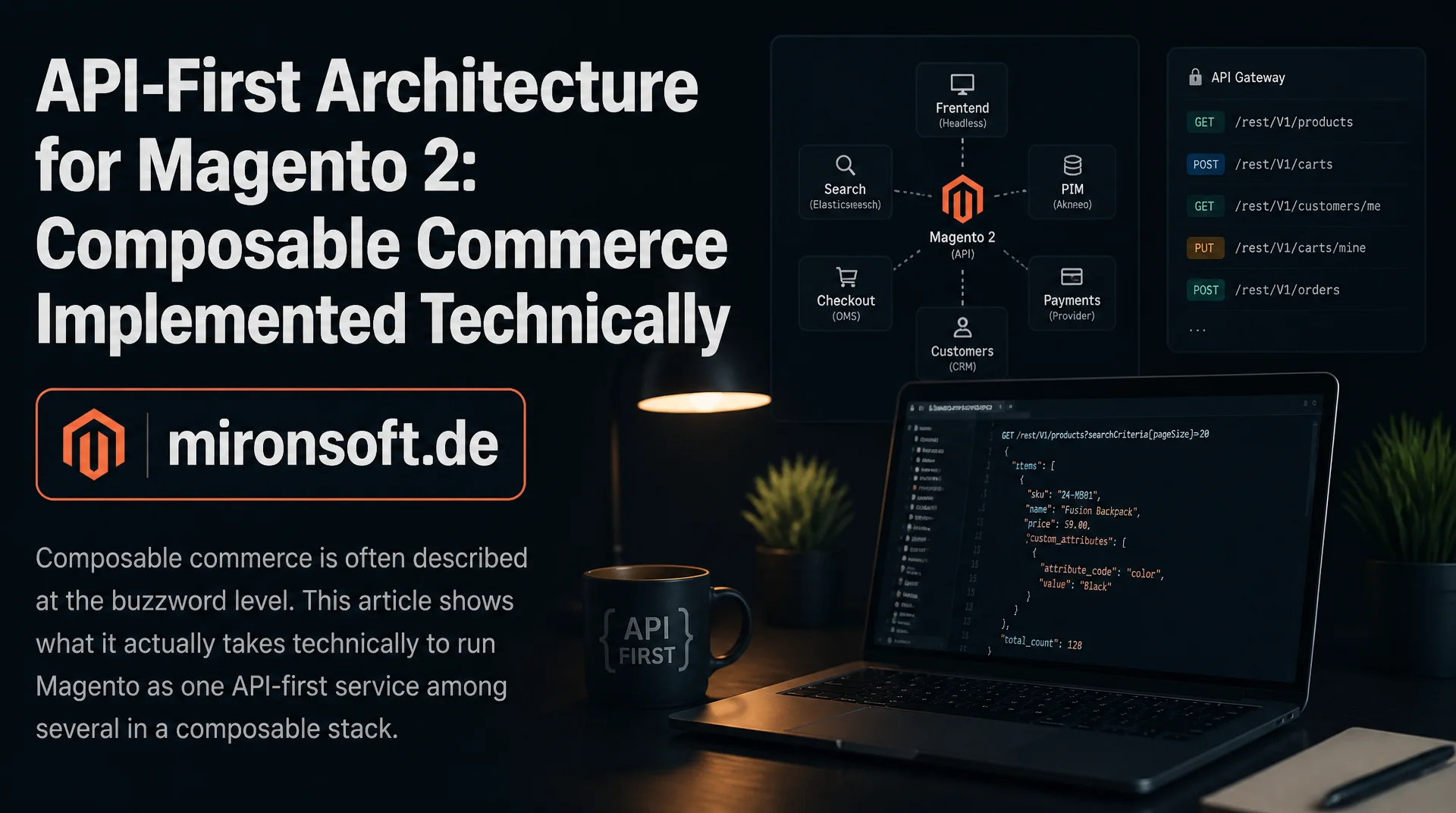
How composable commerce technically breaks Magento 2 into cleanly cut services without flipping the switch on the whole operation in a single day
An API-first architecture reverses the classic order of software development: instead of building a user interface first and treating data access as an afterthought, a stable, well documented API comes first, from which any number of frontends, from the classic storefront to a mobile app, can be served. For Magento 2 that means a deliberate break from the monolithic core architecture, in which frontend rendering and business logic are traditionally tightly interwoven. This article shows what an API-first architecture for Magento 2 looks like in practice, where sensible microservice boundaries run, and how an existing store can migrate there step by step.
Table of Contents
- 1. What API-first architecture means and how it differs from the monolith
- 2. GraphQL versus REST as the API-first foundation
- 3. Frontend decoupling: headless approaches on an API-first foundation
- 4. Drawing microservice boundaries cleanly: what stays in the monolith
- 5. Composable commerce and the MACH principles
- 6. API gateway and versioning in an API-first architecture
- 7. Authentication and rate limiting for API-first architectures
- 8. Migrating an existing store to API-first: step by step, not big bang
- 9. Monolith, API-first, and fully headless compared
- 10. Summary
- 11. FAQ
1. What API-first architecture means and how it differs from the monolith
In a classic, monolithic Magento installation, frontend rendering, business logic, and data storage are tightly interwoven: a block loads a model directly, the model talks to the database directly, and the rendered HTML leaves the server already fully assembled. That architecture is proven and performant, but makes it hard to reuse the same business logic for a second frontend, such as a native app or a digital signage screen in a physical store.
An API-first architecture deliberately separates these layers: business logic is accessed exclusively through well defined APIs, usually GraphQL or REST, and every frontend, regardless of its technology, consumes the same API in an identical way. That separation is not an end in itself, it is a prerequisite for adding new sales channels without reimplementing business logic for every one of them.
2. GraphQL versus REST as the API-first foundation
Magento's native GraphQL API lets a frontend fetch exactly the fields it needs from several related entities in a single request, such as product data, price, and availability all at once, instead of firing off several separate REST calls one after another. For frontends with variable data needs, such as different mobile and desktop views of the same page, that significantly cuts the number of network roundtrips.
REST endpoints, on the other hand, still make sense when a clearly defined, stable resource with no variable field selection is being called, such as a single checkout step with a fixed payload, or when an external system needs to integrate through a simple, well cacheable URL structure. Most production API-first architectures for Magento therefore use both approaches side by side, GraphQL for the storefront frontend and REST for system integrations with a clearly bounded data scope.
3. Frontend decoupling: headless approaches on an API-first foundation
A fully decoupled, headless frontend renders the user interface entirely independent of Magento's own template system, usually with a modern JavaScript framework, and pulls all data exclusively through the GraphQL or REST API. That decoupling allows noticeably faster frontend development, since frontend teams can work independent of Magento's release cycle, but it demands its own infrastructure for rendering, caching, and deploying the frontend.
It matters to distinguish a fully headless setup from a Hyvä theme, which renders server side within Magento but internally still relies heavily on GraphQL requests from Alpine.js components for dynamic elements. A Hyvä theme is therefore not a pure API-first frontend, but it can serve as a pragmatic middle step that already applies many API-first principles on a small scale, without requiring the full effort of a completely separate frontend infrastructure.
# Example: a single GraphQL query for product data,
# price and availability instead of several separate REST calls
query ProductDetails($sku: String!) {
  products(filter: { sku: { eq: $sku } }) {
    items {
      name
      price_range {
        minimum_price {
          final_price { value currency }
        }
      }
      stock_status
    }
  }
}
4. Drawing microservice boundaries cleanly: what stays in the monolith
Not every capability should be pulled out of Magento just because an API-first architecture is generally the goal: catalog management, pricing, and inventory are deeply integrated into Magento and usually more efficient left in the core, while clearly separable, standalone capabilities like a recommendation service or a customer review engine are good candidates for extraction into a dedicated microservice.
A sensible rule of thumb is to only extract a capability when it genuinely needs to evolve independent of Magento's release cycle, or when it is consumed by several different systems outside Magento. Splitting things into too many small services prematurely, without real need, mostly creates additional operational complexity in practice without delivering matching benefit.
5. Composable commerce and the MACH principles
The term composable commerce is often described through the MACH principles: Microservices, API-first, Cloud-native, and Headless, which together describe an architecture in which individual, interchangeable building blocks collaborate through clearly defined APIs, instead of relying on a single, monolithic platform for every requirement. Magento itself is not a pure MACH system, but it can serve as an API-first core building block within a larger composable commerce architecture.
In practice that often means Magento stays responsible for catalog, order processing, and payment, while search, personalization, or a content management system sit alongside it as separate, specialized services orchestrated through APIs. That pragmatic approach differs a lot from a full big bang replacement of every Magento capability with individual best of breed services.
6. API gateway and versioning in an API-first architecture
Once multiple frontends and services consume the same Magento API, an API gateway as a central entry point is worth setting up, bundling authentication, rate limiting, and request routing in one place instead of implementing that logic separately in every single frontend. A gateway also makes it easier to later migrate individual endpoints to a dedicated microservice, since frontends keep calling the same gateway URL while the actual target implementation changes behind the scenes.
Versioning becomes mandatory rather than optional in an API-first architecture, since several frontends with different release cycles consume the same API, and a breaking change in the API would otherwise break all of them at once. A clear versioning strategy, for instance through an explicit version header or a version prefix in the API path, allows older frontend versions to keep being served while new frontends already use a revised API version.
7. Authentication and rate limiting for API-first architectures
Since an API-first architecture inevitably offers more attack surface than a closed monolith whose frontend and backend are not separately reachable from the outside, every API endpoint needs an explicit, consistent authentication strategy, usually OAuth 2.0 or JSON Web Tokens for authenticated requests and a separate, restricted access path for public catalog data.
Rate limiting additionally protects against excessive use by individual clients, whether from faulty frontend implementations firing off unnecessarily frequent requests or from genuinely abusive access, and should be configurable differently per client type. A mobile app frontend with offline synchronization, for instance, has a different, burstier access pattern than a classic web storefront and needs different limits accordingly.
8. Migrating an existing store to API-first: step by step, not big bang
An existing, monolithic Magento store should not be rebuilt into a full API-first architecture in a single big bang project, since the risk of a failed large scale project is considerably higher than with a step by step migration. A sensible first step is often to put a single, clearly bounded capability, such as product search, behind a dedicated API and switch the existing frontend to it, before further areas follow.
Every successfully migrated area delivers valuable insight for the next migration, such as which data structures work well for an API response and what additional transformation is needed. That iterative approach not only reduces technical risk, it also lets the company back up the business case for an API-first architecture with concrete, already realized partial wins, instead of relying purely upfront on a long term strategic benefit.
9. Monolith, API-first, and fully headless compared
The table below compares three typical architecture stages with their respective effort and benefit.
| Architecture | Frontend Coupling | Typical Effort | When It Makes Sense |
|---|---|---|---|
| Classic monolith | Tight, server side rendering | Low | A single sales channel |
| Hyvä with API-first elements | Server side, API driven interactivity | Medium | One channel but modern interactivity needed |
| API-first with dedicated frontend | Decoupled via GraphQL/REST | High | Multiple frontends, independent frontend teams |
| Fully composable/MACH | Multiple specialized services | Very high | Complex multi channel requirements |
Mironsoft
Magento development, module consulting, and system architecture
A Magento project that needs a second opinion or experienced execution?
We build custom Magento modules, advise on architecture decisions, and take on complex implementations, from service contract planning to production-ready deployment.
Architecture Consulting
Have module and system architecture thought through properly before you build.
Custom Module Development
Build custom Magento modules cleanly, following best practices.
Code Review & Audit
Have existing modules reviewed for performance, security, and maintainability.
10. Summary
API-First Architecture: The Essentials at a Glance
Core idea
API-first architecture strictly separates business logic from presentation, so multiple frontends can share the same API.
Key decision
Which capability genuinely deserves to become its own microservice, instead of extracting everything by default.
Biggest risk
Splitting into too many services prematurely, without real need, creates unnecessary operational complexity.
Success criterion
New sales channels can be added without reimplementing existing business logic.