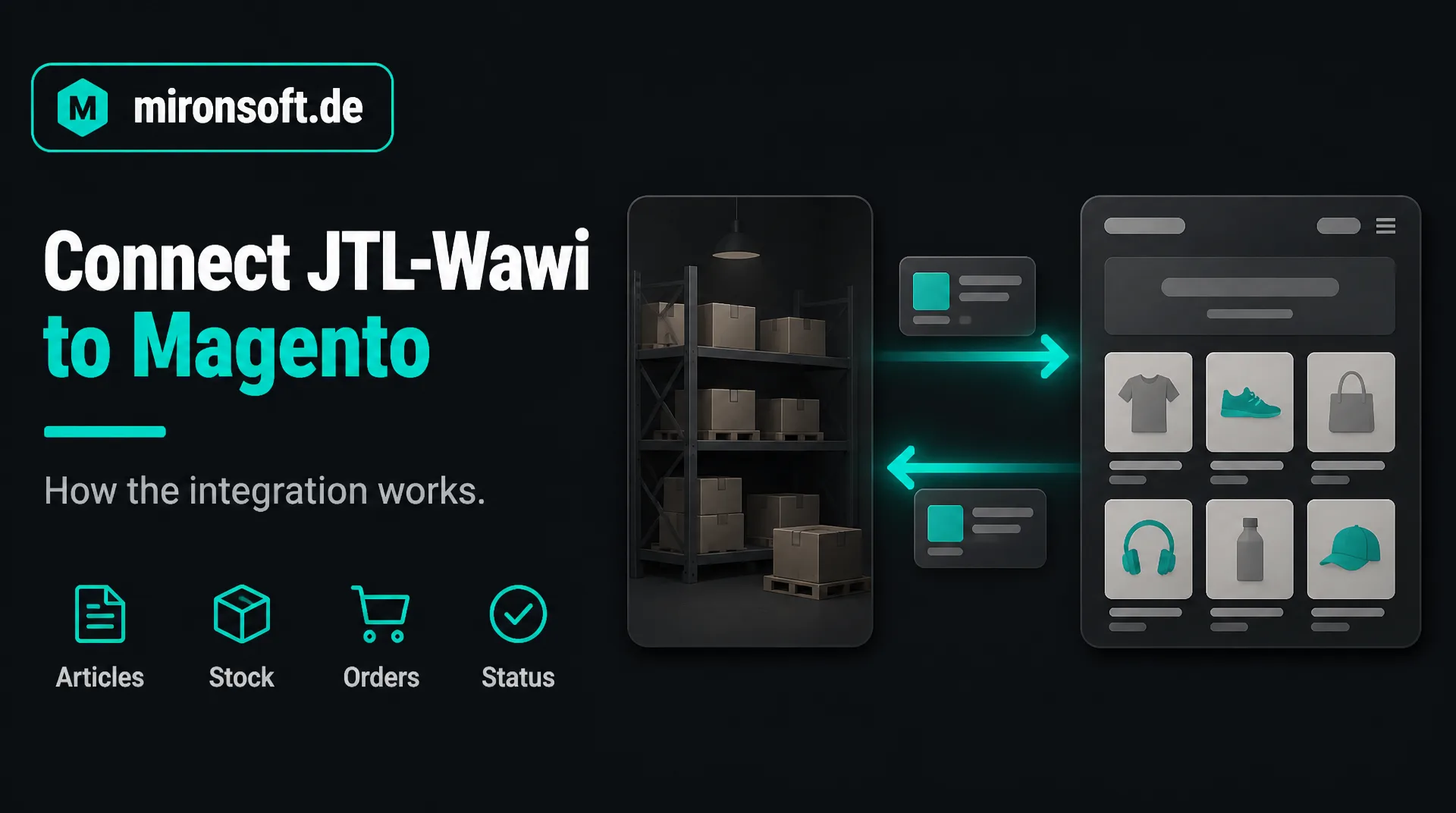
How the integration with your merchandise management works
Whoever works with JTL-Wawi in online retail and wants to build a Magento shop does not want to maintain articles, stock and orders twice. This guide explains how you connect JTL-Wawi to Magento, which ways exist and what determines the effort.
Table of contents
- 1. What it means to connect JTL-Wawi to Magento
- 2. Which data flows between shop and JTL-Wawi
- 3. The ways to connect JTL-Wawi to Magento
- 4. Typical pitfalls when you connect JTL-Wawi to Magento
- 5. Ready-made product or individual development: how you decide
- 6. The process when you connect JTL-Wawi to Magento
- 7. Effort and costs when you connect JTL-Wawi to Magento
- 8. How we support you with the integration
- 9. Summary
- 10. FAQ
1. What it means to connect JTL-Wawi to Magento
JTL-Wawi is a merchandise management system that manages article master, warehouses, orders, shipping and invoices and is widespread in online retail. When you connect JTL-Wawi to Magento, the shop becomes a further sales channel of the Wawi: articles, prices and stock go from there into the shop, orders and new customers go from the shop into the Wawi.
The benefit shows in daily work. Your employees keep working in the familiar Wawi, orders do not have to be retyped, and the stock in the shop matches that in the warehouse. This is especially valuable if you also sell through marketplaces and the stock must stay consistent across all channels.
This guide is aimed at merchants and managing directors who use JTL-Wawi. A general overview of the technical ways is given by the guide to ERP integration, and we describe the service on our page Magento JTL-Wawi.
2. Which data flows between shop and JTL-Wawi
| Data | Leading system | Direction | Typical rhythm |
|---|---|---|---|
| Articles and variants | JTL-Wawi | Wawi to shop | regularly or on change |
| Prices | JTL-Wawi | Wawi to shop | regularly or on change |
| Stock | JTL-Wawi | Wawi to shop | often, depending on need |
| Orders | Shop | Shop to Wawi | immediately or at short intervals |
| New customers | depending on concept | Shop to Wawi | on creation |
| Shipping status and invoices | JTL-Wawi | Wawi to shop | on status change |
Before planning technically, you define which system leads for which data. Whatever can be changed in both systems leads to contradictions sooner or later. Therefore define exactly one leading system per type of data, and record the rule for the conflict case in writing.
Especially with variants, units and tax rates an assignment table that the department and the developers review together is worthwhile. The same terms do not always mean the same: a variant in the Wawi must correspond to exactly one product with options in the shop.
3. The ways to connect JTL-Wawi to Magento
There are essentially four ways for the connection. The first is the direct connection through the programming interface that JTL provides for the Wawi. According to the developer documentation of the vendor it is described according to the OpenAPI standard, and a shop is kept there as its own sales channel. JTL continues to develop this interface, so version and license terms should be checked before the project.
The second way is a file exchange, for example through the import and export tool of the Wawi. It is simple and robust but not in real time. The third way is a ready-made add-on product of a third-party vendor, the fourth an individual development. Which way fits depends on data volume, timeliness and your processes. You should avoid direct access to the database of the Wawi because it bypasses the rules of the software and can break on updates.
4. Typical pitfalls when you connect JTL-Wawi to Magento
Five points we always address
- ✓Variants: the structure in the Wawi does not fit Magento one to one.
- ✓Several sales channels: the stock is sold for marketplaces and shop at the same time.
- ✓Unclear data ownership: prices or texts are changed in both systems.
- ✓Missing monitoring: a failed transfer is noticed only after days.
- ✓Updates of the Wawi: after a version change the integration no longer works.
Most of these points can be avoided with planning and a log that makes errors visible. Whoever wants to connect JTL-Wawi to Magento should also demand that the integration withstands short outages of the Wawi: transfers are buffered and caught up later instead of being lost. An integration is ongoing operation, so care belongs from the start, ideally within a maintenance contract.
5. Ready-made product or individual development: how you decide
For the connection of JTL-Wawi and Magento there are products from third-party vendors. If one covers your requirements, it is often the more economical choice. Before buying, check how it is maintained, what happens on updates of Magento or the Wawi and how far it can be adapted.
An individual development pays off if your processes deviate from the standard: special price rules, several warehouses, bundles, own attributes or processes that a ready-made product does not know. It is more expensive at the start but fits exactly, and it needs someone who looks after it later. Before a decision talk to your provider about both ways, and have the costs over several years calculated for you.
6. The process when you connect JTL-Wawi to Magento
Anyone who wants to connect JTL-Wawi to Magento is best advised to proceed in four steps. First the inventory: which version of JTL-Wawi do you use, how is it operated, which access exists, which data flows are desired and which special cases are there? From this a short concept arises that also records which system leads for which data. Then the work is done on a test system, never first against live data.
In the third step you check with real examples whether everything is correct: articles, orders, special cases. In the fourth step the start is made step by step, first the simple data flows, then the others. In the first weeks you look at the log together, which shows every transfer and every error. After that the integration runs in operation, and an agreement on updates prevents it from failing at the next update.
7. Effort and costs when you connect JTL-Wawi to Magento
The effort depends on the number of data flows, the quality of the data in the Wawi, the special cases with prices, warehouses and customers and the desired timeliness. A data flow in one direction is built faster than a synchronization in both directions with conflict rules. Besides the development, include the running items: hosting, maintenance and, where applicable, licenses.
A flat figure would be unreliable. We estimate in writing after the inventory, the hourly rate is 30 euros net, see pricing. General hints on costs are in the guide Magento costs.
8. How we support you with the integration
We are a web agency in which fixed freelancers work together, all from home offices. We develop the integration project by project, according to your processes and with documented rules, and we do not sell a ready-made connector off the shelf. Source code and access stay with you. More about our approach is on the page Magento JTL-Wawi integration.
This guide gives general orientation. For a first conversation a short message through our contact page is enough. Please name your system, the version and the desired data flows, then we can assess the feasibility specifically.
9. Summary
Whoever wants to connect JTL-Wawi to Magento makes the shop a sales channel of the Wawi. Decisive are clear data ownership, the suitable technical way and planning for ongoing operation.
Connect JTL-Wawi to Magento at a glance
Clarify first
Wawi version, operation, access and desired data flows
Data ownership
Exactly one leading system per type of data
Ways
Programming interface, file exchange, ready-made product or individual development
Operation
Plan log, buffering on outages and care
Note: This article offers general orientation. The concrete feasibility depends on version, operation and configuration of your system.