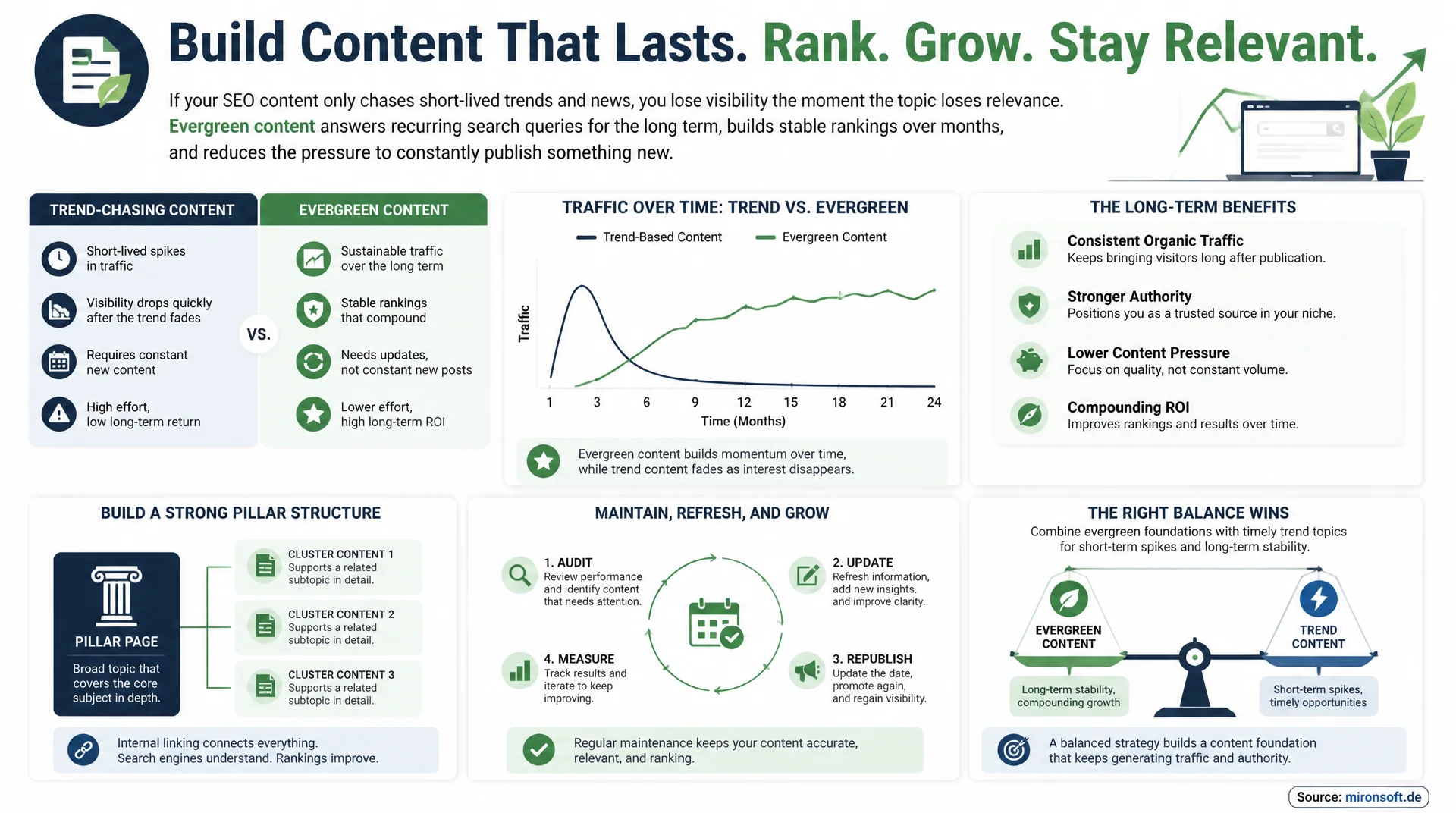
Content maintenance, pillar strategy, and topic selection for lasting visibility
If your SEO content only chases short-lived trends and news, you lose visibility the moment the topic loses relevance. Evergreen content answers recurring search queries for the long term, builds stable rankings over months, and reduces the pressure to constantly publish something new. With clear maintenance cycles, a well-thought-out pillar structure, and the right balance against timely trend topics, you build a content foundation that keeps generating traffic and authority.
Table of Contents
- 1. Why evergreen content determines sustainable rankings
- 2. What sets evergreen content apart from short-lived trend content
- 3. Identifying evergreen topic candidates in your own niche
- 4. Pillar content and topic clusters as a ranking foundation
- 5. Content maintenance: refresh cycles and audit triggers
- 6. Balancing evergreen and trend content in the editorial calendar
- 7. Technical implementation: freshness signals and redirects
- 8. Measuring success: decay tracking and content performance KPIs
- 9. Evergreen versus trend content compared side by side
- 10. Summary
- 11. FAQ
1. Why evergreen content determines sustainable rankings
Most content strategies in B2B and e-commerce are implicitly built around timeliness: a blog post gets published, drives traffic from Google for a few weeks, then loses relevance and sinks into obscurity. Evergreen content works on a different principle. It answers a search query that gets asked consistently, regardless of date, software version, or current trend, such as "What is a Magento 2 Full Page Cache" or "How does server-side rendering work". Content like this accumulates backlinks, internal links, and ranking signals over months and years, instead of spiking briefly and fading away.
The economic leverage is substantial: a single, well-maintained evergreen article can deliver more organic traffic over the years than ten trend articles combined, because the research and writing effort pays off once while the return keeps compounding. For agencies and software vendors in the Magento and Hyvä space, that means something very concrete: instead of writing a new article for every version update that goes stale within a few months, it pays off to invest in foundational, version-independent guides that get maintained regularly instead of rewritten from scratch.
2. What sets evergreen content apart from short-lived trend content
Evergreen content has three defining traits: the underlying search intent is stable and recurring, the content isn't tied to a date, a software version, or a news event, and it answers a fundamental "what is" or "how does it work" question instead of a topical one. An article like "What is Hyvä Theme" stays relevant for as long as Hyvä exists as a technology, regardless of which minor version happens to be current.
Trend content, by contrast, is tied to a specific event: a security update, a new Magento version, a Google algorithm change, or a conference announcement. An article like "Magento 2.4.8-p4 Security Update: What Store Owners Need to Know" generates high traffic in the short term through newsletters, social media, and date-relevant search queries, but almost completely loses that traffic within a few weeks once the next update ships.
The mistake in practice rarely lies in choosing to write trend content at all, but in treating both content types identically. Trend content needs a clear expiration date in the editorial calendar, evergreen content needs a maintenance cycle. Skip that distinction, and you either keep grooming outdated news posts far too long or let genuine evergreen guides decay from neglect.
3. Identifying evergreen topic candidates in your own niche
The most reliable method for identifying evergreen-worthy topics is recurring customer questions: which questions do customers ask over and over in discovery calls, support tickets, or proposal processes, regardless of the year? These questions are almost always evergreen, because they solve a fundamental understanding gap rather than commenting on a current event. Google Trends helps as a complement: topics with stable, non-seasonal search volume over several years are strong evergreen candidates, while topics with sharp, short spikes are typical trend candidates.
For a technical niche like Magento and Hyvä development, conceptual and definitional topics work especially well: What is Dependency Injection in Magento 2, How does the Full Page Cache work, or Core Web Vitals for Magento stores (our own existing article) stay relevant as long as the underlying architecture isn't fundamentally replaced. Version-specific release notes or deprecation warnings, on the other hand, clearly belong in the trend category.
<!-- Hyvä phtml: display a freshness badge for evergreen articles -->
<div class="flex items-center gap-2 text-xs text-slate-500 mb-6">
    <span>Last updated on {{$block->escapeHtml($block->getFormattedUpdateDate())}}</span>

    <?php if ($block->isReviewDue()): ?>
    <span class="bg-amber-100 text-amber-700 px-2 py-0.5 rounded-full font-semibold">
        Review due
    </span>
    <?php endif; ?>
</div>

<!-- dateModified in the Article schema for crawlers and rich snippets -->
<script type="application/ld+json">
{
    "@type": "Article",
    "headline": "{{$block->escapeHtml($block->getTitle())}}",
    "dateModified": "{{$block->getUpdatedAtIso8601()}}"
}
</script>
4. Pillar content and topic clusters as a ranking foundation
The pillar-cluster model structures evergreen content not as isolated single articles, but as a hub with spokes: a comprehensive pillar page fully covers a broad topic like "Magento 2 SEO", while specialized cluster articles such as Core Web Vitals, structured data, or evergreen content strategy itself go deeper into individual sub-topics and consistently link back to the pillar page. This internal linking structure signals topical authority to Google far more strongly than isolated single articles ever could.
In practice, that means: before writing a new article, it should be clear which pillar page it belongs to and which existing cluster articles it should link to. A content calendar with an explicit pillar_id per article prevents topics from being created in isolation and having internal linking bolted on painfully after the fact.
{
  "article_id": "evergreen-content-strategie",
  "content_type": "evergreen",
  "pillar_id": "magento-seo-pillar",
  "cluster_links": [
    "seo-core-web-vitals-fuer-magento-shops-optimieren",
    "seo-strukturierte-daten-magento"
  ],
  "review_cycle_days": 270,
  "last_reviewed": "2026-07-11",
  "decay_threshold_percent": 20
}
5. Content maintenance: refresh cycles and audit triggers
Evergreen doesn't mean "write once, rank forever". Screenshots go stale, code examples stop working after a major update, referenced tools get discontinued, and competitors publish more current, more comprehensive versions of the same topic. Without planned maintenance cycles, every evergreen article gradually loses relevance, an effect known in SEO practice as content decay.
A resilient maintenance process combines calendar-based and signal-based triggers. Calendar-based means: every pillar article gets a mandatory review every six to twelve months, regardless of performance. Signal-based means: a ranking drop in Search Console, a decline in organic clicks over several weeks, or an outdated version reference triggers an immediate review instead of waiting for the next scheduled date.
// Evergreen content audit: flag articles by age and performance decay
async function auditEvergreenContent(articles, searchConsoleClient) {
  const now = Date.now();
  const results = [];

  for (const article of articles) {
    const daysSinceReview = (now - new Date(article.lastReviewed)) / 86400000;
    const clicks = await searchConsoleClient.getClicks(article.url, { days: 90 });
    const previousClicks = await searchConsoleClient.getClicks(article.url, { days: 90, offset: 90 });
    const decayRate = previousClicks > 0
      ? ((previousClicks - clicks) / previousClicks) * 100
      : 0;

    // Flag for review: overdue calendar cycle OR significant traffic decay
    if (daysSinceReview > article.reviewCycleDays || decayRate > article.decayThresholdPercent) {
      results.push({ url: article.url, daysSinceReview, decayRate: decayRate.toFixed(1) });
    }
  }

  return results;
}
6. Balancing evergreen and trend content in the editorial calendar
A pure evergreen strategy looks static to Google: without new, current content, perceived crawling interest drops, and the domain loses signals of topical activity. A pure trend strategy, on the other hand, produces short-term traffic spikes without a sustainable foundation. In practice, a ratio of roughly 70 percent evergreen to 30 percent trend content in the editorial calendar has proven effective, with trend content deliberately used as a testing ground for new keywords and as a short-term traffic channel.
The real value emerges when both content types are woven together: insights from a well-performing trend article, say a new performance pattern discovered around a Magento update, get folded into the relevant pillar page once the trend fades. The original trend article is then consolidated into the pillar page via a 301 redirect, instead of being left behind as dead content.
/* Freshness badge for actively maintained evergreen articles */
.freshness-badge {
  display: inline-flex;
  align-items: center;
  gap: 0.375rem;
  padding: 0.125rem 0.625rem;
  border-radius: 9999px;
  font-size: 0.75rem;
  font-weight: 600;
  background-color: #dcfce7;
  color: #15803d;
}

/* Warning banner for content with a review due */
.stale-content-banner {
  background-color: #fef3c7;
  border: 1px solid #fbbf24;
  border-radius: 0.5rem;
  padding: 0.75rem 1rem;
  font-size: 0.875rem;
  color: #92400e;
}

/* Trend article flagged for consolidation */
.trend-expiring {
  border-left: 3px solid #dc2626;
  padding-left: 0.75rem;
}
7. Technical implementation: freshness signals and redirects
For Google and users to recognize that an evergreen article is actively maintained, visible and structured freshness signals are essential: a user-visible "last updated on" date, a dateModified field in the Article schema, and a current lastmod in the XML sitemap, so crawlers prioritize revisiting the page. Simply changing the publish date without any substantive content update is now reliably detected by Google and works against you instead of for you.
When a trend article is consolidated into a pillar page, the old URL must point to the new target via a 301 redirect to avoid losing backlinks and existing ranking signals. Only genuinely obsolete content with no link value should instead be set to noindex or removed entirely, since unnecessary redirect chains become technical debt of their own.
<!-- Magento url_rewrite: redirect a trend article to the pillar page after consolidation -->
<url_rewrite>
    <request_path>blog/magento-2-4-8-p4-sicherheitsupdate</request_path>
    <target_path>blog/seo-evergreen-content-strategie</target_path>
    <redirect_type>301</redirect_type>
    <!-- Transfer backlinks and existing ranking signals to the pillar page -->
    <description>Consolidation: trend article merged into the pillar cluster</description>
</url_rewrite>
8. Measuring success: decay tracking and content performance KPIs
Pageviews alone say little about whether an evergreen article still works. More telling is the average ranking position per URL over time in Google Search Console, along with the decay rate: the percentage drop in organic clicks over a rolling 90-day window compared to the prior period. A drop of more than 20 percent with no identifiable seasonal cause is a reliable signal that maintenance is needed.
Quarterly content audits that evaluate evergreen and trend articles separately reliably show where further investment pays off and where content should be consolidated or retired. The Search Console API can be exported directly into a spreadsheet or dashboard, so decay trends surface automatically instead of requiring manual click-through analysis.
9. Evergreen versus trend content compared side by side
Evergreen and trend content differ across nearly every strategic dimension, from search intent to the maintenance effort required. The table below summarizes the most important differences.
| Criterion | Evergreen content | Trend content | Recommendation |
|---|---|---|---|
| Search intent | stable, recurring | event-driven, short-lived | Plan the pillar first |
| Half-life | months to years | days to weeks | Schedule trends deliberately |
| Maintenance effort | cyclical, plannable | one-off, then expires | Redirect after the fade |
| Traffic pattern | slow growth, stable | sharp peak, fast drop | Track KPIs separately |
| Link-building potential | high, continuous | narrow window | Secure backlinks before consolidating |
In practice, both content types complement each other: trend content delivers short-term visibility and test data for new keywords, while evergreen content forms the stable traffic foundation. Consistently folding trend insights into pillar pages, instead of letting them decay, gets the maximum long-term value out of both content types.
Mironsoft
SEO content strategy, pillar structure, and content maintenance for sustainable rankings
Ready to build a professional evergreen content strategy?
We identify evergreen-worthy topics in your niche, build a pillar-cluster structure, and set up plannable refresh cycles, so your most important content keeps ranking instead of fading after a few weeks.
Content audit & topic analysis
Evaluate existing content for evergreen potential and decay rate
Pillar-cluster structure
Build topic hubs and internal linking for topical authority
Editorial calendar & refresh cycles
Establish calendar- and signal-based refresh processes for good
10. Summary
An evergreen content strategy solves a recurring problem in content marketing: content that's published once loses visibility after a few weeks, even though the underlying user question hasn't changed at all. Identifying evergreen-worthy topics through recurring customer questions and stable search intent, organizing them in a pillar-cluster structure, and consistently linking back to the pillar page builds topical authority over months and years, instead of starting from zero with every new trend.
The decisive difference between content that fades and content that keeps ranking rarely lies in the original article itself, but in the consistent maintenance that follows: calendar-based reviews every six to twelve months, signal-based triggers from Search Console, and a clear redirect strategy for expiring trend content. A balanced ratio of evergreen to trend content in the editorial calendar further ensures that short-term visibility and long-term stability reinforce each other instead of competing.
Evergreen Content Strategy - The Essentials at a Glance
Evergreen vs. trend
Recognize stable search intent without date or version dependency, and separate it clearly from news content.
Pillar-cluster model
Pillar page as the hub, cluster articles consistently link back to build topical authority.
Refresh cycles
Calendar-based reviews every 6-12 months combined with signal-based triggers from Search Console.
Decay tracking
Monitor ranking position and click decline per URL, consolidate in time instead of letting it fade.