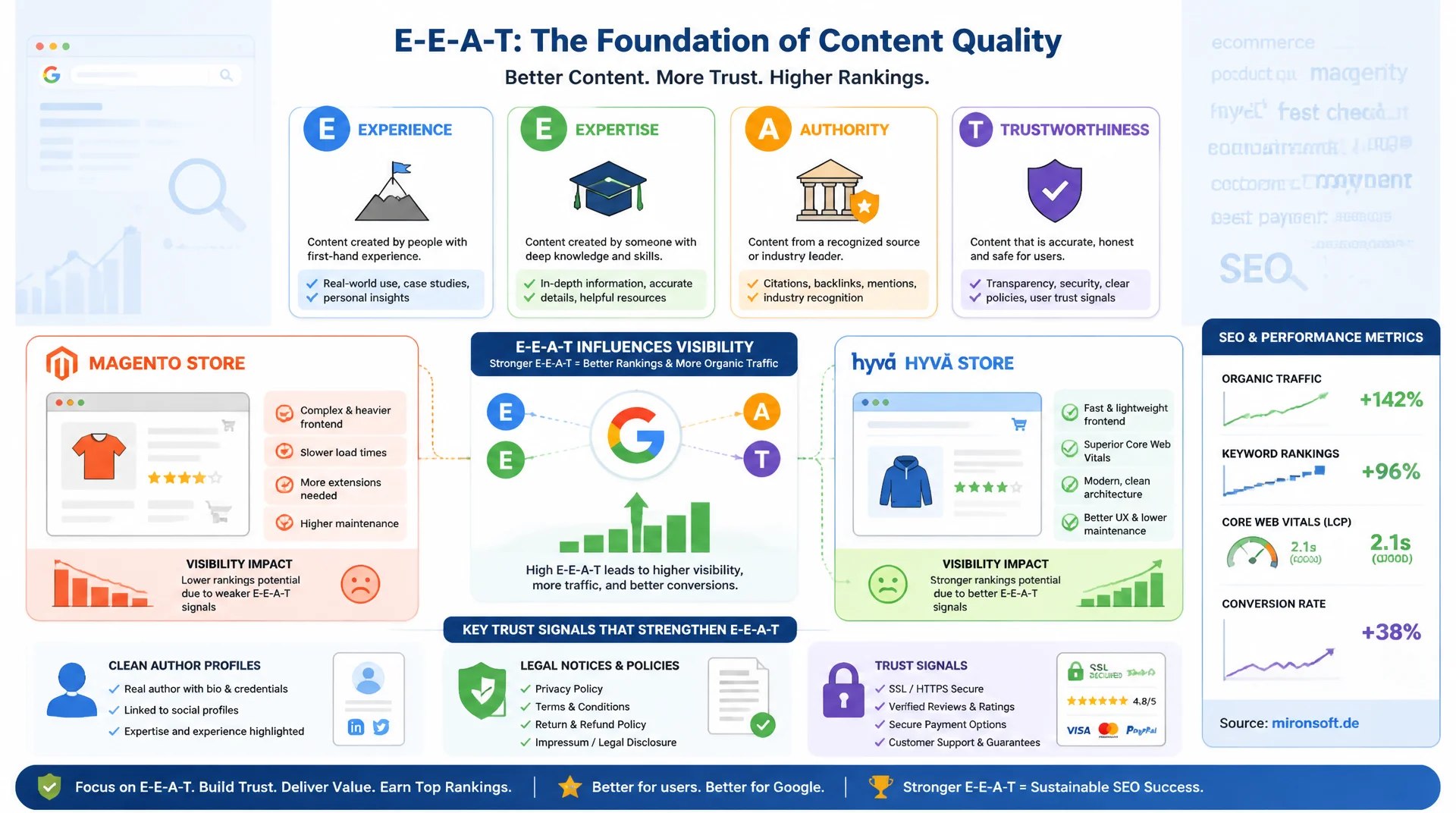
Experience, Expertise, Authoritativeness, Trustworthiness for e-commerce
E-E-A-T describes how Google assesses content quality based on experience, expertise, authority, and trustworthiness. For Magento and Hyvä stores this framework indirectly shapes visibility, because it informs the quality rater guidelines and correlates with ranking signals such as reviews, backlinks, and user behavior. Implementing clean author profiles, legal notices, and trust signals strengthens your position in organic search.
Table of Contents
- 1. The E-E-A-T framework: Experience, Expertise, Authoritativeness, Trustworthiness
- 2. Experience: why the newest "E" demands genuine first-hand experience
- 3. Expertise and Authoritativeness: author bios and topical authority
- 4. Trustworthiness as the most important component of the framework
- 5. YMYL content: why certain topics face extra scrutiny
- 6. How e-commerce stores make trust signals concretely visible
- 7. E-E-A-T is not a direct ranking factor, but works indirectly
- 8. Practical implementation for Magento and Hyvä stores
- 9. Common mistakes in E-E-A-T implementation
- 10. Summary
- 11. FAQ
1. The E-E-A-T framework: Experience, Expertise, Authoritativeness, Trustworthiness
E-E-A-T stands for Experience, Expertise, Authoritativeness, and Trustworthiness, and originates from Google's Search Quality Rater Guidelines, an internal manual for the human quality raters who spot-check search results against quality standards. Until 2022 the concept consisted of only three letters, E-A-T; with the December 2022 update, Experience was added as a fourth dimension to explicitly express that demonstrable, hands-on experience with a topic or product is its own distinct quality signal, independent of formal subject-matter expertise.
An important nuance: the guidelines are not a direct ranking algorithm, but an evaluation manual for human raters, whose judgments feed in aggregated form into the training and validation of the search algorithms. For Magento stores this means E-E-A-T should not be implemented as a single technical signal, but as a bundle of measures that increase trust and credibility with real users, and indirectly with Google: transparent authorship, demonstrable subject-matter knowledge, traceable reputation, and a secure, honest overall presence.
2. Experience: why the newest "E" demands genuine first-hand experience
The Experience criterion evaluates whether a piece of content was created out of demonstrable, first-hand experience, for example a product test where the author actually used the product, or a report drawn from the company's own day-to-day operations. This is fundamentally different from Expertise, which measures formal or acquired subject-matter knowledge: a surgeon has medical expertise without ever having been a patient; a patient has experience with a treatment without possessing medical expertise. Both signals are valuable, but they answer different user questions.
For e-commerce content, this means concretely: product descriptions that visibly draw on the author's own testing, photos from actual use, or specific usage scenarios come across as more credible than generic manufacturer copy. Google raters explicitly look at whether an article convincingly conveys "I tested X myself" or whether the text is clearly a summary of secondhand knowledge without any hands-on use. Original product photos, video reviews, and concrete detail observations are the strongest experience signals a Magento store can editorially produce.
3. Expertise and Authoritativeness: author bios and topical authority
Expertise measures the demonstrable subject-matter knowledge of the author or organization on a topic, while Authoritativeness measures whether others, particularly industry experts and other websites, recognize that competence. The most important technical lever for this is a consistent byline with a recognizable author name, a linked author profile, and clearly stated qualifications, instead of an anonymous or generic "editorial team" attribution. A complete author profile with education, professional experience, social media profiles, and other published articles lets both users and quality raters gauge the credibility of a claim.
Topical authority does not come from a single article, but from consistent, in-depth coverage of a topic cluster over time, combined with external signals such as backlinks from established industry sites, mentions in trade press, or citations from other authorities. Person schema markup with linked sameAs references to LinkedIn, Xing, or industry directory profiles makes this authority machine-readable for search engines and additionally supports knowledge graph connections.
<!-- Author byline pattern with linked author profile and credentials -->
<div class="flex items-center gap-3 not-prose" itemscope itemtype="https://schema.org/Person">
    <img src="/media/authors/jane-doe.jpg" alt="Jane Doe" width="48" height="48" class="rounded-full" itemprop="image">
    <div>
        <a href="/authors/jane-doe" itemprop="url">
            <span itemprop="name" class="font-semibold text-slate-800">Jane Doe</span>
        </a>
        <p class="text-xs text-slate-500" itemprop="jobTitle">E-Commerce SEO Consultant, 8 years of experience with Magento stores</p>
    </div>
</div>
{
  "@context": "https://schema.org",
  "@type": "Person",
  "name": "Jane Doe",
  "url": "https://mironsoft.de/authors/jane-doe",
  "jobTitle": "E-Commerce SEO Consultant",
  "worksFor": { "@type": "Organization", "name": "Mironsoft", "url": "https://mironsoft.de" },
  "sameAs": [
    "https://www.linkedin.com/in/janedoe",
    "https://www.xing.com/profile/Jane_Doe"
  ],
  "knowsAbout": ["Magento 2", "Technical SEO", "Core Web Vitals"]
}
4. Trustworthiness as the most important component of the framework
Google itself emphasizes in the Quality Rater Guidelines that Trustworthiness is the central element of the entire framework: content can radiate plenty of experience, expertise, and authority, but if it is not trustworthy, it loses its value to the user. Trustworthiness is made up of several technical and editorial factors: factual accuracy of the content, transparency about authorship and business purpose, secure technical infrastructure, and honest handling of reviews, prices, and availability.
For a Magento store this means concretely: a correctly configured SSL certificate with no mixed-content warnings, clearly reachable contact options, a complete legal notice that meets local disclosure requirements, and pricing that matches the actual checkout amount exactly. The absence of negative trust signals matters too: aggressive pop-ups, misleading discount countdowns, or hidden shipping costs damage perceived trustworthiness even if everything is technically implemented correctly. Trustworthiness is therefore less a single measure than a consistent stance that runs through design, copy, and technical implementation alike.
5. YMYL content: why certain topics face extra scrutiny
YMYL stands for "Your Money or Your Life" and refers to topic areas where false or misleading information could cause the user significant financial, health-related, or safety-related harm, such as financial advice, medical content, legal topics, or safety-relevant purchase decisions. Google applies noticeably stricter E-E-A-T standards to YMYL pages than to low-stakes topics like hobby blogs, because the potential for harm from incorrect information is disproportionately higher.
YMYL is more relevant to e-commerce than many store operators assume: product categories such as dietary supplements, baby products, electrical devices with safety implications, financial services, or even cosmetics with health-related marketing claims all fall under YMYL. Concretely, this means: product descriptions with medical or safety-related claims need solid sources, clear labeling of marketing claims versus facts, and ideally an expert review by qualified people whose qualifications are transparently disclosed. Unsubstantiated healing claims or exaggerated safety claims are a particularly high risk in YMYL contexts, both for visibility and for legal exposure.
6. How e-commerce stores make trust signals concretely visible
Verified reviews are the strongest visible trust signal in e-commerce, provided they demonstrably come from real buyers, for instance through a link to order history, and are structurally marked up via AggregateRating and Review schema. Equally important are clearly worded, easy-to-find policies on returns, shipping, and privacy: users and quality raters rate a page as more trustworthy when this information is not buried in pages-long terms and conditions, but presented on its own, understandable pages with clear deadlines and processes.
A secure checkout with visible payment icons, a valid SSL certificate, and established payment providers such as PayPal or Klarna reduces cart abandonment while simultaneously signaling technical credibility. Contact transparency rounds out the picture: a complete legal notice, a real physical business address, a reachable phone number, and multiple support channels such as live chat or email set an established retailer apart from anonymous dropshipping sites, which make both users and Google equally skeptical.
{
  "@context": "https://schema.org",
  "@type": "Product",
  "name": "Sample Product",
  "aggregateRating": {
    "@type": "AggregateRating",
    "ratingValue": "4.8",
    "reviewCount": "342",
    "bestRating": "5"
  },
  "review": [
    {
      "@type": "Review",
      "reviewRating": { "@type": "Rating", "ratingValue": "5", "bestRating": "5" },
      "author": { "@type": "Person", "name": "Verified Buyer" },
      "reviewBody": "Fast delivery, product matches the description exactly.",
      "datePublished": "2026-06-14"
    }
  ]
}
7. E-E-A-T is not a direct ranking factor, but works indirectly
Google has repeatedly clarified that there is no single, measurable "E-E-A-T signal" in the ranking algorithm. Instead, the Quality Rater Guidelines feed into the training and validation of ranking systems such as the helpful content systems: raters score search results against E-E-A-T criteria, and these scores serve as training data and a quality benchmark against which algorithm updates are tested before they go live. E-E-A-T therefore works indirectly, but systematically, on ranking quality.
In practice, strong E-E-A-T correlates with signals that actually and measurably feed into ranking: pages with high perceived trustworthiness attract more natural backlinks from reputable sources, lower bounce rates, longer dwell time, and more direct brand searches, all signals that Google interprets as user satisfaction. A store that treats E-E-A-T as a pure checklist exercise without real value for users misses the actual lever: trust generates measurable user behavior, and that behavior is what affects ranking, not the schema markup by itself.
8. Practical implementation for Magento and Hyvä stores
The technical foundation for E-E-A-T in Magento stores is structured markup: Organization or LocalBusiness schema with complete legal-notice-relevant fields such as address, telephone, and vatID on every page, combined with Person schema for authors on blog and guide content. A dedicated trust page structure with linked subpages for About Us, legal notice, shipping, returns, and privacy, each with its own substantial content instead of boilerplate text, helps both users and quality raters make sense of the store.
A Hyvä ViewModel can deliver author and review data to the template cleanly separated from presentation logic, rather than hardcoding trust information directly into the phtml template. This keeps schema data centrally maintainable and lets it be populated consistently from the database via repositories, instead of being duplicated across multiple templates.
{
  "@context": "https://schema.org",
  "@type": "Organization",
  "name": "Mironsoft",
  "url": "https://mironsoft.de",
  "logo": "https://mironsoft.de/media/logo/mironsoft-logo.png",
  "address": {
    "@type": "PostalAddress",
    "streetAddress": "Musterstrasse 1",
    "postalCode": "10115",
    "addressLocality": "Berlin",
    "addressCountry": "DE"
  },
  "telephone": "+49-30-12345678",
  "vatID": "DE123456789",
  "sameAs": [
    "https://www.linkedin.com/company/mironsoft",
    "https://www.xing.com/companies/mironsoft"
  ]
}
<?php

declare(strict_types=1);

namespace Mironsoft\TrustSignals\ViewModel;

use Magento\Framework\View\Element\Block\ArgumentInterface;
use Magento\Review\Model\ResourceModel\Review\CollectionFactory as ReviewCollectionFactory;

/**
 * Exposes author and review trust data to templates without coupling
 * presentation logic to persistence details.
 */
final class TrustSignals implements ArgumentInterface
{
    /**
     * @param ReviewCollectionFactory $reviewCollectionFactory Factory for the review collection.
     */
    public function __construct(
        private readonly ReviewCollectionFactory $reviewCollectionFactory
    ) {
    }

    /**
     * Returns the aggregate rating value for a given product.
     *
     * @param int $productId Product entity id.
     * @return float Average rating between 0 and 5.
     */
    public function getAggregateRating(int $productId): float
    {
        $collection = $this->reviewCollectionFactory->create();
        $collection->addFieldToFilter('entity_pk_value', ['eq' => $productId]);

        $ratingSum = 0.0;
        $count = 0;
        foreach ($collection as $review) {
            $ratingSum += (float) $review->getRatingSummary();
            $count++;
        }

        return $count > 0 ? round($ratingSum / $count, 1) : 0.0;
    }

    /**
     * Returns the total number of verified reviews for a given product.
     *
     * @param int $productId Product entity id.
     * @return int Number of reviews.
     */
    public function getReviewCount(int $productId): int
    {
        $collection = $this->reviewCollectionFactory->create();
        $collection->addFieldToFilter('entity_pk_value', ['eq' => $productId]);

        return $collection->getSize();
    }
}
9. Common mistakes in E-E-A-T implementation
The most common mistake is anonymous or pseudonymous content with no identifiable author: articles attributed only to an "editorial team" or with no author attribution at all give neither users nor quality raters any basis for judging credibility. Almost as common is a missing, hard-to-find, or outdated legal notice, which for European stores represents both a direct legal problem and an indirect trust problem. Fake or purchased reviews are another risk: they violate disclosure requirements and, once discovered, are treated by Google as an active trust penalty, not neutrally ignored.
Thin "About Us" pages with no real substance, lacking team photos, a concrete company history, or verifiable facts, waste one of the most effective opportunities to build authoritativeness. Equally underestimated is inconsistency between different author profiles and external platforms: if the author named in a blog post cannot be found on LinkedIn, or the stated qualification cannot be verified, the profile reads as fabricated rather than authentic, undermining exactly the trust it was meant to build.
The table below summarizes the four E-E-A-T components plus YMYL handling, showing a weak and a strong signal example for each along with the recommended fix.
| E-E-A-T element | Weak signal | Strong signal | Recommended fix |
|---|---|---|---|
| Experience | Generic manufacturer copy, no own test | Original product photos and test report | Document editorial hands-on tests |
| Expertise | Anonymous "editorial team" as author | Named author with stated qualification | Add a byline and author profile |
| Authoritativeness | No external mentions or links | Backlinks from industry sites, citations | Build digital PR and topical authorship |
| Trustworthiness | Missing or outdated legal notice | Complete legal notice, SSL, clear pricing | Audit legal notice and checkout security |
| YMYL handling | Unsubstantiated healing claims | Solid sources, expert review | Back claims with sources and a review process |
In practice, these five elements reinforce one another: a credible author with demonstrable expertise automatically appears more trustworthy, and a trustworthy store with genuine reviews in turn makes it easier to build authoritativeness through natural linking. Using the table as a checklist against your own content inventory usually surfaces the biggest gaps quickly.
Mironsoft
E-E-A-T, trust signals, and schema markup for Magento stores
Ready to embed E-E-A-T properly in your store?
We analyze the authorship, trust signals, and structured data of your Magento store, identify concrete gaps, and implement targeted measures, from author schema to a complete trust page structure.
E-E-A-T audit
Analysis of authorship, trust pages, and YMYL risks
Trust signal optimization
Strengthening reviews, policies, and contact transparency
Schema markup implementation
Person, Organization, and Review schema for Magento/Hyvä
10. Summary
The E-E-A-T framework of Experience, Expertise, Authoritativeness, and Trustworthiness is not a single measurable ranking signal, but the evaluation basis of the Google Quality Rater Guidelines, which shapes the training and validation of the search algorithms. For Magento and Hyvä stores, E-E-A-T still pays off, because strong trust correlates with measurable signals such as backlinks, lower bounce rates, and more direct brand searches. Google scrutinizes credibility more strictly for YMYL content with financial or health implications in particular, which makes clear authorship and demonstrated subject-matter competence essential.
The most effective levers are concretely implementable: complete author profiles with Person schema, an up-to-date legal notice with Organization or LocalBusiness schema, verified reviews marked up with AggregateRating, and a consistent trust page structure for shipping, returns, and privacy. Maintaining these building blocks cleanly through ViewModels and repositories, rather than hardcoding them into templates, builds trust that both users and Google reward.
E-E-A-T for Magento Stores - The Essentials at a Glance
Experience & Expertise
Original product tests and Person schema with a complete author profile instead of an anonymous editorial team.
Authoritativeness
Backlinks from industry sites, sameAs links, and consistent external author profiles.
Trustworthiness
Complete legal notice, SSL, transparent pricing, and honest reviews.
YMYL & implementation
Solid sources for sensitive claims, Organization and Review schema in Magento/Hyvä.