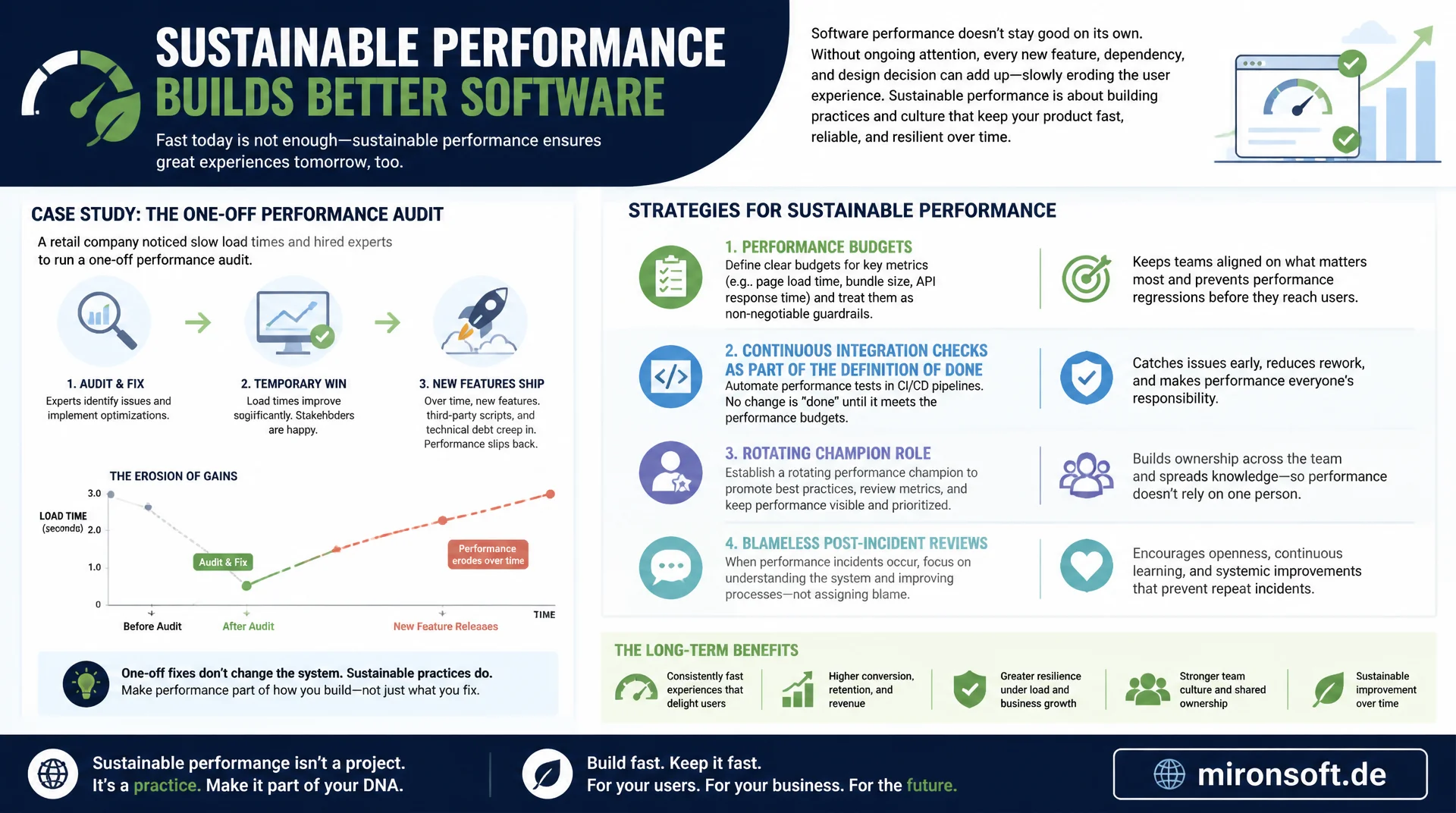
how continuous practices make performance gains stick
A one-off performance audit improves metrics for a few weeks, then every gain erodes under the pressure of new features. This article shows how teams combine performance budgets, CI checks in the Definition of Done, a rotating champion role and blameless post-incident reviews to keep load times stable for good instead of rescuing them every few months.
Table of Contents
- 1. Why Performance Regresses Without a Culture
- 2. Defining Performance Budgets
- 3. Embedding Performance Checks into the Definition of Done
- 4. The Rotating Performance Champion Role
- 5. Making Wins Visible: Dashboards, Changelogs, Retros
- 6. Blameless Post-Incident Reviews for Regressions
- 7. Continuous Monitoring Instead of One-Off Audits
- 8. Tooling That Supports the Culture
- 9. Rollout Playbook for an Existing Team
- 10. Summary
- 11. FAQ
1. Why Performance Regresses Without a Culture
A performance audit hands over impressive numbers on delivery day: LCP drops from 4.2 to 2.1 seconds, the JavaScript bundle shrinks by 40 percent, TTFB falls below 400 milliseconds. Two or three sprints later, many of those numbers are back where they started, without anyone consciously "breaking" anything. The reason is structural: feature work has its own deadlines, performance has none unless somebody keeps asking about it.
Every new feature tends to bring more code, more dependencies, more network requests with it. One extra tracking snippet here, one new npm dependency for a widget there, one synchronously loaded third-party script for the next marketing campaign. Each individual change looks harmless, but together they fully erode the audit's result. Without recurring verification mechanisms, the team only notices the regression once customers complain or conversion rate visibly drops.
The way out is not another one-off effort, it is a shift in ownership: performance needs to become as routine to daily development as code formatting or tests. The following eight practices show how that works concretely in a Magento and Hyva team, without turning a single person into a bottleneck.
2. Defining Performance Budgets
A performance budget is a hard, measurable ceiling on a metric that blocks the build or the pull request merge when it is exceeded. Without a number, "keeping an eye on performance" stays a vague intention that loses against concrete feature deadlines in the daily sprint grind. Typical budgets for a Hyva shop: JavaScript bundle under 180 KB compressed, LCP under 2.5 seconds on the product detail page, TTFB under 600 milliseconds for the full page cache, Cumulative Layout Shift under 0.1.
Budgets need to be defined per page type and per asset class, not as one global number for the whole store. A category page with a hundred product cards has different thresholds than a lean CMS landing page. It also has to be clear who is allowed to change a given budget: a budget that any developer can loosen whenever it's convenient stops being a budget and becomes a suggestion. Budget value changes belong in their own pull request, reviewed by the current performance champion.
Budgets should also be calibrated against real user data, not wishful numbers. If the CrUX report shows that 75 percent of mobile visitors are on mid-range devices over 4G, budgets should reflect that reality instead of being tuned to a high-end test device sitting on someone's desk.
3. Embedding Performance Checks into the Definition of Done
A budget without an enforcement mechanism decays into documentation nobody reads. The decisive step is anchoring performance checks as a fixed part of the Definition of Done, right next to criteria like "tests green" or "code review complete". In practice that means: a GitHub Actions workflow runs Lighthouse CI against a staging environment on every pull request and automatically checks the budgets defined in the previous section.
The workflow has to be registered as a required status check in the branch protection rules, so a merge is technically impossible while the check is red. That constraint is exactly what separates this from a voluntary audit: nobody can wave through a regression "because of time pressure", because the pipeline simply will not allow it. Exceptions should be rare and always explicitly documented, for example through a time-boxed label with an expiry date, never through a silently skipped check.
# .github/workflows/lighthouse-ci.yml
# Gate every pull request on a performance budget before merge is allowed
name: Lighthouse CI Performance Gate

on:
  pull_request:
    branches: [main]

jobs:
  lighthouse:
    runs-on: ubuntu-latest
    steps:
      - uses: actions/checkout@v4

      - name: Set up Node.js
        uses: actions/setup-node@v4
        with:
          node-version: '20'

      - name: Install dependencies
        run: npm ci

      - name: Build Hyva storefront assets
        run: npm run build --workspace=app/design/frontend/Mironsoft/default

      - name: Run Lighthouse CI against staging PLP/PDP
        run: npx @lhci/cli autorun --config=./lighthouserc.json
        env:
          LHCI_GITHUB_APP_TOKEN: ${{ secrets.LHCI_GITHUB_APP_TOKEN }}

      # lighthouserc.json defines the budget assertions (see next example).
      # A failing assertion sets a non-zero exit code, which fails this job
      # and blocks the merge via required-status-checks branch protection.
{
  "ci": {
    "collect": {
      "url": [
        "https://staging.mironsoft.de/",
        "https://staging.mironsoft.de/catalog/product/view/id/1234"
      ],
      "numberOfRuns": 3
    },
    "assert": {
      "assertions": {
        "largest-contentful-paint": ["error", { "maxNumericValue": 2500 }],
        "total-blocking-time": ["error", { "maxNumericValue": 200 }],
        "cumulative-layout-shift": ["error", { "maxNumericValue": 0.1 }],
        "server-response-time": ["error", { "maxNumericValue": 600 }],
        "resource-summary:script:size": ["error", { "maxNumericValue": 180000 }]
      }
    },
    "upload": {
      "target": "temporary-public-storage"
    }
  }
}
4. The Rotating Performance Champion Role
A single permanent performance owner almost inevitably becomes a bottleneck: every question lands with one person, knowledge stays concentrated there, and when that person is on vacation or sick, performance topics stall. A permanent solo role also reinforces the wrong message, that performance is a specialist's job rather than the whole team's responsibility. The rotating performance champion model solves both problems at once.
Concretely, each team member takes on the role for two to four weeks: checking budget violations in CI, reviewing RUM dashboards weekly, taking review ownership on performance-relevant pull requests, and reporting noteworthy trends briefly in standup when needed. The rotation ensures that after twelve months, every team member has repeatedly worked closely with the tools and mindset of performance work, instead of that knowledge staying with a single individual.
For the handover to work, every rotation needs a short, documented transition: open regressions, ongoing experiments, current budget values and their rationale. A simple wiki template with five bullet points is enough, as long as it is actually kept up to date at every handover.
5. Making Wins Visible: Dashboards, Changelogs, Retros
Performance work that nobody sees will lose against visible feature work in the next prioritization round. A RUM dashboard with LCP and INP trend lines from the last twelve weeks, pinned publicly in the team's Slack channel, makes progress tangible even for product owners and stakeholders without a technical background. The trend line matters, not the momentary value: a single good measurement convinces nobody, a steadily falling curve over several months does.
A dedicated "Performance" section in the technical changelog, next to feature and bugfix entries, signals that this work carries the same weight as visible changes. Sentences like "reduced LCP on the category page from 3.1s to 2.3s by preloading the hero image" are concrete, verifiable, and can be celebrated as a win in the next sprint retro. These small, recurring mentions build more long-term momentum than a single blog post about one big performance project.
Inside the retro itself, a fixed question pays off: "what changed about performance this sprint, positive or negative?" That repetition anchors the topic in the team's ritual instead of turning it into a special-case discussion that only surfaces when something breaks.
6. Blameless Post-Incident Reviews for Regressions
When a regression reaches production despite budgets and CI checks, the team's reaction determines whether performance culture grows or gets choked off. A blameless post-incident review consistently asks "what process allowed this", never "who caused this". That distinction is not a formality: as soon as individuals are held responsible for mistakes, teams stop flagging problems openly, and regressions stay undetected longer because nobody volunteers to raise them.
The review documents a timeline from deploy to fix, the measurable impact, and above all concrete, actionable steps: was a budget assertion missing for third-party scripts, was a CI check accidentally marked optional, was there no alert threshold in the RUM system. Every action item becomes a ticket with an owner and a deadline for the next sprint, not a vague intention left sitting in a document. That turns every incident into a structural improvement instead of a repeated excuse.
# Post-Incident Review: Performance Regression
# Fill in within 48 hours of resolution. No blame, focus on systems and process.

## Summary
- What regressed: (e.g. LCP on PDP rose from 2.1s to 4.6s)
- When detected: (RUM alert / user report / weekly CWV report)
- Duration of impact: (from deploy to fix)

## Timeline
- HH:MM - Deploy shipped (PR #1234, feature X)
- HH:MM - RUM dashboard crossed alert threshold
- HH:MM - On-call performance champion paged
- HH:MM - Root cause identified: unbudgeted third-party script added without CI check
- HH:MM - Fix deployed, metrics confirmed recovered

## Root Cause
Describe the technical cause without naming individuals. Focus on what
allowed the regression to reach production (e.g. missing budget assertion
for third-party scripts, a Lighthouse CI job that was allowed to be skipped).

## What Went Well
- RUM alerting caught the regression within 20 minutes

## What Went Wrong
- The Lighthouse CI budget did not cover third-party script weight
- The PR was merged with a CI check marked "skipped" instead of blocking

## Action Items
- [ ] Add resource-summary:third-party:size assertion to lighthouserc.json
- [ ] Make Lighthouse CI a required status check, remove skip option
- [ ] Add this scenario to the performance champion onboarding checklist
7. Continuous Monitoring Instead of One-Off Audits
A Lighthouse report generated manually once a quarter is already a snapshot under lab conditions on the day it is created. Real users show up with a wide range of devices, networks and browser versions, and regressions between two audits stay completely invisible. Real User Monitoring (RUM) via the web-vitals library instead captures every real session and makes trends visible over weeks and months, not just a snapshot.
Synthetic monitoring complements RUM with controlled, repeatable measurements under constant conditions, ideal for comparing individual deploys against each other without noise from varying user devices. The combination of both gives a complete picture: RUM shows what users actually experience, synthetic monitoring pinpoints precisely which commit caused a regression. A weekly automated trend report that summarizes both data sources and posts to the team's Slack keeps the topic present without anyone having to actively open a dashboard.
The decisive cultural difference: an audit answers the question "how are things today", continuous monitoring answers the question "how is this trending over time". Only the second question lets a team catch regressions before customers report them.
#!/usr/bin/env bash
# weekly-cwv-report.sh - post a Core Web Vitals trend summary to Slack
set -euo pipefail

CRUX_API_KEY="${CRUX_API_KEY:?Missing CRUX_API_KEY}"
SLACK_WEBHOOK="${SLACK_WEBHOOK_URL:?Missing SLACK_WEBHOOK_URL}"
ORIGIN="https://mironsoft.de"

# Pull this week's field data from the CrUX History API
response="$(curl -s -X POST \
  "https://chromeuxreport.googleapis.com/v1/records:queryHistoryRecord?key=${CRUX_API_KEY}" \
  -H 'Content-Type: application/json' \
  -d "{\"origin\": \"${ORIGIN}\", \"metrics\": [\"largest_contentful_paint\", \"interaction_to_next_paint\"]}")"

lcp_p75="$(echo "$response" | jq -r '.record.metrics.largest_contentful_paint.percentilesTimeseries.p75s[-1]')"
inp_p75="$(echo "$response" | jq -r '.record.metrics.interaction_to_next_paint.percentilesTimeseries.p75s[-1]')"

# Compare against last week's stored baseline to detect a regression trend
baseline_file="./cwv-baseline.json"
prev_lcp="$(jq -r '.lcp_p75' "$baseline_file")"

status="stable"
if (( lcp_p75 > prev_lcp + 200 )); then
  status="regression detected"
fi

curl -s -X POST "$SLACK_WEBHOOK" \
  -H 'Content-Type: application/json' \
  -d "{\"text\": \"Weekly CWV report for ${ORIGIN}: LCP p75 = ${lcp_p75}ms, INP p75 = ${inp_p75}ms. Status: ${status}\"}"

echo "{\"lcp_p75\": ${lcp_p75}, \"inp_p75\": ${inp_p75}}" > "$baseline_file"
8. Tooling That Supports the Culture
Culture alone is not enough if the right tools are missing to enforce it consistently. Alongside Lighthouse CI for page-level metrics, a team needs a bundle analyzer that makes visible, on every build, which module contributes how much to the JavaScript weight. For Hyva shops built with Vite or Webpack, rollup-plugin-visualizer or webpack-bundle-analyzer produce a treemap view that immediately reveals when a new dependency takes up disproportionate space.
For hard limits at the file or bundle level, a dedicated tool like bundlesize or size-limit works well as its own CI step, forming a second, more granular checkpoint independent of Lighthouse. Combining both layers, page metrics via Lighthouse CI and bundle limits via bundlesize, covers both the user-facing perspective and the technical root cause in a single pull request, before the code is even merged.
{
  "scripts": {
    "build": "vite build",
    "test:bundlesize": "bundlesize"
  },
  "bundlesize": [
    {
      "path": "./pub/static/frontend/Mironsoft/default/**/js/checkout.min.js",
      "maxSize": "45 kB",
      "compression": "brotli"
    },
    {
      "path": "./pub/static/frontend/Mironsoft/default/**/js/catalog.min.js",
      "maxSize": "60 kB",
      "compression": "brotli"
    },
    {
      "path": "./pub/static/frontend/Mironsoft/default/**/css/styles.css",
      "maxSize": "35 kB",
      "compression": "brotli"
    }
  ]
}
9. Rollout Playbook for an Existing Team
A team that has worked without a performance culture so far should not try to introduce all eight practices at once. The proven starting point is a single, hard budget, for example LCP on the product detail page, measured through a simple Lighthouse CI run, initially only as an informational check without a merge block. Two to three sprints of observation show how often the threshold would actually be violated before it gets switched to blocking.
Only once this first check runs stably and is accepted does the champion rotation follow, then visibility through a dashboard, then the remaining budgets for bundle size and TTFB. This order prevents pushback: a team confronted with five new mandatory processes in a single day experiences performance culture as bureaucracy. A team that gradually gains control over an improving metric over eight to twelve weeks experiences it as a tool.
A realistic timeline: weeks 1 to 2 define the budget and introduce it as an informational check, weeks 3 to 4 activate the merge block, weeks 5 to 6 start the first champion rotation, weeks 7 to 8 set up the dashboard and changelog section, from week 9 onward run the first blameless reviews for regressions that occur and reflect on the process in the retro.
| Dimension | One-off audit | Continuous performance culture |
|---|---|---|
| Ownership | External auditor or a single individual | Rotating champion role across the whole team |
| Enforcement | Recommendations in a PDF report | Budgets as a required status check in CI |
| Detection speed | Only at the next audit, often months later | Within minutes via RUM alerts |
| Team morale | Performance as an external judgment, often frustrating | Performance as a shared, visible win |
| Handling regressions | Blame or no follow-up at all | Blameless post-incident review with action items |
| Durability of gains | Erodes within a few sprints | Stable, because it is structurally enforced |
The table makes clear that the difference is not the technical depth of the analysis, a good audit can be technically excellent, it is the mechanism that keeps results in place over time. Without enforcement in CI and without distributed ownership, even the best analysis fades away within a few months.
Mironsoft
Performance culture, CI integration and monitoring for Magento and Hyva teams
Make performance gains stick instead of fighting for them again?
We help your team integrate performance budgets into CI, introduce a rotating champion role, and set up Real User Monitoring so regressions get noticed before customers report them.
Budget Setup
Set up Lighthouse CI and bundle budgets as a required status check
Process Coaching
Establish champion rotation, Definition of Done and retro rituals
RUM & Monitoring
web-vitals tracking, dashboards and Slack alerts for regressions
10. Summary
A performance culture in the team solves a problem that a one-off audit structurally cannot solve: it keeps gains in place over time instead of letting them evaporate after the next feature sprint. The core lies in measurable budgets that block merge approval as a required status check, in a rotating champion role instead of a single owner, in visible communication through dashboards, changelogs and retros, and in blameless post-incident reviews that turn every regression into a structural improvement.
Continuous monitoring through RUM and synthetic testing replaces the snapshot view of a quarterly audit with an ongoing trend that catches regressions before customers feel them. Teams that introduce these eight practices gradually over eight to twelve weeks, instead of mandating them all in a single day, build a culture that still holds when feature pressure rises again.
Performance Culture in the Team - The Essentials at a Glance
Budgets in CI
Lighthouse CI and bundlesize as a required status check that technically blocks a merge, not just recommends one.
Rotating Champion
Two to four weeks per person instead of a permanent solo role. Spreads knowledge and prevents bottlenecks.
Visible Wins
Dashboards, changelog entries and a fixed retro question keep performance work visible against feature work.
Blameless Reviews & RUM
Post-incident reviews without blame, continuous RUM instead of point-in-time audits.