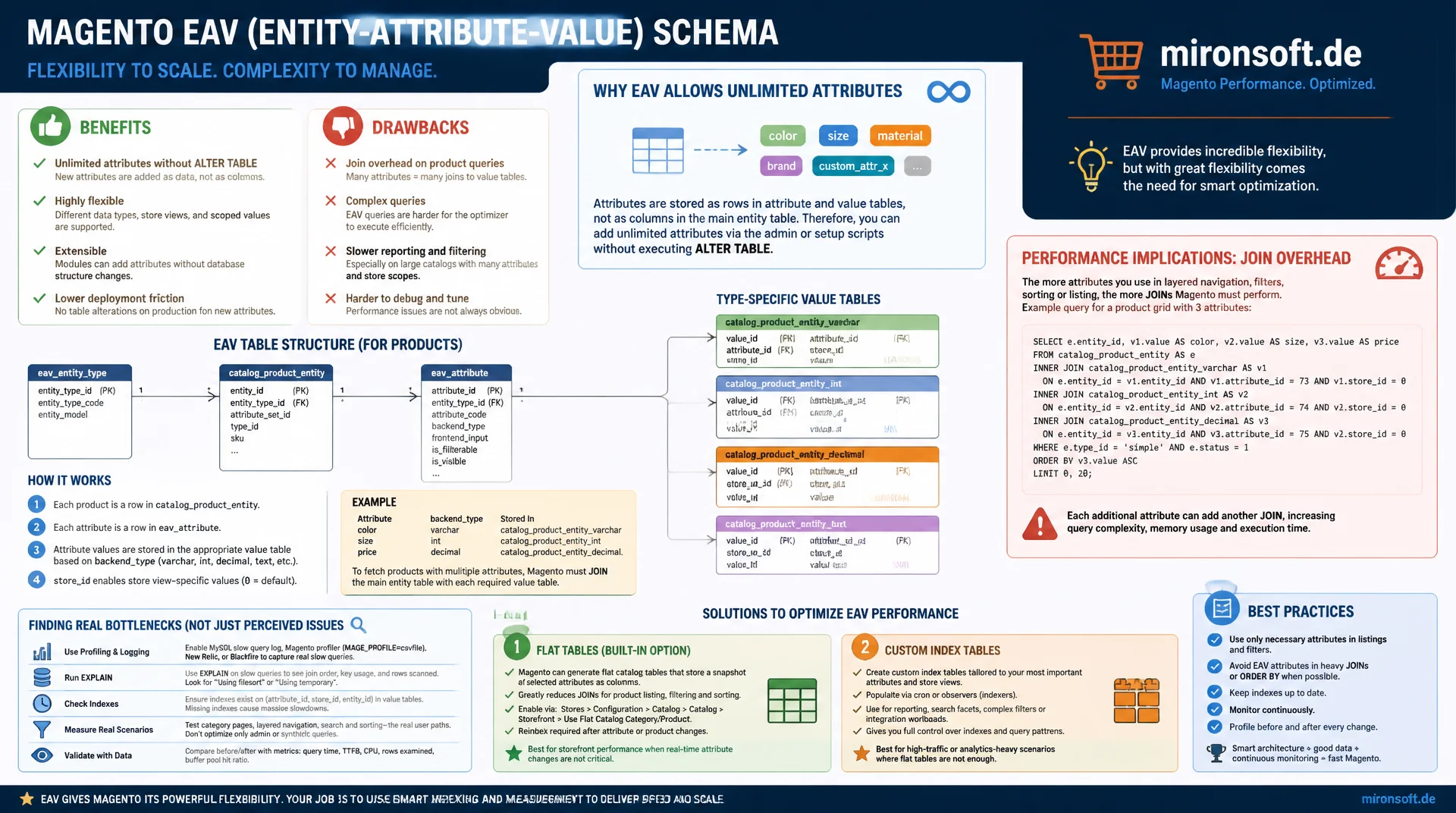
why product queries need so many joins
The EAV schema lets Magento hold an unlimited number of product attributes without ALTER TABLE, but it pays for that flexibility with join overhead on every product query. Understanding the table structure of entity, attribute, and type specific value tables lets you tell real bottlenecks apart from imagined EAV problems, and fix them with flat tables or custom index tables where it actually matters.
Table of Contents
- 1. What the EAV schema in Magento actually is
- 2. Table structure: entity, attribute, and type specific value tables
- 3. The join cost factor of a single product query
- 4. Attribute sets and their effect on cardinality
- 5. Flat table alternatives: catalog_product_flat
- 6. When the EAV schema really is the bottleneck
- 7. Red herring: false suspects instead of the EAV schema
- 8. Practical patterns against EAV overhead
- 9. Database level tuning for EAV tables
- 10. Summary
- 11. FAQ
1. What the EAV schema in Magento actually is
The EAV schema (Entity-Attribute-Value) is Magento's answer to a problem that every flexible product catalog system faces: a hardware store needs thread size and length as attributes, a fashion store needs size and material, an electronics store needs wattage and voltage. A classic relational schema with a fixed number of columns per table would require an ALTER TABLE for every new attribute type, which causes long lock times on tables with millions of rows. The EAV schema avoids that by modeling attributes as rows instead of columns, so the structure becomes dynamic instead of static.
The trade off for this flexibility is structural: every attribute of a product lives in its own row of a separate table, split by data type. Where a classic table with a fixed column count would have one product row with 40 columns, the EAV schema spreads those same 40 attributes across several tables with one row per attribute and product each. That is why a single product query in Magento can internally trigger a double digit number of JOIN operations if implemented naively. Anyone who does not know the mechanics of the EAV schema often sees only the symptoms in a slow query log, not the cause.
Important for context: the EAV schema is not a Magento specific detour, it is a well known database pattern that also appears in other systems with dynamic attributes. Magento uses it consistently for products, categories, and customers. The challenge is not to avoid the EAV schema, but to understand its cost structure and mitigate it specifically where it actually becomes a problem.
2. Table structure: entity, attribute, and type specific value tables
At the center of the EAV schema for products sits catalog_product_entity. This table contains only the base data: entity_id, sku, attribute_set_id, type_id, and timestamps. All the actual attribute values, such as name, price, description, or color, do not live here but in separate tables split by data type: catalog_product_entity_varchar for short text, catalog_product_entity_int for integers and select attributes, catalog_product_entity_decimal for prices and weights, catalog_product_entity_text for long descriptions, and catalog_product_entity_datetime for date fields.
Each of these tables shares the same base structure: value_id, attribute_id, store_id, entity_id, and value. The eav_attribute table defines which attribute (for example "color" or "weight") has which attribute_id and which table holds its value, controlled by the backend_type column. The store_id column allows store view specific overrides, an attribute like the product name can have one value for store_id = 0 (default) and a different, translated value for store_id = 2.
This split is not accidental, it is deliberate normalization by data type. Without it, every value table would need columns for all possible types and rely heavily on NULL values, which leads to inefficient storage usage and worse index maintenance in MySQL. The EAV schema in Magento buys cleaner typing at the cost of more tables being involved in every complete product query.
-- Structure of the varchar value table (same pattern for int, decimal, text, datetime)
DESCRIBE catalog_product_entity_varchar;
-- +----------------+------------------+------+-----+---------+----------------+
-- | Field          | Type             | Null | Key | Default | Extra          |
-- +----------------+------------------+------+-----+---------+----------------+
-- | value_id       | int(10) unsigned | NO   | PRI | NULL    | auto_increment |
-- | attribute_id   | smallint unsigned| NO   | MUL | 0       |                |
-- | store_id       | smallint unsigned| NO   | MUL | 0       |                |
-- | entity_id      | int(10) unsigned | NO   | MUL | 0       |                |
-- | value          | varchar(255)     | NULL |     | NULL    |                |
-- +----------------+------------------+------+-----+---------+----------------+

-- Unique constraint prevents duplicate attribute values per entity and store
SHOW INDEX FROM catalog_product_entity_varchar WHERE Key_name = 'UNQ_KEY';

-- Find the attribute_id and backend_type for a given attribute code
SELECT attribute_id, attribute_code, backend_type, frontend_input
FROM eav_attribute
WHERE entity_type_id = 4 AND attribute_code = 'color';
3. The join cost factor of a single product query
The practical effect of the EAV schema shows up as soon as you try to load a complete product with several attributes in a single SQL query. Each attribute coming from a different value table needs its own LEFT JOIN. A product with name, description, price, weight, and a color select attribute already needs five joins against up to four different value tables, plus the join against catalog_product_entity itself. In practice, typical attribute sets range from 30 to 80 attributes, of which only a subset is actually needed in a given view (product listing, detail page, API response).
Magento's own ORM layer (Model/ResourceModel) wraps these joins via Magento\Eav\Model\Entity\AbstractEntity and does not load all attributes by default, only those marked "used in product listing" in the attribute set or explicitly requested. Still, the join cost factor of the EAV schema remains real: on a category page with 60 products and 10 relevant attributes each, a naive implementation can quickly generate several hundred joins per page load if no caching and no index table sits in between.
This is exactly why Magento does not use the raw EAV schema for category and search pages, but the indexer tables such as catalog_product_index_price, which hold price data already precomputed and flat. The EAV schema stays the source of truth for admin editing and product detail pages, while read heavy, performance critical paths fall back to denormalized index structures. Anyone unaware of this distinction often optimizes in the wrong place.
-- Loading five attributes for one product requires five joins against EAV value tables
SELECT
  e.entity_id,
  e.sku,
  name_val.value    AS name,
  desc_val.value    AS description,
  price_val.value   AS price,
  weight_val.value  AS weight,
  color_val.value   AS color_option_id
FROM catalog_product_entity e
LEFT JOIN catalog_product_entity_varchar name_val
  ON name_val.entity_id = e.entity_id AND name_val.attribute_id = 73 AND name_val.store_id = 0
LEFT JOIN catalog_product_entity_text desc_val
  ON desc_val.entity_id = e.entity_id AND desc_val.attribute_id = 75 AND desc_val.store_id = 0
LEFT JOIN catalog_product_entity_decimal price_val
  ON price_val.entity_id = e.entity_id AND price_val.attribute_id = 77 AND price_val.store_id = 0
LEFT JOIN catalog_product_entity_decimal weight_val
  ON weight_val.entity_id = e.entity_id AND weight_val.attribute_id = 82 AND weight_val.store_id = 0
LEFT JOIN catalog_product_entity_int color_val
  ON color_val.entity_id = e.entity_id AND color_val.attribute_id = 93 AND color_val.store_id = 0
WHERE e.entity_id = 4521;
4. Attribute sets and their effect on cardinality
Attribute sets determine which attributes are relevant for a group of products at all, controlled via eav_attribute_set and eav_attribute_group. In theory a lean attribute set should reduce the join load of the EAV schema, because fewer attributes need to be loaded. In practice attribute sets grow uncontrolled over the years, as new attributes get added for marketing purposes, filter facets, or feed exports, without removing old, unused attributes.
A store with 150 attributes per set, of which only 40 are actually shown on the product detail page and 15 in the product list, carries unnecessary EAV overhead into every admin save and every reindex. Every extra attribute in the EAV schema means one more row per product and store view in the respective value table, which quickly adds up to millions of rows just in catalog_product_entity_varchar at 50,000 products and 3 store views. Regular attribute cleanup is therefore not cosmetic, it is direct EAV performance work.
5. Flat table alternatives: catalog_product_flat
Magento has long offered a flat table option (catalog_product_flat_1, where the number is the store ID) as an alternative to the raw EAV schema. The flat table denormalizes all relevant attributes into a single wide table with one column per attribute, similar to a classic relational product catalog. This eliminates the join cost of the EAV schema entirely for read access, because a single SELECT without joins returns all attribute values.
The price of this simplification is the reindex effort: every change to a product or attribute requires a rebuild of the flat table, which can take several minutes to hours on large catalogs and means lock time on the table. Since Magento 2.3, the flat table option is officially no longer recommended and is increasingly treated as a legacy feature in newer versions, because modern search indexes (Elasticsearch/OpenSearch) and the price index tables already provide the same denormalization for the relevant use cases. For custom development with very specific, read heavy queries outside category and search pages, a dedicated, lean flat table can still make more sense than querying the full EAV schema.
6. When the EAV schema really is the bottleneck
Before blaming the EAV schema for a performance regression, you need measurement data instead of assumption. The first step is the MySQL slow query log with a low long_query_time threshold, combined with EXPLAIN on the identified queries. If EXPLAIN shows many rows combined with Using temporary or Using filesort on the EAV value joins of a product query, that is a clear signal the join chain of the EAV schema is truly the limiting factor.
A second diagnostic tool is the MySQL performance schema, which lets you evaluate cumulative time per table and query digest. Only once catalog_product_entity_varchar or catalog_product_entity_int consistently appear among the top tables by cumulative read time is a structural EAV optimization worth the effort. Measurement often shows instead that a missing index on a completely different table or an inefficient PHP side collection iteration is the actual cause, not the EAV schema itself.
-- Enable slow query logging for EAV diagnosis
SET GLOBAL slow_query_log = 'ON';
SET GLOBAL long_query_time = 0.5;

-- Inspect cumulative time per table via performance_schema
SELECT object_name, count_read, sum_timer_read/1000000000 AS read_time_ms
FROM performance_schema.table_io_waits_summary_by_table
WHERE object_schema = 'magento'
  AND object_name LIKE 'catalog_product_entity%'
ORDER BY sum_timer_read DESC
LIMIT 10;

-- EXPLAIN a typical multi-join EAV query
EXPLAIN SELECT e.entity_id, v.value
FROM catalog_product_entity e
LEFT JOIN catalog_product_entity_varchar v
  ON v.entity_id = e.entity_id AND v.attribute_id = 73 AND v.store_id = 0
WHERE e.attribute_set_id = 4;
7. Red herring: false suspects instead of the EAV schema
A very common pattern in practice: a store gets slower, someone sees many tables with the catalog_product_entity_ prefix in the slow log, and jumps to the conclusion that the EAV schema needs to be abolished altogether. In reality the cause is often elsewhere. N plus 1 loading problems in custom PHP code, where a collection reloads data per product individually instead of loading attributes in bulk, produce the same symptoms as an inefficient EAV schema, but are an application code problem.
Equally common are missing or wrongly set indexes on the combination of attribute_id, store_id, and entity_id, which force MySQL into a full table scan even though the table structure of the EAV schema itself is correctly indexed. A missing or misconfigured full page cache and Redis object cache also causes EAV queries to run again on every request even though they barely change. In all of these cases, migrating away from the EAV schema would be wasted effort, because the actual problem would remain.
8. Practical patterns against EAV overhead
Instead of replacing the entire EAV schema, targeted patterns have proven effective. First, audit attribute sets regularly and remove unused attributes via a bin/magento script or directly through eav_attribute, including their values in the value tables. Second, for very read heavy but rarely changed data points, build a dedicated, narrow index table that gets updated by an observer on product change, instead of querying the full EAV schema on every request.
Third, populate collections deliberately with addAttributeToSelect() for only the attributes you actually need, instead of addAttributeToSelect('*'), which reflexively loads all attributes of the set and needlessly multiplies the join count. Fourth, for API heavy integrations (GraphQL, REST), introduce a dedicated read layer with its own denormalized table that is fed asynchronously from the EAV schema, instead of joining synchronously on every API call.
-- Custom slim index table fed by an observer instead of joining the full EAV schema
CREATE TABLE catalog_product_feed_index (
  entity_id INT UNSIGNED NOT NULL,
  sku VARCHAR(64) NOT NULL,
  price DECIMAL(12,4) NOT NULL,
  color_label VARCHAR(64) NULL,
  updated_at TIMESTAMP NOT NULL DEFAULT CURRENT_TIMESTAMP ON UPDATE CURRENT_TIMESTAMP,
  PRIMARY KEY (entity_id),
  KEY IDX_PRICE (price)
) ENGINE=InnoDB;

-- Populated asynchronously (e.g. catalog_product_save_after observer) instead of
-- reading catalog_product_entity_* on every request
INSERT INTO catalog_product_feed_index (entity_id, sku, price, color_label)
SELECT e.entity_id, e.sku, price_val.value, color_opt.value
FROM catalog_product_entity e
LEFT JOIN catalog_product_entity_decimal price_val
  ON price_val.entity_id = e.entity_id AND price_val.attribute_id = 77 AND price_val.store_id = 0
LEFT JOIN eav_attribute_option_value color_opt
  ON color_opt.option_id = 3 AND color_opt.store_id = 0
WHERE e.entity_id = 4521
ON DUPLICATE KEY UPDATE price = VALUES(price), color_label = VALUES(color_label);
9. Database level tuning for EAV tables
Even without an architecture change, the EAV schema can be tuned at the pure MySQL level. The composite unique index of entity_id, attribute_id, and store_id that Magento sets up by default on all value tables should match this order for the most common query patterns too. For custom reports that filter many products by a specific attribute value, an additional index with attribute_id and value as leading columns pays off, because otherwise MySQL has to scan via entity_id.
The InnoDB buffer pool should be sized large enough to keep the most frequently read value tables largely in memory, because disk I/O is a bigger factor for EAV joins with many small rows than for a few wide rows. A look at innodb_buffer_pool_size relative to the total size of catalog_product_entity_* quickly shows whether the buffer is sufficient for the catalog. Finally, regular ANALYZE TABLE on the EAV tables helps the query optimizer keep current cardinality estimates for join ordering, especially after large import or reindex runs that change the data distribution of the EAV schema.
-- Extra covering index for attribute-value lookups outside the default query pattern
ALTER TABLE catalog_product_entity_int
  ADD INDEX IDX_ATTR_VALUE (attribute_id, value);

-- Refresh optimizer statistics after large imports or reindex runs
ANALYZE TABLE catalog_product_entity_varchar, catalog_product_entity_int,
              catalog_product_entity_decimal, catalog_product_entity_text;

-- Check InnoDB buffer pool sizing against EAV table footprint
SELECT table_name, ROUND((data_length + index_length) / 1024 / 1024, 1) AS size_mb
FROM information_schema.TABLES
WHERE table_schema = 'magento' AND table_name LIKE 'catalog_product_entity%'
ORDER BY size_mb DESC;
Comparison: EAV schema, flat table, and custom index table
| Aspect | EAV schema | Flat table | Custom index table |
|---|---|---|---|
| Write overhead | Low, only affected attributes | High, full reindex required | Low, update via observer |
| Read overhead | High, many joins per attribute | Very low, single SELECT | Very low, deliberately scoped |
| Flexibility for new attributes | Very high, no ALTER TABLE | Low, requires column change | Medium, deliberately limited |
| Maintenance status in Magento | Active, core architecture | Legacy, not recommended | Self maintained |
| Typical use | Admin, product detail | Historical, legacy systems | API, feed, reporting |
Mironsoft
Magento database architecture and performance audits
Is the EAV schema slowing down your store?
We measure with the slow query log and performance schema whether the EAV schema is really the cause, and build targeted index tables where needed instead of proposing a blanket architecture migration.
EAV audit
Attribute sets and query patterns checked against real slow log data
Index tables
Lean, observer maintained tables for read heavy paths
Query tuning
Indexes, buffer pool, and ANALYZE TABLE matched to catalog size
10. Summary
The EAV schema is a deliberate architecture decision by Magento to enable arbitrary product attributes without structural schema changes. The cost is join overhead on every complete product query, because attributes are distributed by type across several value tables like catalog_product_entity_varchar, _int, _decimal, _text, and _datetime. For read heavy, performance critical paths like category and search pages, Magento itself already falls back to denormalized indexer tables, the EAV schema stays the source of truth in the admin and on the product detail page.
Before identifying the EAV schema as the cause of a performance regression, you need measurement data from the slow query log and performance schema instead of assumption, because N plus 1 loading problems, missing indexes, and a weak cache produce the same symptoms. Where the EAV schema really is the bottleneck, an attribute set audit, targeted custom index tables, and MySQL side tuning of indexes and buffer pool help far more than a blanket migration to flat tables.
Magento EAV Schema: The Essentials at a Glance
Table structure
catalog_product_entity plus type specific value tables for varchar, int, decimal, text, and datetime.
Join cost
Every attribute from a different value table means one more JOIN per product query.
Flat table
Denormalized alternative, no longer recommended since Magento 2.3 due to reindex overhead.
Diagnosis
Slow query log and performance_schema.table_io_waits_summary_by_table before any architecture decision.