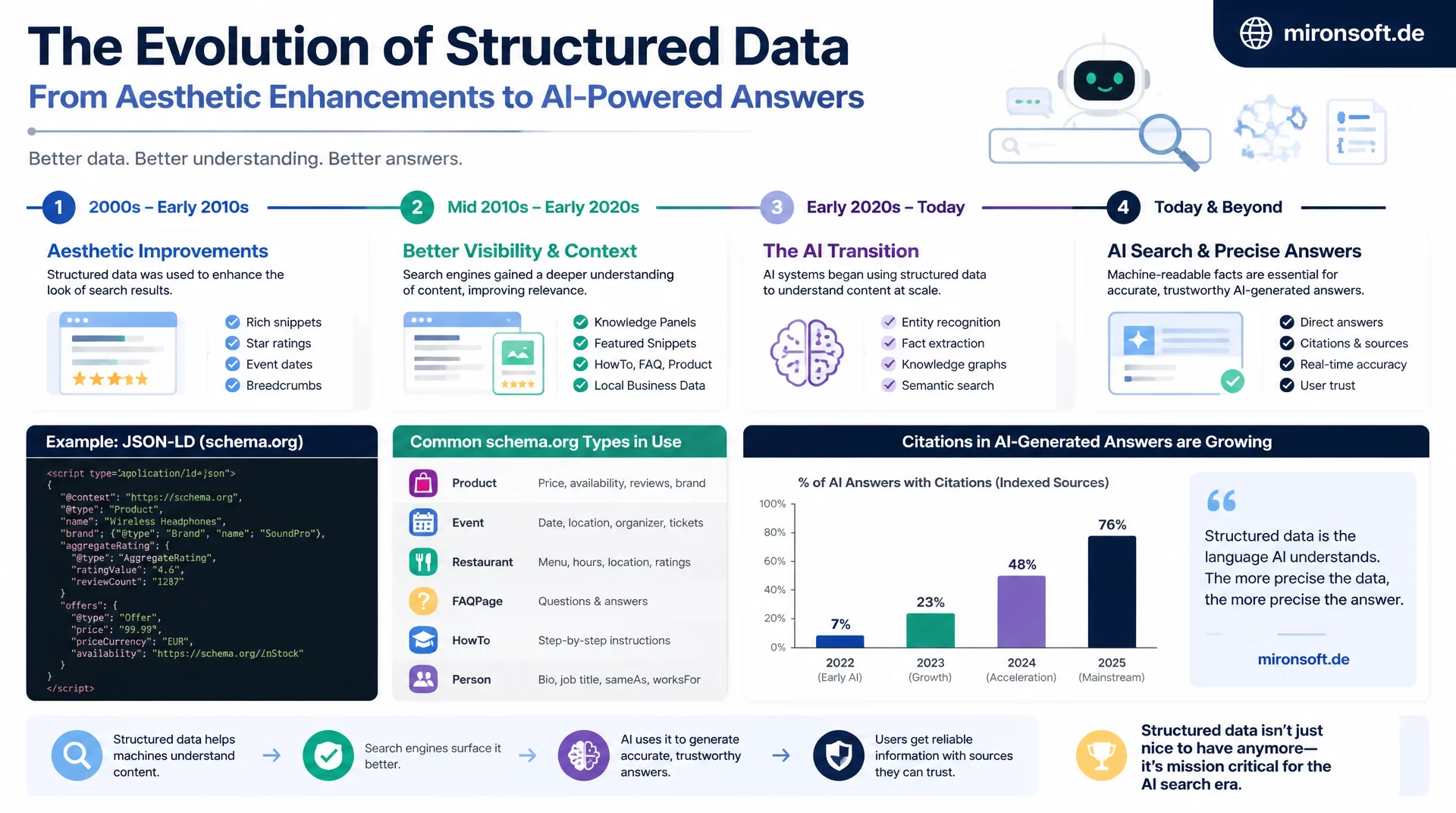
schema.org as an extraction aid, not just rich-snippet decoration
Structured data was long used only to make search results look prettier. AI search engines read the same JSON-LD blocks for a different reason: they need precise, machine-readable facts to phrase answers and correctly attribute sources. Marking up schema.org deliberately for that purpose measurably increases the chance of being cited in AI answers.
Table of Contents
- 1. Why structured data works differently for AI search engines
- 2. How AI search engines actually parse and use JSON-LD
- 3. Schema.org types with special value for AI answers
- 4. Entities and knowledge graphs: sameAs, knowsAbout, mainEntity
- 5. Difference from classic rich-snippet SEO
- 6. Nested schemas and speakable markup for AI excerpts
- 7. Common mistakes with structured data for AI systems
- 8. Classic schema SEO vs. AI-optimized structured data
- 9. Implementation checklist: prioritization, validation, maintenance
- 10. Summary
- 11. FAQ
1. Why structured data works differently for AI search engines
Structured data in the schema.org and JSON-LD sense was originally built to help search engines render rich snippets: star ratings, prices, breadcrumbs, event dates. The goal was visual prominence in the search results and a higher click rate. AI search engines like Perplexity, Google's AI Overviews or ChatGPT with web search pursue a different goal with the same structured data: they extract facts from it that flow directly into a generated answer, without a user ever visiting the source page at all.
This difference changes prioritization considerably. For classic rich-snippet SEO, a handful of visually impactful fields like rating and price are often enough. For AI search engines, completeness and unambiguity matter more: every additional, correctly marked-up field reduces the chance of misinterpretation by the parsing system. Structured data thus becomes less of a decorative element and more of a machine-readable summary of the page content that a language model can rely on when formulating an answer.
The sections below show concretely which schema.org types carry the biggest lever for AI search engines, how entities get correctly linked, and where AI-optimized structured data differs from classic schema SEO.
2. How AI search engines actually parse and use JSON-LD
Before an AI system incorporates a page into its answer, the content goes through an extraction stage. The visible body text is analyzed together with all embedded JSON-LD blocks. Structured data has a decisive advantage over plain HTML here: it delivers already preprocessed facts in a fixed schema, instead of forcing the language model to derive values from body text, tables or captions first. A correctly marked-up Product schema with price, availability and rating provides exactly the data points an AI search engine needs for a product comparison answer, with no room for interpretation.
Important detail: AI systems generally do not validate structured data against Google's official Rich Results ruleset, they parse JSON-LD against the general schema.org vocabulary. That means types not officially supported for classic Google rich snippets, such as more detailed TechArticle or Claim markup, can still be valuable for AI search engines. The example below shows a typical Article schema, the kind an AI search engine would use to extract author, date and core claim.
{
  "@context": "https://schema.org",
  "@type": "TechArticle",
  "headline": "Marking Up Structured Data for AI Search Engines",
  "author": { "@type": "Organization", "name": "Mironsoft" },
  "datePublished": "2026-07-23",
  "dateModified": "2026-07-23",
  "about": ["schema.org", "JSON-LD", "Generative Engine Optimization"],
  "proficiencyLevel": "Intermediate",
  "dependencies": "No framework needed, plain JSON-LD in the head"
}
// AI search engines parse this block directly, without
// needing Google's specific Rich Results eligibility rules
3. Schema.org types with special value for AI answers
Not every schema.org type is equally valuable to AI search engines. Types that deliver clear question-and-answer or step-by-step structures rank especially high: FAQPage and HowTo map almost one to one onto the format AI systems use for their own answers, and are correspondingly adopted or paraphrased directly quite often. Organization and Person with complete sameAs links are also important, because they identify an entity unambiguously and connect it to external knowledge sources like Wikidata. For e-commerce pages, Product with a nested Offer and AggregateRating provides the data points cited most often in product comparison answers.
Less relevant for AI search engines, though still useful for classic SEO, are purely visual types like BreadcrumbList tied to pure navigation display, they yield hardly any extractable facts. The combined example below shows what an FAQPage schema for a typical GEO guide article looks like, one that can directly serve as an answer source for similar user questions.
{
  "@context": "https://schema.org",
  "@type": "FAQPage",
  "mainEntity": [
    {
      "@type": "Question",
      "name": "Which schema works best for AI search engines?",
      "acceptedAnswer": {
        "@type": "Answer",
        "text": "FAQPage and HowTo provide the clearest structure because they directly match the answer format AI systems use."
      }
    }
  ]
}
// FAQPage and HowTo map almost one-to-one onto how
// AI systems themselves structure generated answers
4. Entities and knowledge graphs: sameAs, knowsAbout, mainEntity
AI search engines build internal entity models, similar to a knowledge graph: a brand, a person or a product gets treated as a distinct node enriched with attributes and relationships to other nodes. Structured data is the most direct way to populate that node. The sameAs property links your own entity to external, trustworthy profiles such as Wikidata, Wikipedia or LinkedIn and helps the system resolve ambiguity, for instance when several companies share a similar name. knowsAbout assigns topical areas of expertise to an organization or person and directly influences which topical queries consider a brand a relevant source.
The mainEntity property at the page level explicitly states what a page is primarily about, which is especially helpful on pages covering multiple topics, to avoid confusion. These links have an immediate effect on structured data across the whole domain: if an organization is referenced consistently with the same sameAs values on every relevant page, a stable, recognizable entity profile emerges that AI search engines can reliably map across multiple queries.
{
  "@context": "https://schema.org",
  "@type": "Organization",
  "name": "Mironsoft",
  "url": "https://mironsoft.de",
  "sameAs": [
    "https://www.wikidata.org/wiki/Q000000",
    "https://www.linkedin.com/company/mironsoft",
    "https://github.com/mironsoft"
  ],
  "knowsAbout": [
    "Magento 2",
    "Hyva Themes",
    "Generative Engine Optimization"
  ],
  "mainEntityOfPage": {
    "@type": "WebPage",
    "@id": "https://mironsoft.de/services"
  }
}
// sameAs disambiguates the entity against external
// knowledge sources such as Wikidata and LinkedIn
5. Difference from classic rich-snippet SEO
Classic schema SEO primarily optimizes for visibility and click rate within a results list. A star rating snippet or an event date in the SERPs is meant to drive a click, the real value only materializes after the page visit. AI-optimized structured data follows a different principle: the value should already arrive in the generated answer, often without a click happening at all. That shifts the focus away from eye-catching but shallow attributes toward complete, factually solid datasets.
A practical example: for classic rich-snippet SEO, a product often only needs price, priceCurrency and availability. For an AI search engine phrasing a comparison answer, additional fields like brand, sku, detailed additionalProperty entries and a solid review structure matter too, because they enable a more nuanced, citable answer. Anyone who only maintains structured data to meet the minimum requirements of Google's Rich Results documentation leaves potential for AI search engines untapped.
6. Nested schemas and speakable markup for AI excerpts
For content that should be quoted or read aloud especially often, for instance in voice assistants or compact AI answers, SpeakableSpecification exists. This schema explicitly marks which sections of a page are suited for a compact, spoken or directly citable summary. Combined with CSS selectors or XPath expressions, it tells a system precisely which block of text is meant as a self-contained, citable unit, instead of leaving the system to guess which paragraph carries the core claim.
Nested schemas reinforce this effect further: an Article with an embedded FAQPage as hasPart clearly signals that a portion of the page contains a self-contained question-and-answer structure that can be extracted separately. Structured data that makes this hierarchy explicit reduces the chance an AI system loses context when it only pulls a fragment of a page into an answer.
{
  "@context": "https://schema.org",
  "@type": "Article",
  "headline": "GEO basics for structured data",
  "speakable": {
    "@type": "SpeakableSpecification",
    "cssSelector": [".summary-card", ".key-facts"]
  },
  "hasPart": {
    "@type": "FAQPage",
    "mainEntity": [
      {
        "@type": "Question",
        "name": "What is speakable markup?",
        "acceptedAnswer": {
          "@type": "Answer",
          "text": "A schema.org extension that marks sections for compact, citable output."
        }
      }
    ]
  }
}
// cssSelector points AI systems to the exact block
// intended as a self-contained, citable summary
7. Common mistakes with structured data for AI systems
The most common mistake is a mismatch between structured data and visible body text: the JSON-LD claims a price or a date that does not appear in the visible content, or differs from it. AI search engines treat such contradictions as a trust problem and, when in doubt, ignore both values. A second mistake is incomplete nesting, for example a Product schema without an Offer object, meaning central data points like price and availability are entirely missing. A third, very common mistake is using outdated or incorrect property names, which validators tolerate but parsers simply ignore.
// WRONG: structured data claims a price not shown on the page
{
  "@type": "Product",
  "name": "Hyva Performance Package",
  "offers": { "@type": "Offer", "price": "990", "priceCurrency": "EUR" }
}
// visible page text says "from EUR 1,200" - mismatch damages trust

// RIGHT: structured data matches the visible content exactly
{
  "@type": "Product",
  "name": "Hyva Performance Package",
  "offers": { "@type": "Offer", "price": "1200", "priceCurrency": "EUR" }
}

// WRONG: outdated date format, silently ignored by parsers
{ "@type": "Article", "datePublished": "23/07/2026" }

// RIGHT: ISO 8601 date format, correctly parsed everywhere
{ "@type": "Article", "datePublished": "2026-07-23" }
8. Classic schema SEO vs. AI-optimized structured data
The table below lines up the different priorities. Both approaches are not mutually exclusive, a complete schema usually covers both use cases, but the order in which fields get added should follow the respective goal.
| Aspect | Classic rich-snippet SEO | AI-optimized structured data |
|---|---|---|
| Primary goal | Higher click rate in search results | Correct extraction and citation in the answer |
| Ruleset | Google Rich Results documentation | Full schema.org vocabulary |
| Field depth | Minimal, only fields required for snippet eligibility | As complete as possible, including optional fields |
| Entity linking | Often without sameAs, not required | sameAs and knowsAbout central to success |
| Success metric | CTR, impressions in Search Console | Citation rate in AI answers, referral traffic |
In practice this means a page optimized only for Google rich snippets is rarely fully prepared for AI search engines. Conversely, fully marked-up structured content usually benefits from better classic rich snippets too, because both systems build on the same schema.org vocabulary. The most economical path is therefore to maintain structured data completely from the start instead of minimally.
9. Implementation checklist: prioritization, validation, maintenance
The first step is an inventory: which page types exist, and which schema.org schema fits each best? Content hubs and guide articles get priority with Article or TechArticle plus FAQPage, product pages with Product plus Offer and AggregateRating, the homepage and about page with a complete Organization schema including sameAs. These three baseline types already cover most of the potential for AI search engines on most websites.
After the initial rollout comes validation, ideally through schema.org's own Schema Markup Validator rather than relying solely on Google's Rich Results Test, since the latter only checks a subset of types. Then maintenance begins: structured data must be updated alongside every content change on the corresponding page, an outdated price or date field damages an AI search engine's trust in the entire domain, not just the individual page. An automated comparison between visible content and JSON-LD, for example as part of the CI pipeline, reliably prevents this drift.
10. Summary
Structured data for AI search engines differs significantly from classic rich-snippet SEO in both goal and depth. Instead of a few required fields for snippet eligibility, completeness matters: price, availability, ratings, entity links through sameAs and topical mapping through knowsAbout. Schema.org types that match the answer format of AI systems are especially valuable, above all FAQPage and HowTo, complemented by SpeakableSpecification for directly citable sections.
Whoever maintains structured data rigorously benefits twice over: better classic rich snippets and higher visibility in AI-generated answers, because both systems evaluate the same schema.org vocabulary. The decisive success factor is consistency between structured data and visible content, every deviation undermines the trust an AI search engine places in the entire domain.
Structured Data for AI Search Engines: the essentials at a glance
Goal: extraction, not CTR
AI search engines use structured data to pull facts directly into generated answers, not just for snippet appearance.
Priority types
FAQPage, HowTo, Article/TechArticle and a complete Organization schema with sameAs deliver the biggest lever.
Completeness over minimalism
Optional fields such as additionalProperty and detailed reviews provide extra citable data points.
Consistency is mandatory
Structured data must match visible content exactly, any deviation undermines the system's trust.