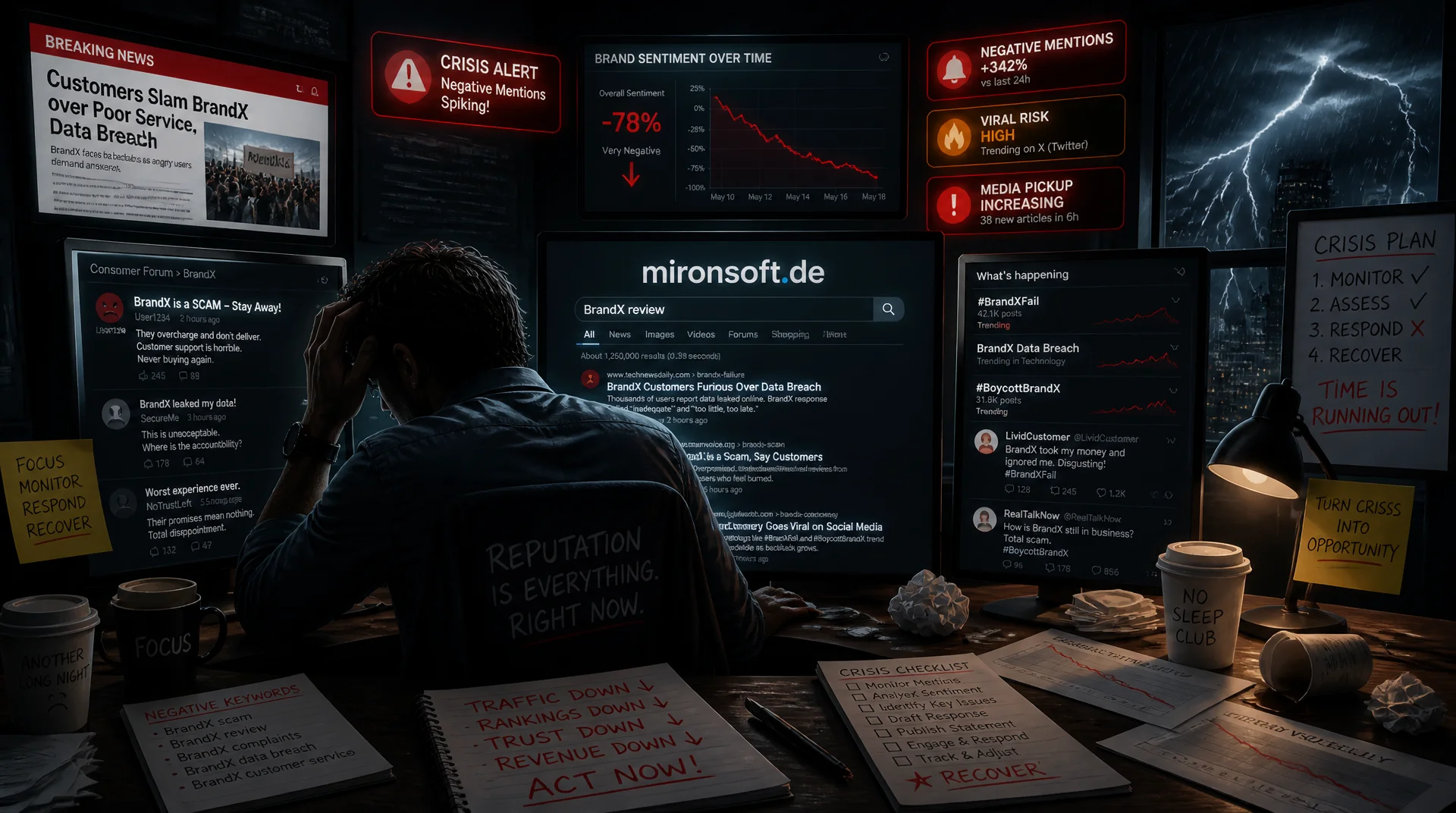
when sentiment shapes the search results
A social media crisis rarely stays confined to its original platform: negative press, critical forum threads and shifting sentiment signals change within days what users see when they type the brand name into Google. Anyone who plans crisis management separately from brand SEO gives up the chance to actively shape the search results space instead of leaving it to the coverage.
Table of Contents
- 1. Why social media crises become SEO events
- 2. Sentiment signals and their effect on brand SEO
- 3. How the brand SERP changes during a crisis
- 4. Negative press: ranking dynamics and lifespan
- 5. Response strategy: the first 48 hours
- 6. Using owned channels as an SEO counterweight
- 7. Technical setup: monitoring and schema
- 8. Aftercare: restoring visibility after the crisis
- 9. Response patterns compared: right and wrong
- 10. Summary
- 11. FAQ
Part of the series: SEO Part 2, GEO and Social.
Relevant for PR, marketing and SEO teams alike.
With practical examples and response templates.
Applicable across industries and company sizes.
Quick overview
This article covers the SEO dimension of social media crises, not classic PR communication strategy in detail. The focus is on how search engines react to shifting sentiment signals and how brand SEO measures can support reputation recovery.
1. Why social media crises become SEO events
Understanding this crossover early is what separates teams that stay in control of the narrative from teams reacting one step behind it.
Distinction from classic crisis PR
This article complements but does not replace classic crisis communication planning. Legal review, messaging guidelines and stakeholder management remain the job of PR and legal departments, while this post specifically examines the search engine dimension of a crisis.
A social media crisis almost always begins on a single platform, a viral tweet, a critical TikTok video, or a Reddit thread with a high engagement rate. Within a few hours, however, the topic leaves the originating platform: news sites pick up the story, forums keep discussing it, and users start actively searching for the brand name to learn more about the incident. It is at this exact moment that a social media crisis turns into an SEO event, because the Google search results for the brand's own name start to shift.
This shift is so critical because the brand SERP, the search results page for the company's own name, is the first point of contact for many stakeholders after a crisis event. A potential customer, an investor, or a journalist who has heard about the crisis almost reflexively googles the brand name to form their own picture. What appears on the first results page at that moment often shapes perception more strongly than the original social media discussion itself.
Classic crisis management often focuses exclusively on communication within the affected platform, a statement on X, a clarifying post on LinkedIn. These reactions, however, only reach users who are already active on that particular platform. Brand SEO as part of crisis management ensures that users who encounter the brand through classic Google search also find a reasonably balanced and up-to-date picture.
2. Sentiment signals and their effect on brand SEO
These indirect mechanisms explain why sentiment matters for SEO even though search engines have no direct emotion detector built in.
Search engines do not evaluate content directly by emotional sentiment in the sense of a mood gauge, but sentiment affects the brand SERP indirectly through several measurable signals. A sudden spike in negative mentions frequently leads to a sharp increase in click-through rate on critical articles and forum threads, because users are actively searching for more information about the incident. This elevated click-through rate is a strong relevance signal that prompts Google to rank exactly this critical content higher for brand name searches.
A second mechanism concerns link building during a crisis. News articles reporting on the incident frequently link to each other and to the original social media discussion, creating a dense, topically focused backlink network around the crisis topic. This network strengthens the authority of critical content relative to the company's own website, which is often less freshly linked, an effect that weakens the brand SEO visibility of owned channels relative to negative coverage.
For the response strategy it is important to understand that this effect is time-limited but very strong during the acute phase. Sentiment signals typically subside within a few weeks if no new news trigger emerges, while the backlinks that formed often remain in place permanently and can serve as a long-term reference for future searches about the incident.
Practical example of the sentiment effect
After a viral critical thread about a product defect, the click-through rate on a critical trade article rose so sharply within 48 hours that it climbed from position eight to position two for the brand name, ahead of the company's own product page. Only a targeted response with updated, linked content restored the original ranking order after roughly three weeks.
3. How the brand SERP changes during a crisis
Recognizing these patterns as predictable, not random, makes it possible to plan a response rather than merely react to each new development.
Regular SERP snapshots
A simple but effective practical tip: before an expected or already ongoing crisis, regularly capture screenshots of the brand's own SERP. These reference points later make it much easier to objectively assess the actual effect of the crisis and of your own countermeasures.
The structure of the search results page for a brand name changes during a crisis in typical, recurring patterns. First, current news articles and social media discussions increasingly push the company's own official pages down from the top positions, because Google heavily weights freshness and topical relevance to current search interest. The company's own homepage or product page, which normally occupies position one, can fall back to position three or four during an acute crisis.
A second typical pattern is the appearance of "People also ask" boxes and related searches that explicitly pick up the crisis context, such as "Is [brand name] safe" or "[brand name] scandal explanation." These automatically generated additions arise from actual user search behavior and further amplify the visibility of critical questions, independent of a brand's own content.
A third pattern concerns Google News and the top stories section, which frequently appears high on the search results page for current events and shows exclusively third-party sources over which the affected brand has no direct control. This section typically disappears again after a few days once the news currency of the topic subsides, but it can claim a substantial share of first-page visibility during the acute phase.
4. Negative press: ranking dynamics and lifespan
Understanding this lifecycle helps set realistic expectations for how long a brand's search results will carry the marks of a crisis.
Why an early response shapes the long-term SERP
Press articles that appear early in the course of a crisis often receive the most follow-up backlinks, because later coverage frequently references the first sources. A fast statement of your own increases the chance of becoming one of these early-cited sources yourself.
Negative press articles that emerge in the course of a social media crisis follow their own ranking dynamics, which differ significantly from normal editorial content. In the first few days they benefit strongly from a freshness bonus and high click-through rate, leading to quick, sometimes volatile ranking jumps. After about two to four weeks the position usually stabilizes at a level that depends on the long-term authority of the publishing domain and the number of inbound backlinks.
An important factor for the long-term visibility of negative press is the domain authority of the reporting publication. An article on an established news site with high domain authority can remain visible for brand name queries for years, even long after the original event has lost relevance. This longevity is one of the main reasons a fast, well-considered response during the acute crisis phase matters so much, it influences which version of the story remains anchored in the search results long-term.
Interestingly, a factual, well-documented response from the affected brand itself can become its own indexed content that ranks long-term alongside the negative coverage. A detailed, transparent statement on the company's own website, correctly marked up with schema, has a real chance of permanently appearing in the brand SERP alongside the original press articles, instead of being completely displaced by them.
<!-- Checklist as an HTML comment for the statement page -->
<!--
  1. Concrete, verifiable facts instead of vague phrasing
  2. Clear timeline of events and measures
  3. Visible ownership clearly named
  4. Article schema with correct date set
  5. Regular updates with progress planned
-->
5. Response strategy: the first 48 hours
What happens in this narrow window tends to determine the trajectory of the entire recovery period that follows.
The first 48 hours after a social media crisis emerges are decisive for how the brand SERP develops over the following weeks. The first priority is not SEO optimization but factual, fast and honest communication across all relevant channels, because delayed or evasive responses can themselves become the subject of new critical coverage, an effect that prolongs the crisis instead of containing it.
Alongside communication, a monitoring process should be established that captures new mentions, press articles and forum discussions hourly. This overview forms the basis for identifying precisely which content is gaining visibility in the brand SERP, enabling an informed decision about where an own statement or supplementary content is most urgently needed.
Technically, an official statement page on the company's own domain should also be prepared within this time window, correctly marked up with Article schema and a current date so it gets indexed quickly and can appear as an authoritative, official source alongside external coverage. This page should be written factually, without glossing language, and with concrete, verifiable facts, because vague or evasive statements are quickly recognized as untrustworthy by search users and journalists alike.
<!-- Example meta setup for an official statement page during a crisis -->
<meta name="robots" content="index, follow">
<meta name="description" content="Official statement from Mironsoft regarding the incident of July 23, 2026, with timeline and concrete measures.">
<script type="application/ld+json">
{
  "@context": "https://schema.org",
  "@type": "Article",
  "headline": "Official Statement: Incident of July 23, 2026",
  "datePublished": "2026-07-23T14:00:00+02:00",
  "dateModified": "2026-07-23T14:00:00+02:00",
  "author": { "@type": "Organization", "name": "Mironsoft" }
}
</script>
6. Using owned channels as an SEO counterweight
Owned channels are the one lever a brand fully controls during a crisis, which is exactly why they deserve priority attention.
Tightening internal approval processes
Long approval loops for statement copy are one of the most common reasons companies let the critical first 48 hours pass unused. A pre-agreed, shortened approval process specifically for crisis communication significantly reduces this risk.
Why owned domains make the difference here
A statement published only on social media barely improves the brand SERP, because platform content rarely ranks with the same authority for the brand name as the company's own domain. Only the combination of social media response and an indexed website statement creates a real SEO counterweight.
The company's own website remains the most important tool during a crisis for actively shaping the brand SERP, because search engines naturally attribute high relevance to a brand's official domain for searches on its own name. An updated blog post, an FAQ page about the incident, or a transparent timeline of the measures taken can specifically ensure that the brand's own, controlled version of the story stays present in the brand SERP instead of being completely dominated by external coverage.
It matters that this content actually delivers new, concrete information and does not just repeat placating PR language. Search engines and users quickly recognize hollow statements, which paradoxically can lead to even stronger trust in critical third-party coverage. A good crisis page documents concrete facts, clearly names responsibilities, and updates as the resolution progresses, which from an SEO perspective is also evaluated as continuously fresh, valuable content.
7. Technical setup: monitoring and schema
None of this technical work is glamorous, but it is exactly what turns a crisis response from improvised into repeatable.
A resilient technical setup for crisis times combines real-time monitoring with clean schema markup. Google Alerts or specialized social listening tools should be configured to capture both the brand name and common misspellings and thematically related terms, so relevant developments are not missed due to overly narrow search filters. This monitoring infrastructure should ideally already be set up before a crisis, not built during the acute phase.
At the technical level, a clean Organization schema with correctly maintained sameAs links to official social media profiles and press contact information helps search engines and AI systems reliably distinguish official from unofficial sources. This foundation, as is generally common in technical SEO, should be built permanently, not reactively during a crisis.
{
  "monitoring_alert_configuration": {
    "terms": ["brand name", "product names", "executive names", "hashtag variants"],
    "check_interval_hours": 1,
    "sources": ["news", "reddit", "x", "forums"],
    "escalation_threshold_mentions": 50
  }
}
{
  "@context": "https://schema.org",
  "@type": "Organization",
  "name": "Mironsoft",
  "url": "https://mironsoft.de",
  "contactPoint": [
    {
      "@type": "ContactPoint",
      "contactType": "press",
      "email": "press@mironsoft.de"
    }
  ],
  "sameAs": [
    "https://www.linkedin.com/company/mironsoft",
    "https://x.com/mironsoft"
  ]
}
8. Aftercare: restoring visibility after the crisis
Aftercare is where most companies underinvest, precisely when patient, consistent effort would pay off the most.
Alert configuration in practice
In addition to the exact brand name, alerts should also cover product names, executive names and common hashtag variants. Crises frequently ignite not around the company name itself but around a product or a single individual, which an overly narrow monitoring setup can easily miss.
Once the acute phase of a crisis has calmed down, an often underestimated aftercare phase begins in which brand SEO visibility must be actively restored. Many companies consider a crisis over as soon as the social media discussion subsides, overlooking that negative press articles and forum threads often remain visible for brand name queries for months if no active countermeasures are taken.
In this phase, consistently publishing fresh, positive, and topically relevant content on the company's own website helps gradually diversify the brand SERP again. Success stories, product updates, and, where appropriate, a retrospective on lessons learned from the crisis can provide new, current signals that prompt search engines to display more of the brand's own content instead of exclusively third-party coverage for the brand name.
{
  "aftercare_content_plan": {
    "frequency_weeks": 1,
    "formats": ["blog post", "FAQ update", "product news"],
    "target_serp_diversity_weeks": 8,
    "brand_serp_review": "weekly screenshot comparison"
  }
}
9. Response patterns compared: right and wrong
Laid out side by side, the pattern is consistent: transparency and speed beat silence and vague language on every dimension.
Realistic time horizon
In practice, fully restoring a diversified brand SERP typically takes between six and twelve weeks of continuous content work, depending on the severity of the crisis and the authority of the news sources involved. Impatience during this phase often leads to rushed, unconvincing PR measures.
The following overview shows typical response patterns in social media crises and their respective impact on brand SEO visibility.
| Situation | Flawed response | Recommended response | SEO effect |
|---|---|---|---|
| First response | Silence or deleting comments | Fast, factual statement on own domain | Own source becomes indexable and authoritative |
| Wording | Vague, placating PR language | Concrete facts and measures | Higher dwell time, lower bounce rate |
| Monitoring | No systematic tracking | Hourly monitoring of all channels | Early detection of new ranking shifts |
| Aftercare | Ignoring the topic after social media subsides | Continuous fresh content over weeks | Diversification of the brand SERP |
| Technical setup | No schema markup on statement page | Complete Article schema with date | Faster indexing, better attribution |
Mironsoft
Crisis management, brand SEO and reputation monitoring
Be prepared before the next crisis reshapes your brand SERP?
We build a monitoring setup, schema markup and a response playbook so your brand SEO visibility stays under your control even in critical moments, instead of being left to the coverage.
Monitoring setup
Set up real-time tracking for brand name, variants and related topics
Crisis playbook
Prepared statement page templates with correct schema markup
Aftercare strategy
Content plan to restore the brand SERP after an acute crisis
10. Summary
Pulling the threads of this article together, brand SEO during a crisis is less about tactics and more about disciplined, prepared execution.
A social media crisis never stays confined to its originating platform, it changes the brand SERP within days through altered click-through rates, new backlinks to critical content and automatically generated search suggestions. These sentiment-driven effects are time-limited but strong enough during the acute phase to push the official company page off the top positions. A fast, factual response within the first 48 hours, combined with a correctly marked-up statement page, is the single most important lever for anchoring your own version of the story in the search results.
Sustainable crisis management does not end when the social media discussion subsides, it requires a deliberate aftercare phase in which fresh, relevant content gradually diversifies the brand SERP again. Anyone who has monitoring, schema markup and response playbooks prepared before a crisis can react significantly faster and more effectively than companies that only discover brand SEO as a topic during the acute crisis.
Crisis Management and Brand SEO: The Essentials at a Glance
Sentiment as a ranking factor
Elevated click-through rates and new backlinks during a crisis indirectly strengthen critical content in the brand SERP.
The first 48 hours
A fast, factual statement on the company's own domain with correct schema markup decides the long-term SERP.
Negative press is durable
Articles on authoritative domains can stay visible for the brand name for years.
Do not forget aftercare
Continuously fresh content restores brand SERP diversity after the acute crisis phase.