images and video as a ranking factor
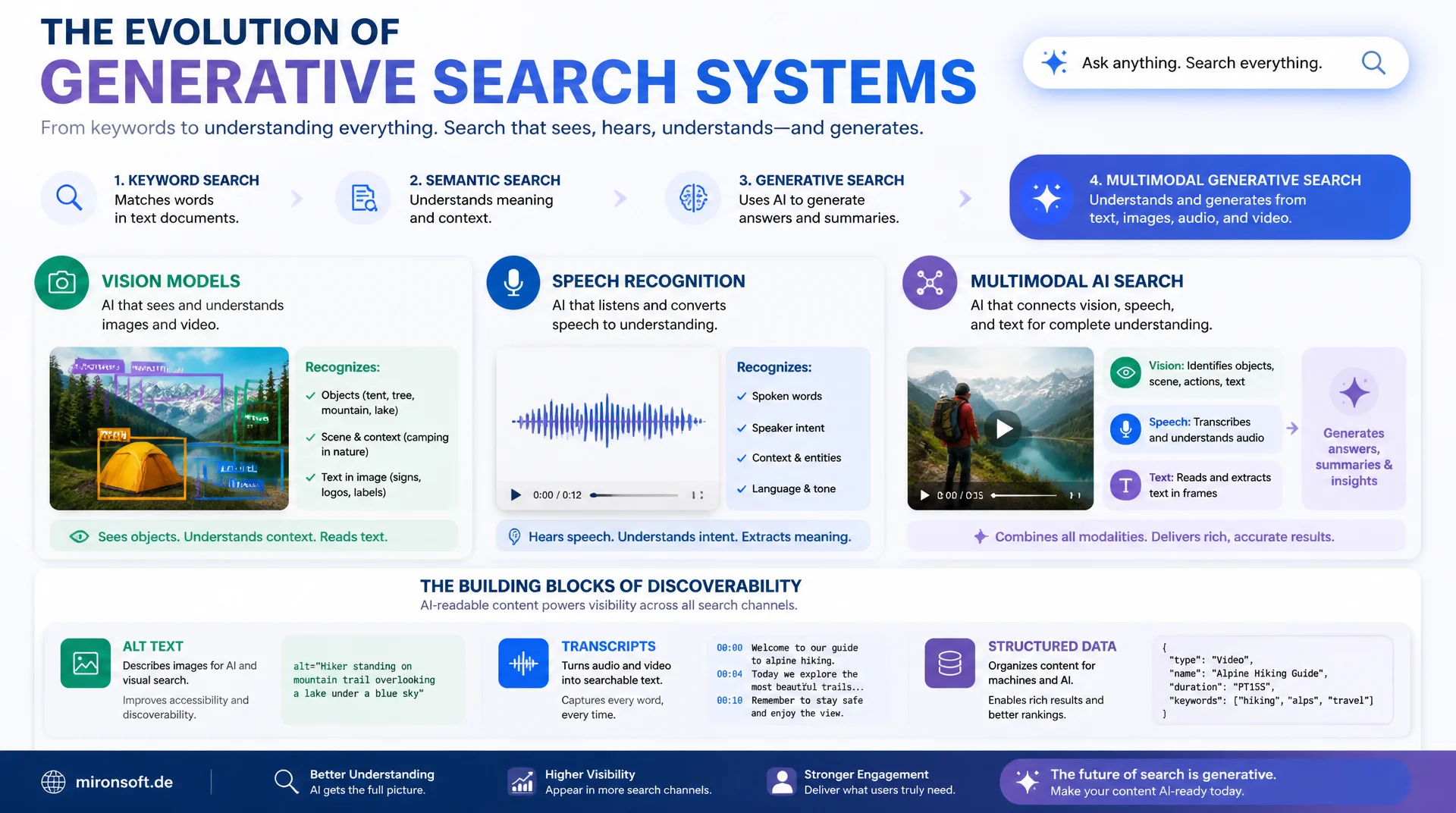
Generative search systems no longer just read text: vision models recognize objects, context and text within images, while speech recognition turns video content into searchable transcripts. Multimodal AI search increasingly treats visual content as an independent ranking factor, and anyone who neglects alt text, transcripts and structured data loses visibility in a growing search channel.
Table of Contents
- 1. Why Multimodal AI Search Deserves Its Own Chapter
- 2. How Multimodal Retrieval Systems Work
- 3. Image Understanding: What AI Systems Actually Recognize
- 4. Writing Alt Text Correctly for Multimodal AI Search
- 5. Video Understanding: Transcripts, Chapters and Visual Analysis
- 6. Structured Data for Images and Video
- 7. Technical Fundamentals: File Formats and Accessibility
- 8. Measuring Visibility of Multimodal Content
- 9. Textual vs. Multimodal Optimization Compared
- 10. Summary
- 11. FAQ
1. Why Multimodal AI Search Deserves Its Own Chapter
Classic image search worked for decades almost exclusively through text: file name, alt attribute, surrounding running text. The actual image information remained largely invisible to search algorithms. Multimodal AI search fundamentally changes this basic principle, because modern vision-language models can analyze images directly: recognizing objects, reading text within an image, understanding spatial relationships, and describing image content in natural language, all without depending on external text signals.
A similar shift applies to video. Where previously only title, description and tags were searchable, modern systems now process audio tracks through speech recognition, extract individual frames for visual analysis, and link both into searchable, time-referenceable content. Multimodal AI search therefore means not just better image search, but a fundamentally new way in which visual and audiovisual content is considered by generative answer systems.
This article shows how multimodal retrieval systems technically work, which signals actually work for images and video, and how content strategies can be adapted accordingly to stay visible in multimodal AI search.
2. How Multimodal Retrieval Systems Work
The technical core of multimodal search systems is shared embedding spaces, in which text, image and partly audio are mapped into the same mathematical representation. An image and a text passage that are topically related end up close together in this shared vector space, regardless of whether the source data was originally pixels or characters. This architecture allows a system to link a text query directly to matching images, even if the image itself has no descriptive text nearby.
Nevertheless, accompanying text remains an important additional signal, because it provides context that a model cannot reliably derive from pure pixel data alone: brand names, exact product designations, price information, or company-specific terminology are rarely correctly extractable from an image alone. Multimodal AI search therefore combines visual analysis and accompanying text into a more robust overall signal, instead of relying exclusively on one of the two sources.
{
  "multimodal_embedding_match": {
    "query": "red leather sofa Scandinavian style",
    "query_embedding_dim": 768,
    "candidates": [
      { "image_id": "sofa-red-001.jpg", "similarity": 0.87, "matched_via": "vision" },
      { "image_id": "sofa-red-001.jpg", "similarity": 0.81, "matched_via": "alt_text" },
      { "image_id": "sofa-blue-014.jpg", "similarity": 0.42, "matched_via": "vision" }
    ],
    "note": "Vision and text signals scored independently, then combined"
  }
}
3. Image Understanding: What AI Systems Actually Recognize
Modern vision models recognize several layers of an image simultaneously: individual objects and their category, spatial arrangement and relationships between objects, text within the image through optical character recognition, and stylistic features such as color scheme, image composition, and recognizable brand aesthetics. These capabilities allow a system to match a query like "red leather sofa in Scandinavian style" directly against image content, without that exact phrasing needing to appear anywhere in the accompanying text.
What matters for multimodal AI search is that image quality and clarity directly affect recognition accuracy. Blurry, cluttered, or heavily edited images make correct object recognition more difficult, while clearly photographed products with a neutral background are recognized and categorized more reliably. This observation shifts part of image SEO work away from pure metadata maintenance toward actual image quality as a technical ranking factor.
4. Writing Alt Text Correctly for Multimodal AI Search
Even though modern vision models can analyze images directly, well written alt text remains relevant, because it provides precise information that cannot be reliably derived from the image alone: exact product names, model numbers, usage context, or brand designations. Alt text like "image1.jpg" or a plain repeat of the page title, on the other hand, provides no additional value and is effectively ignored by multimodal AI search, because the vision model already extracts the same or better information from the image itself.
The most effective alt text precisely describes what is visible in the image and supplements it with information that is not visually recognizable, such as material properties not visible in the photo, or the functional context of a pictured product. This combination of visual confirmation and textual supplementation gives the multimodal model the most robust overall signal and increases the probability of correct matching for specific search queries.
<!-- Weak alt text: purely descriptive, no added information -->
<img src="sofa-red.jpg" alt="Sofa">

<!-- Better: precise, adds context not visually derivable -->
<img
  src="sofa-red.jpg"
  alt="Two-seater sofa in rust red, Nordic Oak model, recycled leather upholstery"
  width="1200"
  height="800"
  loading="lazy"
>

<!-- Best practice: pair with structured data for e-commerce context -->
<script type="application/ld+json">
{
  "@context": "https://schema.org",
  "@type": "Product",
  "name": "Nordic Oak Two-Seater Sofa",
  "image": "https://example.com/images/sofa-red.jpg",
  "material": "Recycled leather",
  "color": "Rust red"
}
</script>
5. Video Understanding: Transcripts, Chapters and Visual Analysis
Video is the most complex content type for multimodal AI search, because a system must process audio, visual frames, and temporal structure simultaneously. A complete, correctly formatted transcript is the single most important measure here, because it gives the model the entire spoken content in searchable text form, including technical terms that automatic speech recognition without context would easily transcribe incorrectly.
Chapter markers with precise timestamps considerably extend this benefit, because they allow the system to link a user question directly to a specific time segment in the video, instead of returning only the entire video as a whole. A user asking "how do I install the module" benefits from an answer that points directly to the minute in the video where installation is shown, rather than to a twenty minute video with no further orientation.
{
  "@context": "https://schema.org",
  "@type": "VideoObject",
  "name": "Magento Module Installation Step by Step",
  "description": "Complete guide to installing a Magento 2 module via Composer.",
  "thumbnailUrl": "https://example.com/thumbnails/module-install.jpg",
  "uploadDate": "2026-06-15",
  "duration": "PT12M30S",
  "transcript": "In this video we show the installation of a Magento 2 module...",
  "hasPart": [
    {
      "@type": "Clip",
      "name": "Running composer require",
      "startOffset": 45,
      "endOffset": 180,
      "url": "https://example.com/video#t=45"
    },
    {
      "@type": "Clip",
      "name": "Setup upgrade and cache clear",
      "startOffset": 180,
      "endOffset": 320,
      "url": "https://example.com/video#t=180"
    }
  ]
}
6. Structured Data for Images and Video
Structured data serves the same function for multimodal content as it does for text: it provides a machine-readable, redundant confirmation of what is already visible, reduces ambiguity, and eases a system's assignment of metadata such as duration, publication date, or licensing information. For images, ImageObject is most relevant, for video VideoObject, supplemented with properties such as contentUrl, uploadDate, and, where available, transcript.
A frequently overlooked aspect is consistency between visible content, alt text, and structured data. If these three sources contradict each other, for example when the schema states a different video length than the actual file, a system's overall trust in the accuracy of the metadata decreases, which can negatively affect visibility in multimodal AI search. Regular technical audits that validate structured data against actual media properties are therefore part of a solid multimodal content strategy.
{
  "@context": "https://schema.org",
  "@type": "ImageObject",
  "contentUrl": "https://example.com/images/sofa-red.jpg",
  "name": "Nordic Oak Two-Seater Sofa in Rust Red",
  "description": "Two-seater sofa, recycled leather upholstery, Scandinavian design",
  "width": 1200,
  "height": 800,
  "license": "https://example.com/license",
  "acquireLicensePage": "https://example.com/license"
}
7. Technical Fundamentals: File Formats and Accessibility
Before content optimization can even take effect, images and video must be technically accessible to crawlers. That means: no offloading of critical visual content into JavaScript-rendered canvas elements without a fallback, modern but broadly supported formats such as WebP or AVIF for images, and for video a directly retrievable contentUrl instead of a source only loadable through player interaction.
Load time also plays an indirect but relevant role: if a training crawler or live retrieval system has a time budget per page, excessively large, uncompressed media files reduce the probability that a page's entire content is fully processed within that budget. Compressed but high quality media is therefore not only a classic performance factor but also relevant for complete capture by multimodal AI search.
A frequently underestimated foundation is the consistent use of image and video sitemaps in addition to the classic XML sitemap. A dedicated image or video sitemap explicitly signals to a crawler which media files belong to a page, even when they are technically loaded asynchronously, reducing the risk that relevant visual content is simply overlooked during crawling.
<!-- Video sitemap entry, supplements the classic XML sitemap -->
<url>
  <loc>https://example.com/module-installation-guide</loc>
  <video:video>
    <video:thumbnail_loc>https://example.com/thumbnails/module-install.jpg</video:thumbnail_loc>
    <video:title>Magento Module Installation Step by Step</video:title>
    <video:description>Complete guide to module installation via Composer.</video:description>
    <video:content_loc>https://example.com/videos/module-install.mp4</video:content_loc>
    <video:duration>750</video:duration>
  </video:video>
</url>
8. Measuring Visibility of Multimodal Content
Measuring multimodal GEO effect follows a similar logic as with pure text, but requires additional prompt variants that explicitly ask for image or video content, such as "show me an example of X" or "is there a video explaining Y". These prompts are run against AI search systems that support multimodal answers, and the results are checked for whether your own images or videos are referenced or embedded.
In addition, analyzing referrer traffic from multimodal search interfaces, where technically capturable, provides an additional signal. An increase in sessions that start directly at a video timestamp or an image detail page indicates that a multimodal retrieval system is actually using your page as a source for a visual or audiovisual excerpt, regardless of whether an accompanying text excerpt was also cited.
A third measurement signal is the manual spot check: regularly running relevant image and video prompts against several AI search interfaces and documenting whether and in what form your own media content appears reveals gaps that automated metrics alone do not show. This manual check is especially worthwhile in the first weeks after publishing new video or image content, to detect early whether the technical setup actually worked before more resources flow into further multimodal content.
9. Textual vs. Multimodal Optimization Compared
The following table contrasts central optimization measures for pure text with the corresponding measures for multimodal AI search.
| Goal | Textual Measure | Multimodal Measure |
|---|---|---|
| Describe content | Clear paragraphs, semantic HTML | Precise alt text plus image quality |
| Make structure machine-readable | Article/FAQPage schema | ImageObject/VideoObject schema |
| Ease extraction | Core claim at start of paragraph | Chapter markers with timestamps |
| Full content capture | Clean HTML without rendering blockers | Directly retrievable media URLs |
| Measure effect | Prompt set with text questions | Prompt set with image/video queries |
Both columns do not exclude each other but complement each other: a page with strong text but weak multimodal optimization gives away visibility in a growing share of generative search queries that explicitly ask for visual content.
Mironsoft
Image and video SEO, structured data and multimodal GEO audits
Are your images and videos even visible to AI search systems?
We check alt text, transcripts and structured data for your media content, add missing VideoObject and ImageObject schemas, and set up the technical fundamentals for multimodal visibility.
Media Audit
Systematically check alt text, transcripts and file formats
Schema Implementation
Set up ImageObject and VideoObject with chapter markers
Multimodal Tracking
Build prompt sets with image and video queries
10. Summary
Multimodal AI search increasingly treats images and video as an independent source of information, not just a supplement to text. Vision-language models recognize objects, text and context directly in an image, while speech recognition and chapter structure turn video into searchable, time-referenceable content. Alt text and structured data remain relevant because they provide information that cannot be reliably derived from pure pixel or audio data.
Anyone taking multimodal visibility seriously combines precise alt text with high quality imagery, complete transcripts with precise chapter markers, and valid ImageObject as well as VideoObject schemas that stay consistent with the visible content. This combination unlocks a growing share of generative search queries that explicitly ask for visual or audiovisual answers, which text optimization alone cannot reach.
Multimodal AI Search, the Essentials at a Glance
Images Are Understood Directly
Vision models recognize objects, text and style in an image, independent of accompanying text.
Alt Text Supplements, Not Describes
Effective alt text provides information not visually recognizable, instead of repeating the obvious.
Transcripts and Chapters for Video
Complete transcripts with timestamps allow precise answers pointing to specific video segments.
Consistency Matters
Structured data must match visible content and actual media properties.