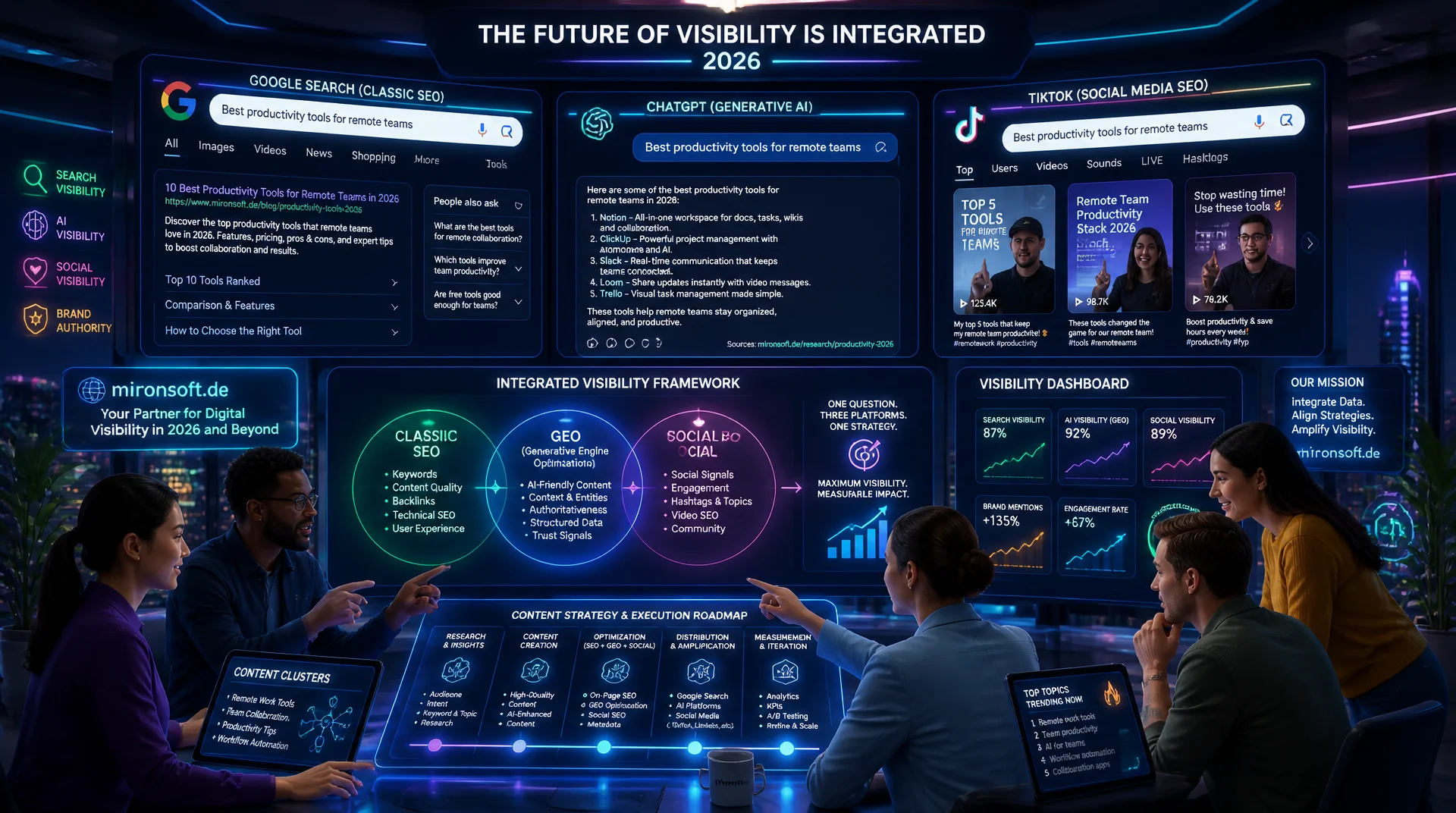
one framework instead of three separate silos
Classic search engine optimization, generative AI search and social media visibility are increasingly merging into a single, connected visibility space in 2026, where the same user question can be answered simultaneously through Google, ChatGPT and TikTok. This article brings together the central principles from GEO, classic SEO and social media SEO into one shared planning framework that teams can use as the basis for their annual strategy.
Table of Contents
- 1. Why an integrated strategy is necessary for 2026
- 2. The three pillars: SEO, GEO and social media SEO
- 3. Shared principles across all three pillars
- 4. The integrated planning framework in detail
- 5. The content hub model: one core, many outputs
- 6. Technical foundation for all three pillars
- 7. Prioritization: allocating resources sensibly
- 8. Success measurement across channel boundaries
- 9. Classic SEO silo versus integrated strategy
- 10. Summary
- 11. FAQ
Closing article of the series: SEO Part 2, GEO and Social.
Builds on the previous articles in the series without repeating their depth.
With framework, checklist and prioritization model.
Where this closing article fits
This post does not go deep again into any single topic of the series, such as forum visibility, content repurposing, Google Discover or crisis management. Instead it shows how these building blocks work together in an overarching framework and serves as a practical planning foundation for your own 2026 strategy.
1. Why an integrated strategy is necessary for 2026
Seeing these forces as one connected shift, rather than three unrelated trends, is the mental model this entire framework rests on.
Until a few years ago, SEO, social media and PR could be run as largely separate disciplines with their own teams, their own KPIs and their own tools. This separation is becoming increasingly impractical in 2026 because the boundaries between channels are blurring both technically and from a user perspective. A Reddit thread ranks on Google, a blog post gets cited as a source in an AI answer, a Google Discover entry behaves like a social feed post, and a social media crisis changes classic brand search. This series has examined each of these connections individually, this article brings them together into an integrated strategy.
The practical reason for integration is resource efficiency. When three separate teams independently produce content for the same audience, redundancy, inconsistent messaging and missed synergies result. An integrated framework ensures that a single thorough piece of research simultaneously feeds an SEO-optimized blog post, GEO-suitable, citable statements and several social media formats, instead of every team starting from scratch.
The strategic reason is resilience. An integrated strategy reduces dependency on any single channel. When a Google algorithm update shakes up classic search visibility, the presence built through GEO and social remains intact. When a social media platform changes its rules, the SEO foundation continues to carry visibility. For 2026, it is therefore advisable to understand all three pillars as parts of one system, not as competing budget line items.
2. The three pillars: SEO, GEO and social media SEO
Each pillar deserves its own expertise, but none of them should be planned in isolation from the other two going forward.
Classic SEO remains the foundation the other two pillars build on: a technically clean website, clear information architecture, content clusters and backlink authority are still the base without which neither GEO nor social media SEO functions sustainably. Google rankings for core queries remain the most reliable, longest-standing traffic source in 2026, even as their relative share of the overall visibility mix declines.
GEO, generative engine optimization, addresses the growing importance of AI-generated answers. Here what matters is not the position in a results list but whether content is drawn on as a source for a synthesized answer. Clear, directly citable statements, structured data and topical authority are the central levers of this pillar, which is closely intertwined with forum visibility and E-E-A-T signals, as earlier articles in this series have shown.
Social media SEO makes up the third pillar: the deliberate optimization of social media presence for visibility both within the platforms and as a feeder into classic search and GEO. Content repurposing, Google Discover, crisis management and forum engagement are building blocks of this pillar, ensuring a brand stays present across the entire information ecosystem, not just on its own website.
3. Shared principles across all three pillars
Why these principles work across channels
All three pillars were originally built for different technical systems, search index, language model, recommendation algorithm, but at their core evaluate similar signals: demonstrable expertise, structural clarity and genuine user interest. This convergence is the real reason an integrated strategy works, rather than simply juxtaposing three arbitrary tactics.
Despite different technical mechanisms, SEO, GEO and social media SEO share several overarching principles that serve as the common denominator for the integrated strategy. The first principle is E-E-A-T, Experience, Expertise, Authoritativeness, Trustworthiness. Classic SEO evaluates E-E-A-T via backlinks and author profiles, GEO via citable, verifiable statements, social media SEO via community reputation and authentic engagement. In all three cases the underlying question is identical: can this source be trusted.
The second shared principle is structural clarity. Clear headings, well-organized paragraphs and structured data equally help classic search with crawling, language models with extracting citable statements, and social media users with quickly grasping the core message. The third principle is freshness and continuity: regularly updated, maintained content performs better across all three pillars than content created once and then neglected.
4. The integrated planning framework in detail
The four phases below are meant to run as a continuous loop, not a one-time project with a fixed end date.
The framework proposed here organizes content planning into four phases that serve all three pillars simultaneously. Phase one, topic research, identifies topics based on three parallel signal sources: classic keyword research for SEO, questions actually asked in AI chats for GEO, and trend and discussion analysis from social media platforms and forums. A topic showing signals in all three sources gets the highest priority for integrated content production.
Phase two, content creation, produces a detailed core article that simultaneously meets SEO requirements, GEO-suitable, clearly citable statements, and repurposing potential for social media formats. Phase three, distribution, spreads the content in staggered fashion across website publication, social media formats and targeted forum engagement, as described in detail in previous articles in this series. Phase four, monitoring, tracks performance across all three pillars and feeds the findings back into the next round of topic research.
{
  "integrated_framework_2026": {
    "phase_1_topic_research": [
      "classic keyword research",
      "AI chat question analysis for GEO",
      "social media trend and forum analysis"
    ],
    "phase_2_content_creation": {
      "core_article": "SEO-optimized, GEO-citable, repurposing-ready",
      "minimum_word_count": 1200,
      "structure": "clear H2 outline, direct answer sentences, sourced claims"
    },
    "phase_3_distribution": [
      "website publication with schema markup",
      "staggered social media repurposing over 3-4 weeks",
      "targeted forum engagement in relevant communities"
    ],
    "phase_4_monitoring": [
      "classic rankings via Search Console",
      "GEO citations via AI answer monitoring",
      "social media engagement and Discover report"
    ]
  }
}
5. The content hub model: one core, many outputs
Reference to deeper articles in the series
The concrete process for deriving carousels, video scripts and threads from a core article is covered in detail in the content repurposing article of this series and is deliberately not repeated here, to keep the focus on the overarching framework.
The content hub model is the structural foundation that makes an integrated strategy practically implementable. Instead of creating separate content from scratch for every channel, a thorough, well-researched core article emerges as the central knowledge source from which all further formats are systematically derived. This core article lives on the company's own website, is SEO-optimized, and simultaneously delivers the clearly formulated, verifiable statements that are decisive for GEO citations.
From this core, as detailed in the content repurposing article of this series, carousel slides, short video scripts and threads are derived that generate additional reach on social media platforms and drive traffic back to the core article. At the same time, the same core article serves as the basis for targeted engagement in relevant forums like Reddit or Quora, where well-founded expert answers to related questions make natural references to the core article possible.
The decisive advantage of this model lies in consistency: all derived formats carry the same core message, adapted per format, instead of contradictory or diluted messages across different channels. This consistency strengthens both classic brand perception and technical recognizability for search engines and AI systems, which classify the same core statements across multiple sources as confirmed and trustworthy.
{
  "content_hub_model": {
    "core_article": {
      "minimum_word_count": 1200,
      "citable_statements": true,
      "schema_markup": "Article"
    },
    "derived_formats": ["carousel", "short video script", "thread", "forum answer"],
    "consistency_check": "same core message across all formats"
  }
}
6. Technical foundation for all three pillars
This foundation is typically built once and then continuously maintained, instead of being decided from scratch for every new article.
A shared technical foundation substantially reduces duplicate work. A consistently maintained Organization schema with correct sameAs links to all relevant social media profiles simultaneously supports classic SEO, GEO entity mapping and the credibility of social media presences. A consistent author schema with visible expertise information strengthens E-E-A-T across all three pillars, from Google rankings through GEO citability to Quora answer performance.
The UTM tracking system should also be built consistently across channels, so traffic flows from social media repurposing, forum engagement and classic search can be combined into a single shared report, instead of being viewed separately in isolated channel dashboards. This technical integration is usually the most involved but also the most durable part of introducing the framework, because it lays the foundation for all subsequent optimization decisions.
<!-- Checklist for the shared technical foundation -->
<!--
  1. Organization schema with complete sameAs links
  2. Author schema with visible expertise on every article
  3. Uniform UTM conventions across all channels
  4. Article schema with correct date on every core article
-->
| Technical building block | Benefit for SEO | Benefit for GEO | Benefit for social media SEO |
|---|---|---|---|
| Organization schema | Knowledge graph mapping | Correct entity reference | Verified profile linking |
| Author schema | E-E-A-T signal | Increased citability | Credibility in forums |
| UTM conventions | Channel attribution | Citation traceability | Measurable format performance |
| Article schema | Rich snippet eligibility | Freshness signal | Discover compatibility |
7. Prioritization: allocating resources sensibly
Realistic timeline for small teams
A team of two to three people can usually roll out the framework within a quarter for the three to five most important topic clusters, without completely disrupting existing processes. Full scaling across the entire content portfolio typically takes longer and should happen iteratively.
Not every company can run all three pillars with equal intensity, which is why prioritization is a central part of the framework. Companies with limited resources should first secure the technical SEO foundation, since GEO and social media SEO are significantly less effective without it. Only on a solid SEO base does targeted investment in GEO-suitable content structures and systematic social media repurposing pay off.
Common prioritization mistakes
A common mistake is evaluating topics exclusively by classic search volume while ignoring GEO and social signals. Conversely, orienting purely around viral social media trends without a connection to sustained search interest often leads to short-lived, non-cumulative content.
A pragmatic prioritization model evaluates every potential topic along three dimensions: search volume for classic SEO, frequency of related questions in AI chat interfaces for GEO potential, and existing discussion intensity on social media platforms and forums for social media SEO potential. Topics with high scores in at least two of these three dimensions offer the best return on investment for integrated content production and should be prioritized in the 2026 annual plan.
{
  "prioritization_model": {
    "dimension_seo": "classic search volume",
    "dimension_geo": "frequency in AI chat questions",
    "dimension_social": "discussion intensity social and forums",
    "rule": "at least 2 of 3 dimensions high = high priority"
  }
}
8. Success measurement across channel boundaries
Cross-channel success measurement requires a set of metrics that goes beyond classic SEO figures like rankings and organic traffic. For GEO, standardized, widely available analysis tools are still completely missing, which is why many teams run manual spot checks in common AI chat interfaces to verify whether and how their own brand is cited for relevant questions. This manual component remains a necessary, if inconvenient, part of success measurement in 2026.
For social media SEO, engagement rates, swipe-through rates and the UTM-tracked flow-back rate to the company's own website are the most relevant indicators, as detailed in the content repurposing article of this series. A consolidated, monthly report that presents rankings, GEO citation spot checks and social media flow-back together gives teams the overview necessary for sound strategic decisions, instead of having to interpret isolated channel reports separately.
{
  "monthly_reporting": {
    "seo_metrics": ["rankings", "organic traffic"],
    "geo_metrics": ["manual citation spot checks"],
    "social_metrics": ["engagement rate", "swipe-through rate", "UTM flow-back"],
    "review_cadence": "monthly"
  }
}
9. Classic SEO silo versus integrated strategy
The following comparison summarizes the most important differences between a classic, isolated SEO approach and the integrated strategy described in this article.
| Aspect | Classic SEO silo | Integrated strategy 2026 |
|---|---|---|
| Content production | Separate teams, redundant research | One core article, systematically derived formats |
| Visibility space | Classic Google results only | Search, AI answers, feeds, forums |
| Risk profile | High dependency on one channel | Diversified, more resilient to updates |
| Success measurement | Rankings and organic traffic | Rankings, GEO citations, social flow-back |
| Technical foundation | Isolated schema implementation | Consistent cross-channel markup |
This comparison makes clear that an integrated strategy does not mean investing more resources into every single channel, but distributing existing resources more efficiently through a shared framework. For 2026, it is advisable to approach this transition step by step, starting with the content hub model for the most important topic clusters, rather than attempting a complete reorganization of all teams and processes at once.
Mironsoft
Integrated SEO, GEO and social media strategy for 2026
Put your 2026 visibility strategy on one shared foundation?
We develop an integrated planning framework that brings your content hub model, technical schema foundation and cross-channel reporting together for SEO, GEO and social media SEO.
Framework workshop
Develop shared topic research and a prioritization model for 2026
Technical foundation
Build consistent cross-channel schema markup and UTM tracking
Reporting dashboard
Combine rankings, GEO citations and social flow-back in one view
10. Summary
For 2026, classic SEO, generative engine optimization and social media SEO are increasingly merging into a single, connected visibility space. Instead of running three separate silos, an integrated strategy brings the shared principles of E-E-A-T, structural clarity and freshness together in a content hub model, where a thoroughly researched core article simultaneously feeds SEO, GEO and social media formats.
A shared technical foundation of schema markup and cross-channel UTM tracking reduces duplicate work and enables cohesive reporting. Prioritizing topics that show signals across multiple pillars simultaneously secures the best return on investment, while a step-by-step rollout, starting with the most important topic clusters, makes the transition practically manageable. This series has covered the individual building blocks in detail, this integrated framework is the frame in which they should work together in 2026.
Integrated SEO and Social Media Strategy 2026: The Essentials at a Glance
Three pillars, one system
SEO, GEO and social media SEO share common principles and should be planned as an integrated system.
Content hub model
A thoroughly researched core article systematically feeds all derived formats and channels.
Shared technical foundation
Consistent schema markup and UTM tracking reduce duplicate work and enable unified reporting.
Prioritize by signal strength
Topics with signals across multiple pillars simultaneously deliver the best return on investment.