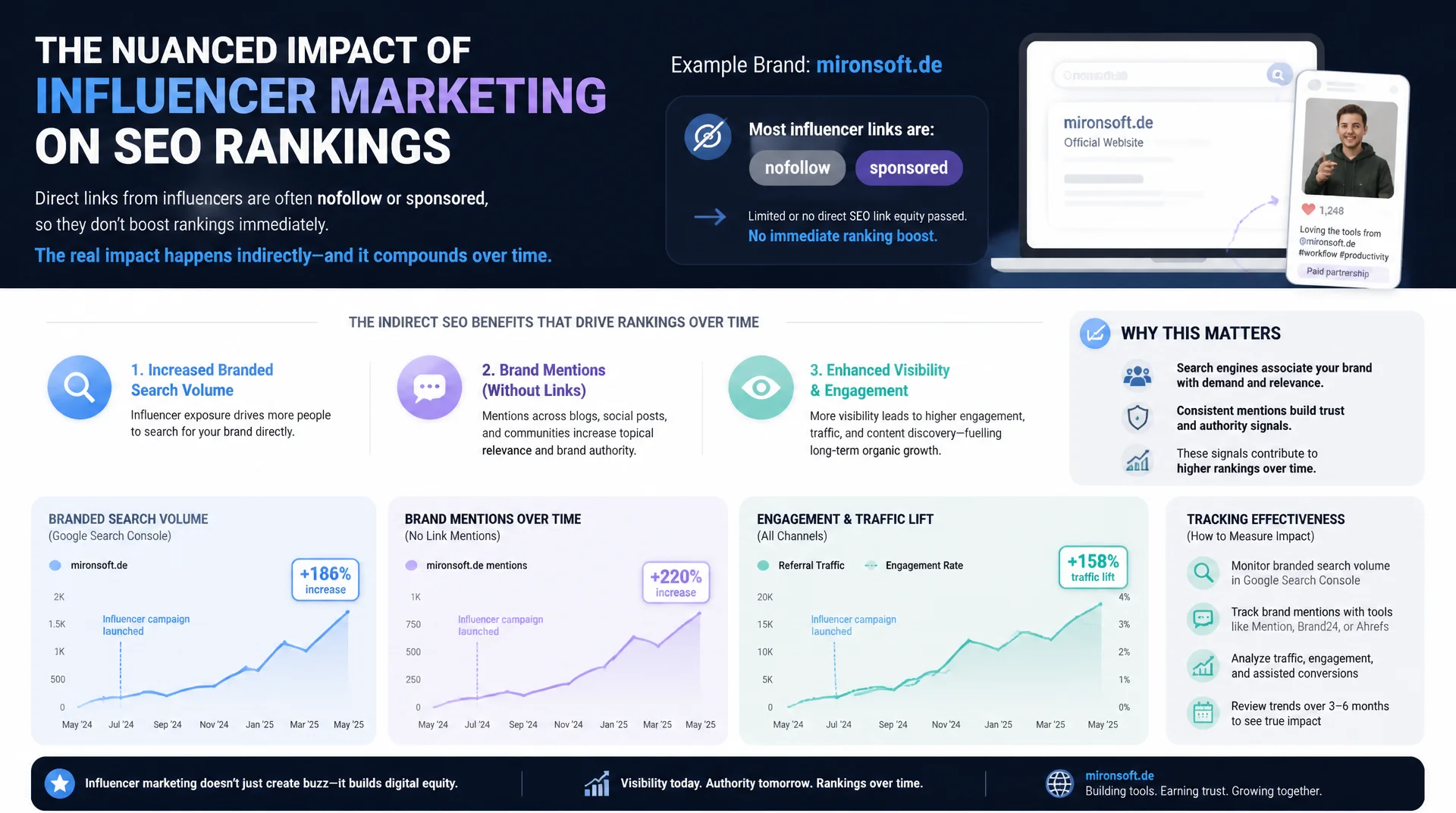
between expectation and measurable impact
Influencer marketing rarely changes a domain's ranking directly, because most collaboration links are marked nofollow or sponsored. The real SEO value emerges indirectly through rising branded search volume, brand mentions without a link, and additional visibility that only becomes visible with clean tracking.
Table of Contents
- 1. What influencer marketing can really deliver for SEO
- 2. Backlink reality: nofollow, sponsored and Google link guidelines
- 3. Branded search as the real goal of influencer marketing
- 4. Brand mentions without a link: co-citation and entity signals
- 5. Micro, macro and nano influencers compared
- 6. Campaign tracking: UTM parameters and GA4 setup
- 7. Product pages, discount codes and landing pages as measurement points
- 8. Common mistakes when evaluating influencer effects
- 9. Influencer channel types compared
- 10. Summary
- 11. FAQ
1. What influencer marketing can really deliver for SEO
Selling influencer marketing as a fast track to better rankings sets expectations that are rarely met. The campaigns work on SEO almost exclusively indirectly: through added brand awareness, through traffic spikes, and through a rising number of users who afterward type the brand name into search on purpose. A direct, short-term ranking boost from a single collaboration is unrealistic, no matter how large the account's reach is.
That does not mean influencer marketing is worthless for SEO. It means the effect becomes visible on a different timeline and through different metrics than classic link building. Where an editorial backlink from a topically relevant domain is a relatively direct authority signal, the effect of influencer marketing emerges through many small touchpoints: a reel that shows a product page, a story that names a brand, a comment that repeats the brand name.
The most important step before any campaign is therefore expectation management. Anyone who treats influencer marketing as a complement to content-driven SEO work measures the right metrics from the start: branded search volume, direct visits, time on linked pages, and the development of brand mentions over time. Anyone who instead only watches domain rating changes will be disappointed and will draw the wrong conclusions from what is actually a successful campaign.
2. Backlink reality: nofollow, sponsored and Google link guidelines
The vast majority of links created through influencer marketing should, according to Google's own guidelines, correctly carry rel="sponsored", because they were created in exchange for compensation. A link in an Instagram bio or a TikTok profile does not even count as a crawlable, followable link in the classic sense, because these platforms handle outbound links technically differently from a normal website. Anyone expecting direct link equity here overestimates the technical reality of the platforms.
Correct attribution is still worthwhile, because Google can impose manual actions against the linked domain if paid links are consistently mislabeled as editorial links, that is, without sponsored or nofollow. Clean influencer marketing therefore also means insisting on correct link attributes with collaboration partners, even though this creates no direct PageRank flow. The transparency protects against penalties and builds trust with a community that reacts increasingly sensitively to unmarked advertising.
<!-- Correct link attribution for influencer/sponsored content -->

<!-- Paid or compensated collaboration link -->
<a href="https://shop.example.com/product" rel="sponsored noopener">
  View product page
</a>

<!-- User-generated content link (e.g. comment section, review) -->
<a href="https://shop.example.com/product" rel="ugc noopener">
  View product page
</a>

<!-- Generic untrusted link, no compensation but no editorial trust either -->
<a href="https://shop.example.com/product" rel="nofollow noopener">
  View product page
</a>

<!-- WRONG: treated as an unmarked, fully trusted editorial link by Google -->
<a href="https://shop.example.com/product">View product page</a>
For your own domain, it is worth regularly checking in Google Search Console which external domains actually link to your product pages. This makes it possible to tell whether a collaboration actually set a link and whether it was attributed correctly. This check is part of a credible influencer marketing report and prevents wrong expectations from being passed on to your own team or agency.
3. Branded search as the real goal of influencer marketing
The metric shift is decisive: instead of counting backlinks, you should watch the development of branded search volume for influencer marketing. If a campaign runs and, in the days after, the number of search queries for the exact brand name or for combinations of brand name and product name rises, that is a far more reliable signal of impact than a single nofollow link. Google interprets rising, stable search volume for a brand as evidence of real relevance and trust in the market.
Google Search Console provides the raw data for this analysis through the "Performance" report, filtered for queries containing the brand name. A before-and-after comparison over a period of two to four weeks around the campaign window shows whether influencer marketing actually brought new users into search, rather than just generating short-lived direct traffic on the platform itself.
{
  "comment": "Simplified Search Console query comparison, brand queries only",
  "query_filter": "contains 'brandname'",
  "period_before_campaign": {
    "date_range": "2026-06-01 to 2026-06-14",
    "clicks": 1180,
    "impressions": 9400,
    "avg_position": 2.1
  },
  "period_during_after_campaign": {
    "date_range": "2026-06-22 to 2026-07-05",
    "clicks": 2340,
    "impressions": 16200,
    "avg_position": 1.6
  },
  "delta": {
    "clicks_percent": 98.3,
    "impressions_percent": 72.3,
    "interpretation": "Clear rise in branded search volume after the influencer campaign"
  }
}
Cleanly separating seasonal effects or parallel campaigns matters. Anyone evaluating influencer marketing should isolate the campaign period as much as possible and document other marketing activity in the same window, so the attribution of the effect remains traceable and is not based on pure correlation.
4. Brand mentions without a link: co-citation and entity signals
An often underestimated effect of influencer marketing is the plain text mention of the brand, without any link being set at all. Google increasingly processes web content through an entity model in which a brand is recognized as a distinct, identifiable entity, regardless of whether a hyperlink is present. Frequent, consistent mentions of a brand in connection with certain topics or product categories strengthen this entity association, similar to how classic co-citations work for academic publications.
These signals cannot be read directly in Search Console, but they correlate with an improved topical classification of your own domain over time. Structured data helps to reinforce this entity technically as well, for instance through the sameAs attribute in the Organization schema, which explicitly links your own social profiles to the brand.
<script type="application/ld+json">
{
  "@context": "https://schema.org",
  "@type": "Organization",
  "name": "Example Brand GmbH",
  "url": "https://shop.example.com",
  "sameAs": [
    "https://www.instagram.com/examplebrand",
    "https://www.tiktok.com/@examplebrand",
    "https://www.facebook.com/examplebrand",
    "https://www.youtube.com/@examplebrand"
  ]
}
</script>
Important for a clean influencer marketing setup: the spelling of the brand used across all channels should be identical, including capitalization and special characters. Inconsistent spelling makes it harder for search engines to attribute different mentions to the same entity, and it dilutes exactly the effect a campaign is meant to achieve.
5. Micro, macro and nano influencers compared
The size of the collaboration partner significantly changes the type of SEO effect that influencer marketing produces. Macro influencers with six to seven figure reach produce short-term, high traffic spikes and a noticeable but quickly fading rise in branded search volume. Nano and micro influencers with a few thousand to low tens of thousands of followers produce smaller individual spikes, but often a more credible, higher-converting audience, because the perceived closeness to the target group is greater.
For sustainable SEO effects, a combination of many micro collaborations over a longer period is usually more effective than a single large campaign. Continuous, smaller mentions produce a more even, stable branded search volume, instead of a single spike that falls back to baseline after a few days. This consistency is more valuable from an SEO perspective, because search engines value constant demand as a stronger relevance signal than a one-time surge.
6. Campaign tracking: UTM parameters and GA4 setup
Without clean tracking, the effect of influencer marketing cannot be distinguished from organic growth or other campaigns. Every link a collaboration partner uses should carry clear UTM parameters that clearly name source, medium and campaign name. A fixed naming convention is important, so evaluations across multiple collaborations remain comparable instead of every campaign getting its own, inconsistent scheme.
// UTM naming convention for influencer campaigns
// Format: utm_source=influencer_[handle], utm_medium=social,
//         utm_campaign=[product_line]_[year-month]

const campaignLink =
  "https://shop.example.com/product/sneaker-model-x" +
  "?utm_source=influencer_mariam_style" +
  "&utm_medium=social" +
  "&utm_campaign=sneaker_2026-07" +
  "&utm_content=reel_swipe_up";

// GA4 config: mark influencer traffic as its own channel group
// (gtag.js snippet, loaded once per page)
gtag("config", "G-XXXXXXXXXX", {
  custom_map: { dimension1: "influencer_handle" }
});

gtag("event", "campaign_click", {
  influencer_handle: "mariam_style",
  campaign_name: "sneaker_2026-07"
});
In GA4, these parameters can be grouped into a custom channel group report, so influencer marketing appears as its own channel next to Organic Search, Organic Social and Paid Social, instead of disappearing into a generic "Referral" category. That is the prerequisite for comparing conversion rates and visibility effects of individual collaborations cleanly.
7. Product pages, discount codes and landing pages as measurement points
Alongside UTM links, individual discount codes help attribute the effect of influencer marketing even when users do not click the link directly but return to the page manually later. A code like "MARIAM10" can be uniquely attributed to a collaboration at checkout, regardless of device or browser, which is a realistic problem especially with mobile in-app browsers.
Dedicated, campaign-specific landing pages are another effective tool. Instead of linking directly to the generic product page, influencer marketing benefits from a landing page that picks up the context of the collaboration, for instance with a short quote or image from the influencer. This raises the conversion probability and at the same time provides a cleanly isolated URL for traffic analysis, without relying solely on UTM parameters as the only data source.
8. Common mistakes when evaluating influencer effects
The most common mistake is measuring influencer marketing exclusively by the number of backlinks gained. Since most links are nofollow or not crawlable at all anyway, this measurement method almost always leads to a seemingly disappointing result, even though the campaign was substantively successful. A second common mistake is missing or inconsistent UTM tracking, which makes the entire effect disappear into the generic direct or referral category and become unreconstructable.
// WRONG: no tracking parameters, effect becomes invisible in analytics
const badLink = "https://shop.example.com/product/sneaker-model-x";

// WRONG: inconsistent naming across campaigns, breaks channel grouping
const inconsistentLink1 = "?utm_source=insta&utm_medium=story";
const inconsistentLink2 = "?utm_source=Instagram&utm_medium=Story_Post";

// RIGHT: consistent, lowercase, documented naming convention
const goodLink =
  "https://shop.example.com/product/sneaker-model-x" +
  "?utm_source=influencer_mariam_style" +
  "&utm_medium=social" +
  "&utm_campaign=sneaker_2026-07";
A third mistake is too short an observation window. The effect of influencer marketing on branded search volume often only shows up with a delay of one to two weeks, when users first consume the content and only later actively search for the brand. Anyone who closes the evaluation just 48 hours after the campaign systematically underestimates the actual impact.
9. Influencer channel types compared
Not every platform and not every collaboration size delivers the same kind of SEO-relevant effect. The following overview ranks the most important channel types by their typical impact on backlinks, visibility and branded search volume.
| Channel type | Direct backlink value | Effect on branded search volume | Recommendation |
|---|---|---|---|
| Macro influencer (Instagram/TikTok) | Very low, bio link usually not crawlable anyway | Short-term high | Use for launch momentum |
| Micro influencer, topically relevant | Low, sometimes dofollow via blog collaborations | Steady, cumulative | Use for sustainable growth |
| Blog and YouTube collaboration | Medium, often a real dofollow link in body text | Medium, slower build-up | Prioritize for authority and backlinks |
| Nano influencer / UGC community | Practically none | Low per person, high in aggregate | Use for social proof and authenticity |
The table shows: anyone whose goal is real, crawlable backlinks should prioritize blog and YouTube collaborations, where body text links are common. Anyone whose goal is primarily visibility and branded search volume benefits more from a broad mix of macro and micro collaborations. Influencer marketing unfolds its greatest impact when both goals are deliberately planned and measured separately.
Mironsoft
SEO tracking, attribution and campaign analysis for social media marketing
Want to evaluate influencer campaigns with solid numbers?
We build clean UTM and GA4 tracking for your influencer collaborations, connect branded search volume with campaign periods, and deliver solid reporting instead of gut feeling.
Tracking setup
UTM conventions, GA4 channel groups and discount code tracking for every collaboration
Branded search analysis
Search Console analysis to measure branded search volume around campaigns
Reporting
Understandable dashboards that show visibility instead of raw backlink counts
10. Summary
Influencer marketing rarely delivers direct backlink strength, because most collaboration links are correctly marked nofollow or sponsored, and social platforms handle outbound links technically differently from classic websites anyway. The real value emerges indirectly: through rising branded search volume, through entity signals from consistent brand mentions, and through additional visibility that only becomes cleanly isolable with proper UTM and GA4 tracking.
Anyone who wants to evaluate campaigns successfully should align expectations for influencer marketing with the right metrics from the start: branded search instead of domain rating, conversions via discount codes instead of raw click counts, and an observation window of several weeks instead of a few days. A deliberate mix of macro, micro and blog collaborations covers both the visibility and the backlink side.
Influencer marketing and SEO: the essentials at a glance
Backlink reality
Most collaboration links are nofollow or sponsored and carry little direct link equity. Blog and YouTube collaborations are the exception with real dofollow potential.
Branded search as the goal
Branded search volume in Google Search Console is the most solid indicator of a campaign's actual SEO effect.
Clean tracking
Consistent UTM parameters, individual discount codes and campaign-specific landing pages are what make effects measurable in the first place.
Channel mix
Macro collaborations for momentum, micro collaborations for consistency, blog collaborations for real backlinks.