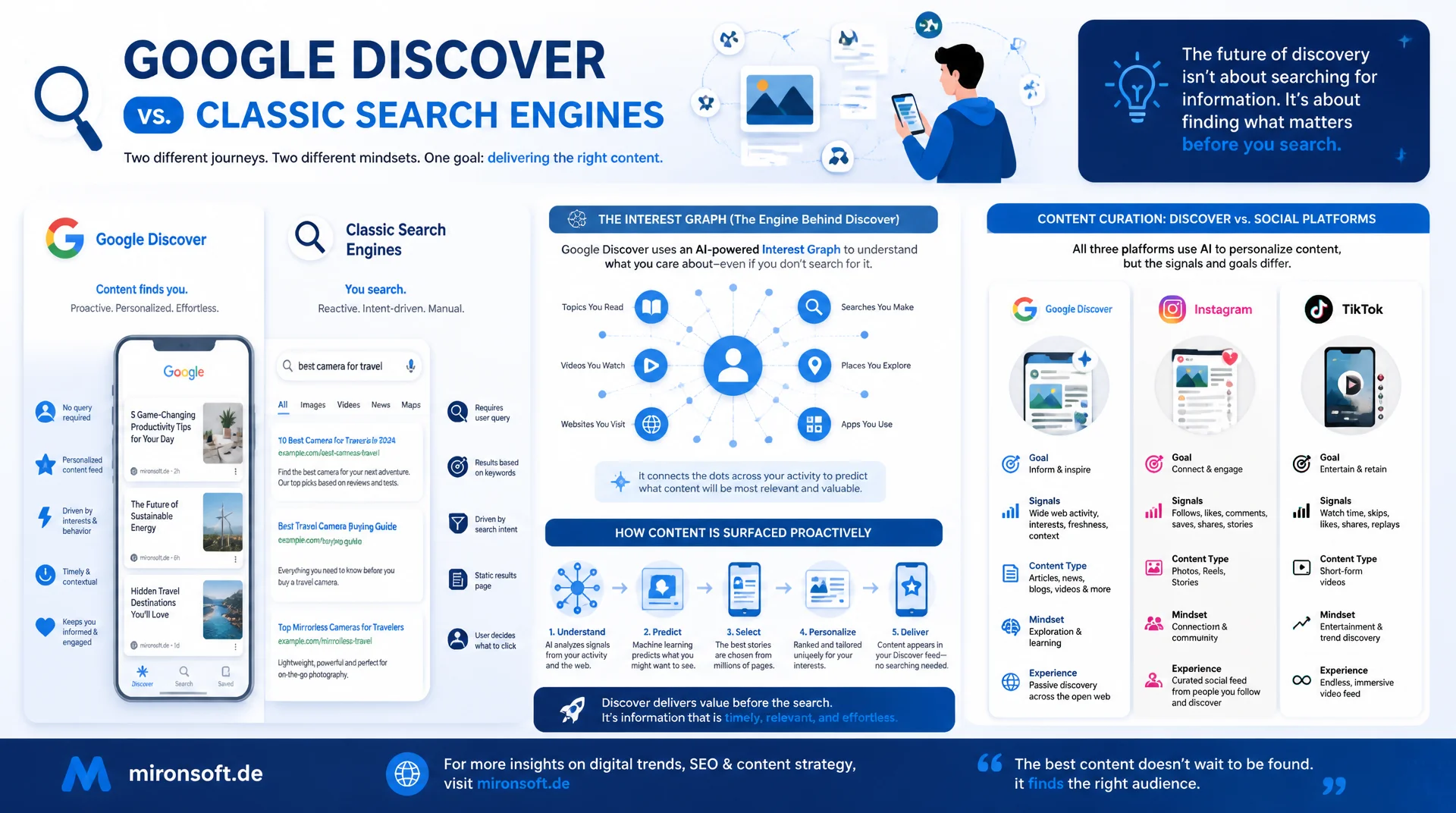
interest graph instead of keyword match
Google Discover works fundamentally differently from classic search: instead of responding to a user query, the feed proactively surfaces content based on an interest graph of user interests, much like Instagram or TikTok curate their feeds. Anyone who understands this mechanic can optimize content specifically for Discover instead of relying on classic keyword ranking.
Table of Contents
- 1. What Google Discover is and how it fits in
- 2. The interest graph: the feed logic in detail
- 3. Discover versus classic search results
- 4. Image requirements: the most important technical lever
- 5. E-E-A-T and trust signals in Discover
- 6. Content traits Discover favors
- 7. Technical setup: markup and structured data
- 8. Understanding volatility and traffic swings
- 9. Discover, classic search and social feed compared
- 10. Summary
- 11. FAQ
Part of the series: SEO Part 2, GEO and Social.
Reading time includes practical examples and checklists.
Relevant for publishers, blogs and news sites.
Focused on mobile Discover delivery.
Written for editorial and technical SEO teams alike.
Quick overview
This article focuses on the structural parallels between Google Discover and classic social feeds. Other articles in this series cover forum visibility or content repurposing separately, this post positions Discover as its own feed-based channel within the GEO and social SEO strategy.
1. What Google Discover is and how it fits in
Understanding Discover as a feed rather than a search results page is the first mental shift needed before optimizing content for it.
Availability of Google Discover
Google Discover is primarily available in the Google app on iOS and Android as well as on the mobile Google homepage of many Android devices. On desktop devices Discover plays practically no role, which heavily focuses technical optimization on mobile signals like load time and responsive rendering.
Google Discover is the personalized content feed that appears in the Google app and on the mobile homepage of many Android devices below the search bar. Unlike classic Google search, Discover is not triggered by an explicit user query. The user does not type a keyword but scrolls passively through a feed that automatically shows curated content based on their past behavior. This fundamental shift from active search to passive consumption is the core of what makes Google Discover so close to social media feeds.
For publishers, Google Discover represents an enormous, often underestimated traffic source. For many news sites and topic portals, Discover traffic accounts for a double-digit percentage of total organic traffic, sometimes even more than classic search. At the same time, this traffic is notoriously volatile: an article can receive enormous reach via Discover for a few days and then almost completely disappear, a pattern that resembles viral social media posts more than the comparatively stable rankings of classic search.
This scale makes clear why ignoring Discover in a content strategy can mean a significant, unused reach opportunity.
Many teams only discover this gap after checking the Search Console Discover report for the first time and finding traffic they never actively planned for.
Important for classification: Google Discover is not a ranking system in the classic sense with positions one through ten for a specific search query. There is no query against which a position could be measured. Instead, a relevance score per user and per moment decides whether an article appears in an individual feed or not, a principle that structurally is much closer to Facebook's newsfeed ranking or TikTok's For You feed than to the classic Google results page.
This absence of a position concept is the most important conceptual difference teams need to internalize before trying to measurably integrate Discover success into existing SEO reporting.
2. The interest graph: the feed logic in detail
The interest graph is what actually decides visibility in Discover, which is why understanding it matters more than chasing any single ranking factor.
Where the interest data comes from
Google feeds the interest graph from several signal sources: search history, watched YouTube videos, installed apps, location and past interaction with the Discover feed itself. This combination explains why two users with identical search history can still see different Discover feeds if their other usage behavior differs.
The technical foundation of Google Discover is the so-called interest graph, a model that derives an individual interest profile per user from the entire Google ecosystem: search history, YouTube behavior, app usage and past Discover interaction. This profile is dynamic and changes continuously as a user explores new topics or deepens existing interests. Unlike classic keyword ranking, there is no static search term against which content is evaluated, but an ongoing matching between content signals and individual interest profile.
This interest graph logic is why Google Discover is structurally closer to social media feeds than to classic search. Instagram, TikTok and LinkedIn also use interest profiles to proactively surface content instead of waiting for explicit queries. The decisive difference from these platforms is that Google Discover exclusively surfaces web content, primarily articles and some videos from websites, not platform-internal posts, which makes Discover one of the few feed-based channels that pays directly into classic website SEO.
For content creators this means: an article must not just be relevant to a specific search query but broadly attractive within a topic cluster, so it fits into the interest profiles of as many users as possible who are interested in that topic area. This thematic breadth differs fundamentally from the keyword precision that often takes center stage in classic SEO.
Editorial teams that already plan content clusters for classic SEO benefit doubly, because the same topic clustering also strengthens Discover reach across several related articles.
3. Discover versus classic search results
Confusing these two channels leads teams to apply the wrong optimization playbook to each, wasting effort on levers that do not move the needle.
The central structural difference between Google Discover and the classic search results page lies in the trigger. Classic search is reactive: a user formulates a query, Google matches relevant documents and delivers a ranked list. Google Discover is proactive: the feed decides without an explicit query which content is shown to a user at that moment. This proactivity means Discover traffic can arise even for topics a user would never have actively searched for, but for which their interest profile signals a high likelihood of relevance.
A second difference concerns ranking factors. While classic search relies heavily on keyword relevance, backlinks and technical SEO, Google Discover weighs freshness, visual appeal and broad topical interest significantly more. An article can rank number one in classic search for a niche keyword and still never appear in Discover if it is visually unappealing or does not address a sufficiently broad interest segment.
A third difference is the lifespan of visibility. A well-ranking blog post can generate stable search traffic for years. Discover traffic, by contrast, almost always concentrates into a narrow time window, usually a few days after publication or after a topical trigger of currency, and then drops off steeply, a pattern very similar to the lifecycle curve of a viral social media post.
This narrow time window should factor into editorial planning processes, for instance through especially careful image selection for articles whose publication is deliberately timed to coincide with an expected attention peak.
Publishing calendars that already account for seasonal or news-driven spikes can extend that same logic to Discover with only minor adjustments.
4. Image requirements: the most important technical lever
No amount of writing quality compensates for a missing or undersized image in Discover, which makes this the highest-leverage technical fix available.
No other technical factor influences Discover visibility as directly as the image. Google Discover is visually dominated, every feed entry shows a large-format image, often in a 16:9 ratio, before the user even reads the headline. Without a qualifying large image, an article is either not shown in Discover at all or displayed in a significantly less attractive, smaller format, which drastically reduces click-through rate.
Google requires an image at least 1200 pixels wide for optimal Discover display, activated via the max-image-preview:large property in the robots meta tag. Without this explicit permission, Google shows only a small preview thumbnail by default, even if a large image is technically present. This one meta tag is one of the most commonly overlooked levers for Discover visibility because many standard SEO setups do not set it automatically.
<!-- Required meta tag for large-format image display in Discover -->
<meta name="robots" content="max-image-preview:large">

<!-- Supplementary Open Graph image at sufficient resolution -->
<meta property="og:image" content="https://mironsoft.de/media/article-hero-1600x900.jpg">
<meta property="og:image:width" content="1600">
<meta property="og:image:height" content="900">
Image format recommendation
Beyond the minimum width of 1200 pixels, a 16:9 aspect ratio has proven especially reliable for full feed width. Square or portrait images are frequently cropped by Discover, which in the worst case makes important image content invisible.
Beyond pure resolution, image quality itself plays a role that Google evaluates algorithmically. Generic stock photos demonstrably perform worse in Discover than original, topically specific images. Equally important: text-heavy images, for example with large embedded headlines, tend to be downranked by Google in Discover because they look more like ad banners than editorial content, a signal that Discover explicitly derives from its quality guidelines for publishers.
Investing in original photography or custom-made illustrations therefore often pays off faster for Discover visibility than further text optimization on an already solid article.
5. E-E-A-T and trust signals in Discover
Trust signals feel abstract until they are tied to concrete, checkable page elements, which is what the rest of this section focuses on.
Why trust matters more in a passive feed
In active search, the user chooses from several results themselves. In a passive feed like Discover, Google has already made that preselection. This shifted responsibility explains why Google applies stricter E-E-A-T standards for Discover than for many classic search results, especially for topics with potential harm such as health or finance.
Because Google Discover proactively surfaces content to users without them having actively searched for it, Google bears greater editorial responsibility for the quality of the content shown compared to classic search. This responsibility manifests in tightened E-E-A-T requirements: Experience, Expertise, Authoritativeness, Trustworthiness. Websites without a recognizable author byline, without an imprint, or with unclear topical focus are shown significantly less often in Discover than in classic search.
In practice this means: a visible author name with traceable expertise, a current publication date and clear editorial transparency increase the likelihood of Discover delivery. Google's own documentation on Discover explicitly states that content that is "trustworthy, accurate and appropriate for a broad audience" is preferred, a phrasing that strongly echoes the editorial standards of classic media houses rather than pure technical SEO.
Websites that already maintain a clean author schema from classic SEO work usually do not need to build fundamentally new structures for Discover, just ensure these signals are also correctly machine-readable.
6. Content traits Discover favors
Beyond images and E-E-A-T, subtler editorial choices about topic and headline shape whether an article ever reaches a wide interest segment.
Beyond image and E-E-A-T, there are content patterns that systematically perform better in Google Discover. Timeliness is one of the strongest factors: articles that pick up an emerging topic, a current event, or a seasonal occasion receive significantly higher Discover visibility in the first days after publication than evergreen content without a current hook. This does not mean evergreen content is unsuited for Discover, but the likelihood of delivery measurably increases when an article ties into a current interest.
Headlines play a different role in Discover than in classic search. While classic SEO often relies on clear keyword presence in the title tag, Discover favors headlines that spark curiosity without feeling sensationalist, a narrow line that Google explicitly describes in its guidelines as a distinction from clickbait. Overly sensationalist headlines can even lead to a manual or algorithmic downranking of Discover visibility.
Topic breadth instead of niche precision is another pattern: an article that treats a niche topic extremely specifically may rank well in classic search for a long-tail keyword but reaches a smaller interest segment in Discover. Articles covering a broader but still clearly focused topic usually reach a larger interest segment across the Google ecosystem and thus potentially more Discover reach.
This tension between niche precision and topic breadth should be decided deliberately per article, rather than applying either strategy uniformly across the entire content portfolio.
{
  "discover_content_checklist": {
    "timeliness_present": true,
    "headline_curiosity_not_sensationalist": true,
    "topic_breadth": "cluster instead of pure niche",
    "image_quality_original": true
  }
}
7. Technical setup: markup and structured data
The technical layer is largely a checklist exercise once the editorial fundamentals are in place, which makes it a good area to hand off to a developer.
Beyond the image meta tag, Google Discover benefits from clean, structured markup, using the same foundations as classic SEO but with particular focus on Article and NewsArticle schema. A complete Article schema with correct datePublished, author, and an image property at sufficient resolution helps Google precisely capture freshness and editorial attribution, two factors that feed directly into the Discover relevance evaluation.
Core Web Vitals and mobile load time are also relevant, since Discover is exclusively surfaced on mobile devices. A slow-loading page that is clicked from the feed on a mobile device but takes several seconds to fully load results in high bounce rates, which Google can treat as a negative user signal for that publisher's future Discover placements.
These technical prerequisites overlap heavily with mobile performance best practices that are advisable anyway, so Discover optimization rarely means isolated extra work but usually complements existing technical SEO measures.
<!-- Minimum mobile Core Web Vitals targets for Discover-relevant pages -->
<!--
  Largest Contentful Paint: under 2.5 seconds
  Interaction to Next Paint: under 200 milliseconds
  Cumulative Layout Shift: under 0.1
-->
A single Core Web Vitals fix can therefore quietly improve both classic search rankings and Discover eligibility at the same time.
{
  "@context": "https://schema.org",
  "@type": "NewsArticle",
  "headline": "Google Discover: Why the Mechanics Resemble Social Feeds",
  "image": [
    "https://mironsoft.de/media/article-hero-1600x900.jpg"
  ],
  "datePublished": "2026-07-23T08:00:00+02:00",
  "dateModified": "2026-07-23T08:00:00+02:00",
  "author": {
    "@type": "Person",
    "name": "Mironsoft Editorial Team"
  }
}
8. Understanding volatility and traffic swings
Setting the right expectations about volatility upfront prevents stakeholders from misreading a normal traffic dip as a failed strategy.
Pre-publication checklist
Image at least 1200 pixels wide, max-image-preview:large set, author name visible, complete Article schema, mobile load time under three seconds. These five points cover the most common technical reasons why otherwise high-quality articles fail to appear in Google Discover.
Anyone planning Google Discover as a traffic source must accept the inherent volatility that sets this channel apart from classic search. An article can receive tens of thousands of Discover impressions on one day and drop to nearly zero the following week without anything about the article itself having changed. This volatility is not a bug in the system but a direct consequence of interest graph logic: as soon as current user interest in a topic subsides, the likelihood of delivery automatically drops, regardless of the article's continuing content quality.
For planning purposes this means treating Discover traffic realistically as bonus reach, not as a reliable base traffic source like stable keyword rankings. A diversified content portfolio that relies both on classic SEO for long-term stability and on Discover-optimized content for short-term reach spikes is more robust than one-sided dependency on either channel.
A monthly glance at the Discover report in Search Console is usually enough in practice to spot broad patterns, without falling into daily reporting micromanagement that yields little additional insight for this volatile channel.
{
  "discover_monitoring": {
    "source": "Google Search Console Discover report",
    "review_interval": "monthly",
    "metrics": ["impressions", "clicks", "CTR"],
    "comparison_window_days": 28
  }
}
Trying to explain every single day-to-day fluctuation is rarely a productive use of a team's time given how the underlying mechanism behaves.
9. Discover, classic search and social feed compared
Seeing all three channels side by side clarifies which optimization skills transfer between them and which do not.
The following overview positions Google Discover structurally between classic Google search and a typical social media feed, and shows why the mechanics are closer to the latter than the former.
| Criterion | Classic search | Google Discover | Social media feed |
|---|---|---|---|
| Trigger | Explicit search query | Interest profile, proactive | Interest profile, proactive |
| Most important factor | Keyword relevance, backlinks | Image quality, freshness, E-E-A-T | Engagement, watch time |
| Traffic stability | High, stable over months | Low, short-term spikes | Low, short-term spikes |
| Content source | Any indexed website | Any indexed website | Platform-internal posts |
| Measurable via GSC | Yes, fully | Yes, dedicated Discover report | No, platform-native analytics |
This table makes clear why Google Discover occupies a hybrid position: technically it remains tied to Google Search Console and classic website SEO, but mechanically it behaves like a social media feed. This exact hybrid status makes Discover one of the most interesting channels within an integrated GEO and social SEO strategy.
For teams already producing social media content, this means the visual and editorial discipline developed for feeds can be applied directly to Discover optimization of blog posts, without needing to build completely new processes.
Mironsoft
Google Discover optimization and integrated social SEO strategy
Unlock additional reach through Google Discover?
We optimize image formats, E-E-A-T signals and structured data for your website so content is reliably surfaced not just in classic search but also in the Discover feed.
Image audit
Check resolution, meta tags and image quality for maximum Discover visibility
E-E-A-T setup
Build author profiles, schema markup and editorial transparency
Discover monitoring
Evaluate the Search Console Discover report and adjust the content calendar
10. Summary
Bringing the previous sections together shows a consistent picture: Discover rewards the same editorial discipline that already pays off on social platforms.
Google Discover differs fundamentally from classic Google search because it works proactively instead of reactively and is based on an interest graph instead of explicit search queries. This mechanic makes Discover structurally closer to social media feeds than to classic search results pages, both in delivery logic and in traffic volatility. Image quality, activated via max-image-preview:large, timeliness and tightened E-E-A-T requirements are the most important levers for becoming visible in this feed.
Anyone treating Google Discover as its own channel within an integrated GEO and social SEO strategy, rather than as a side effect of classic search engine optimization, can deliberately unlock additional reach. The channel's inherent volatility makes it a sensible complement, not a replacement, for stable, classically ranking content.
In the end, the same fundamental principles that also apply to social media SEO, editorial quality, visual care and trust signals, pay directly into visibility within Google Discover.
Teams that already run a social media content process therefore have a natural head start when extending their strategy to cover Google Discover as well.
Google Discover: The Essentials at a Glance
Interest graph
Proactive delivery based on user interests instead of reactive keyword matching as in classic search.
Image quality as a lever
max-image-preview:large and images at least 1200 pixels wide are prerequisites for large-format feed display.
Tightened E-E-A-T requirements
Visible author bylines and editorial transparency significantly increase the likelihood of being surfaced.
Plan for volatility
Treat Discover traffic as short-term bonus reach, not as a stable base traffic source.