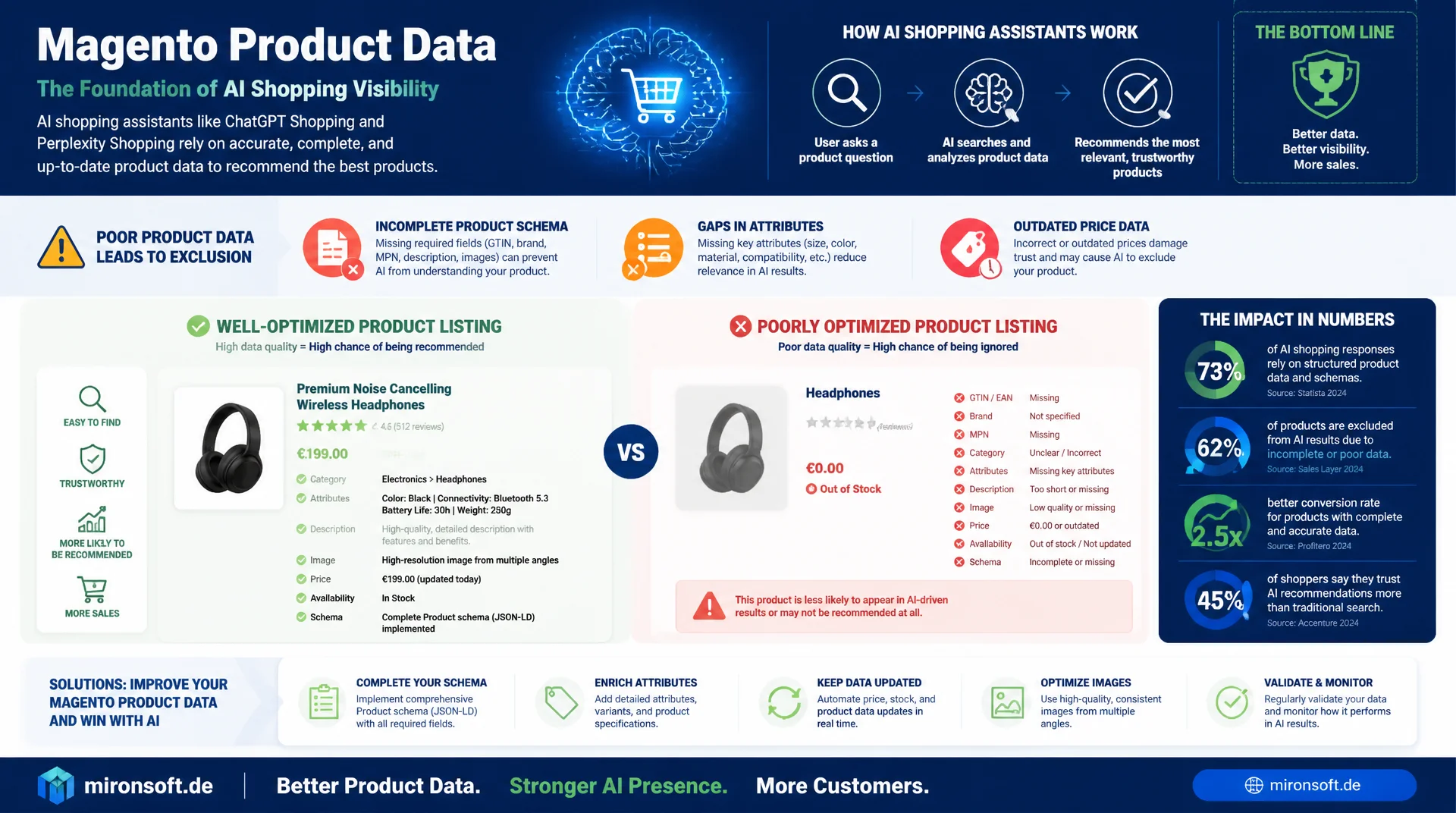
schema completeness, feed quality and Hyva implementation
Magento product data increasingly determines whether an AI shopping assistant like ChatGPT Shopping or Perplexity Shopping can even find and correctly recommend a product. Incomplete product schema, gaps in attributes, and outdated price data cause a Magento store to be excluded from AI-driven product queries, even when the product would perfectly match the request in substance.
Table of Contents
- 1. Why Magento product data is decisive for AI shopping
- 2. Rolling out complete Product schema
- 3. Implementing Schema.org output technically in Hyva
- 4. Structured attributes instead of free-text descriptions
- 5. Feed quality for Google Merchant Center and AI systems
- 6. Real-time availability and price freshness
- 7. Reviews and ratings as a trust signal
- 8. Marking up configurable products and variants correctly
- 9. Complete vs. incomplete product data compared
- 10. Summary
- 11. FAQ
1. Why Magento product data is decisive for AI shopping
AI shopping assistants answer queries like "which waterproof running shoe model is available under 100 dollars" not through classic crawling of individual product pages, but through structured access to product data, usually via a combination of Schema.org markup on the product page itself and supplementary product feeds. Magento product data that exists only in free-text descriptions, without accompanying structured markup, is significantly harder for these systems to use than fully marked-up product records with clear attributes for price, availability, size, and material.
For Magento stores this means a shift in priorities compared to classic e-commerce SEO. It is no longer enough to rank a product page for Google, the underlying Magento product data additionally needs to exist in a form an AI system can translate directly into a product recommendation, without having to extract information from unstructured text. This requirement affects several technical layers at once: the Product schema on the PDP, feed quality for external channels, and consistent attribute maintenance in the Magento backend.
This article walks through how Magento product data gets marked up correctly within a Hyva context, which attributes matter most for AI shopping answers, and how feed quality and real-time freshness can be ensured.
2. Rolling out complete Product schema
The Schema.org Product type is the central data structure through which AI shopping systems capture Magento product data in a machine-readable way. Many standard Magento installations implement a basic Product schema but leave important fields like aggregateRating, offers.availability, or offers.priceValidUntil empty or incompletely filled. For AI shopping answers, exactly these supplementary fields are often decisive, because a system, faced with several candidate products, tends to include the one with more complete, more trustworthy data in its answer.
A complete Product schema for a Magento store should include at minimum name, description, SKU, brand, image, price with currency, availability status, and, where available, aggregated ratings. It is additionally worth marking up GTIN or MPN, where maintained in the product catalog, because these identifiers allow AI systems to unambiguously map a product to a known product database, significantly increasing the likelihood of correct recommendations.
{
  "@context": "https://schema.org",
  "@type": "Product",
  "name": "TrailRunner Pro running shoe",
  "sku": "TR-PRO-42",
  "gtin13": "4006381333931",
  "brand": { "@type": "Brand", "name": "Mironsoft Sport" },
  "description": "Waterproof trail running shoe with reinforced sole for rough terrain",
  "image": "https://shop.example.com/media/catalog/product/tr-pro-42.jpg",
  "offers": {
    "@type": "Offer",
    "priceCurrency": "USD",
    "price": "89.90",
    "availability": "https://schema.org/InStock",
    "priceValidUntil": "2026-12-31",
    "url": "https://shop.example.com/trailrunner-pro.html"
  },
  "aggregateRating": {
    "@type": "AggregateRating",
    "ratingValue": "4.6",
    "reviewCount": "128"
  }
}
3. Implementing Schema.org output technically in Hyva
In a Hyva theme, Product schema is typically provided via a dedicated ViewModel that collects the relevant product data and renders it as JSON-LD on the product page, instead of using XML blocks with Knockout.js bindings as in Luma. This approach fits the general Hyva philosophy of delivering server-rendered, complete HTML responses, which also benefits AI crawlers, since no JavaScript needs to execute to reach the complete Magento product data.
For a clean implementation, a dedicated ViewModel implementing ArgumentInterface is recommended, assembling the schema data from the product, its associated pricing, and review data. Output then happens in its own phtml template dedicated exclusively to the JSON-LD markup, wired into the product detail page via layout XML, without modifying existing Hyva block structures.
<?php

declare(strict_types=1);

namespace Mironsoft\GeoProduct\ViewModel;

use Magento\Catalog\Api\Data\ProductInterface;
use Magento\Catalog\Model\Product;
use Magento\Framework\View\Element\Block\ArgumentInterface;
use Magento\Framework\Pricing\Helper\Data as PricingHelper;
use Magento\Review\Model\ResourceModel\Review\CollectionFactory as ReviewCollectionFactory;

/**
 * ViewModel providing complete Product schema data for AI shopping systems.
 */
final class ProductSchemaViewModel implements ArgumentInterface
{
    /**
     * @param PricingHelper $pricingHelper Magento pricing helper for formatted prices
     * @param ReviewCollectionFactory $reviewCollectionFactory Factory for product reviews
     */
    public function __construct(
        private readonly PricingHelper $pricingHelper,
        private readonly ReviewCollectionFactory $reviewCollectionFactory,
    ) {
    }

    /**
     * Builds the complete Product schema array for JSON-LD output.
     *
     * @param ProductInterface $product Current product on the detail page
     * @return array<string, mixed>
     */
    public function getProductSchema(ProductInterface $product): array
    {
        /** @var Product $product */
        return [
            '@context' => 'https://schema.org',
            '@type' => 'Product',
            'name' => $product->getName(),
            'sku' => $product->getSku(),
            'description' => strip_tags((string) $product->getData('short_description')),
            'offers' => [
                '@type' => 'Offer',
                'priceCurrency' => 'USD',
                'price' => $product->getFinalPrice(),
                'availability' => $product->isSaleable()
                    ? 'https://schema.org/InStock'
                    : 'https://schema.org/OutOfStock',
            ],
        ];
    }
}
4. Structured attributes instead of free-text descriptions
A common problem in grown Magento catalogs is that important product properties like material, fit, or intended use exist only in the free-text product description, instead of being maintained as their own structured EAV attributes. For AI shopping systems, free-text statements are significantly less reliably extractable than dedicated attributes, because the system first has to filter the relevant property out of a longer description text instead of reading it directly from a structured field.
The practical consequence for Magento product data: central purchase criteria of a product segment, for instance waterproofing, weight class, or target audience for running shoes, should be created as their own attributes in the attribute set and consistently maintained for every product, not just occasionally mentioned in the description. These attributes can then be output in Product schema as additionalProperty as well as used for filtering and facet navigation in the store itself, justifying the maintenance effort.
<!-- app/code/Mironsoft/GeoProduct/etc/catalog_attributes.xml -->
<!-- Additional structured attributes for AI-relevant product properties -->
<config xmlns:xsi="http://www.w3.org/2001/XMLSchema-instance"
        xsi:noNamespaceSchemaLocation="urn:magento:module:Magento_Catalog:etc/catalog_attributes.xsd">
    <group name="quote_item">
        <attribute name="waterproofing"/>
        <attribute name="weight_class"/>
        <attribute name="intended_use"/>
    </group>
</config>
5. Feed quality for Google Merchant Center and AI systems
Beyond the schema markup on the product page itself, many AI shopping systems, especially those with Google integration, additionally use structured product feeds in the Google Merchant Center format style. An incomplete or outdated feed with missing GTINs, wrong category assignments, or unsynchronized stock levels causes Magento product data to be classified as unreliable in these channels and considered less often in recommendations.
For Magento stores, a dedicated, regularly running feed generation is recommended, accessing current product data including price, stock, and attributes directly, instead of relying on a manually maintained, potentially outdated export. Correct Google product category assignment (google_product_category) is also important, because a wrong categorization can cause a product not to be considered at all for otherwise topically matching queries.
<?php

declare(strict_types=1);

namespace Mironsoft\GeoProduct\Cron;

use Mironsoft\GeoProduct\Model\ProductFeedGenerator;
use Psr\Log\LoggerInterface;

/**
 * Cron job for regular regeneration of the structured product feed.
 */
final class GenerateProductFeed
{
    /**
     * @param ProductFeedGenerator $feedGenerator Service for feed creation
     * @param LoggerInterface $logger Logger for error reporting
     */
    public function __construct(
        private readonly ProductFeedGenerator $feedGenerator,
        private readonly LoggerInterface $logger,
    ) {
    }

    /**
     * Runs the daily feed generation and logs errors.
     *
     * @return void
     */
    public function execute(): void
    {
        try {
            $this->feedGenerator->generate();
        } catch (\Throwable $exception) {
            $this->logger->error('Product feed generation failed: ' . $exception->getMessage());
        }
    }
}
6. Real-time availability and price freshness
AI shopping assistants relying on outdated price or availability data risk presenting users with incorrect information, which is why many systems prefer sources with frequent, verifiable updates. For Magento product data this means both the schema markup on the page and the external feed need to reflect actual stock and current price as close to real time as possible, instead of relying on a cache with hours of delay.
Practically this can be achieved through a combination of short cache lifetimes for price- and stock-relevant blocks and an invalidation logic that, on price changes or stock updates, deliberately clears the affected full-page cache entries instead of flushing the entire cache. In Magento with Hyva this can be implemented via targeted cache tags at the product level, so a price update in the backend regenerates the corresponding product page within seconds, without impacting the performance of the rest of the store.
<!-- app/code/Mironsoft/GeoProduct/etc/frontend/robots.xml -->
<!-- Additional robots.txt allowances for AI shopping crawlers -->
<config xmlns:xsi="http://www.w3.org/2001/XMLSchema-instance"
        xsi:noNamespaceSchemaLocation="urn:magento:module:Magento_Robots:etc/robots.xsd">
    <robots>
        User-agent: OAI-SearchBot
        Allow: /catalog/
        User-agent: PerplexityBot
        Allow: /catalog/
        User-agent: Google-Extended
        Allow: /catalog/
    </robots>
</config>
7. Reviews and ratings as a trust signal
Aggregated product ratings are an important additional signal for AI shopping systems, because they provide an independent, quantifiable quality assessment that goes beyond the pure product description. Magento product data without a maintained review module or with very few ratings appears less trustworthy to an AI system than comparable products with a meaningful number of ratings and a high average value, even if the underlying product quality is identical.
For Magento stores with a still-thin review base, an active review request after purchase completion pays off, combined with correctly implemented aggregateRating schema that only gets output above a minimum number of ratings, avoiding misleadingly small samples being presented as a supposedly reliable signal. It also matters that the rating data in the schema exactly matches the values visibly displayed on the page, because discrepancies between structured data and visible content can be interpreted by some systems as a potential trust violation.
8. Marking up configurable products and variants correctly
Configurable products with several variants, for instance different sizes or colors, present a particular challenge for schema markup, because every variant can have its own price and availability data. For correct Magento product data in this scenario, Schema.org recommends using ProductGroup with individual Product entries as hasVariant, where each variant carries its own SKU, its own availability status, and, if it differs, its own price.
In Magento practice this means building the schema generation correctly not only for the configurable parent product but also for the associated simple products, and explicitly mapping the relationship between them via isVariantOf or hasVariant. Without this structure, an AI system may only see the configurable parent product with a misleading blanket price, even though individual variants are priced differently or partially sold out.
9. Complete vs. incomplete product data compared
The following table shows the difference complete versus incomplete Magento product data makes for AI shopping visibility.
| Data point | Incomplete | Complete | Impact on AI shopping |
|---|---|---|---|
| GTIN / MPN | Missing | Maintained | Unambiguous product mapping possible |
| Availability | Static, outdated | Synced in real time | No recommendation of sold-out items |
| Attributes | Free text only | Structured EAV attributes | Reliable extraction of purchase criteria |
| Reviews | None or few | Aggregated, sufficient sample | Higher trust signal |
| Variants | Only parent product marked up | hasVariant correctly mapped | Correct price per variant |
The table makes clear that incomplete product data does not only hurt classic visibility in Google Shopping, it increasingly also means exclusion from AI-generated product recommendations. For Magento stores with larger catalogs, a systematic, attribute-by-attribute review pays off more than a spot fix of individual products.
Mironsoft
Magento and Hyva development for GEO-optimized product data
Can AI even find your products?
We audit your Magento Product schema for completeness, cleanly build structured attributes and feed generation into your Hyva theme, and set up real-time synchronization of price and availability.
Schema audit
Check completeness of Product schema and feed data in the catalog
Hyva implementation
Cleanly integrate ViewModel-based schema output into the theme
Feed & attributes
Set up structured attributes and automated feed generation
10. Summary
Complete and correctly maintained Magento product data is the baseline requirement for AI shopping assistants to reliably find and recommend products from a Magento store at all. That starts with a complete Product schema including GTIN, availability, and aggregated ratings, continues through structured EAV attributes instead of free-text descriptions, and extends to real-time synchronization of price and stock via product-level cache invalidation.
Within a Hyva context, this schema markup can be cleanly implemented via dedicated ViewModels that implement ArgumentInterface and render the relevant product data server-side as JSON-LD, without modifying existing Hyva block structures. For configurable products with variants, the correct hasVariant structure is additionally decisive, so AI systems correctly capture not just the parent product but also differing prices and availability of individual variants.
Magento Product Data for AI Shopping: The Key Takeaways
Complete schema
Consistently maintain GTIN, availability, price, and aggregated ratings in Product schema.
Structured attributes
Maintain purchase criteria as dedicated EAV attributes instead of only in free-text descriptions.
Real-time freshness
Product-level cache invalidation for fast price and stock updates.
Map variants correctly
hasVariant structure for configurable products with differing prices per variant.