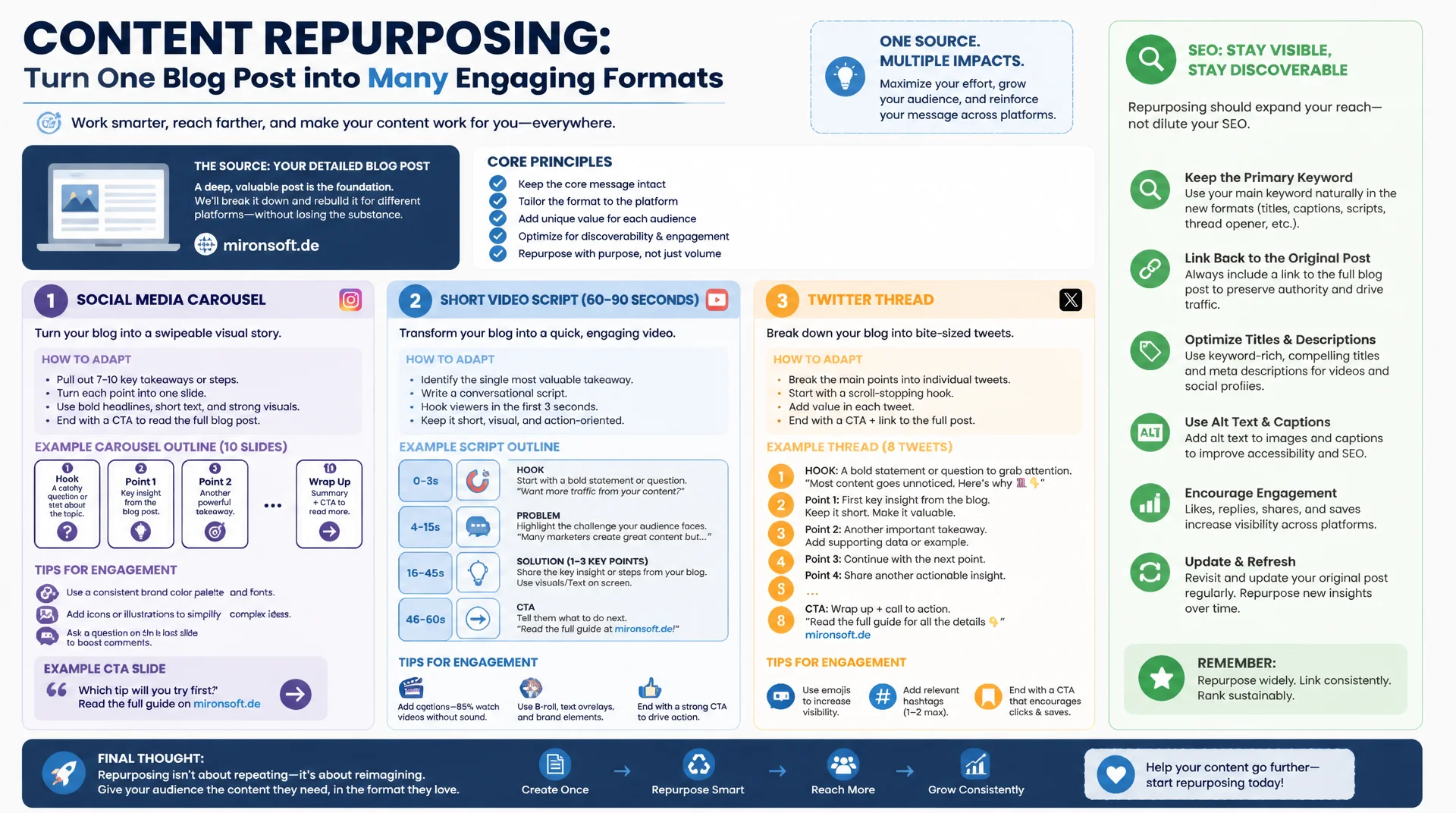
a process, not a one-off action
A single detailed blog post is packed with substance that lands very differently on social platforms: as a carousel, as a short video script, or as a thread. Content repurposing systematically turns this substance into multiple formats without simply copying identical text blocks and without the original blog post losing search visibility through duplicate content.
Table of Contents
- 1. Why content repurposing is more than time savings
- 2. The repurposing workflow at a glance
- 3. From blog post to carousel
- 4. From blog post to short video script
- 5. From blog post to thread
- 6. Avoiding duplicate content risks
- 7. Technical setup: tracking and editorial calendar
- 8. Metrics and success measurement per format
- 9. Common mistakes in repurposing
- 10. Summary
- 11. FAQ
Part of the series: SEO Part 2, GEO and Social.
Reading time includes practical examples and templates.
Written for teams already publishing long-form blog content.
Where this article fits in the GEO and social SEO series
This post is part of a series on GEO and social media SEO and specifically covers the distribution side, while other articles in the series go deeper into topics like forum visibility or Google Discover. Content repurposing is the operational process that turns the principles described there into recurring editorial practice.
1. Why content repurposing is more than time savings
Treating repurposing as a strategic channel rather than an afterthought changes both the quality of the output and how much reach it earns.
Content repurposing is often understood as a pure efficiency measure: an article is already written, so why not quickly derive a few social media posts from it. This view falls short. Properly executed content repurposing is a distribution strategy in its own right, adapting the same content core to different usage contexts across multiple channels. A reader who reads a complete blog post is in a different attention phase than someone scrolling a social feed and deciding within three seconds whether a post is relevant.
The strategic value of content repurposing lies in the fact that a single piece of research, a single well-founded analysis, generates reach multiple times without requiring completely new research for every format. This not only reduces production effort but also ensures content consistency across all channels: the core message of a blog post reappears in the carousel, the video script and the thread, consistent in substance but adapted to each format's requirements.
That consistency also matters for brand perception, since audiences increasingly encounter the same company across several platforms within a single week.
It is important to distinguish repurposing from mere duplication. Simply copying text blocks from the blog post into a LinkedIn post is not repurposing but content recycling without added value, which rarely performs well on social platforms because the formats serve different reading habits. Systematic content repurposing always means genuine structural transformation, not just shortening the original text.
That distinction is the single biggest predictor of whether a repurposing program keeps producing results after the initial novelty wears off.
2. The repurposing workflow at a glance
A defined workflow turns repurposing from a creative struggle each time into a predictable, delegable production step.
A repeatable content repurposing workflow consists of four clearly separated phases: audit, extraction, format mapping and publication. In the audit phase, the blog post is searched for its strongest, independently understandable statements. Not every paragraph is suited for social media. What is sought are core statements that make sense even without the full article context, such as a surprising statistic, a clear recommendation, or a concise comparison.
In the extraction phase, these core statements are lifted out of the running text and turned into independent, short statement units that serve as building blocks for all subsequent formats. Each block should carry exactly one idea so it can be flexibly combined across different formats. A typical 1500-word article, in practice, yields six to ten such independent statement blocks.
Format mapping assigns these blocks to the social media formats they fit best: numbers and comparisons work great as carousel slides, process steps suit short video scripts, controversial or opinionated statements suit threads. The final publication phase plans timing and sequence so the formats spread over several weeks instead of all appearing on the same day and cannibalizing each other's reach.
Skipping any one of the four phases tends to produce noticeably weaker output, even when the writing itself is strong, because the phases each solve a different problem.
{
  "repurposing_workflow": {
    "phase_1_audit": "Identify core statements in the blog post",
    "phase_2_extraction": "Formulate 6-10 independent statement blocks",
    "phase_3_mapping": {
      "carousel": "Numbers, comparisons, step by step",
      "video_script": "Processes, explanations, live demo",
      "thread": "Opinions, controversies, deep analysis"
    },
    "phase_4_publication": "Spread over 3-4 weeks, no format overload on one day"
  }
}
3. From blog post to carousel
Carousels reward compression more than any other format covered here, which makes the extraction step from the blog post especially important.
Tools for extraction
A simple shared document with one column per statement block and one column per target format is entirely sufficient for most teams. Elaborate specialized software is not necessary to get started with content repurposing, as long as the structure is consistently followed.
The carousel format, whether on Instagram, LinkedIn or Facebook, follows its own rules that fundamentally differ from a blog post. Each slide must be understandable on its own, because many users do not swipe to the last slide. The first slide carries the entire responsibility for the click or the continued swipe and should therefore summarize the blog post's strongest core statement in a single sentence at most, often supplemented by a concrete number.
For translating a blog post into a carousel, a ten-slide structure has proven effective: slide one as the hook with the strongest statement, slides two through eight as a sequential unfolding of the article's key arguments or steps, slide nine as a summary, and slide ten as a call to action referencing the full blog post. This last slide is the decisive content repurposing building block that redirects social media reach back to the actual SEO target page.
Slide captions on a carousel should never take identical sentences from the blog post one to one, but instead use shortened phrasing optimized for the visual format. A blog sentence with twenty-five words often has to be reduced to eight to twelve words for a slide without losing the core statement. This compression is the actual creative core of content repurposing for the carousel format.
{
  "carousel_structure_ten_slides": {
    "slide_1_hook": "Strongest core statement plus a concrete number",
    "slides_2_to_8": "Sequential unfolding of the main arguments",
    "slide_9_summary": "Three bullet points",
    "slide_10_cta": "Reference to the full blog post"
  }
}
Example slide structure
Slide 1: "73 percent of Reddit threads about purchase decisions rank on Google page 1." Slide 2: "Why that happens." Slides 3 through 7: the individual ranking factors from the original article, one per slide. Slide 8: "What this means for your content strategy." Slide 9: summary in three bullet points. Slide 10: "Full analysis on the blog, link in bio."
4. From blog post to short video script
Video is the format most sensitive to hook quality, and it is also the one where content repurposing effort is most likely to be wasted without one.
Plan production effort realistically
A short video script is written quickly, but production with recording, editing and captioning takes considerably more time than a carousel or thread. Teams new to content repurposing often therefore start with carousel and thread and add video only once the workflow is established.
Short video formats such as Reels, TikToks or YouTube Shorts follow a three-act structure that can be derived directly from the blog post: hook, body, call to action. The hook, the first three to five seconds, decides between continued watching and drop-off and should pick up the most surprising or controversial statement from the blog post, often phrased as a question or a provocative claim. A sentence like "Most companies make this one mistake with forum SEO" works far better as a hook than a factual topic announcement.
The body of the short video script carries the central explanatory part from the blog post, but radically compressed. While a blog post can unfold an idea over several sentences with justification and example, a fifteen- to thirty-second video must convey the same idea in two to three short, spoken sentences. The trick with content repurposing for video is to drop the justification and keep only the core statement plus a single concrete example, while the full justification stays in the blog post.
The closing call to action in the short video should be specific and not say a generic "more info in the link," but concretely name what the viewer will additionally find in the linked blog post, for example "in the article I break down all nine ranking factors in detail." This specificity demonstrably increases the click-through rate back to the website and turns the short video into a working funnel instead of an end in itself.
{
  "video_script_template": {
    "hook_seconds": "0-4",
    "hook_example": "Most companies make this one mistake with forum SEO",
    "body_seconds": "5-22",
    "body_content": "Core statement plus one concrete example, no lengthy justification",
    "cta_seconds": "23-30",
    "cta_example": "All nine ranking factors in detail in the linked article"
  }
}
5. From blog post to thread
Threads are the format closest to the blog post's own argumentative style, which makes them the easiest starting point for teams new to repurposing.
LinkedIn versus X
A thread for LinkedIn can be more factual and detailed in tone than a thread for X, where brevity and sharp framing are rewarded more. Content repurposing should therefore consider not only the blog post but also the respective platform culture, instead of posting the same thread unchanged on both channels.
Threads on platforms like X or LinkedIn are especially suited for blog posts with a clear line of argument or a controversial thesis, because the thread format offers room for gradually unfolding an argument, similar to a blog post but in smaller, individually shareable units. The first tweet or post of a thread takes on the same hook function as the first carousel slide and should work standalone, even if a reader never opens the rest of the thread.
For content repurposing into a thread format, a one-idea-per-post rule has proven effective: each individual post in the thread carries exactly one point from the blog post, phrased so it can also be retweeted or shared in isolation. Numbering the posts helps readability but is secondary to the content independence of each individual post. A good thread from a 1500-word article typically comprises eight to fifteen posts.
The last post of a thread should not just link to the blog post but explicitly state what additional value the full article offers over the thread, such as deeper data, code examples or a more detailed derivation. This differentiation matters because it gives the reader a clear reason to actually move to the website instead of having already consumed the complete content within the thread.
<!-- Thread structure as an editorial comment template -->
<!--
  POST 1 (Hook): Strongest, independently understandable claim
  POST 2-7: One argument or piece of evidence per post, numbered
  POST 8 (Close): Summary
  POST 9 (CTA): Name the concrete added value of the full article
-->
Skipping this final differentiation is one of the most common reasons a well-performing thread still fails to move readers toward the blog post.
6. Avoiding duplicate content risks
Fear of duplicate content should never become an excuse to avoid social distribution altogether, since the actual risk is narrower than most teams assume.
A central misunderstanding about content repurposing concerns duplicate content worries. Classic duplicate content risk in the classic SEO sense primarily refers to identical or nearly identical text content on multiple indexable URLs of the same or different domains. Social platforms like Instagram, LinkedIn or X are generally not treated by Google as competing, indexable content sources in the classic sense, which is why a carousel caption on Instagram does not normally create a direct duplicate content problem for the blog post.
A real risk arises, however, when companies additionally publish the same blog post unchanged on platforms like LinkedIn Articles or Medium, which are actually indexed by Google. In that case the secondary publication competes directly with the original for the same rankings. The solution is either a rel=canonical from the secondary publication to the original, if the platform supports it, or a deliberate content rewrite that prevents the two versions from being nearly identical.
This distinction between indexable long-form republishing and short-form social formats is the one most teams get wrong when assessing repurposing risk.
For the short formats covered in this article, carousel, video script and thread, the duplicate content risk practically does not exist, because these formats deviate structurally so much from the running text that no textual proximity in the search engine evaluation sense arises. Still, the recommendation remains to never copy text blocks verbatim but always rephrase them format-specifically, both out of duplicate content caution and simply because identical sentences read differently on every platform.
This is good news for teams worried about SEO cannibalization, since it removes one of the biggest imagined blockers to starting a repurposing program.
Practical rule
Every social media text, read in isolation, should feel like its own standalone piece of content and not like a ripped-out section. Anyone consistently applying this rule avoids duplicate content questions almost automatically, because genuine rewriting always also creates structural independence.
7. Technical setup: tracking and editorial calendar
Without a tracking discipline, every repurposing decision after the first quarter is based on impressions rather than evidence.
Ownership within the team
A fixed point of contact should maintain the UTM conventions and check them before every publication so that consistent parameters are used across several team members. Inconsistent UTM values are one of the most common reasons why content repurposing successes cannot later be reliably demonstrated.
For content repurposing to remain measurable, every social media format that links back to the blog post needs its own UTM parameterization. Without this separation it becomes impossible to later determine whether a traffic increase came from the carousel, the thread or the short video, which reduces any prioritization of future repurposing effort to guesswork. A consistent naming convention for UTM parameters across all formats is the foundation of any later success measurement.
An editorial calendar that plans blog posts and their derived social media formats together also prevents repurposing from degenerating into an ad-hoc activity. A model that has proven effective publishes the blog post itself on day one, the carousel follows three to four days later, the video script after about a week, and the thread after two weeks, so that each format gets its own attention window instead of getting lost in the content flood.
<!-- UTM example for consistent tracking across all repurposing formats -->
<a href="https://mironsoft.de/blog/article-slug?utm_source=instagram&utm_medium=social&utm_campaign=repurposing_2026&utm_content=carousel">To the article</a>
<a href="https://mironsoft.de/blog/article-slug?utm_source=tiktok&utm_medium=social&utm_campaign=repurposing_2026&utm_content=video">To the article</a>
<a href="https://mironsoft.de/blog/article-slug?utm_source=x&utm_medium=social&utm_campaign=repurposing_2026&utm_content=thread">To the article</a>
8. Metrics and success measurement per format
Comparing formats on the wrong metric is one of the fastest ways to defund a channel that was actually working.
Choosing a comparison window
For a fair comparison between formats, the same observation window after publication should be chosen, for example the first seven days after posting. Different time windows distort the comparison, because platforms have different rollout speeds.
Every social media format needs its own success criteria because user interaction is structurally different. For carousels, the swipe-through rate, the share of users who swipe to the last slide, is the most important interim metric because it shows whether the content repurposing material actually captivates. For short videos, average watch time relative to total length is decisive, since it directly reflects hook quality.
For threads, the reply and repost rate is a stronger quality signal than raw impressions, because it indicates genuine content engagement rather than passive consumption. Across all formats, though, the UTM-tracked click rate back to the blog post remains the decisive metric for whether content repurposing actually generates additional, measurable website traffic, or whether the social media presence generates reach but no SEO-relevant effect.
| Format | Primary metric | Secondary metric | Typical flow back to blog |
|---|---|---|---|
| Carousel | Swipe-through rate | Saves, shares | Medium |
| Short video | Relative watch time | Comments | Low to medium |
| Thread | Reply rate | Repost rate | High |
| LinkedIn post | Comment quality | Profile visits | High |
9. Common mistakes in repurposing
Most repurposing failures trace back to one of three predictable mistakes, all of which are cheap to fix once identified.
The most common mistake is a lack of format adaptation: a team extracts sentences from the blog post but changes nothing about sentence structure, length or tone before the text lands on social media. The result reads equally out of place on every platform, because it hits neither the brevity of a carousel nor the directness of a thread. Content repurposing without genuine transformation is, in effect, barely better than not promoting the blog post at all.
A second common mistake is a lack of prioritization: not every blog post is equally suited to every format. A technical deep dive with a lot of code is a poor fit for a carousel but works well as a thread with code examples as screenshots. Anyone trying to force every article into all three formats wastes resources on formats that are structurally unsuited for that particular topic.
The third mistake concerns timing: if all derived formats are published simultaneously with the blog post, they cannibalize each other's attention and make it harder to later attribute traffic sources. A staggered publication plan over several weeks ensures that each format gets its own visibility window and the blog post receives continuous new traffic over a longer period, instead of a one-time traffic peak on the publication day.
All three mistakes share a common root: treating repurposing as an afterthought rather than as part of the original content plan.
Mironsoft
Content repurposing workflows and integrated social SEO strategy
Turn blog posts systematically into social media reach?
We build a repeatable content repurposing process for your blog, from format extraction through UTM tracking to the editorial calendar, without duplicate content risks for your search visibility.
Workflow setup
Establish audit, extraction and format mapping as a repeatable process
Format templates
Carousel, video and thread templates matched to your content strategy
Tracking setup
UTM conventions and dashboards for format-precise success measurement
10. Summary
The discipline required for content repurposing pays off precisely because it compounds: each properly transformed post makes the next one easier to plan and produce.
Content repurposing is a distinct, repeatable process, not a one-time add-on after publishing a blog post. The four-stage workflow of audit, extraction, format mapping and planned publication ensures that every detailed article is systematically translated into carousel, short video script and thread, each with genuine structural adaptation instead of mere text copying. This transformation is also why serious duplicate content risks practically do not arise with these short formats.
Technical foundations like consistent UTM tracking and a staggered editorial calendar make the success of content repurposing measurable and prevent formats from competing with each other for reach. Anyone who selects metrics format-appropriately, swipe-through rate for carousels, watch time for videos, reply rate for threads, recognizes early which formats actually bring traffic back to the blog post for their specific topic area.
Treated this way, content repurposing stops being a marketing side task and becomes a durable, compounding source of qualified traffic back to owned content.
Content Repurposing for Social Media: The Essentials at a Glance
Four-stage workflow
Audit, extraction, format mapping, staggered publication as a repeatable process instead of a one-off action.
Format-appropriate transformation
Carousel, video script and thread each need their own structure instead of copied text blocks.
Duplicate content safety
Genuine rewriting instead of text copying avoids SEO risks almost automatically.
Measurability
Consistent UTM tracking and format-specific metrics show what actually brings traffic back.