marked up correctly for Google and AI systems
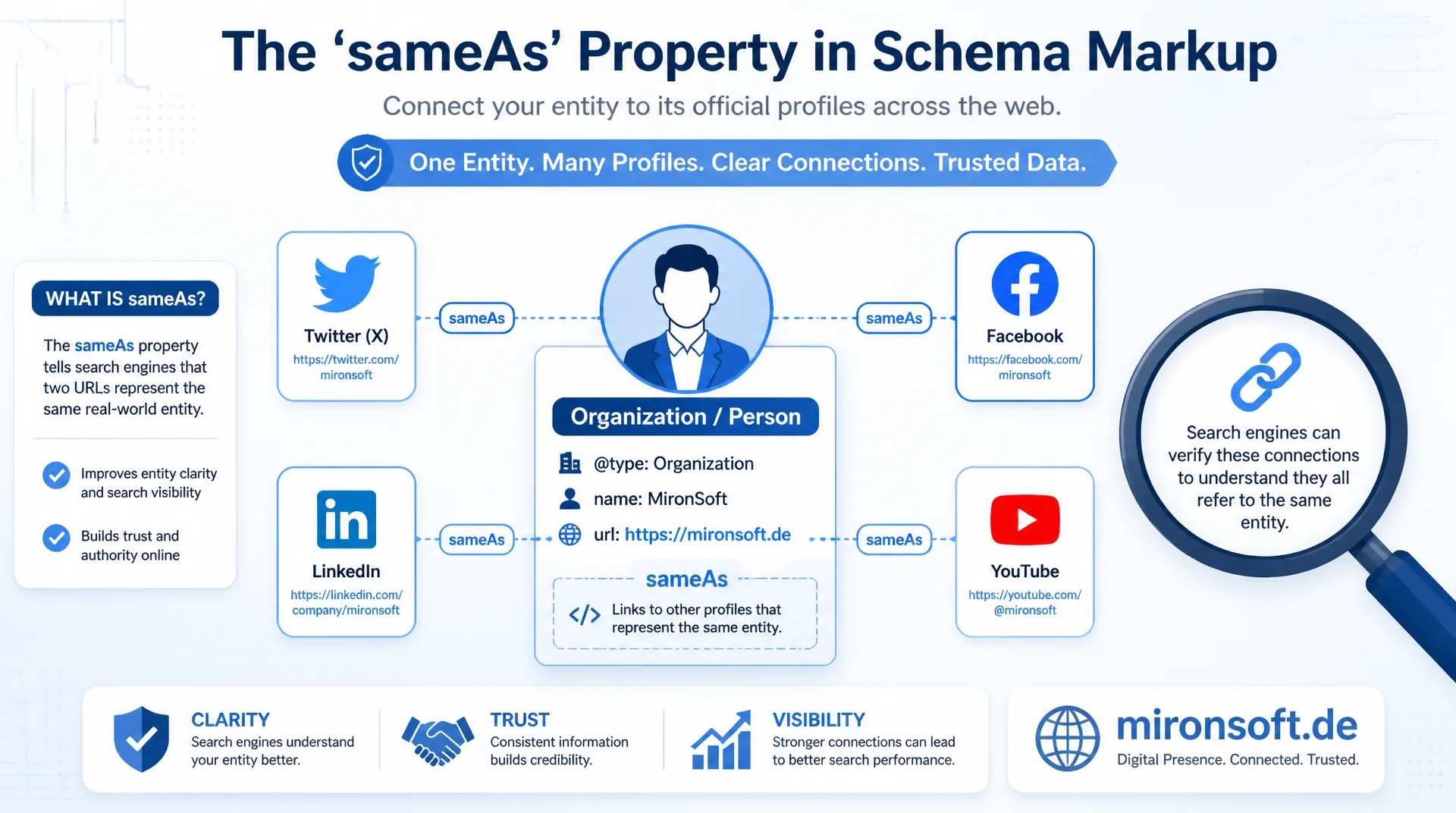
The sameAs property connects an Organization or Person schema to the official social media profiles of the same entity. This seemingly small piece of markup helps decide whether Google and generative AI systems recognize a company as one clear, trustworthy entity, or confuse it with a similarly named competitor.
Table of contents
- 1. Why entity recognition matters for SEO and AI systems
- 2. The sameAs property: definition and how it works
- 3. Implementing Organization schema with sameAs correctly
- 4. Linking Person schema and author profiles
- 5. Which profiles belong in sameAs? Selection criteria
- 6. Knowledge graph, entity recognition and disambiguation
- 7. Why sameAs also matters for GEO and AI answer systems
- 8. Common mistakes in sameAs implementation
- 9. Validation with structured data tools
- 10. Summary
- 11. FAQ
1. Why entity recognition matters for SEO and AI systems
Search engines and generative AI systems increasingly work not with individual web pages but with entities: clearly identifiable companies, people or products that get recognized consistently across different sources. A sameAs reference is one of the most direct technical signals available to actively support that recognition, because it explicitly states that a webpage and a social media profile describe the same real-world entity.
Without this link, search engines and AI models have to infer, from name similarity, context and indirect signals alone, whether a LinkedIn profile, an Instagram account and a website actually belong together. For generic company names or people who share their name with someone else, this regularly leads to misattribution. SameAs schema removes that uncertainty by making the connection explicit and machine-readable, instead of leaving it to chance.
In practice this means: a technically clean sameAs markup is not just a nice-to-have for rich snippets, it is a structural foundation for everything related to entity-based search and generative answer generation, from classic Google knowledge panels to citations by AI assistants.
2. The sameAs property: definition and how it works
The sameAs property originally comes from the Semantic Web vocabulary and was adopted by schema.org to explicitly state that a URL represents the same entity as the object currently being described. Technically it is a simple array property inside an Organization, Person or other entity type that holds a list of URLs, typically social media profiles, Wikipedia articles, or other authoritative sources about the same entity.
Important to understand: sameAs is not a ranking factor in the classic sense, like backlinks, it is an identity signal. Google itself states in its documentation on Organization markup that sameAs links help confirm the Wikidata and Knowledge Graph association of an organization. The more consistent, authoritative profiles are connected through sameAs, the more robust this identity mapping becomes against confusion with similarly named entities.
// Minimal sameAs example inside an Organization schema
{
  "@context": "https://schema.org",
  "@type": "Organization",
  "name": "Mironsoft",
  "url": "https://mironsoft.de",
  "sameAs": [
    "https://www.linkedin.com/company/mironsoft",
    "https://www.instagram.com/mironsoft",
    "https://www.youtube.com/@mironsoft"
  ]
}
3. Implementing Organization schema with sameAs correctly
For companies, the Organization schema is the central anchor point for sameAs references and should ideally be embedded on every page of the website, usually through a global layout template rather than individually per subpage. Besides the sameAs list, name, logo, url and, where available, a clear Wikidata or Wikipedia URL belong in the same schema object, so the entity is described as thoroughly as possible.
A common implementation mistake: companies with multiple brands or country subsidiaries connect all social profiles inside a single, global Organization schema, even though the profiles actually represent different legal entities. It is cleaner to maintain a separate Organization schema with matching sameAs references for each independent brand or country organization, even if that means more maintenance effort.
// Organization schema with full entity context, embedded site-wide
{
  "@context": "https://schema.org",
  "@type": "Organization",
  "@id": "https://mironsoft.de/#organization",
  "name": "Mironsoft",
  "legalName": "Mironsoft GmbH",
  "url": "https://mironsoft.de",
  "logo": "https://mironsoft.de/assets/logo.png",
  "sameAs": [
    "https://www.linkedin.com/company/mironsoft",
    "https://www.instagram.com/mironsoft",
    "https://www.youtube.com/@mironsoft",
    "https://www.wikidata.org/wiki/Q000000"
  ]
}
4. Linking Person schema and author profiles
Besides organizations, individual people, especially authors, leadership and subject-matter experts, also benefit from their own Person schema with sameAs references. This matters especially for editorial content, because Google explicitly looks for traceable authorship as part of its E-E-A-T criteria (Experience, Expertise, Authoritativeness, Trustworthiness). An article with author markup that links via sameAs to an active, topically relevant LinkedIn profile delivers a considerably stronger trust signal than a plain name mentioned in body text.
The Person schema should be embedded inside the author field of an Article or BlogPosting schema, not isolated on a separate page without content relevance. Consistency matters here too: the name linked via sameAs, the profile picture and the professional self-description should match the authorship role stated in the article, since inconsistent information weakens the trustworthiness of the entire markup.
// Person schema embedded as the author of a BlogPosting
{
  "@context": "https://schema.org",
  "@type": "BlogPosting",
  "headline": "Marking Up sameAs and Social Profile Schema Correctly",
  "author": {
    "@type": "Person",
    "name": "Mira Sonnenberg",
    "jobTitle": "SEO Consultant",
    "sameAs": [
      "https://www.linkedin.com/in/mira-sonnenberg",
      "https://www.xing.com/profile/Mira_Sonnenberg"
    ]
  }
}
5. Which profiles belong in sameAs? Selection criteria
Not every social profile automatically belongs in the sameAs list. What matters is that a profile is actively maintained, publicly accessible, and clearly recognizable as the official profile of the described entity, for example through a verification badge or reciprocal linking to the website. Abandoned profiles with their last activity dating back years weaken the credibility of the entire list rather than strengthening it.
A solid rule of thumb: five actively maintained, clearly attributable profiles beat fifteen profiles where half are abandoned or barely verifiable. For companies with an international presence across different platforms, it is also worth only including regional variants of a profile, such as separate country accounts, when they actually belong to the same legal entity described in the Organization schema.
| Source | Suitable for sameAs? | Reasoning |
|---|---|---|
| LinkedIn company page | Yes | Official, verifiable B2B profile |
| Wikidata entry | Yes | Authoritative, structured reference source |
| Personal private account | No | No clear entity attribution possible |
| Abandoned profile with no activity | No | Weakens rather than strengthens the trust signal |
| Verified Instagram profile | Yes | Public, active, clearly attributable |
6. Knowledge graph, entity recognition and disambiguation
Google's Knowledge Graph stores billions of entities and their relationships to each other, and sameAs references are among the signals used to place a new or previously unclear entity into that network. When a name collides with another entity, such as a similarly named company in a different industry, a consistent sameAs network built from multiple authoritative sources helps support the correct attribution and avoid confusion.
This process is called entity disambiguation and largely runs automated, but it is based on the consistency of the available signals. An Organization schema whose sameAs profiles all show the same name, the same logo and the same contact information delivers a considerably stronger consistency signal than a collection of profiles with mismatched company names or outdated information.
7. Why sameAs also matters for GEO and AI answer systems
Generative AI systems such as chatbots and AI search assistants increasingly rely on structured, verifiable sources rather than plain text when answering questions about companies and people. For generative engine optimization, sameAs schema is therefore a direct lever: an AI system that sees an entity clearly confirmed across multiple consistent sources is more likely to cite and reference that entity correctly, instead of mixing up information or attributing it to the wrong entity.
In practice this means: a company that is cleanly linked via sameAs to LinkedIn, Wikidata and other authoritative sources tends to be described more precisely by AI systems, for example when answering questions about founding year, location or contact people. This effect is admittedly harder to measure than a classic ranking position, but it is an increasingly relevant building block alongside classic SEO, precisely because generative answer systems process entities differently than a classic results list does.
8. Common mistakes in sameAs implementation
The most common mistake is using a personal profile instead of an official one inside Organization schema, for example linking to an employee's private Instagram account instead of the official company profile. A second common mistake: sameAs lists that never get updated when a company switches platforms or abandons a profile, leaving dead links inside the schema that weaken the consistency evaluation.
// WRONG: personal profile instead of official brand profile
{
  "@type": "Organization",
  "sameAs": ["https://www.instagram.com/max_private_2019"]
}

// WRONG: mixing entities that are not the same legal entity
{
  "@type": "Organization",
  "name": "Mironsoft GmbH",
  "sameAs": ["https://www.linkedin.com/company/mironsoft-usa-inc"]
}

// RIGHT: official, verified, matching entity
{
  "@type": "Organization",
  "name": "Mironsoft GmbH",
  "sameAs": ["https://www.linkedin.com/company/mironsoft"]
}
A third mistake concerns placement: sameAs markup embedded only on an isolated legal notice page instead of globally in the layout is less reliably connected by search engines to the website's main entity. Equally problematic: multiple contradictory Organization schemas on different pages of the same domain, each carrying a different sameAs list, which confuses rather than clarifies entity attribution.
9. Validation with structured data tools
After implementation, every sameAs schema should be checked with the Google Rich Results Test and the Schema Markup Validator, to catch both technical syntax errors and missing required fields. Neither tool evaluates the content consistency of the sameAs targets, but both reliably check whether the JSON-LD parses correctly and whether all referenced URLs are syntactically valid.
It is also worth doing a manual spot check: every URL listed in sameAs should actually be visited to verify the profile still exists, is publicly accessible, and is recognizably tied to the described entity. This manual check should be a fixed part of a recurring technical SEO audit, since social profiles, unlike static website content, can change or disappear without warning.
Mironsoft
Structured data, entity recognition and schema audits
Get recognized as one clear entity by Google and AI systems?
We implement Organization and Person schema with cleanly maintained sameAs references, review existing markup for consistency errors, and set up a recurring validation audit.
Schema audit
Review existing Organization and Person markup for errors and inconsistencies
Implementation
Embed sameAs references for organizations and authors cleanly in the layout
Ongoing validation
Regular checks with the Rich Results Test and manual profile review
10. Summary
SameAs schema is a technically simple but strategically important signal for making organizations and people recognizable as clear entities to search engines and generative AI systems. The property connects an Organization or Person schema to official, actively maintained social profiles and authoritative sources such as Wikidata, instead of leaving that attribution to the chance of algorithmic name similarity.
What determines effectiveness is consistency: matching names, matching logos, exclusively official and actively maintained profiles, embedded globally in the layout rather than isolated on a single subpage. Companies that implement sameAs cleanly and validate it regularly strengthen both classic Knowledge Graph attribution and citability by AI answer systems as part of generative engine optimization.
sameAs schema for social profiles: the essentials at a glance
Official profiles only
Only list actively maintained, publicly accessible and clearly attributable profiles in sameAs.
Embed globally
Place Organization schema with sameAs site-wide instead of only on an isolated subpage.
Use for authors too
Person schema with sameAs in the author field strengthens E-E-A-T signals for editorial content.
Validate regularly
Make the Rich Results Test and manual profile checks a fixed part of the SEO audit.