Dwell time, internal search and the fight over external links
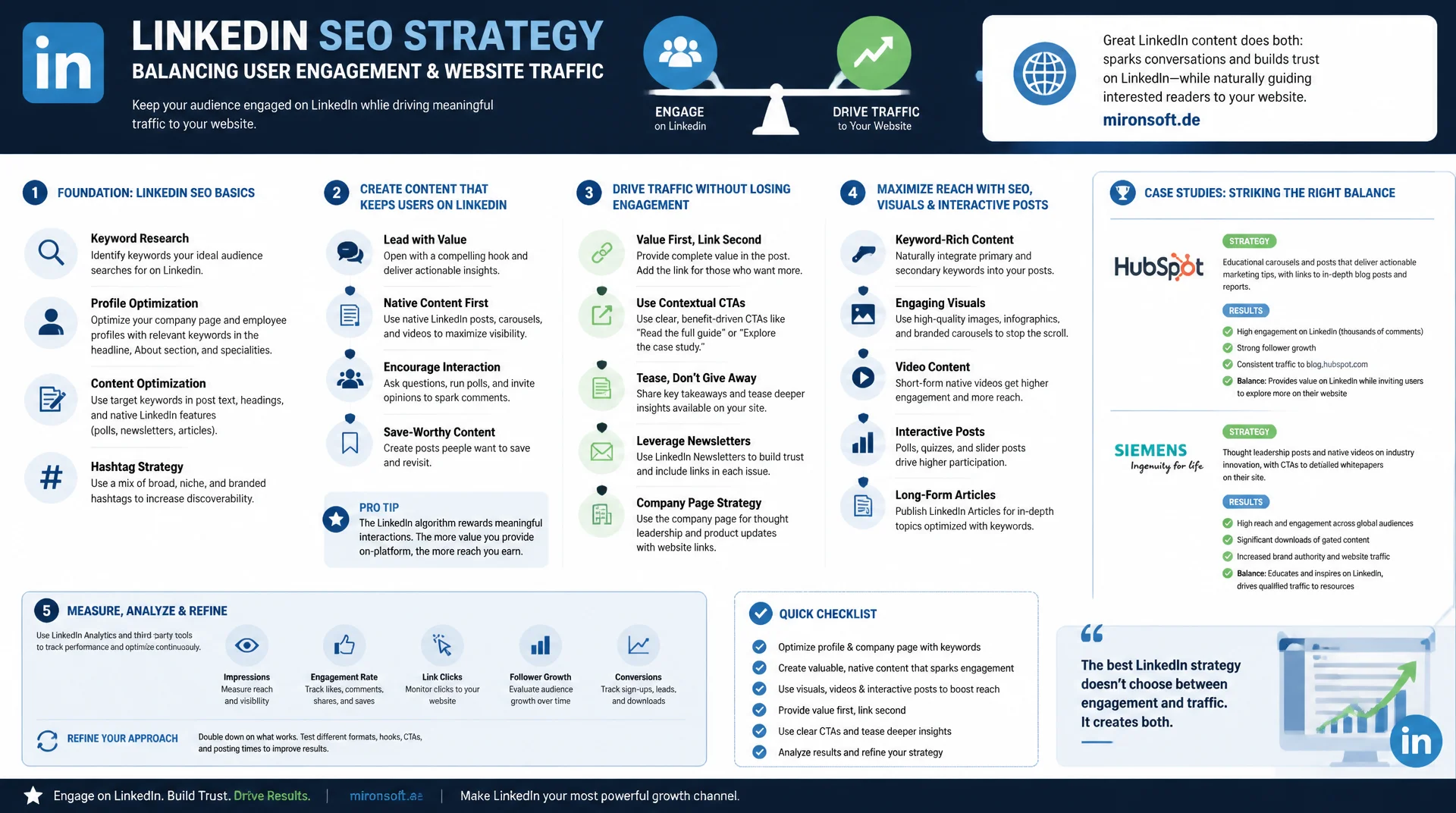
LinkedIn rewards content that keeps users on the platform and structurally penalizes anything that sends them away immediately. A workable LinkedIn SEO strategy has to actively manage this conflict between reach on the platform and traffic to your own website, instead of ignoring it.
Table of contents
- 1. LinkedIn as a B2B search channel: context and relevance
- 2. How the LinkedIn feed algorithm evaluates content
- 3. LinkedIn's internal search and discovery
- 4. Dwell time and engagement as ranking signals
- 5. LinkedIn articles versus external blog linking
- 6. Company pages and profiles as an SEO factor
- 7. Content formats with reach: native versus link post
- 8. LinkedIn SEO compared to classic Google SEO
- 9. Measuring success: LinkedIn Analytics and Social Selling Index
- 10. Summary
- 11. FAQ
1. LinkedIn as a B2B search channel: context and relevance
For B2B companies, LinkedIn has long stopped being a digital resume archive, it is an actively used channel for research, vendor selection and topic monitoring. Buyers and decision-makers follow company pages and individual subject-matter people deliberately before ever running a Google search. LinkedIn SEO in this context describes the deliberate alignment of content, profiles and interaction patterns so a company becomes visible around relevant topics, both inside the platform and as a trustworthy source beyond it.
The key difference from B2C platforms: on LinkedIn, the largest reach is not what matters, reach among the right decision-makers is. A post with 200 relevant impressions from the target industry is worth more for LinkedIn SEO than 20,000 impressions from an irrelevant audience, because LinkedIn weights engagement within topically related networks more heavily than raw view counts.
A solid LinkedIn content strategy therefore does not chase viral one-off posts, it builds consistent, topically focused presence over weeks and months. LinkedIn itself confirms in its creator guidelines that consistency in frequency and topic contributes more to visibility than sporadic outlier posts with high but short-lived reach.
2. How the LinkedIn feed algorithm evaluates content
LinkedIn's feed ranking runs through several stages. First, a classification model roughly checks each new post for quality and filters out obvious spam as well as pure engagement-bait phrasing like "comment YES for the link", which LinkedIn now actively downranks. The post is then shown to a small test group from the author's own network, whose initial reactions within the first 60 to 90 minutes largely determine whether the post gets rolled out further.
For LinkedIn SEO this means: the first hour after publishing is decisive. Comments count considerably more than plain likes, because a comment represents a deeper engagement signal and additionally creates fresh visibility inside the commenter's own network. A post that deliberately poses a discussion question instead of just stating an opinion structurally raises the comment rate, and with it the odds of a wider rollout.
<!-- LinkedIn post structure that supports early engagement signals -->
<!-- Line 1-2: hook, no external link, must work without "see more" -->
Why 80% of B2B leads from LinkedIn never make it into the CRM.

<!-- Line 3-6: concrete value, short paragraphs, one idea per line -->
The reason is rarely the content.
It's the missing tracking between post and form.

<!-- Closing: discussion question instead of a flat statement -->
How do you currently track which post actually leads to a lead?

<!-- Link to the external article goes in the FIRST comment, not the post body -->
Practical checklist: the first hour after publishing
- The post contains no external links in the main text
- The first two lines work as a standalone hook without "see more"
- The post closes with a genuine discussion question instead of a flat statement
- The team is briefed and actively comments within the first 60 minutes
- The external link is ready for the first comment, not the post text
- Publishing time falls within the audience's active usage window
- Images or document attachments are formatted to read well on mobile
- Spelling and formatting were checked before publishing
3. LinkedIn's internal search and discovery
Besides the feed, LinkedIn runs its own search function that is frequently underestimated. Decision-makers search there deliberately for industry terms, company names and people, and LinkedIn shows both profiles and individual posts or articles in the results whenever the contained terms match the query. For LinkedIn SEO this means: the profile headline, the "About" section and recurring industry terms in posts act as separate, searchable text fields, similar to meta tags on a webpage.
Company pages additionally benefit from using the actual industry terms decision-makers search for in the "About us" description, rather than pure marketing language. Since LinkedIn search results are sometimes indexed by Google when a profile is publicly visible, a clean LinkedIn SEO setup even feeds slightly into classic web search, although this effect is considerably weaker than for your own domain.
4. Dwell time and engagement as ranking signals
Dwell time, the amount of time a user spends with a post before scrolling on, is one of the strongest signals in LinkedIn ranking. A post that crosses the "see more" threshold and prompts users to click and keep reading automatically generates longer dwell time than a post consumed entirely without interaction. For LinkedIn SEO this implies a clear format recommendation: short, compelling first two lines as a hook, followed by structured text with line breaks instead of dense paragraph blocks that feel discouraging on mobile.
Carousel posts in document format are among the formats with the highest measured dwell time, because users actively swipe through multiple slides and therefore spend more time on the post than with a plain text update. LinkedIn itself confirms in internal reporting that document posts achieve noticeably higher engagement rates than text-only posts on average, making them one of the most reliable formats for a B2B content strategy.
5. LinkedIn articles versus external blog linking
One of the most common strategic questions within LinkedIn SEO is: publish content natively as a LinkedIn article, or link out to your own blog? Both paths have clear trade-offs. Native LinkedIn articles stay entirely on the platform, get indexed by LinkedIn's own search function, and generate no reach loss from a platform exit, but they lose all control over design, tracking depth and conversion elements like forms.
External links in the caption, on the other hand, are demonstrably suppressed by the algorithm, because LinkedIn wants to keep users on the platform as long as possible. The established practical solution: deliver the actual value directly in the post, and place the external link, if needed, in the first comment instead of the post text. This separation protects initial reach without giving up traffic to your own website entirely, and works considerably more reliably than a link placed directly in the main text.
| Format | Reach in the feed | Control over conversion | Recommendation |
|---|---|---|---|
| Native LinkedIn article | High | Low, no form possible | For thought leadership |
| Link directly in post | Low | High, full website control | Avoid |
| Link in first comment | Medium to high | High, full website control | Preferred solution |
| Document carousel | Very high | Medium, CTA on last slide | For explainer content |
| Native video | High | Low without form integration | For brand building |
Practical checklist: activating employee profiles
- Headlines of leadership and subject-matter staff include relevant industry terms
- The featured section points to current content instead of outdated presentations
- Core messages are distributed through profiles first, the company page second
- Employees regularly comment on topically relevant posts from other people
- Profile picture and about section stay consistent across all involved profiles
- The company page acts as an archive and anchor, not the only channel
- New employees get a short briefing on the profile and content strategy
- Quarterly review of which profiles achieve the most qualified reach
6. Company pages and profiles as an SEO factor
A frequently neglected part of LinkedIn SEO is consistently maintaining company pages and employee profiles as one connected visibility system. Employee posts achieve, on average, a multiple of the organic reach of company page posts, because LinkedIn fundamentally favors content from personal networks over company accounts. A strategy that posts exclusively through the company page systematically gives up reach.
In practice this means: distribute core messages first through the profiles of leadership and subject-matter staff, and use the company page as an anchor point for republishing and consistency. The featured section, skills area and about description in a profile should carry the same industry terms as the overall content strategy, so LinkedIn's internal search recognizes the profile and the content as topically connected.
7. Content formats with reach: native versus link post
Beyond text and document carousels, native video and newsletter formats are gaining importance within a LinkedIn content strategy. LinkedIn newsletters trigger a recurring notification for all subscribers whenever a new issue is published, creating a reliable, repeatable touchpoint that individual posts cannot offer. For B2B topics that require explanation, newsletters work especially well, because subscribers have already made a conscious decision to follow that topic.
Native videos are algorithmically favored in the feed, because unlike external video links they play entirely within the app. Important for LinkedIn SEO: videos should also carry subtitles, since a significant share of users consume LinkedIn, like other platforms, muted at work or during a commute, and LinkedIn additionally indexes subtitle text for internal search.
8. LinkedIn SEO compared to classic Google SEO
LinkedIn SEO and classic Google SEO pursue the same basic goal, visibility with the right audience, but they differ considerably in their levers. While Google rankings can stay stable for weeks or months, the reach of a LinkedIn post mostly decays almost completely within 48 hours, which requires a considerably higher publishing frequency to build continuous visibility.
A central difference also lies in the role of authority: on Google, domain authority built through backlinks counts, on LinkedIn the personal network quality and interaction history of a profile counts. A profile that regularly leaves thoughtful comments under other people's posts demonstrably builds visibility for its own posts, a mechanism that has no direct equivalent in classic SEO.
9. Measuring success: LinkedIn Analytics and Social Selling Index
Measuring LinkedIn SEO success happens on two levels. At the post level, LinkedIn Analytics delivers impressions, engagement rate and a demographic breakdown of viewers by industry, job title and company size, which directly shows whether the right audience is being reached. At the profile level, the Social Selling Index provides a score built from four areas: establishing a professional brand, finding the right people, engaging with insights, and building relationships.
To connect this to your own website, a consistent UTM structure on every link placed in the first comment is essential, to cleanly separate LinkedIn traffic from other social channels. Only the combination of LinkedIn's native metrics and website analytics shows whether a LinkedIn content strategy actually produces leads, instead of just producing impressions.
<!-- UTM structure for the link placed in the first comment of a LinkedIn post -->
https://example.com/whitepaper-b2b-content?
  utm_source=linkedin
  &utm_medium=organic_social
  &utm_campaign=b2b_content_strategy_q3
  &utm_content=first_comment_link
Mironsoft
B2B content strategy, LinkedIn visibility and lead tracking
Build systematic B2B visibility on LinkedIn?
We build a LinkedIn content strategy with a clear post, article and comment structure, set up UTM tracking for leads, and connect profile and company page reach into one consistent system.
Content planning
Post, article and carousel formats aligned with your target industry and decision-makers
Profile optimization
Sharpen industry terms in headline, about section and featured area for internal search
Lead tracking
UTM structure and analytics integration for measurable LinkedIn SEO results
10. Summary
LinkedIn SEO revolves around a conflict every B2B content strategy has to actively manage: LinkedIn rewards content that stays on the platform, but companies need traffic on their own website. The solution is not either-or, it is a clear format choice: deliver value directly in the post or carousel, move external links into the first comment, and use newsletters for recurring touchpoints.
Dwell time, early comments in the first hour, and consistent industry terms across profile and content are the levers with the biggest impact. Companies that actively involve employee profiles in the LinkedIn content strategy, instead of posting exclusively through the company page, reach considerably more organic visibility among the relevant decision-makers.
LinkedIn SEO for B2B: the essentials at a glance
The first hour decides
Early comments within the first 60 to 90 minutes determine whether a post gets rolled out further.
Links in the comment
Place external links in the first comment instead of the post text to avoid losing reach.
Profiles over company page only
Employee profiles achieve considerably more organic reach than posts from the company page alone.
Two levels of measurement
LinkedIn Analytics and Social Selling Index at the profile level, UTM tracking for website conversion.