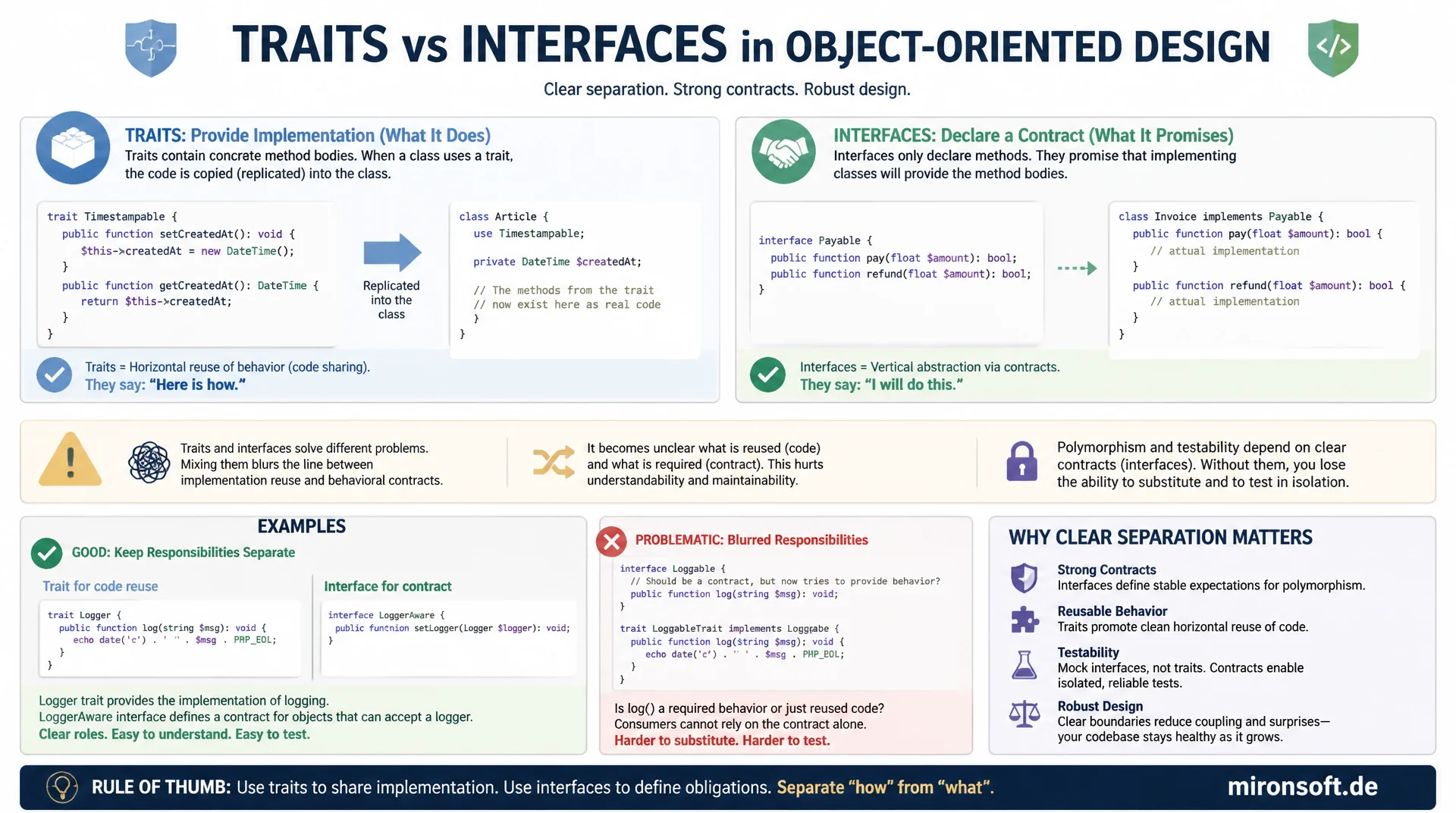
Cleanly Separating Code Reuse
A trait copies real method bodies straight into a class, an interface only promises those methods exist, without shipping a single line of implementation. Anyone who mixes traits and interfaces, or swaps one for the other, loses exactly the sharpness that makes object-oriented design robust: horizontal reuse of behavior on one side, binding contracts for polymorphism and testability on the other.
Table of Contents
- 1. Two Fundamentally Different Reuse Mechanisms
- 2. Traits in Depth: the trait Keyword and use
- 3. Combining Multiple Traits: insteadof and as
- 4. Traits and Their Hidden Dependency on the Host
- 5. Interfaces in Depth: Multiple Contracts, Constants
- 6. Combining Traits and Interfaces Correctly
- 7. What Traits Cannot Do
- 8. Decision Heuristic: Trait, Interface or Composition
- 9. Traits and Interfaces Side by Side
- 10. Summary
- 11. FAQ
1. Two Fundamentally Different Reuse Mechanisms
An interface answers the question of WHAT a class must be able to do. It consists exclusively of method signatures, without a single method body. An interface is a pure contract: writing implements Comparable promises that a method compareTo() with exactly this signature exists. That guarantee is what enables polymorphism and type-hinting: a function can accept a parameter of type Comparable without knowing the concrete class behind it.
A trait answers an entirely different question: HOW something is done. A trait contains real method bodies and properties that get copied directly into the using class at compile time, exactly as if the code had been typed there by hand. A trait creates no type of its own, no inheritance relationship and no contract. It is a pure tool for horizontal code reuse between otherwise unrelated classes.
The mental error that leads to messy design in many codebases is treating traits and interfaces as interchangeable tools for "reuse". In reality they solve disjoint problems. An interface says nothing about how a method is implemented. A trait says nothing about what type a class represents to the outside world. The following example shows an interface in its purest form, with no trait mixed in.
<?php

declare(strict_types=1);

namespace App\Contract;

/**
 * Contract for objects that can be ordered relative to another instance
 * of the same type. Pure behavior, zero implementation.
 */
interface Comparable
{
    /**
     * Compares this instance to another and returns -1, 0 or 1.
     */
    public function compareTo(self $other): int;
}

final readonly class Money implements Comparable
{
    public function __construct(
        private int $cents,
        private string $currency,
    ) {
    }

    public function compareTo(self $other): int
    {
        if ($this->currency !== $other->currency) {
            throw new \InvalidArgumentException('Cannot compare different currencies');
        }

        return $this->cents <=> $other->cents;
    }
}
2. Traits in Depth: the trait Keyword and use
A trait is declared with the keyword trait instead of class and can contain methods, properties and even static methods. Inside a class, a trait is pulled in with use TraitName;. The PHP compiler then copies all methods and properties of the trait into the class as if they had been written there directly. No runtime delegation happens, no extra method call, no indirection. Traits are purely compile-time text building blocks.
That makes traits ideal for cross-cutting concerns: behavior that has nothing to do with the business purpose of a class but is technically needed across many independent classes. A classic example is timestamp management. An Order class and a Comment class share nothing conceptually, no common base class, no common interface. Yet both need identical behavior for createdAt and updatedAt. This is exactly where a trait delivers real value that neither inheritance nor an interface could provide.
The important distinction: a trait creates no shared type. Order and Comment in the example below remain completely independent types after using the trait, just now equipped with identical timestamp behavior. Anyone who wants to type-safely pass around a collection of "all timestampable objects" needs an interface for that in addition, more on that in section 6.
<?php

declare(strict_types=1);

namespace App\Concern;

/**
 * Reusable timestamp behavior. Provides real method bodies that get
 * copied into every class that uses this trait.
 */
trait TimestampableTrait
{
    private ?\DateTimeImmutable $createdAt = null;
    private ?\DateTimeImmutable $updatedAt = null;

    public function markCreated(): void
    {
        $this->createdAt = new \DateTimeImmutable();
        $this->updatedAt = $this->createdAt;
    }

    public function markUpdated(): void
    {
        $this->updatedAt = new \DateTimeImmutable();
    }

    public function getCreatedAt(): ?\DateTimeImmutable
    {
        return $this->createdAt;
    }

    public function getUpdatedAt(): ?\DateTimeImmutable
    {
        return $this->updatedAt;
    }
}

final class Order
{
    use TimestampableTrait;

    public function __construct(private readonly string $orderNumber)
    {
        $this->markCreated();
    }
}

final class Comment
{
    use TimestampableTrait;

    public function __construct(private readonly string $text)
    {
        $this->markCreated();
    }
}
3. Combining Multiple Traits: insteadof and as
A class can pull in several traits at once, written as use Loggable, Auditable;. Things get problematic as soon as two included traits define a method with the identical name, for example if both Loggable and Auditable bring a method called log(). PHP does not resolve this conflict automatically, it requires an explicit decision, otherwise the class definition fails with a fatal error.
For exactly this case there is the insteadof operator: Loggable::log insteadof Auditable; decides which of the two methods wins in the conflict. If you still want to make the displaced method accessible, you use as to create an alias, for example Auditable::log as auditLog;. The as operator can additionally change visibility, for instance downgrading an originally public method to protected inside the using class via Loggable::log as protected internalLog;.
In small codebases this conflict resolution feels elegant. With three, four or more combined traits per class, the insteadof/as table quickly becomes hard to follow, and from the outside it is barely visible which method from which trait is actually being called. That is a strong signal to deliberately keep the number of traits combined per class small and to avoid conflicts through clear method names up front, rather than managing them afterward with conflict rules.
4. Traits and Their Hidden Dependency on the Host
A trait can declare a method as abstract without implementing it, thereby requiring the using class to provide that method itself. A trait that encapsulates formatting logic might, for example, require an abstract method exportFields(): array, leaving the concrete implementation up to the including class. This construction lets a trait offer generic behavior that depends, at one clearly defined point, on individual class knowledge.
Subtler, and considerably more dangerous, is the dependency via $this. A trait can access $this->someProperty inside its methods even though that property is not declared in the trait itself, but is silently assumed to be provided by the using class. The PHP compiler does not check this assumption, an error only surfaces at runtime, often as a hard-to-trace undefined-property warning in a class that includes the trait months later somewhere entirely different in the project.
This implicit coupling is why traits with dependencies on the host must never be documented in isolation. Anyone writing a trait that assumes abstract methods or expected properties should list those expectations explicitly in the trait's docblock, so that every future class applying use to this trait immediately recognizes the implicit contract it is entering into, even though that contract is technically not an interface.
5. Interfaces in Depth: Multiple Contracts, Constants
A class can implement any number of interfaces at once, written as implements InterfaceA, InterfaceB. Unlike with traits, no conflict resolution is ever needed here, because interfaces by definition ship no implementation, so two method bodies can never contradict each other. A class simply has to provide every method required by both interfaces itself.
Interfaces are allowed to contain constants, for example public const int DEFAULT_TTL_SECONDS = 3600;, which every implementing class inherits and can reference. What interfaces in PHP explicitly cannot do is ship a default implementation for a method, the way Java default methods allow. In PHP an interface always remains one hundred percent implementation-free, that is a deliberate language decision.
The real payoff of interfaces shows up with loose coupling and testability. A function that programs against an interface instead of a concrete class can be replaced in a test by a simple fake or mock, without ever loading the real implementation. This interchangeability is the central reason interfaces are indispensable in test-driven architectures.
<?php

declare(strict_types=1);

namespace App\Contract;

interface Cacheable
{
    public const int DEFAULT_TTL_SECONDS = 3600;

    public function getCacheKey(): string;
}

interface JsonExportable
{
    /**
     * @return array<string, mixed>
     */
    public function toArray(): array;
}

final readonly class ProductListing implements Cacheable, JsonExportable
{
    public function __construct(
        private string $sku,
        private string $title,
        private int $priceCents,
    ) {
    }

    public function getCacheKey(): string
    {
        return "product_listing:{$this->sku}";
    }

    public function toArray(): array
    {
        return [
            'sku' => $this->sku,
            'title' => $this->title,
            'priceCents' => $this->priceCents,
        ];
    }
}

// A test double only needs to satisfy the interface, never a concrete class
final class FakeCacheableStub implements Cacheable
{
    public function getCacheKey(): string
    {
        return 'fake-key';
    }
}
6. Combining Traits and Interfaces Correctly
The idiomatic way to use both concepts together follows a clear pattern: an interface defines the contract, a trait provides a sensible default implementation for part or all of that contract's methods. A class then writes both implements Exportable and use CsvExportTrait;, inheriting a type and a ready-made implementation at the same time, without having to assemble both by hand.
The decisive advantage of this combination: classes that deviate from the default behavior can simply override the method taken from the trait with their own method of the same name. The interface contract remains unchanged, only the concrete implementation changes. That way you get the best of both worlds: a stable, type-safe contract through the interface and a swappable, reusable implementation through the trait.
This pattern is especially valuable when many classes are meant to fulfill the same contract, but only a minority of them actually need a genuinely different implementation. The majority uses the trait unchanged, a few exception classes write their own method. Without this combination you would either have to duplicate the default logic in every single class or fall back to a shared abstract base class, which in turn forces single inheritance and ties classes to a fixed hierarchy.
<?php

declare(strict_types=1);

namespace App\Contract;

interface Exportable
{
    public function export(): string;
}

trait CsvExportTrait
{
    public function export(): string
    {
        return implode(',', $this->exportFields());
    }

    /**
     * @return array<int, string>
     */
    abstract protected function exportFields(): array;
}

final class CustomerRecord implements Exportable
{
    use CsvExportTrait;

    public function __construct(
        private readonly string $name,
        private readonly string $email,
    ) {
    }

    protected function exportFields(): array
    {
        return [$this->name, $this->email];
    }
}
7. What Traits Cannot Do
Traits are regularly overestimated because on the surface they look like a form of multiple inheritance. In reality several properties of true inheritance are missing. For constructors there is no automatic merging: if a class pulls in two traits that each define a __construct(), the same naming conflict arises as with any other method, and the class must resolve it manually with insteadof or its own constructor. There is no special constructor chaining, the way classic multiple inheritance in other languages might offer.
A second, often overlooked point: traits are not classes. instanceof TimestampableTrait is syntactically conceivable but never returns true, because a trait has no identity of its own at runtime, it is already fully resolved into the using class by the time the program executes. Anyone who wants to type-safely check whether an object supports certain behavior needs an accompanying interface for that, no trait can take on that role.
Third, traits lack any form of shared state between instances. Every class that pulls in a trait gets its own independent copy of the trait's properties, there is no shared storage the way real base classes with protected state have. And fourth looms the "trait explosion" anti-pattern: once a project starts outsourcing practically every recurring detail into its own trait, logging, caching, validation, serialization, everything as a trait, classes lose their clarity. You can no longer tell from the class definition alone which behavior is actually present, without looking up every included trait individually.
8. Decision Heuristic: Trait, Interface or Composition
A trait is the right choice when behavior needs to be shared that is purely technical in nature, establishes no shared conceptual type between the using classes, and would otherwise need to be implemented identically in several conceptually independent classes. Timestamp management, simple getter bundles or generic validation helpers are typical candidates.
An interface is the right choice as soon as polymorphism, type-hinting or a swappable test seam is needed, in other words whenever code should program against an abstraction instead of a concrete class. As soon as "which concrete classes could this be" becomes more important than "how exactly is this implemented", there is no way around an interface.
There is, however, a third option that is considered far too rarely in practice: composition, meaning a "has-a" relationship through an ordinary object reference instead of a trait. Where a trait mixes behavior invisibly into a class, composition makes the dependency explicitly visible and swappable through the constructor. For many cases where a trait is reached for reflexively, an injected collaborator is the clearer, more testable solution.
<?php

declare(strict_types=1);

namespace App\Service;

final readonly class RequestLogger
{
    public function log(string $message): void
    {
        error_log("[REQUEST] {$message}");
    }
}

final class ApiController
{
    // Composition ("has-a") instead of a trait ("is-mixed-with")
    public function __construct(
        private readonly RequestLogger $logger = new RequestLogger(),
    ) {
    }

    public function handle(string $path): void
    {
        $this->logger->log("Handling {$path}");
    }
}
9. Traits and Interfaces Side by Side
After the previous sections, the difference between traits and interfaces can be condensed into a few hard criteria. The following table summarizes when each tool is technically even an option, independent of taste.
| Property | Trait | Interface | Practical Implication |
|---|---|---|---|
| Contains implementation | Yes, real method bodies | No, only signatures | Trait saves duplication, interface enforces structure |
| instanceof works | No | Yes | Type-safe checks only through an interface |
| Resolves naming conflicts | Yes, via insteadof and as | Not needed, no implementation exists | Deliberately limit traits combined per class |
| Encourages | Horizontal code reuse | Loose coupling and polymorphism | Both goals are complementary, not competing |
| Typical use case | Cross-cutting concerns like logging, timestamps | Testable contracts, dependency injection | Combination: interface as contract, trait as default |
The table makes visible that traits and interfaces are not competing tools for the same problem, but two axes of clean design: the axis of the contract and the axis of the implementation. An interface without an accompanying implementation strategy forces every class into its own code. A trait without an accompanying contract delivers behavior but no type safety. Only the deliberate combination of both concepts, as shown in section 6, uses the strengths of traits and interfaces at the same time, without importing their respective weaknesses.
10. Summary
Traits and interfaces solve two fundamentally different problems in PHP, and that separation is the core of clean object-oriented design. An interface describes exclusively what behavior a class guarantees to the outside world, without ever contributing a single line of implementation. A trait describes exclusively how a piece of functionality is concretely implemented, without creating its own type or contract guarantee. Anyone who blends the two concepts, for instance by misusing a trait as a substitute for a contract, loses type safety and testability alike.
In practice, combining both tools works best: an interface defines the stable contract, a trait provides the swappable default implementation, and composition takes over the cases where a trait's coupling to the host would be too invisible and too risky. Anyone who deliberately and separately applies these three tools, trait, interface and composition, builds class hierarchies that can still be understood and extended years later, instead of collapsing under unclear responsibilities.
Traits vs. Interfaces: The Essentials at a Glance
Trait = Implementation
Real method bodies, copied into the class at compile time via use. No type of its own, no instanceof.
Interface = Contract
Only signatures, no implementation. Enables polymorphism, type-hinting and easy mocking in tests.
Trait Conflicts
insteadof and as resolve naming conflicts between several traits, but should rarely be needed.
Third Option: Composition
Where a trait mixes in behavior invisibly, an injected collaborator makes the same dependency visible and swappable.
11. FAQ: Traits vs. Interfaces in PHP
1Main difference between trait and interface?
2Use multiple traits at once?
3Conflict on identical method name?
4Trait with its own constructor?
5instanceof possible with a trait?
6Interfaces with default implementation?
7Combine interface and trait sensibly?
8Traits with abstract methods?
9When to use composition instead?
10Interfaces with constants?
Mironsoft
PHP architecture, code reviews and clean object-oriented design
Introduce traits and interfaces cleanly across your team?
We review existing class hierarchies, surface responsibilities mixed up between traits and interfaces, and build clear, testable contract and reuse structures together with your team.
Architecture Review
Analysis of existing trait and interface structures for coupling and testability
Refactoring
Separating contracts from implementation, resolving trait explosion
Coaching
Hands-on training on traits, interfaces and composition using your real project code