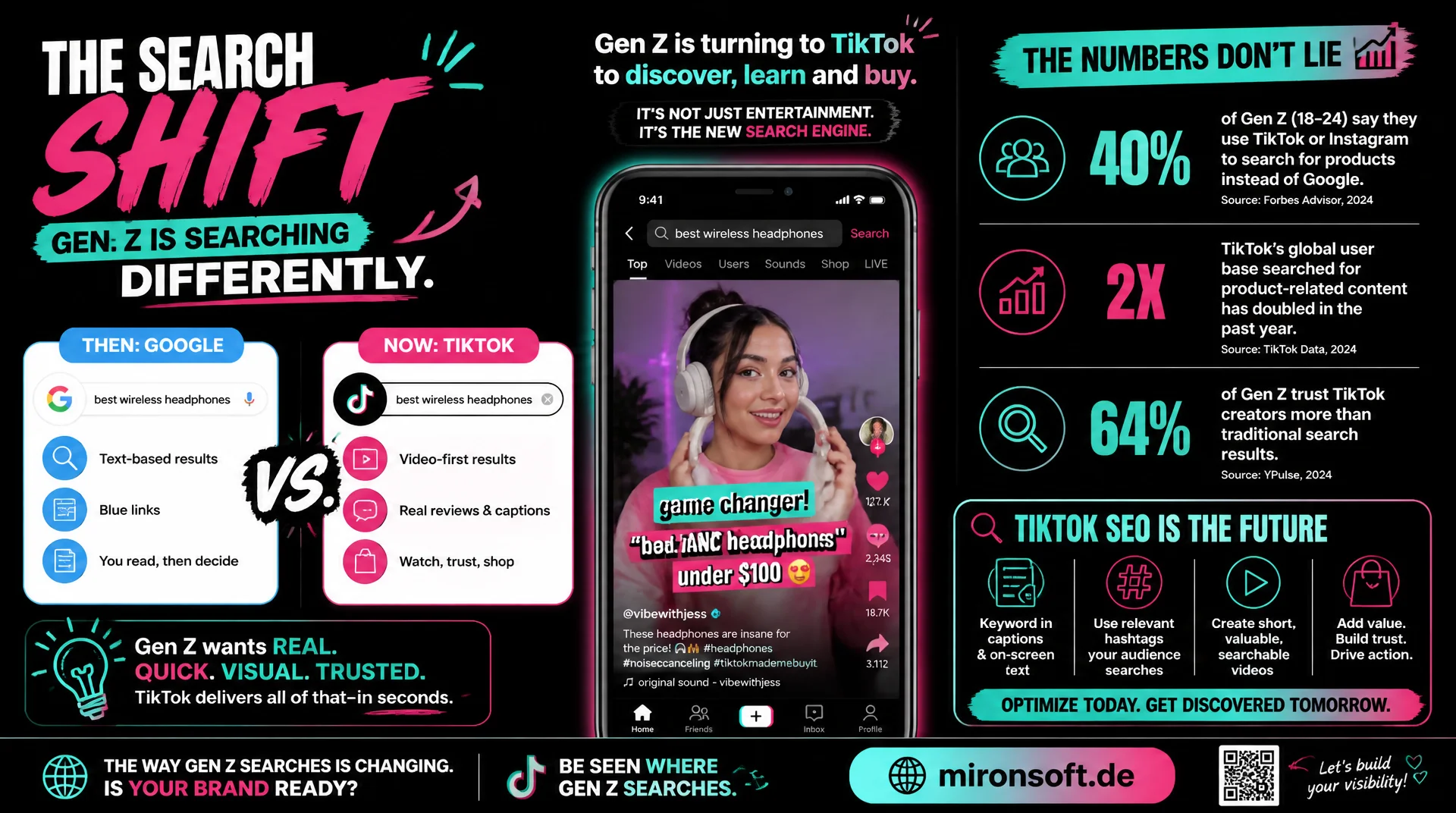
Captions, on-screen text and hashtags as ranking factors
A large share of Gen Z no longer opens Google for a first product search, they open the TikTok search bar instead. TikTok SEO describes the deliberate optimization of videos, captions and text overlays so content gets found for exactly those queries, instead of disappearing into the endless For You feed.
Table of contents
- 1. TikTok as a search engine: numbers and context for Gen Z
- 2. How the TikTok search algorithm actually works
- 3. Keyword research for TikTok SEO
- 4. On-screen text and captions as a ranking factor
- 5. Caption optimization: structure and keyword placement
- 6. Hashtag strategy 2026: context over keyword stuffing
- 7. Sounds, trends and their role in discoverability
- 8. TikTok SEO compared to classic Google SEO
- 9. Measuring success: TikTok Analytics and search insights
- 10. Summary
- 11. FAQ
1. TikTok as a search engine: numbers and context for Gen Z
Google itself admitted publicly in 2022 that almost 40 percent of younger users open TikTok or Instagram first when looking for a lunch spot, before ever touching Google Maps or Google Search. That finding is the starting point for TikTok SEO: the deliberate optimization of content so it gets found for specific queries inside the app, instead of relying purely on algorithmic distribution through the For You feed. For a generation that grew up visually, a 30-second video with a real demonstration often answers a question faster than a text article buried under ten ad banners.
The search bar in TikTok is no longer a minor feature, it is an actively used entry point into the app. Users type product names, problem descriptions and brand comparisons into it, often in the same colloquial phrasing they would use in conversation. Anyone who ignores TikTok SEO does not just lose reach in the feed, they become invisible at exactly the moment a user is actively preparing a purchase decision.
An important nuance: TikTok does not replace Google, it adds a parallel search surface with its own logic. Similar to how generative engine optimization works for AI answer systems, this creates a second discovery channel that classic SEO strategies frequently overlook entirely, even though it already covers a meaningful share of search volume among younger audiences.
2. How the TikTok search algorithm actually works
The TikTok search algorithm differs fundamentally from For You feed ranking, even though both systems draw on the same raw data. While the feed optimizes mainly for interaction probability, search matches the typed query against several text sources inside the video: the caption, the spoken words transcribed via speech recognition, and the on-screen text read out through optical character recognition. This triple text match effectively turns TikTok into a full-text search engine for video content, even though users rarely think of it that way.
On top of that, engagement signals feed into ranking: completion rate, shares, saves into collections, and how long a viewer stays after clicking through from a search result. A video that gets abandoned immediately after being clicked from search results loses relevance for that specific query, even if it collects plenty of likes in the normal feed. For TikTok SEO this means: a clickable thumbnail alone is not enough, the video has to actually deliver on the expectation set by the search term.
<!-- Example: how TikTok indexes text sources of a single video -->
<!-- Source 1: Caption text entered by the creator -->
Caption: "The 3 most common mistakes when buying an inverter #solarsetup"

<!-- Source 2: Spoken audio, transcribed via automatic speech recognition -->
Transcript (auto-generated): "The first mistake with inverters is..."

<!-- Source 3: On-screen text, read via optical character recognition -->
On-screen overlay (frame 1, 0:00-0:03): "INVERTER MISTAKE #1"

<!-- All three sources are matched independently against a user's search query -->
3. Keyword research for TikTok SEO
Keyword research for TikTok SEO does not start with a classic SEO tool, it starts inside the app itself. Typing into the search bar immediately surfaces autocomplete suggestions based on actual search volume. TikTok also shows a related-terms panel directly below the search field, often labeled "Others searched for". Both sources give a realistic picture of how the target audience actually phrases things within minutes, without going through a generic keyword database at all.
The Discover tab additionally shows currently trending search terms, grouped by categories such as beauty, tech or food. For more structured research, the TikTok Ads Creative Center offers a keyword insights tool that surfaces search volume and topic clusters over a longer time frame, even for brands without an active campaign. What matters most is not thinking in formal written language but in the everyday language of the audience: "how does it work" instead of "functional principle", "is it worth it" instead of "cost-benefit analysis".
4. On-screen text and captions as a ranking factor
On-screen text is one of the most underrated levers in the entire TikTok SEO toolkit. Because TikTok reads displayed text via optical character recognition and indexes it, every text card in a video acts like an additional, separately searchable text layer. The primary keyword should therefore appear as a text overlay within the first three seconds, not after a long introduction, since TikTok weights early video content more heavily and viewers drop off within seconds if no relevance is apparent.
In practice this means: choose a font size large enough for reliable OCR recognition, do not scatter the text across the entire runtime in tiny swipe gestures, and never let your own text elements cover the native caption bar. Since a significant share of users consume TikTok muted, on-screen text is also an accessibility factor: anyone who delivers the core message only through spoken audio loses silently scrolling viewers, and loses an important ranking signal for search at the same time.
<!-- On-screen text sequence example for a 30-second product explainer -->
0:00-0:03  "3 MISTAKES WHEN BUYING AN INVERTER"   <!-- primary keyword up front -->
0:04-0:09  "MISTAKE 1: WRONG POWER CLASS"
0:10-0:16  "MISTAKE 2: MISSING GRID PROTECTION"
0:17-0:23  "MISTAKE 3: WRONG PLUG TYPE"
0:24-0:30  "MORE TIPS IN BIO"                      <!-- clear call to action -->

<!-- Rule of thumb: keyword-bearing text in frame 1, legible font size,
     never fully covered by the native caption bar -->
Practical checklist: on-screen text for TikTok SEO
- The main keyword appears as a text overlay within the first three seconds
- Font size is large enough for reliable OCR recognition
- The text overlay does not cover the native caption bar at the bottom of the screen
- Every text card carries a distinct, meaningful term instead of filler words
- The message is fully understandable even without sound
- Contrast between text and background stays legible on mobile devices
5. Caption optimization: structure and keyword placement
The caption is the most precise text signal source for TikTok SEO, because it is consciously written by the creator rather than generated automatically like subtitles or a transcript. TikTok truncates captions in feed view after roughly 150 characters behind a "see more" link. The primary keyword should therefore sit within those first 150 characters, embedded in a complete, naturally readable sentence rather than a stacked list of keywords, since TikTok can flag artificially stacked terms as a spam signal.
A proven structure: one sentence carrying the main keyword and the concrete value proposition, followed by a second sentence with secondary terms and a clear call to action. "These 3 mistakes when buying an inverter cost you real money. Save yourself the hassle and check the checklist in bio." delivers context, keyword and call to action in two sentences without sounding forced. What matters most: the caption has to deliver on what the video actually shows, otherwise completion rate drops, and with it the search ranking indirectly suffers too.
6. Hashtag strategy 2026: context over keyword stuffing
The role of hashtags in TikTok SEO has shifted noticeably since the app's early years. In the past, as many broad hashtags as possible were considered a growth lever, today hashtags function primarily as topical classifiers for content distribution, not as a direct search index. A hashtag like #fyp carries essentially no search relevance anymore, because it says nothing about the video's content and TikTok now largely ignores such generic tags.
A solid structure combines one broad category hashtag, two to three precise topic hashtags, and one dedicated branded hashtag. Five to seven well-chosen tags almost always outperform twenty generic ones, because TikTok checks each hashtag's relevance against the rest of the video content. A hashtag with millions of completely unrelated videos dilutes visibility rather than boosting it, because the video lands in a far too broad audience pool where relevance signals barely register anymore.
<!-- Weak: generic, oversized hashtag pool, no topical precision -->
#fyp #foryou #viral #trending #love #instagood #photooftheday

<!-- Strong: layered hashtag mix for TikTok SEO -->
#SolarSetup           <!-- broad category tag -->
#InverterTips          <!-- precise niche tag -->
#AvoidSolarMistakes    <!-- precise niche tag -->
#Mironsoft              <!-- branded tag -->

<!-- 4-6 well-matched tags outperform 15+ generic ones for search relevance -->
7. Sounds, trends and their role in discoverability
Sounds are a double-edged tool for TikTok SEO. A trending sound temporarily raises the odds of being surfaced in the For You feed, because TikTok actively promotes trend momentum. For direct search, however, what counts most is the spoken content layered over the sound, transcribed and indexed via speech recognition. A video riding a trending sound but without any recognizable spoken or displayed text tied to a search term will barely appear for a specific query, no matter how viral the sound currently is.
Uploading original sound with a descriptive title, for example "Explainer: how to properly size an inverter" instead of a default title, creates an additional searchable text layer and, at the same time, a recognizable brand sound that can be reused in future videos. The workable balance: use trending sounds for feed reach, but never skip clear spoken statements and text overlays if a video is also meant to be found through search.
8. TikTok SEO compared to classic Google SEO
Anyone coming from classic Google SEO intuitively carries over concepts like backlinks or domain authority, which simply do not exist on TikTok. TikTok SEO instead works with engagement signals at the individual video level and a far shorter indexing latency: a video can surface for matching queries within minutes, while a new webpage on Google often needs days or weeks before it is fully indexed.
| Factor | Google SEO | TikTok SEO | Practical implication |
|---|---|---|---|
| Ranking unit | Whole page / domain | Single video | Every video needs its own optimization |
| Authority | Backlinks, domain age | Completion rate, shares, saves | Engagement quality instead of link building |
| Indexing | Days to weeks | Minutes | Fast reaction to trends is possible |
| Text sources | HTML, meta tags | Caption, on-screen text, transcript | Optimize three text layers instead of one |
| Content lifespan | Continuous freshness signal | Can resurface at any time | Review and refresh old videos regularly |
These differences do not make classic SEO knowledge worthless. Principles like understanding user intent, answering a query precisely, and structuring content clearly apply on TikTok just as they do on Google, only the concrete technical execution shifts from meta tags and backlinks toward captions, on-screen text and engagement rates.
9. Measuring success: TikTok Analytics and search insights
Without measurement, TikTok SEO stays a guess. TikTok Analytics shows, under "Traffic source" for each video, the percentage of views that came from search, from For You, from Following, or directly from the profile. A rising search share on videos deliberately optimized for specific keywords is the most direct proof that the optimization is actually working, independent of total reach in the feed.
It also pays to regularly check the content inspiration tool in the TikTok Ads Creative Center, which filters current search trends by industry. Brands running their own shop should additionally tag the bio link with UTM parameters, to cleanly separate TikTok traffic from other channels inside their own web analytics tool and trace the real effect of TikTok SEO on clicks, leads or sales, instead of only looking at vanity metrics like likes.
<!-- UTM structure for a TikTok bio link, to separate TikTok SEO traffic
     from paid campaigns and other social channels in web analytics -->
https://shop.example.com/solar-setup?
  utm_source=tiktok
  &utm_medium=organic_search
  &utm_campaign=inverter_guide
  &utm_content=bio_link
Mironsoft
Social media SEO, content strategy and visibility for younger audiences
Get found by Gen Z on TikTok instead of overlooked?
We audit your existing TikTok content, build a caption and hashtag strategy with real search intent behind it, and set up measurement so TikTok SEO shows up in clicks and sales, not just vanity metrics.
Keyword audit
Analysis of your audience's search terms directly inside TikTok search and the Discover tab
Content structure
Caption, on-screen text and hashtag templates built on real search intent
Tracking setup
UTM structure and analytics integration to make TikTok SEO success measurable
10. Summary
TikTok SEO is no longer a niche topic, it is its own discovery channel with clear, technically traceable ranking factors. The TikTok search algorithm matches queries against three text sources: caption, transcribed spoken text, and OCR-recognized on-screen text. Placing the primary keyword consistently across all three layers raises the odds of matching exactly the queries that precede a purchase decision.
Hashtags have shifted from a search index toward a topical classifier, sounds remain mainly a reach lever in the feed rather than a central search factor. Anyone who confuses TikTok SEO with classic Google SEO logic underestimates the importance of completion rate, shares and saves as ranking signals. Regularly reviewing the traffic source in TikTok Analytics shows whether the optimization is actually working.
TikTok SEO for younger audiences: the essentials at a glance
Three text sources
Caption, transcribed audio and on-screen text are indexed separately. The primary keyword belongs in all three.
First three seconds
On-screen text carrying the main keyword must appear immediately, not after a long intro.
Hashtags as classifiers
4 to 6 precise hashtags instead of 20 generic tags. Combine a branded tag with niche tags.
Make it measurable
Check traffic source in TikTok Analytics, tag the bio link with UTM parameters.