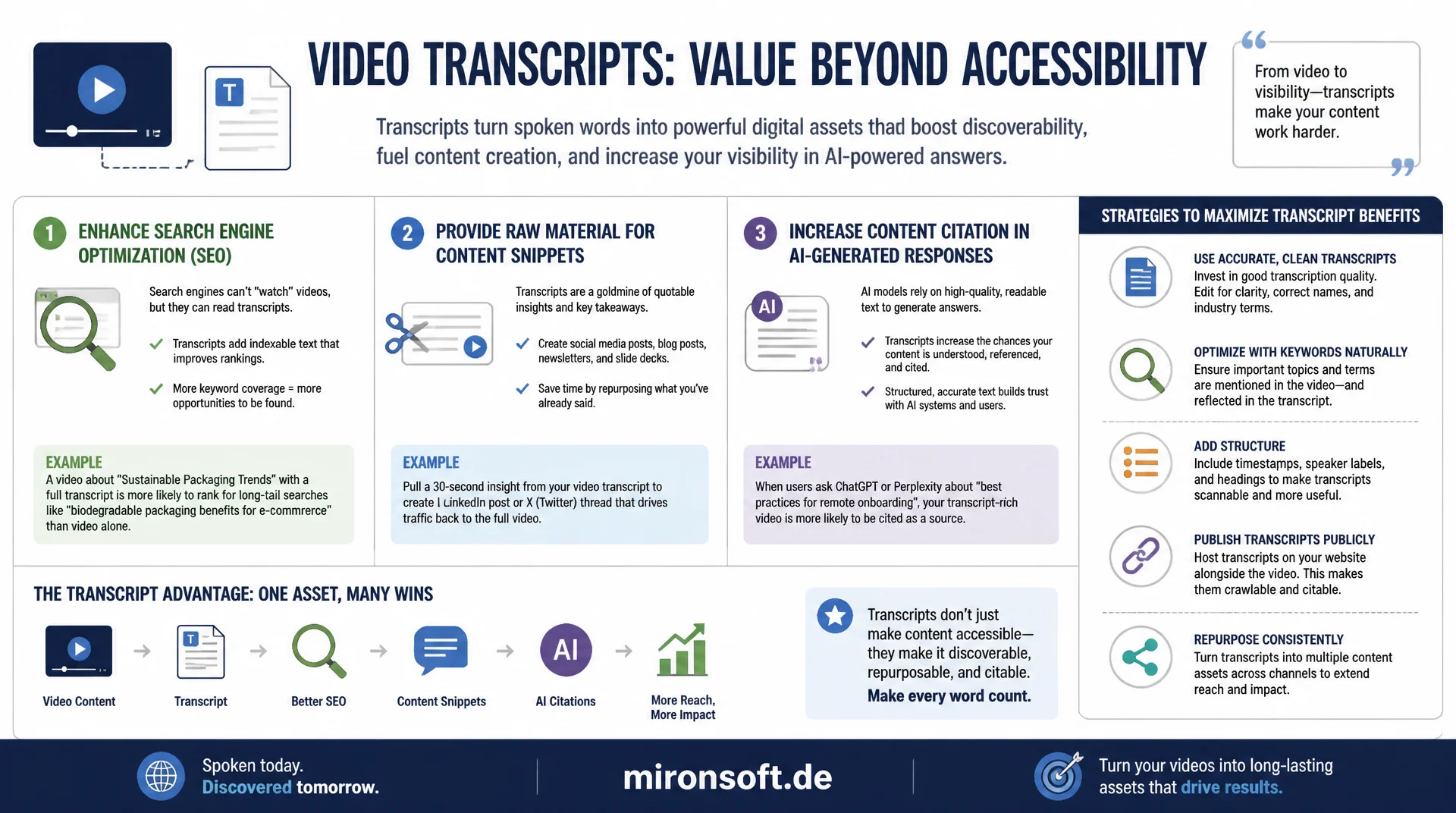
indexable text, snippets and AI citability
Video transcripts are usually treated as an accessibility checkbox, yet their biggest value lies elsewhere: they make video content readable for search engines and AI systems, supply raw material for snippets, and increase the likelihood that content gets cited in AI-generated answers.
Table of Contents
- 1. Why video transcripts are more than accessibility
- 2. Video transcripts as indexable text
- 3. Formats: VTT, SRT and readable transcript pages
- 4. Connecting video transcripts with structured data
- 5. Video transcripts and citability in AI search
- 6. Featured snippets and timestamps from transcripts
- 7. Implementation on video pages in practice
- 8. Quality assurance: automatic versus edited transcripts
- 9. Transcript approaches compared directly
- 10. Summary
- 11. FAQ
1. Why video transcripts are more than accessibility
Video transcripts are treated in most projects purely as an accessibility topic: people with hearing impairments should be able to read video content, and legal requirements such as the ADA or European accessibility directives demand corresponding offerings. That is a legitimate and important reason, but it only describes part of the actual value. For SEO teams, video transcripts are above all one thing: the only way to turn moving-image content into searchable, indexable text.
Search engines cannot understand video files as deeply as they understand text. Without a transcript, a video remains largely a black box for crawlers, recognizable only through metadata such as title, description and structured data. With a complete video transcript, on the other hand, a searchable body of text emerges that can reach the same content depth as a well-written article, just derived from spoken language.
This dual function, delivering accessibility and SEO value at the same time, makes video transcripts one of the most efficient content investments available. A single transcript satisfies legal requirements, improves the experience for everyone who prefers reading over listening, and simultaneously supplies the raw material for additional SEO signals covered in detail throughout the rest of this article.
2. Video transcripts as indexable text
The core of the SEO value of video transcripts lies in the sheer amount of text a page gains from them. A ten-minute video contains between 1200 and 1500 words of spoken content at a normal speaking pace. Without a transcript, a search engine sees none of that. With a transcript, a body of text emerges on the video page that delivers topical relevance, keyword context and semantic signals that would otherwise be completely missing.
Placement matters here: a video transcript that exists only as a hidden element without visible content in the DOM is increasingly judged critically by modern search engines, because hidden text has historically been misused for spam techniques. The recommended practice is a visible, expandable transcript directly under or next to the video player that offers real user value while remaining fully indexable.
WEBVTT

00:00:00.000 --> 00:00:04.500
Welcome to our video about video transcripts and SEO.

00:00:04.500 --> 00:00:09.200
Today we show why a complete transcript
is more than an accessibility measure.

00:00:09.200 --> 00:00:14.800
We cover three areas: indexing, snippets
and citability in AI-powered search.
3. Formats: VTT, SRT and readable transcript pages
Several formats with different strengths exist for the technical implementation of video transcripts. VTT (WebVTT) is the web standard for captions in the HTML5 video element and additionally supports positioning and styling. SRT is older, simpler and accepted by almost every platform, but offers fewer features. For SEO purposes, neither format alone is sufficient, because caption files themselves are usually not crawled directly by search engines as page content.
A third layer is therefore decisive: a readable transcript page or a transcript section in the HTML of the video page itself, generated from the VTT file or maintained in parallel. This HTML version is what actually gets indexed and gives search engines the full text. The workflow is therefore: VTT for the caption function in the player, HTML transcript for indexing, ideally generated automatically from the same source to avoid inconsistencies.
<video controls preload="metadata" poster="/media/video-transcripts-thumb.jpg">
  <source src="/media/video-transcripts.mp4" type="video/mp4">
  <track
    kind="subtitles"
    src="/media/video-transcripts-en.vtt"
    srclang="en"
    label="English"
    default
  >
</video>
4. Connecting video transcripts with structured data
Structured data using the VideoObject schema from schema.org makes it possible to mark up transcript information in a machine-readable way. The transcript property is not an officially documented standard field in the VideoObject schema, but many search engines and AI systems additionally use the visible HTML next to the structured VideoObject to capture the full context. More important than a single schema field is therefore the combination of correct VideoObject markup and a complete, visible HTML transcript placed directly near the video.
In addition, the VideoObject schema should fully populate fields such as description, uploadDate, duration and thumbnailUrl, since these fields together with the transcript text form a coherent semantic picture of the video content. If one of these fields is missing, the connection between structured metadata and the actual transcript text becomes harder for search systems to trace.
{
  "@context": "https://schema.org",
  "@type": "VideoObject",
  "name": "Video Transcripts and SEO: A Practical Guide",
  "description": "How video transcripts improve indexing, snippets and AI citability.",
  "thumbnailUrl": "https://mironsoft.de/media/video-transcripts-thumb.jpg",
  "uploadDate": "2026-07-23",
  "duration": "PT9M40S",
  "contentUrl": "https://mironsoft.de/media/video-transcripts.mp4",
  "embedUrl": "https://mironsoft.de/video/video-transcripts-seo"
}
5. Video transcripts and citability in AI search
AI-powered search systems and answer engines generate answers by summarizing and citing text sources, not by watching videos. A video without a transcript is practically invisible to these systems, regardless of how valuable the content is. A complete, well-structured transcript, on the other hand, supplies exactly the raw material an AI system needs to correctly summarize a statement from the video and cite the source.
For this citability, the structure of the transcript plays a bigger role than for pure human readability. Clearly separated paragraphs, topical subheadings and avoiding filler words typical of spoken language increase the likelihood that an AI system can extract a single, self-contained statement and attribute it correctly. A raw, unedited automatic transcript with slips of the tongue, repetitions and missing punctuation is considerably less suitable for this purpose than an edited transcript.
Another aspect is timestamp accuracy: when a transcript carries precise timestamps, both classic search engines and AI systems can link or refer to a specific video segment. This significantly increases the practical benefit for end users, because they can jump directly to the relevant point instead of having to watch the entire video.
6. Featured snippets and timestamps from transcripts
Video transcripts are an underrated source for featured snippets. When a user asks a specific question and the answer sits in a well-structured transcript section with a clear timestamp, that text passage can be served as a snippet, often with a direct deep link into the corresponding video segment. This combination of text snippet and video jump mark produces an above-average click-through rate, because users immediately see that the answer is demonstrated visually in the video.
To use this effect deliberately, it is worthwhile to structure transcripts afterward with subheadings that pick up typical search questions. A transcript section that starts with a clear question as a heading and delivers a precise, self-contained answer underneath works on the same pattern as an FAQ entry, just with video evidence behind it.
7. Implementation on video pages in practice
The technical implementation follows a repeatable pattern: first, the video is fitted with VTT captions embedded in the <track> element of the HTML5 video player. Second, an expandable HTML transcript is generated from the same text source below the player, with clickable timestamps that jump the player to the corresponding point when clicked. Third, the VideoObject schema is completed with full metadata that matches the visible transcript.
For Hyvä-based Magento shops, this structure can be implemented via a dedicated template element with Alpine.js that shows the transcript section collapsed by default, but keeps it fully present in the DOM and therefore accessible to crawlers. It is important not to hide the transcript text with display: none, but through an accessible accordion pattern with aria-expanded, so that both screen readers and search engine crawlers reliably capture the full content.
<div x-data="{ open: false }" class="video-transcript">
  <button
    type="button"
    @click="open = !open"
    :aria-expanded="open.toString()"
    class="transcript-toggle"
  >
    Show transcript
  </button>
  <div x-show="open" x-collapse class="transcript-body">
    <p><a href="#t=0" data-time="0">00:00</a> Welcome to our video about video transcripts and SEO ...</p>
    <p><a href="#t=9" data-time="9">00:09</a> We cover three areas: indexing, snippets and citability ...</p>
  </div>
</div>
8. Quality assurance: automatic versus edited transcripts
Automatic speech recognition today delivers usable raw transcripts in minutes instead of hours, but error rates for technical terms, proper nouns and numbers remain a real problem. A misrecognized product name or an incorrectly transcribed number in the transcript can generate misleading search results and, in the worst case, pass wrong information on to AI systems that cite this text source. That is why editorial review, at minimum a correction pass by someone with subject expertise, is essential for high-value video content.
A practical compromise for teams with limited resources is a two-stage process: automatic transcription for all videos as a baseline, followed by prioritized manual correction for the videos with the highest expected search traffic or the greatest strategic importance. This keeps effort under control while making sure the most important video transcripts reach the quality needed for citability and snippet eligibility.
{
  "transcript_quality_workflow": {
    "step_1": "automatic transcription for all videos",
    "step_2": "prioritization by expected search traffic",
    "step_3": "manual correction for top videos",
    "correction_focus": ["technical terms", "proper nouns", "numbers", "punctuation"],
    "review_required_before_publish": true
  }
}
9. Transcript approaches compared directly
The choice of transcript approach has a direct impact on SEO value, accessibility and citability in AI search. The following overview compares common approaches across the most important criteria.
| Approach | Indexability | AI citability | Effort |
|---|---|---|---|
| VTT captions only | Low | Low | Low |
| Automatic transcript, hidden | Medium | Medium | Low |
| Automatic transcript, visible | High | Medium | Medium |
| Edited transcript with timestamps | High | High | High |
For videos with high strategic importance, the effort of an edited transcript with timestamps is almost always worthwhile, because it simultaneously maximizes indexability, AI citability and snippet eligibility. For less important videos, a visible automatic transcript is often a solid middle ground.
Mironsoft
Video SEO, transcription and structured data for video content
Video content that search engines and AI systems can actually read?
We set up video transcripts, VideoObject schema and accessible transcript components so your videos get indexed, snippeted and cited in AI search results.
Transcript setup
Building VTT captions, HTML transcripts and an editorial process
Schema markup
Implementing VideoObject correctly and connecting it to the transcript
Hyvä integration
Accessible Alpine.js transcript component with no accessibility compromises
10. Summary
Video transcripts solve a fundamental problem: search engines and AI systems work with text, not moving images. Without a transcript, the content of a video remains practically invisible to these systems, regardless of its quality. With a complete, visible transcript, indexable text emerges that increases snippet chances, supplies timestamps for deep links, and raises the likelihood that AI search systems cite the content correctly.
The decisive difference between a simple automatic transcript and a strategically valuable transcript lies in structure and editorial quality: clear paragraphs, correct technical terms and precise timestamps. Combining video transcripts consistently with VideoObject schema and editing them for the most important videos unlocks an SEO channel that remains unused in many projects.
Video transcripts for SEO, the key points at a glance
Indexability
A visible HTML transcript next to the player turns spoken content into searchable, indexable text.
Formats
VTT for the player, edited HTML transcript with timestamps for indexing and snippets.
AI citability
Clear paragraphs and correct technical terms increase the likelihood that AI systems cite the video as a source.
Quality assurance
Automatic transcription as a baseline, prioritized manual correction for strategically important videos.