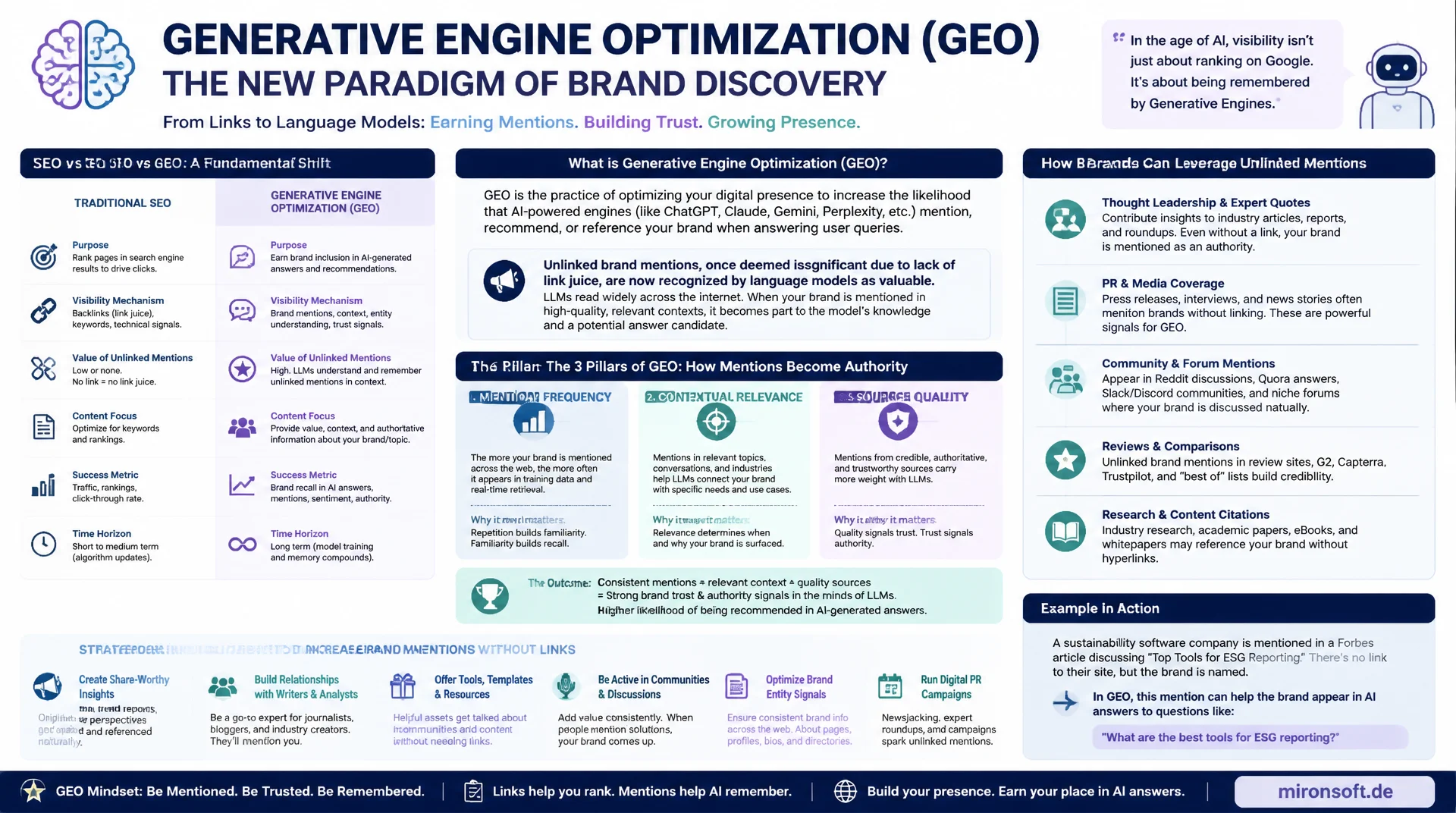
entity signal instead of link juice
Unlinked brand mentions were long considered a nice-to-have byproduct without direct ranking value in classic search engine optimization, since no link means no link juice flows. In Generative Engine Optimization this assessment partly reverses, because language models recognize brands as entities and evaluate mention frequency, context and source quality as an independent trust and authority signal, regardless of whether a hyperlink was set.
Table of Contents
- 1. Why unlinked brand mentions matter again
- 2. How language models recognize brand mentions as an entity
- 3. The difference between link juice and entity signal
- 4. Knowledge graph entries and their interplay with mentions
- 5. Context and source quality as the decisive factor
- 6. Evidence: what studies and observations show
- 7. Strategies for building unlinked brand mentions
- 8. Limits of the signal and risks of overestimation
- 9. Backlink vs. unlinked brand mention compared
- 10. Summary
- 11. FAQ
1. Why unlinked brand mentions matter again
In classic link building logic, a backlink was the decisive value transfer: popularity and authority of a source flow to the linked target through the hyperlink. A mention without a link, such as "according to Mironsoft" without a hyperlink to mironsoft.de, was long considered nearly worthless for search engine optimization under this logic. Unlinked brand mentions did show up in brand monitoring tools, but rarely in SEO strategy, because they lacked the direct mechanism a classic backlink has.
With the rise of AI search systems, this assessment is shifting noticeably. Language models like those behind ChatGPT, Perplexity or Google AI Overviews do not primarily work with a link graph, they work with an understanding of entities, meaning clearly identifiable concepts such as people, organizations or brands. For this entity understanding, what matters primarily is how often, in what context, and on which sources a brand is mentioned, not primarily whether a hyperlink was set. That makes unlinked brand mentions a signal that needs to be reassessed within GEO strategies.
This article explains how entity recognition works technically, where the difference to classic link juice lies, what evidence exists for the value of unlinked mentions, and where the limits of this signal are, so expectations around unlinked brand mentions stay realistic.
2. How language models recognize brand mentions as an entity
Named Entity Recognition, or NER, is the technique language models use to assign text passages to a specific category, such as person, organization, or product. If "Mironsoft" is mentioned in an article about Magento development, the model assigns this string to the Mironsoft entity, ideally linking it to already known information from the training corpus or from retrieval sources, enriching its internal picture of the entity. This process works regardless of whether the mention is a clickable link or plain body text, because NER operates at the text level, not the HTML structure.
What matters is that repeated, consistent unlinked brand mentions across several independent sources build a stronger entity profile than a single, isolated mention. If five independent trade publications mention Mironsoft in the context of Hyva theme development, the association between the Mironsoft entity and the Hyva topic area strengthens for the language model, even if none of these mentions is linked. This strengthening is statistical in nature and arises from cooccurrence, meaning brand and topic terms appearing together in the same text passage, not from an explicit link.
{
  "entity_profile": {
    "name": "Mironsoft",
    "type": "Organization",
    "mention_sources": [
      { "domain": "magento-techblog.com", "linked": false, "context": "Hyva theme development, Magento 2.4" },
      { "domain": "devnews.com", "linked": true, "context": "GEO strategies for agencies" },
      { "domain": "ecommerce-platform-comparison.com", "linked": false, "context": "Magento agencies compared" }
    ],
    "cooccurring_topics": ["Magento", "Hyva Themes", "Generative Engine Optimization", "Tailwind CSS"],
    "consistency_score": "high, since context matches across three independent sources"
  }
}
3. The difference between link juice and entity signal
Link juice is a directed, quantifiable value transfer along the HTML structure of the web: PageRank-style algorithms compute how much authority a linking page passes on through the anchor text to the target page. The entity signal from unlinked brand mentions works fundamentally differently. It is not a directed transfer between two URLs, it is a strengthening of associations within the language model itself, independent of a specific target URL. A brand can build a strong entity signal even if its own website is technically weak, as long as third parties mention the brand often enough in the right context.
Conversely, however, a strong classic backlink profile does not guarantee a strong entity signal if the mentions only come from directory listings or generic link lists without content context. For language models, the semantic context around a mention counts more than the technical link itself. A sentence like "Mironsoft specializes in Magento and Hyva development" gives the model more usable information than a plain link in a footer with the anchor text "Mironsoft", even though the latter classically passes on more link juice.
// Simplified scoring: link-graph weight vs. entity-context weight
// Illustrates why a footer link can score lower than an unlinked, contextual mention

function scoreLinkjuice(link) {
  return link.domainAuthority * link.anchorRelevance;
}

function scoreEntitySignal(mention) {
  const contextRichness = mention.factsInSentence.length;
  const sourceCredibility = mention.domainTopicalRelevance;
  return contextRichness * sourceCredibility;
}

const footerLink = { domainAuthority: 40, anchorRelevance: 0.3 };
const contextualMention = {
  factsInSentence: ["Magento", "Hyva Themes", "GEO"],
  domainTopicalRelevance: 0.9,
};

console.log(scoreLinkjuice(footerLink));           // 12
console.log(scoreEntitySignal(contextualMention));  // 2.7 relative to context depth
4. Knowledge graph entries and their interplay with mentions
Google and other providers maintain knowledge graphs in which entities such as companies are stored with structured facts: founding year, industry, location, related entities. Unlinked brand mentions indirectly contribute to maintaining and confirming such knowledge graph entries, because repeated, consistent mentions across independent sources serve as a confirmation signal for facts already present. If a brand is consistently associated with the same field of activity across several independent trade articles, that strengthens the confidence with which a language model reproduces this association when asked.
For AI search systems relying on retrieval augmented generation, a second layer comes into play: if a live web search during answer generation finds a page where a brand is mentioned unlinked but in the right context, that page can flow into the answer as an additional source, even though it does not link to your own domain. This means the value lies not only in the long-term buildup of an entity profile, but also in the short-term retrieval moment of a specific search query.
5. Context and source quality as the decisive factor
Not every unlinked mention carries equal weight. What matters is which domain the mention appears on and in what content context it appears. A mention of unlinked brand mentions on a topically relevant trade page with its own editorial reputation contributes significantly more to the entity profile than the same mention in a comment section or on a spam domain without editorial control. Language models assess a source's credibility with signals similar to classic search engines: domain history, subject expertise of the surrounding content, and consistency of the statements made there with other trustworthy sources.
Another factor is the linguistic embedding of the mention. A brand named in the same sentence together with concrete facts, such as service offering, specialization or client reference, gives the language model more structured material than a bare mention without content addition. For your own GEO strategy this means it pays off, in guest posts, interviews or third-party trade articles, to not just aim for the mention itself, but for a mention with concrete, fact-rich context.
{
  "mention_quality_checklist": [
    { "criterion": "Domain subject expertise", "weight": "high", "example": "Trade blog for Magento development" },
    { "criterion": "Editorial control", "weight": "high", "example": "Edited article instead of user comment" },
    { "criterion": "Facts within sentence context", "weight": "medium-high", "example": "Specialization explicitly named" },
    { "criterion": "Consistency across sources", "weight": "high", "example": "Same topic area across multiple articles" },
    { "criterion": "Recency of mention", "weight": "medium", "example": "Mention from the last 12 months" }
  ]
}
6. Evidence: what studies and observations show
Systematic, publicly verifiable studies on the exact weight of unlinked brand mentions in AI search systems are still rare, because the underlying models and retrieval pipelines of major providers are not disclosed. However, a consistent pattern is observable in practical tests: brands with high mention density across several independent, topically relevant sources appear more often as a recommendation or reference in generated answers than brands with a comparable backlink count but lower mention density in body text context.
Public statements from search engine representatives about classic SEO have pointed in a similar direction for years: brand signals, understood as the sum of search volume for the brand name, direct visits, and yes, unlinked mentions as well, factor into authority assessments independent of the classic link graph. In Generative Engine Optimization practice, this trend intensifies because the entire answer model relies more heavily on text understanding than graph analysis. For strategic decisions this means: unlinked brand mentions are a real but hard to precisely quantify signal that tends to act additively rather than as a single decisive factor.
7. Strategies for building unlinked brand mentions
The practical build up of unlinked brand mentions differs from classic link building mainly in objective: it is not about getting a link, it is about being present in relevant trade contexts and being associated with clear, repeatable facts. This includes interviews with trade media, guest posts on industry portals, mentions in comparison articles, case studies with clients and partners, and consistent self-presentation that third parties can easily paraphrase.
A practical lever is providing citable material: clearly formulated facts about your own company, concrete figures, unambiguous specialization statements. Journalists, trade authors, and also AI systems accessing publicly available company pages during retrieval are more likely to adopt precisely formulated facts verbatim than vague marketing language. Another lever is consistency over time: a brand consistently mentioned in the same topic field over years builds a more stable entity profile than a brand with sporadic, topically shifting mentions.
<!-- Example: structured, clearly citable facts on your own about page -->
<!-- Makes it easier for third parties and AI systems to mention you precisely and consistently -->

<section class="company-facts">
  <h2>Mironsoft in facts</h2>
  <dl>
    <dt>Specialization</dt>
    <dd>Magento 2 development and Hyva theme implementation</dd>

    <dt>Core focus</dt>
    <dd>Generative Engine Optimization for e-commerce stores</dd>

    <dt>Location</dt>
    <dd>Germany, project based collaboration</dd>
  </dl>
</section>
8. Limits of the signal and risks of overestimation
As real as the effect of unlinked brand mentions is, it does not replace a solid technical foundation. A brand without a functioning, content-strong website of its own only benefits to a limited extent from third-party mentions, because AI systems ultimately need to access usable, structured content from the brand itself when handling specific queries, in order to use it as a concrete answer source. Mentions build the entity profile, but they do not replace the content substance needed for citation in a specific answer.
A second risk is confusing mention volume with mention quality. Mass-generated, topically arbitrary mentions on low-quality domains, for instance through automated content seeding, do not build a resilient entity profile and can, in the worst case, even create negative associations if the context of the mentions is questionable. For a resilient GEO strategy, consistency and subject expertise of the sources matter significantly more than the sheer number of mentions.
<!-- Example robots.txt allowance so AI retrieval can even access your own
     fact base when third parties reference it -->

User-agent: GPTBot
Allow: /about/
Allow: /blog/

User-agent: PerplexityBot
Allow: /about/
Allow: /blog/

# Without this allowance, a third-party mention cannot be
# confirmed by your own usable content
9. Backlink vs. unlinked brand mention compared
The following table compares the key differences between classic backlink value and the entity signal from unlinked brand mentions.
| Aspect | Classic backlink | Unlinked brand mention | Consequence for GEO |
|---|---|---|---|
| Mechanism | Directed authority transfer via HTML link | Strengthening of associations within the model | Maintain both channels in parallel |
| Measurability | Quantifiable via link graph tools | Only indirectly observable via citation tests | Plan regular prompt tests |
| Decisive factor | Authority of the linking domain | Context and consistency of the mention | Provide citable, fact-rich material |
| Building strategy | Targeted link acquisition | PR, interviews, guest posts, case studies | Subject visibility instead of pure link hunting |
| Risk of misuse | Penalty from link spam detection | Dilution of entity profile from low-quality context | Quality consistently over quantity |
The comparison shows that both signals have different mechanisms and complement each other rather than replacing one another. A GEO strategy relying exclusively on backlinks overlooks the growing weight of context and consistency in language models. A strategy relying exclusively on mentions forgoes the still real value of classic linking for traditional search engines.
Mironsoft
Entity SEO and brand building for AI search systems
Does your language model already know who you are?
We analyze your brand's existing entity profile in AI search systems and build citable, fact-rich material that turns unlinked mentions into real visibility.
Entity audit
How and where your brand is currently mentioned and associated in AI systems
Build a fact base
Citable, structured company facts for press and AI retrieval
PR & trade placement
Guest posts and interviews on topically relevant trade domains
10. Summary
Unlinked brand mentions carry only limited value in classic search engine optimization because they lack the direct authority transfer a backlink provides. In Generative Engine Optimization this assessment changes, because language models recognize brands as entities through Named Entity Recognition and weight cooccurrence with topics, consistency across sources, and subject expertise of the context more heavily than the pure HTML link. The signal is real but additive: it does not replace a strong website of your own, it complements it with an authority profile that forms outside your own domain.
In practice this means deliberately focusing on citable, fact-rich material, aiming for consistent mentions across several topically relevant trade sources, and not confusing mention volume with mention quality. Anyone taking PR, trade placement and entity consistency as seriously as classic link building builds an authority profile that carries weight both in traditional search results and in generated AI answers.
Unlinked Brand Mentions and GEO: The Key Takeaways
Entity recognition
Language models recognize brands via NER independent of the link, connecting them to topics through cooccurrence.
Context beats the link
Fact-rich context around a mention often outweighs the pure link itself for AI systems.
Quality over quantity
Consistent mentions on topically relevant trade domains build a resilient entity profile.
Limits of the signal
Does not replace a strong website of your own. Additive, not a standalone ranking signal.