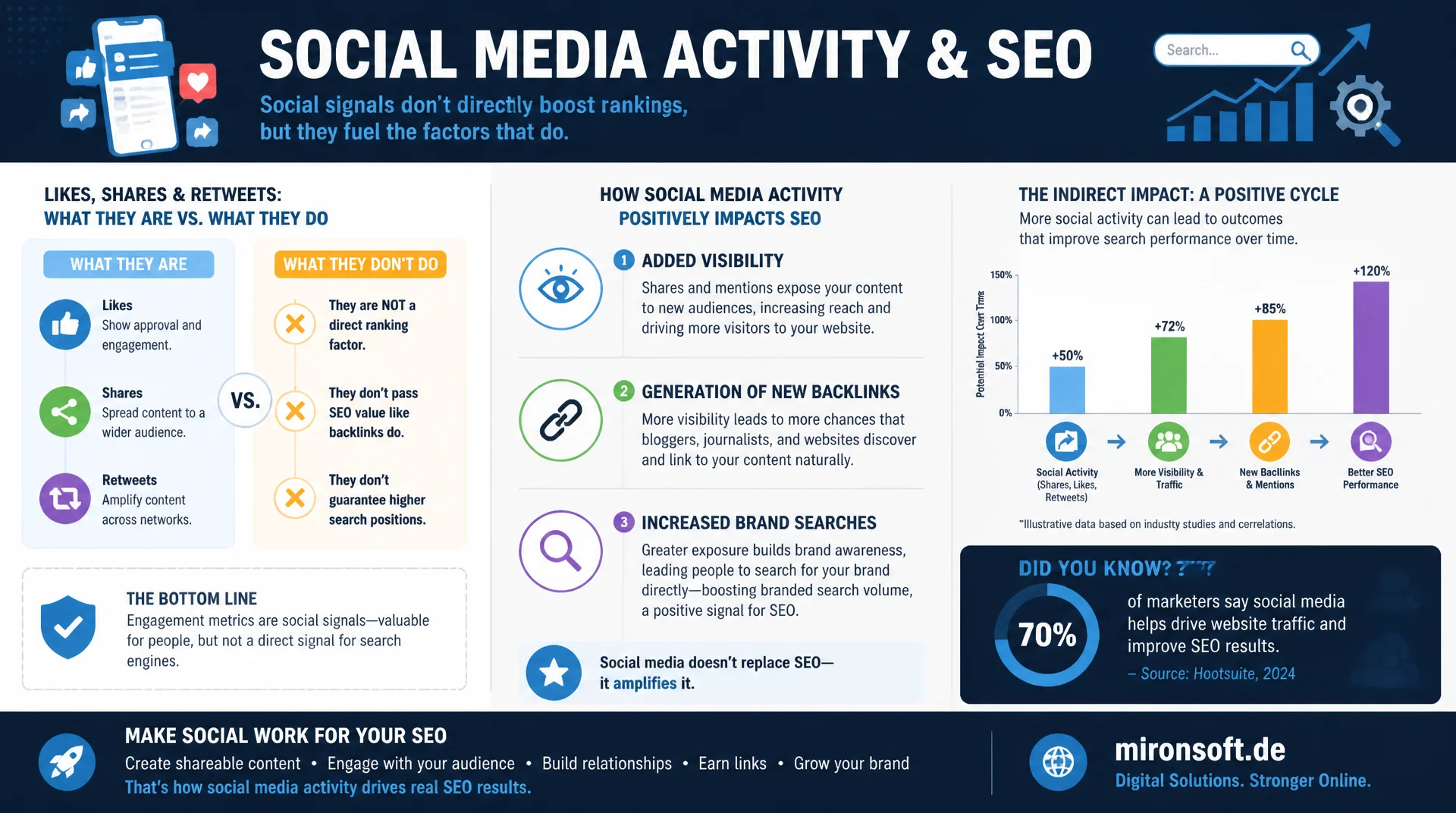
what likes and shares actually do for rankings
Likes, shares, and retweets feel like success, but Google has repeatedly confirmed that Social Signals are not a direct ranking factor. The real effect happens indirectly, through added visibility, new backlinks, and rising brand searches triggered by social media activity. Understanding this difference means investing time in the right levers instead of pure vanity metrics.
Table of Contents
- 1. What Social Signals actually are
- 2. What Google has officially said about Social Signals as a ranking factor
- 3. Correlation studies and why they mislead
- 4. Indirect effects: visibility and traffic from Social Signals
- 5. Backlinks as the bridge: how Social Signals lead to real ranking factors
- 6. Brand search: the underrated effect of Social Signals
- 7. Social Signals and crawling/indexing: the technical reality
- 8. Practical example: measuring and interpreting Social Signals correctly
- 9. What actually matters: priorities for 2026
- 10. Summary
- 11. FAQ
1. What Social Signals actually are
Social Signals is the umbrella term for all measurable interactions a URL receives on social media platforms: likes, shares, retweets, comments, pins, reactions, and the follower count of the sharing profile. The term is often used interchangeably with "social proof" in the SEO community, but it technically means something very concrete: a counter that accumulates on the respective platform and does not automatically flow into Google's ranking algorithm. It is important to distinguish this from social media presence as a marketing channel, since the two are frequently conflated in discussions.
An article with 5,000 shares on X or LinkedIn does not automatically earn 5,000 additional ranking points. What it does have is increased reach among real people, some of whom will visit the page, link to it, search for it again, or mention it in their own content. This exact chain of reach, visit, mention, and link is the point where Social Signals actually come into contact with SEO-relevant signals, just not directly and not in real time, but through several intermediate steps.
2. What Google has officially said about Social Signals as a ranking factor
Google's official position on Social Signals as a ranking factor has been consistent and clear for more than a decade: Facebook likes, shares, and retweets are not used as a direct ranking signal. As early as 2014, the then Head of Webspam explained that Google treats signals like Facebook likes or retweets just like any other link on a web page, with one decisive caveat: most social media links carry a rel="nofollow" or rel="ugc" attribute by default and therefore do not pass direct link value.
John Mueller has also confirmed this position repeatedly in Search Central hangouts: Social Signals do not flow into the core algorithm as an independent ranking factor, because like and share counts are easily manipulated, counted differently across platforms, and technically expensive for Google to read in real time. This statement does not contradict the observation that popular content often ranks well, it merely explains that the causality runs the other way: good content generates both Social Signals and organic backlinks, but the Social Signals themselves are not the cause of the good ranking.
3. Correlation studies and why they mislead
Studies regularly appear showing a high correlation between Social Signals and Google rankings, usually with charts plotting shares against the ranking positions of top-10 results. This correlation is statistically real and misleading at the same time, because it ignores a third, shared cause: content quality and publisher reach. An article from an established brand with a large email list, an active community, and a strong link profile automatically gets more shares and more backlinks at the same time, regardless of whether the shares themselves have any influence on ranking.
Anyone who concludes from such correlation studies that more Social Signals automatically lead to better rankings is confusing correlation with causation, a classic mistake in SEO analysis. The clean test would be a controlled experiment: artificially generated Social Signals without real traffic, without new backlinks, and without rising brand searches, measured in isolation against the ranking change. Such experiments have been run multiple times, including with purchased fake shares, and consistently showed no measurable direct ranking effect, confirming Google's official position.
{
  "@context": "https://schema.org",
  "@type": "Organization",
  "name": "Mironsoft",
  "url": "https://mironsoft.de",
  "logo": "https://mironsoft.de/media/logo.png",
  "sameAs": [
    "https://www.linkedin.com/company/mironsoft",
    "https://twitter.com/mironsoft",
    "https://www.facebook.com/mironsoft",
    "https://www.youtube.com/@mironsoft",
    "https://www.pinterest.com/mironsoft"
  ]
}
The sameAs array links the organization to its social profiles. This is not a direct ranking signal, but it helps Google identify the entity unambiguously, which in turn supports Knowledge Panel data and brand recognition.
4. Indirect effects: visibility and traffic from Social Signals
Even without a direct ranking influence, Social Signals produce real, measurable effects that indirectly touch SEO. The most obvious one is additional referral traffic: every click from X, LinkedIn, or Pinterest to your own site is a real visitor who influences engagement metrics such as time on page and pages per session. These user signals do not flow 1:1 into the ranking algorithm, but over time they shape how a domain is perceived and recommended by real people.
The second indirect effect concerns the discovery speed of new content. When a freshly published article is widely shared, it increases the likelihood that journalists, bloggers, or other content creators notice it before it is even visible in organic search results. This early visibility through Social Signals is a time advantage, not a ranking factor in the technical sense, but a strategic lever that shortens the path to real backlinks.
5. Backlinks as the bridge: how Social Signals lead to real ranking factors
The most important indirect channel through which Social Signals actually gain ranking relevance is backlinks. A viral post on LinkedIn or X gets seen by editors, curators, and subject matter authors who reference it in their own articles, often with a regular, dofollow link. These secondary links are real ranking factors in the classic PageRank sense, but they only arise because the Social Signals generated enough reach beforehand for the right people to see the content at all.
This chain can be tracked well in practice: a case study article gets shared on LinkedIn, an industry newsletter picks it up three days later, and two weeks after that the first organic backlinks from trade blogs that read the newsletter start appearing. Without the initial Social Signals, this backlink chain might never have started. That is why it is technically more accurate to speak of "content distribution through social channels as a backlink accelerator" rather than "Social Signals as a ranking factor," even though both phrases are often used interchangeably in everyday conversation.
<!-- Head section: rel=me verification links to your own social profiles -->
<link rel="me" href="https://twitter.com/mironsoft">
<link rel="me" href="https://www.linkedin.com/company/mironsoft">

<!-- Author bio block with social profile links -->
<div class="author-bio">
  <p>Written by Mironsoft. Find us on
    <a rel="me noopener" href="https://twitter.com/mironsoft">X</a> and
    <a rel="me noopener" href="https://www.linkedin.com/company/mironsoft">LinkedIn</a>.
  </p>
</div>
6. Brand search: the underrated effect of Social Signals
One effect of Social Signals that is often overlooked in the discussion is the growth of brand searches. Someone who repeatedly sees a brand on social media is more likely to later search for it by name on Google instead of using a generic term. Rising brand search volume is treated in several Google patents, and in repeated statements from Google employees, as an indicator of brand authority, a factor Google does take into account within quality signals, even if not as an isolated ranking criterion.
The mechanism behind it happens in stages: increased social media presence leads to more brand awareness, more brand awareness leads to more brand searches, and more brand searches correlate with higher trust in the domain and better click-through rates on your own search results. This chain can be observed well in Google Search Console by filtering search queries for your own brand name and tracking the trend alongside social media activity, a pattern that in practice is far more robust than any direct correlation between like counts and ranking positions.
{
  "query": "mironsoft",
  "type": "branded",
  "period": "2026-01-01 to 2026-06-30",
  "rows": [
    { "month": "2026-01", "impressions": 1240, "clicks": 410, "avgPosition": 1.8 },
    { "month": "2026-02", "impressions": 1510, "clicks": 505, "avgPosition": 1.6 },
    { "month": "2026-03", "impressions": 2130, "clicks": 780, "avgPosition": 1.3 },
    { "month": "2026-04", "impressions": 2860, "clicks": 1040, "avgPosition": 1.2 },
    { "month": "2026-05", "impressions": 3520, "clicks": 1330, "avgPosition": 1.1 },
    { "month": "2026-06", "impressions": 4180, "clicks": 1590, "avgPosition": 1.1 }
  ]
}
Example Search Console export filtered on branded search queries. The rise in impressions and clicks over six months can be compared against social media activity in the same period, giving a far more reliable picture than the like count of a single post.
7. Social Signals and crawling/indexing: the technical reality
From a technical standpoint, Social Signals interact with Google on two completely different levels. First, the platforms themselves crawl URLs as soon as they are shared, usually via their own bots such as facebookexternalhit, Twitterbot, or LinkedInBot, which read Open Graph and Twitter Card data to generate a preview. These crawls have nothing to do with Googlebot and do not directly affect indexing or ranking, they simply make sure the link preview looks correct.
Second, social media activity can indirectly speed up the discovery of new URLs. When a link appears on a public, frequently crawled platform, the likelihood increases that Googlebot will find it through that page, especially for new domains without an established crawl budget. This is a discovery effect, not a ranking effect: the URL gets indexed faster, which combined with strong on-page signals can lead to an earlier ranking start, but the Social Signals themselves do not change the position within search results.
8. Practical example: measuring and interpreting Social Signals correctly
To evaluate the actual effect of Social Signals in your own project, you need a clean separation of data sources. In Google Analytics 4, social referral traffic can be isolated via the standard "Social" channel grouping, supplemented with UTM parameters for each campaign so that individual posts remain traceable. In parallel, Google Search Console delivers the trend of impressions, clicks, and positions for the affected URLs as well as for branded queries, revealing the indirect effect that pure social media analytics cannot show.
In practice, a simple before-and-after setup works well: compare referral traffic, new referring domains per your backlink tool, and brand search volume for the four weeks before and the four weeks after a major social media campaign. If all three values rise together, that is a strong indicator of the indirect effect, while an isolated increase in raw like counts without an accompanying change in traffic, links, or brand searches shows that this particular campaign had no SEO impact.
<!-- UTM-tagged social share links for clean attribution in GA4 -->
<a href="https://mironsoft.de/blog/seo2-social-signals-ranking-factor-myth-reality?utm_source=linkedin&utm_medium=social&utm_campaign=social_signals_launch" rel="noopener">
  Share on LinkedIn
</a>
<a href="https://mironsoft.de/blog/seo2-social-signals-ranking-factor-myth-reality?utm_source=twitter&utm_medium=social&utm_campaign=social_signals_launch" rel="noopener">
  Share on X
</a>

<!-- gtag.js: custom parameter to separate organic vs paid social -->
<script>
  gtag('config', 'G-XXXXXXX', {
    'custom_map': { 'dimension1': 'social_channel_type' }
  });
</script>
9. What actually matters: priorities for 2026
Anyone investing in social media activity in 2026 should not primarily justify it with "better rankings through more Social Signals," but with the effects that are actually documented: faster content discovery, more backlink potential from greater reach, and growing brand searches that lead to higher trust and better click-through rates over time. This shift in priorities changes what kind of content you produce: link-worthy and citation-worthy formats such as original data, studies, and well-argued opinion pieces perform far better in this chain than pure reach-driven posts without substance.
With the rise of AI-powered search interfaces, Generative Engine Optimization, and Answer Engine Optimization, a related factor is gaining importance: citability. Content that is shared and discussed on social media shows up more often as a source in AI-generated answers, because training and retrieval systems treat recency and discussion volume as a quality signal. This too is not a direct ranking factor in the classic sense, but yet another indirect channel through which Social Signals gain relevance, without Google ever needing to feed like counts directly into the core algorithm.
| Signal type | Direct ranking factor? | Actual effect | Recommendation |
|---|---|---|---|
| Like/share counts | No | Reach, no direct ranking effect | Use as a reach KPI, not as an SEO KPI |
| sameAs profiles in schema | No | Entity clarity, Knowledge Panel support | Always maintain, low effort |
| Social referral traffic | No | Real visitors, engagement metrics | Track cleanly with UTM parameters |
| Brand search queries | Indirectly yes | Trust and authority signal | Monitor continuously in Search Console |
| Backlinks from social distribution | Yes | Classic PageRank-relevant link | The single most important indirect lever |
Mironsoft
SEO strategy, content distribution, and social media integration
Ready to put Social Signals in perspective instead of chasing vanity metrics?
We analyze which channels actually generate backlinks, brand search, and qualified traffic for you, and build a content distribution strategy that uses Social Signals deliberately for real SEO impact.
Attribution audit
GA4 and Search Console setup for clean Social Signal tracking
Distribution strategy
Planning content so Social Signals convert into real backlinks
Brand search tracking
Continuously measuring brand queries and matching them to campaigns
10. Summary
Social Signals are not a direct ranking factor at Google, a point confirmed consistently over the years by both official statements and controlled experiments. Likes, shares, and retweets do not directly contribute to PageRank because of nofollow attributes and a lack of verifiability. The real effect of Social Signals emerges through three indirect channels: faster content discovery, backlink generation through increased reach, and growing brand searches that improve trust and click-through rates.
Anyone wanting to use social media work as an SEO lever should therefore not optimize for like counts, but for the chain behind them: producing citation-worthy content, reaching the right multipliers, and cleanly measuring the resulting backlinks and brand searches. This view of Social Signals is less spectacular than the promise of a direct ranking boost, but it is the only one that actually matches the official Google statements and the available data.
Social Signals as a Ranking Factor: The Key Points at a Glance
Google's position
Likes, shares, and retweets are not a direct ranking signal, confirmed officially multiple times, in part because of nofollow links on social platforms.
Correlation vs. causation
Popular content generates both shares and backlinks, but the shares themselves are not the cause of good rankings.
Main indirect lever
Backlinks from content distribution through social channels are the strongest indirect path through which Social Signals gain SEO impact.
Measurability
GA4 channel grouping, UTM parameters, and Search Console brand queries deliver reliable data instead of raw like counts.