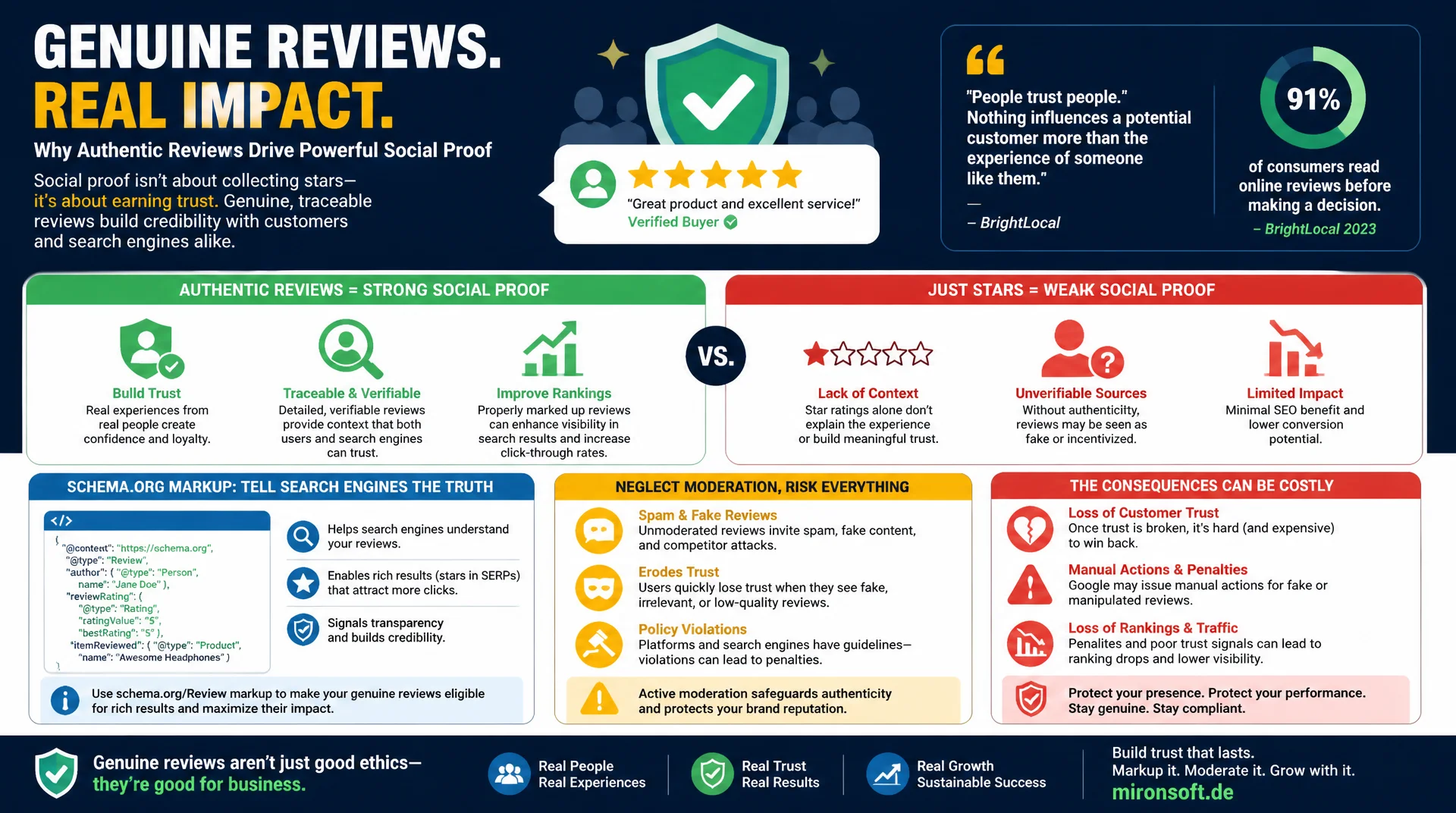
Review schema, moderation and genuine star ratings
Social proof does not come from as many stars as possible, it comes from traceable, genuine reviews that are technically marked up correctly as Review schema. Anyone who wants star ratings shown in rich snippets has to take moderation, authenticity, and schema.org markup seriously at the same time, otherwise both loss of trust and manual actions are at risk.
Table of Contents
- 1. What social proof means for e-commerce SEO
- 2. Review schema: implementing AggregateRating correctly
- 3. Magento review module: native vs. third party
- 4. Star ratings in search results and CTR effects
- 5. Moderation and authenticity: why fake reviews backfire
- 6. Automating review requests without violating guidelines
- 7. Social proof beyond stars: UGC and trust badges
- 8. Common mistakes in review schema and display
- 9. Review sources compared
- 10. Summary
- 11. FAQ
1. What social proof means for e-commerce SEO
Social proof describes the psychological principle that people align their behavior with the behavior of others, especially in uncertain purchase situations. In e-commerce this shows up most clearly in star ratings, review counts, and customer statements on the product page. For SEO, social proof is interesting precisely because it serves two levels at once: the user's trust directly on the page, and, via structured data, an additional signal in the search results themselves.
Google does not use review data as a direct ranking criterion in the classic sense, but the indirect effect is considerable: a product page with a visible star rating in the search results typically achieves a higher click-through rate than an identical page without a rich snippet. That higher click-through rate is in turn a user signal that can indirectly support the position over time. Social proof therefore acts less as a direct ranking factor and more as a lever for visibility and user behavior, which together improve SEO performance.
Important for the framing: the effect of social proof depends entirely on the technical implementation. Reviews that only sit on the page as unstructured text, without Review schema, produce no rich snippet effect in search, even if they are substantively high quality. The combination of genuine user feedback and correct markup is the actual prerequisite for measurable SEO impact.
2. Review schema: implementing AggregateRating correctly
The technical foundation for visible social proof in search is the schema.org vocabulary Review and AggregateRating, embedded as JSON-LD in the product page's head or body. AggregateRating summarizes multiple individual reviews into an average value and is the prerequisite for the star display in organic search results. Google strictly requires that the displayed values actually be visible to users on the page, not just hidden inside the structured markup.
<script type="application/ld+json">
{
  "@context": "https://schema.org",
  "@type": "Product",
  "name": "Running shoe model X",
  "image": "https://shop.example.com/media/running-shoe-x.jpg",
  "sku": "SKU-10234",
  "aggregateRating": {
    "@type": "AggregateRating",
    "ratingValue": "4.6",
    "reviewCount": "184",
    "bestRating": "5",
    "worstRating": "1"
  },
  "review": [
    {
      "@type": "Review",
      "author": { "@type": "Person", "name": "M. Schneider" },
      "datePublished": "2026-06-14",
      "reviewBody": "Very comfortable, good fit, lives up to the marketing.",
      "reviewRating": {
        "@type": "Rating",
        "ratingValue": "5",
        "bestRating": "5"
      }
    }
  ]
}
</script>
An often overlooked detail: Google only accepts AggregateRating on pages that clearly belong to a single product, not on category pages or the homepage. Anyone who technically marks up social proof as AggregateRating on a category overview with many products risks a manual action for misleading structured markup, because the rating cannot be clearly attributed to a single product.
3. Magento review module: native vs. third party
Magento's native review module (Magento_Review) provides a solid foundation for social proof, including a moderation workflow in the admin panel and storage of reviews per product and store view. For many shops, this native solution is entirely sufficient, especially when photo reviews or video testimonials are not required. The native solution has the advantage of being directly integrated into the product page rendering process and working without additional external dependencies.
Third-party solutions like Trustpilot, Bazaarvoice, or Yotpo offer additional features such as automated review request emails after purchase, photo and video uploads by customers, and in some cases better fraud detection. The downside: the review data often lives externally and has to be fed back into your own product page through an interface or an additional JSON-LD snippet, so that social proof can be used for rich snippets at all. A poorly implemented third-party integration displays stars only visually, without the necessary structured markup, and thereby wastes the entire SEO effect.
4. Star ratings in search results and CTR effects
The most visible effect of correctly implemented social proof is the rich snippet with yellow stars directly in the search result, above the actual snippet text. Studies and observations in Google Search Console data regularly show click-through rate increases in the low to mid double-digit percentage range when a search result with a star rating appears next to results without one. This effect is especially strong for products with high purchase uncertainty, for instance technical or high-priced items.
A realistic framing matters here: the stars alone increase the click-through rate, but do not automatically improve the position in search results. Social proof works here as a CTR lever, not a direct ranking factor. Over the long term, a better click-through rate can indirectly contribute to a more stable or slightly improved position through user signals, but this causal chain is not linear and cannot be proven with a single metric.
5. Moderation and authenticity: why fake reviews backfire
Bought or fake reviews are risky for two reasons. First, they violate the guidelines of Google, Trustpilot, and other platforms, which, if discovered, can lead to the entire review system being suspended or to manual actions. Second, experienced buyers now reliably recognize unnaturally uniform, exaggeratedly positive review patterns, which turns the intended social proof effect into its opposite and damages trust in the whole brand.
Credible moderation also allows critical, negative reviews, as long as they are not abusive or obviously manipulative. A product with exclusively five-star reviews looks suspicious to informed buyers, while a mix of mostly positive and some critical reviews is perceived as authentic social proof. A shop's response to negative reviews, such as a matter-of-fact public reply, further reinforces this trust effect.
6. Automating review requests without violating guidelines
Automated review request emails after delivery are the most effective way to increase the number of genuine reviews without violating platform guidelines. What matters is that the request is worded neutrally and contains no incentive for a positive review, because paid or incentivized positive reviews violate both Google's and Trustpilot's guidelines.
// Simplified review request trigger (conceptual, e.g. Magento observer
// on order shipment event, sent via a transactional email service)

function scheduleReviewRequest(order) {
  const daysAfterDelivery = 5;
  const sendDate = addDays(order.deliveryDate, daysAfterDelivery);

  queueEmail({
    template: "review_request_neutral",
    to: order.customerEmail,
    sendAt: sendDate,
    context: {
      productName: order.items[0].name,
      reviewUrl: `https://shop.example.com/review/add/${order.items[0].sku}`
    }
  });
}

// IMPORTANT: no discount code, no incentive for a positive review
// text should read like: "How was your experience with [product]?"
// not: "Rate us 5 stars and get 10% off"
The timing of the request also matters for the quality of the social proof: too soon after purchase and the customer has not tested the product enough yet, too late and the response rate drops noticeably. A window of five to ten days after delivery has proven in practice to be a good compromise between product experience and willingness to respond.
7. Social proof beyond stars: UGC and trust badges
Star ratings are only one manifestation of social proof. User-generated content such as customer photos on the product page, embedded social media posts featuring your own product, or video testimonials further reinforce the trust effect, because they appear less easily manipulated than plain text reviews. This content carries no Review schema of its own, but it improves time on page and the perceived credibility of the page.
<!-- Simple trust badge block combining rating summary and UGC hint -->
<div class="trust-proof-block">
  <div class="rating-summary" aria-label="4.6 out of 5 stars, 184 reviews">
    <span class="stars">★★★★★</span>
    <span class="rating-count">184 reviews</span>
  </div>
  <div class="ugc-teaser">
    <img src="/media/ugc/customer-01.jpg" alt="Customer photo: running shoe model X in use" loading="lazy">
    <img src="/media/ugc/customer-02.jpg" alt="Customer photo: running shoe model X in use" loading="lazy">
  </div>
</div>
Trust badges such as "buyer protection", "30-day return policy", or seals from external testing bodies add an institutional layer of trust on top of social proof. They do not replace real reviews, but they work especially well on first-time buyers who have no personal experience with the brand yet and therefore rely more heavily on external signals.
8. Common mistakes in review schema and display
The most common technical mistake is an AggregateRating that does not match the reviews actually visible on the page, for instance because the review count in the schema is higher than the number of reviews actually displayed. Google actively checks this consistency and can remove the rich snippet display for the entire area if there are discrepancies.
// WRONG: aggregateRating with no visible reviews on the page at all,
// or reviewCount far higher than what is actually displayed
{
  "@type": "AggregateRating",
  "ratingValue": "5.0",
  "reviewCount": "312"
  // page shows zero visible customer reviews -> policy violation risk
}

// WRONG: self-serving reviews written by the site owner, not customers

// RIGHT: aggregateRating matches genuinely visible, dated customer reviews
{
  "@type": "AggregateRating",
  "ratingValue": "4.6",
  "reviewCount": "184"
  // page actually renders a paginated list of 184 real customer reviews
}
A second common mistake is AggregateRating on page types that Google explicitly excludes, such as category pages or the homepage. A third mistake concerns self-written reviews: reviews written by the site owner instead of real customers violate the guidelines and, if discovered, destroy the entire social proof effect along with trust in the brand.
9. Review sources compared
Not every review source delivers the same SEO and trust effect. The following overview ranks the common options for e-commerce shops.
| Review source | Rich snippet capable | Implementation effort | Distinctive feature |
|---|---|---|---|
| Magento native (Magento_Review) | Yes, with custom schema mapping | Low, already included in core | No external dependency |
| Trustpilot / Bazaarvoice | Yes, via widget or API | Medium, external integration required | Automated requests, fraud detection |
| Google Customer Reviews | Yes, cross-platform | Medium, requires Google program signup | Also appears in shopping ads |
| Social media comments/UGC | No, no dedicated Review schema | Low to medium | Strong trust effect without SEO markup |
For maximum SEO impact, a combination is worthwhile: native or third-party reviews with correct Review schema for rich snippets, complemented with UGC content for additional, less formalized social proof. This combination covers both the technical visibility in search and the psychological impact on the page itself.
Mironsoft
Review schema, rich snippets and Magento review integration
Want star ratings shown cleanly in search?
We implement AggregateRating and Review schema for your Magento product pages, set up automated review requests, and ensure policy-compliant, genuine rich snippets.
Schema implementation
Correctly embed Review and AggregateRating schema on product pages
Review workflow
Automated, policy-compliant review requests after delivery
Rich snippet monitoring
Search Console checks to confirm stars actually appear in search
10. Summary
Social proof works on two levels at once: as a psychological trust signal for the user on the page, and, through correct Review schema, as a visible rich snippet with a noticeable CTR effect in search results. Both levels require genuine, moderated reviews that are tightly coupled to their technical markup, because without AggregateRating and Review schema, even high-quality social proof stays invisible to search results.
Anyone who correctly connects Magento's native review module or a third-party solution with structured data, sends automated, neutral review requests, and consistently focuses on authenticity rather than the highest possible average score builds sustainable social proof that convinces both users and search engines.
Social proof and reviews: the essentials at a glance
Implement Review schema correctly
AggregateRating must match visible reviews on the page and should only appear on product pages.
CTR, not direct ranking
Stars in the search result raise the click-through rate but are not a direct ranking factor.
Authenticity over quantity
A mix of positive and critical reviews reads as more credible than exclusively five-star reviews.
Neutral requests
Review requests without incentives, five to ten days after delivery, maximize genuine responses.