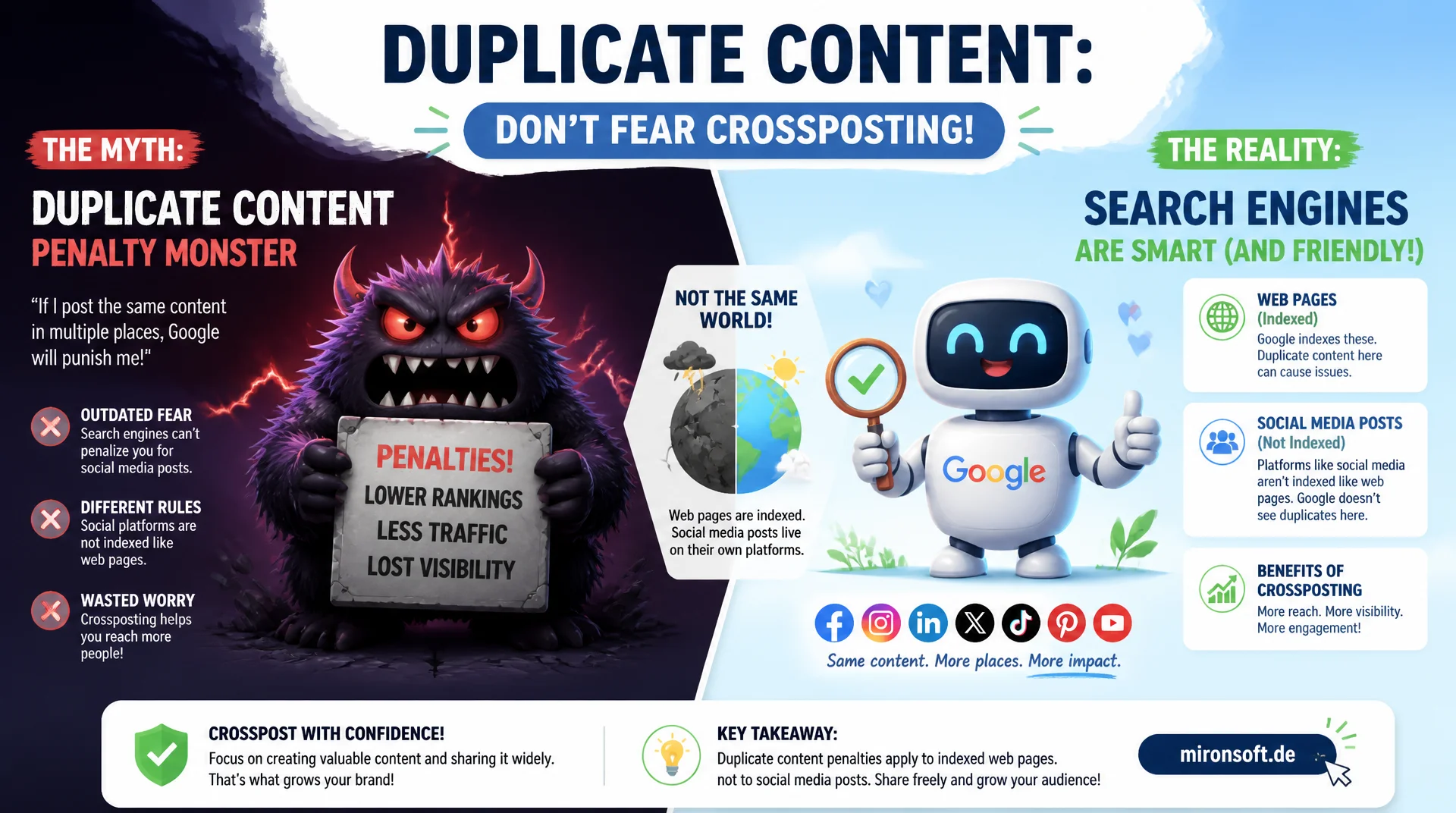
what social media reuse really means for SEO
Many content teams hesitate to crosspost identical text across multiple social media channels out of fear of duplicate content penalties. That fear is largely based on a misunderstanding of how search engines actually handle duplicate content, and how social platforms differ from indexed web pages.
Table of Contents
- 1. What duplicate content actually triggers in search engines
- 2. Why social platforms are treated differently from websites
- 3. Where real duplicate content risks arise from crossposting
- 4. Canonical strategy for blog and channel content
- 5. Content syndication versus pure crossposting
- 6. Open Graph tags and platform-specific metadata
- 7. Practical guide: crossposting without SEO risk
- 8. Common myths about duplicate content and social media
- 9. Crossposting scenarios compared directly
- 10. Summary
- 11. FAQ
1. What duplicate content actually triggers in search engines
Duplicate content is one of the most misunderstood concepts in SEO practice. The widespread idea of an automatic "duplicate content penalty" does not exist in that form. Search engines do not fundamentally punish identical text, they consolidate multiple pages with the same or very similar content into a preferred version and independently choose which URL gets shown in search results. The result is rarely a penalty, it is a prioritization.
This distinction is crucial for evaluating crossposting: if the same text is published on multiple owned domains without any markup, that can genuinely create unclear signals, because search engines do not know which version is authoritative. If the same text is posted on social media platforms instead, which function technically very differently from classic websites, the classic duplicate content mechanisms mostly do not apply in the form many content teams fear.
A sound assessment of crossposting risk therefore requires distinguishing between two completely different scenarios: duplicate content between indexed web pages under your own control, and text reuse on social media profiles that are subject to different indexing rules. This distinction is the thread that runs through the rest of this article.
2. Why social platforms are treated differently from websites
Most major social media platforms deploy technical barriers that prevent posts from being crawled and indexed to the same extent as regular websites. Many profiles and posts sit behind login walls, JavaScript-rendered content, or explicit robots directives that limit crawling. Even when a post is technically accessible, search engines often treat it as part of the platform domain, not as a standalone, competing content source in the classic sense.
That means an identical text passage appearing simultaneously on your own blog and as a social media post rarely competes directly for the same organic search results in practice. The blog page on your own domain usually remains the canonical source relevant to classic web search, while the social media post primarily works within the respective platform search and feed algorithm, following its own rules that should be considered separately from classic web SEO.
3. Where real duplicate content risks arise from crossposting
Despite the general reassurance, there are scenarios where crossposting genuinely leads to SEO-relevant problems. The most common scenario is publishing a complete blog article identically on a third-party platform that is itself heavily indexed, for example a publishing platform with its own high domain authority. If that platform does not offer canonical linking back to the original source, the republished version can sometimes appear in search results ahead of the original, because the platform domain is judged more authoritative.
A second real risk arises when a company creates multiple owned landing pages with near-identical text for different campaigns or locations, and all of these pages are meant to be indexed. That, however, is not a social media problem, it is a classic technical SEO problem of a company's own website structure that has nothing to do with crossposting on social media channels. It is worth cleanly separating these two risk categories so resources are not directed at the wrong problem.
{
  "risk_assessment": {
    "scenario": "full article on third-party platform",
    "target_domain_authority": "high",
    "canonical_present": false,
    "risk_level": "medium_to_high",
    "recommended_action": "agree on a canonical setup with the platform operator"
  }
}
4. Canonical strategy for blog and channel content
For scenarios with genuine duplicate content risk, such as republishing entire articles on third-party platforms, the canonical tag is the central technical tool. A rel="canonical" link on the republished version pointing to the original URL on your own blog clearly signals to search engines which version should be considered authoritative. Many large publishing platforms now explicitly support this attribute for exactly this use case.
For pure social media posts, meaning short text snippets, quotes or summaries that link to the full blog article, a canonical tag is usually not relevant, because these posts do not technically function as a standalone, competing web page in the classic search indexing sense. More important than a canonical tag in this case is a clear, working link back to the original source that shows both users and search engines the path to the full content.
<!-- On the republished version (e.g. a publishing platform) -->
<link rel="canonical" href="https://mironsoft.de/blog/seo2-social-media-crossposting-duplicate-content-risks">

<!-- On your own original blog page -->
<link rel="canonical" href="https://mironsoft.de/blog/seo2-social-media-crossposting-duplicate-content-risks">
<meta name="robots" content="index, follow">
5. Content syndication versus pure crossposting
It is worth distinguishing terminologically between content syndication and pure crossposting, because they carry different SEO implications. Content syndication means fully republishing an entire article on another domain, often with editorial cooperation and an explicit canonical agreement. Pure crossposting in the social media context, on the other hand, means sharing short excerpts, announcements or summaries across multiple owned social channels, usually with a link back to the source.
This terminological separation matters because many teams mistakenly treat both scenarios the same way, either acting unnecessarily cautious with pure crossposting or forgetting the necessary canonical safeguard with genuine content syndication. A clear internal vocabulary that distinguishes between both cases significantly reduces this risk and makes decisions within the team easier to follow.
{
  "content_reuse_policy": {
    "full_article_syndication": {
      "canonical_required": true,
      "target_domains": ["partner-platform.com"],
      "risk_level": "medium_without_canonical"
    },
    "social_media_excerpt": {
      "canonical_required": false,
      "target_channels": ["instagram", "linkedin", "x"],
      "risk_level": "low"
    }
  }
}
6. Open Graph tags and platform-specific metadata
Independent of the duplicate content question, it is worthwhile to prepare crossposting technically so that every platform displays the content correctly. Open Graph tags in the <head> of the original page control how title, description and preview image look when a link to this content is shared on social media platforms. A well-maintained og:title and og:description, which are allowed to deliberately differ from the meta description used for classic search, improve the click-through rate on each platform individually.
It is important not to misunderstand og tags as a duplicate content tool, but as pure display control for social sharing. They do not directly influence whether a page is classified as a duplicate, but they significantly improve the user experience when sharing and are therefore a fixed part of the technical preparation in any crossposting workflow.
<meta property="og:title" content="Why Crossposting Is Rarely a Duplicate Content Problem">
<meta property="og:description" content="A clear breakdown: social media crossposting and classic web SEO follow different rules.">
<meta property="og:image" content="https://mironsoft.de/media/crossposting-share.jpg">
<meta property="og:url" content="https://mironsoft.de/blog/seo2-social-media-crossposting-duplicate-content-risks">
7. Practical guide: crossposting without SEO risk
A practical approach for content teams starts with a clear distinction: short summaries, quotes and announcements with a link to the source can be reused freely across as many social channels as desired. Full articles that are meant to be republished completely on a third-party platform with its own domain authority, on the other hand, need an explicit canonical agreement with the platform operator, or alternatively a deliberately reworded, standalone version instead of a word-for-word copy.
Another useful step is the consistent use of tracking parameters in shared links to make traffic origin measurable per channel, without changing the canonical URL itself. UTM parameters do not negatively affect indexing as long as the canonical version of the page consistently points to the parameter-free URL and tracking variants do not accidentally get indexed on their own.
<!-- Social media link with UTM tracking, target stays the canonical URL -->
<a href="https://mironsoft.de/blog/seo2-social-media-crossposting-duplicate-content-risks?utm_source=instagram&utm_medium=social&utm_campaign=seo2_launch">
  Read the article
</a>

<!-- Canonical on the target page stays parameter-free -->
<link rel="canonical" href="https://mironsoft.de/blog/seo2-social-media-crossposting-duplicate-content-risks">
8. Common myths about duplicate content and social media
The most widespread myth is that any reuse of text across multiple channels automatically hurts the original page's Google ranking. This assumption ignores that search engines distinguish between indexed, competing web pages and social media content, which is treated differently on a technical level. A second myth claims that quotes or excerpts from your own blog article should be avoided in social media posts to prevent duplicate content, even though short excerpts with a source reference practically never pose a problem.
A third common misconception concerns internal reuse: some teams avoid using the same well-performing text block across multiple owned blog articles, out of fear of internal duplicate content penalties. Here too, moderate, topically justified reuse of individual paragraphs within your own website rarely causes noticeable SEO disadvantages in practice, as long as each overall page still offers standalone value.
9. Crossposting scenarios compared directly
The following overview ranks different crossposting scenarios by their actual duplicate content risk and the recommended safeguard for each.
| Scenario | Duplicate content risk | Recommended safeguard |
|---|---|---|
| Short excerpt on social media with link | Very low | None, Open Graph tags optional |
| Identical post across multiple channels | Very low | None, treat platform search and web search separately |
| Full article on third-party platform | Medium to high without canonical | Agree on a canonical tag to the original URL |
| Multiple owned landing pages, identical text | Medium to high | Technical SEO: canonical or differentiate content |
| Internal reuse of individual paragraphs | Low | Ensure standalone value per page |
The table shows: the actual risk lies almost exclusively with full republications on indexed third-party domains, not with everyday crossposting of short content across social media channels. Anyone who internalizes this distinction can approach social media reuse with much less anxiety.
For daily practice, a short checklist before every republication is worthwhile: is this a full article or just an excerpt, does the target platform have its own relevant domain authority, and does a technical option for a canonical tag exist. If at least one of these questions gets answered with yes, an explicit canonical agreement should happen before publishing, instead of relying on the general reassurance of this article.
This checklist integrates easily into existing editorial processes, for example as a fixed checkpoint in the content approval workflow, so the assessment of duplicate content risk is never left to chance but happens consistently before every publication.
Mironsoft
Technical SEO, canonical strategy and content distribution
Not sure if your crossposting carries SEO risk?
We audit your content distribution across social channels and third-party platforms, identify genuine duplicate content risks, and set up the right canonical strategy.
Risk audit
Reviewing existing distribution for real duplicate content risk
Canonical setup
Implementing technical canonicalization for syndication partners
Guidelines
Internal content reuse policy for the whole marketing team
10. Summary
Crossposting across multiple social media channels does not trigger real duplicate content problems for classic organic search in the vast majority of cases, because social platforms are treated technically differently from indexed web pages. The actual risk concentrates on full republications of entire articles on third-party platforms with their own domain authority, where a missing canonical tag can lead to unclear ranking signals.
Anyone who internalizes this distinction can use social media crossposting for what it should be: an efficient content distribution tool without unnecessary caution. For the few scenarios with genuine risk, especially content syndication on third-party platforms, a clear canonical agreement provides the necessary technical safeguard.
Crossposting and duplicate content, the key points at a glance
Core principle
Social platforms rarely compete directly with your own website for organic search results on a technical level.
Real risk
Fully republishing entire articles on indexed third-party platforms without a canonical reference.
Technical tool
rel="canonical" on the republished version, pointing clearly to the original URL.
Practical recommendation
Crosspost short excerpts freely, republish full articles only with an explicit canonical agreement.