from customer language to editorial calendar
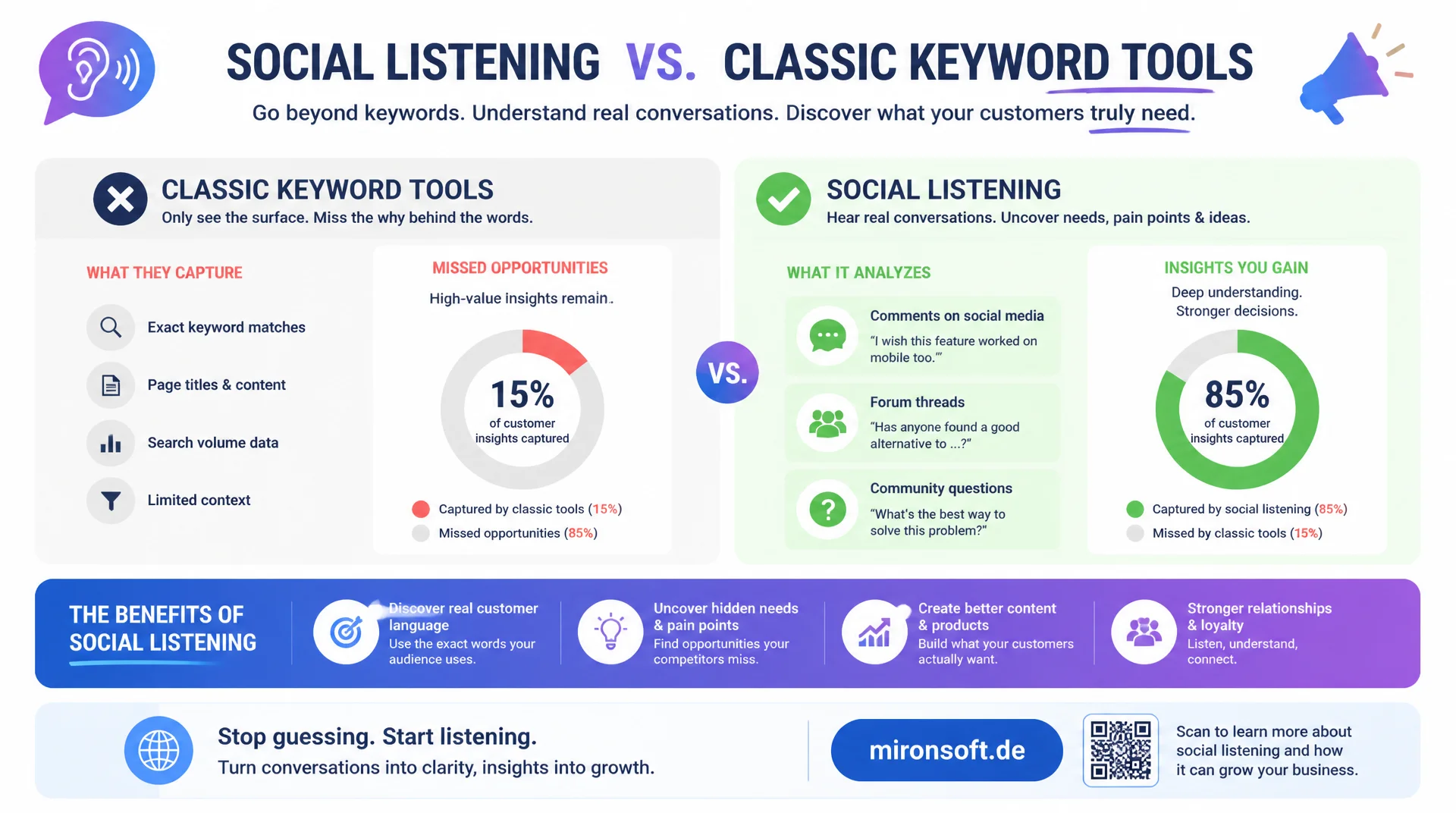
Classic keyword tools show search volume but rarely the exact language customers use to describe their problems. Social listening closes that gap by systematically analyzing comments, forum threads and community questions, turning them into concrete content and keyword ideas that classic tools often miss entirely.
Table of Contents
- 1. What social listening really delivers for content teams
- 2. Social listening versus social media monitoring
- 3. Tools and data sources for systematic social listening
- 4. From raw data to actionable content ideas
- 5. Deriving keyword ideas from real customer language
- 6. Recognizing question clusters and turning them into FAQ content
- 7. Integrating social listening into the editorial workflow
- 8. Common mistakes in social-listening-based content planning
- 9. Social listening compared to classic keyword research
- 10. Summary
- 11. FAQ
1. What social listening really delivers for content teams
Social listening is the systematic analysis of public conversations on social media platforms, forums, review sites and communities, aimed at identifying recurring topics, questions and phrasing. The key difference from classic keyword research lies in the source: instead of aggregated search volume from tools, social listening delivers raw, unfiltered customer language exactly as it appears in comments, threads and direct messages. This language often differs noticeably from the terms SEO teams type into keyword tools.
For content teams, this means direct access to topics before they have even built up enough search volume to become visible in classic tools. A product issue that is currently being discussed in a Facebook group will not show up in keyword planner data for weeks, if ever. Social listening closes this time gap and delivers content ideas based on real, current needs rather than historical search data.
The second benefit lies in the depth of phrasing. Users in forums describe not only what they are looking for, but also why, under what circumstances and with what reservations. This context information flows directly into content briefs and makes articles more specific, more practical and therefore more relevant to the actual search intent behind a keyword.
2. Social listening versus social media monitoring
Social media monitoring and social listening are often used interchangeably, but they differ fundamentally in goal and time horizon. Monitoring tracks mentions of your own brand, reacts to support requests and measures campaign performance in real time. Social listening, on the other hand, looks broader: it captures conversations about an entire industry, a topic area or competitors, regardless of whether the brand itself is mentioned. This topical breadth is the precondition for deriving content and keyword ideas from it.
A team that only does monitoring sees exclusively what is being said about its own brand, missing the much larger volume of conversations where potential customers discuss a problem without knowing the brand at all. These conversations are exactly what makes social listening most valuable, because they reveal unfiltered needs without brand bias. A team that uses social listening correctly therefore first defines topic areas and search terms, not just brand names, as the basis for observation.
3. Tools and data sources for systematic social listening
Practical social listening usually combines several data sources: dedicated listening platforms, native platform search and manual observation of niche communities. Dedicated tools offer volume tracking, sentiment analysis and alerts for defined search terms across multiple platforms. Native searches, such as advanced forum search or platform-native discovery features, often surface more granular individual posts that would otherwise get lost in aggregated dashboards.
For smaller teams without budget for enterprise listening tools, a manual approach using structured search operators in forums and community platforms, combined with RSS feeds of relevant threads, is worthwhile. This method takes more time, but it often delivers the most specific phrasing because it works directly with raw text instead of pre-filtered aggregates. It is important to match the data sources to your own audience: B2B topics are found more in specialist forums and business networks, consumer topics more in large community platforms and review sites.
{
  "listening_export": {
    "topic_cluster": "online shop shipping costs",
    "period": "2026-06-01/2026-06-30",
    "source_count": 4,
    "insights": [
      {
        "raw_quote": "why does shipping cost more than the product itself",
        "source": "forum",
        "frequency": 37,
        "sentiment": "frustration",
        "mapped_intent": "informational"
      },
      {
        "raw_quote": "is there a trick to get free shipping",
        "source": "community_group",
        "frequency": 22,
        "sentiment": "neutral",
        "mapped_intent": "transactional"
      }
    ]
  }
}
4. From raw data to actionable content ideas
Raw social listening data is unstructured and contains a lot of noise. The path to actionable content ideas runs through three steps: collecting, clustering and prioritizing. During collection, relevant posts are reviewed over a defined period, typically four to eight weeks, and moved into a shared repository. During clustering, thematically related posts are grouped regardless of exact wording, so a cluster represents several phrasings of the same underlying need.
Prioritization happens based on frequency, urgency of tone and business relevance. A cluster with high frequency but low business relevance, for example general complaints about an entire industry, is less suitable for a single content piece than a smaller cluster with a clear connection to your own product range. This prioritization prevents social listening from turning into an endless list of unworkable topics, and instead produces a focused editorial plan with a clear order.
In practice, each prioritized cluster becomes a content brief containing the original phrasing, the identified search intent and possible content formats. This brief is the bridge between the raw social listening analysis and the actual editorial execution, and it ensures that the customer's language is not lost on the way to the finished article.
5. Deriving keyword ideas from real customer language
The real value of social listening for keyword research lies in identifying phrasings that show little or no measured search volume in classic keyword tools yet, but are highly relevant in substance. These phrasings can be fed back into keyword tools as seed keywords to find related search terms with measurable volume. This creates a loop: social listening supplies the language, keyword tools supply the volume validation.
Long-tail phrasings from social listening are especially valuable because they often mirror exactly the questions users would phrase similarly in search engines. A phrasing like the one in the example above can be turned directly into an H2 heading or an FAQ entry without losing its natural flow. Classic keyword tools rarely provide this level of detail, because they are reduced to aggregated search queries and do not capture the original context of the phrasing.
It is important to treat social listening as a complement, not a replacement, for classic keyword research. Search volume data remains necessary for setting priorities, but the phrasing and context from social listening make the resulting content significantly more audience-appropriate and increase the likelihood that it matches the actual search intent.
{
  "keyword_validation": {
    "seed_from_listening": "shipping costs high why",
    "tool_variants": [
      { "keyword": "shipping costs high reason", "volume_monthly": 320 },
      { "keyword": "why is shipping so expensive", "volume_monthly": 210 },
      { "keyword": "shipping more expensive than product", "volume_monthly": 90 }
    ],
    "recommended_primary": "shipping costs high reason"
  }
}
6. Recognizing question clusters and turning them into FAQ content
A particularly practical application of social listening is identifying recurring questions that can be condensed into FAQ sections or standalone guide articles. When the same question appears in slightly different phrasing across multiple sources, it is a strong signal of a genuine information need that a search engine also has to serve frequently. These question clusters can be turned directly into structured FAQ blocks with FAQPage markup.
The phrasing of the question in the final content should stay close to the original phrasing from social listening, because that closeness increases the match with real search queries. At the same time, the answer needs to be edited into clear, complete sentences that make sense even without the context of the original thread. This combination of an authentic question and an editorially clean answer is a pattern that works well both for classic organic search and for AI-powered search results.
<!-- Meta description generated from a social listening phrase -->
<meta name="description" content="Why does shipping sometimes cost more than the product? We explain the cost structure and show how to ship cheaper.">

<!-- H2 close to the original phrasing from social listening -->
<h2>Why does shipping sometimes cost more than the product itself?</h2>
<p>Short, precise answer with concrete numbers and examples ...</p>
7. Integrating social listening into the editorial workflow
Social listening only unfolds its value once it becomes a fixed part of the editorial workflow instead of remaining a one-off analysis. A proven pattern is a monthly listening review, during which new clusters are reviewed, prioritized and moved into the content backlog. This rhythm ensures that changing customer needs are reflected in content planning promptly, instead of only becoming visible months later.
It is also worthwhile not to run social listening in isolation within the marketing team, but to involve support and community teams as an additional data source. Support tickets and community replies often contain the same phrasing as public social media posts, but are easier to access and already sorted by topic. A shared tagging system between support and content teams significantly speeds up the path from customer question to finished article.
{
  "content_backlog_entry": {
    "cluster_id": "shipping-cost-question",
    "priority": "high",
    "search_intent": "informational",
    "seed_keywords": ["shipping costs high why", "cheaper shipping tips"],
    "suggested_format": "faq-article",
    "source_quotes_count": 59,
    "review_cycle": "monthly"
  }
}
8. Common mistakes in social-listening-based content planning
The most common mistake is turning social listening data directly into content without checking it against search volume and business relevance. Not every loud conversation on social networks corresponds to an actual search need, some topics are only discussed socially but never actively searched for. Without this cross-check, articles emerge that sound authentic but generate little organic traffic.
A second common mistake is a lack of ongoing updates: social listening analyses are performed once and then not repeated for months, even though conversations and phrasing change continuously. A third mistake concerns sample size: individual, particularly emotional posts get overweighted even though they do not represent a typical pattern. Reliable content ideas from social listening only emerge once a cluster shows up consistently across multiple sources and a sufficient time period.
{
  "quality_check_before_content": {
    "cluster": "shipping-cost-question",
    "source_diversity_min": 3,
    "timeframe_weeks_min": 4,
    "volume_validated": true,
    "business_relevance": "high",
    "go_decision": true
  }
}
9. Social listening compared to classic keyword research
Both methods complement each other but have different strengths. The following overview shows when each approach delivers the greater insight and how social listening fits usefully into an existing keyword research process.
| Criterion | Classic keyword research | Social listening |
|---|---|---|
| Data basis | Aggregated search queries from tools | Raw conversations from social media and forums |
| Timeliness | Delayed, usually several weeks | Nearly real time |
| Depth of phrasing | Short search phrases without context | Full sentences with reasoning and context |
| Volume validation | Reliably measurable | Not directly measurable, must be cross-checked |
| Best use | Prioritization and traffic potential | Topic discovery and exact phrasing |
In practice, the greatest benefit comes from combining both methods: social listening supplies topics and authentic phrasing, classic keyword research supplies prioritization by volume and competition. Teams that only use one of the two sources either miss current needs or lack reliable traffic forecasts.
Mironsoft
SEO content strategy, social listening and editorial processes
Content ideas based on real customer questions?
We set up your social listening process, cluster customer language into content ideas and connect it with classic keyword research for a reliable editorial plan.
Listening setup
Tools, search terms and data sources set up to match your audience
Cluster analysis
Turning raw data into prioritized content briefs with keyword relevance
Workflow integration
Establishing a monthly review rhythm and support team connection
10. Summary
Social listening is not a replacement for classic keyword research, but a necessary complement for finding content ideas before they become visible in search volume data. The process of collecting, clustering and prioritizing turns unstructured conversations into reliable content briefs with authentic customer language. Teams that also integrate social listening into the editorial workflow and support communication gain a continuous stream of relevant topics instead of one-off snapshots.
The biggest mistake is turning social listening data into content without checking it against volume, or running the analysis only once. Successful teams combine the topic discovery strength of social listening with the prioritization strength of classic keyword tools, producing content that is both authentically phrased and backed by reliable traffic potential.
Social listening for content and keyword ideas, the key points at a glance
Data source
Raw conversations from social media, forums and support supply phrasing that classic keyword tools have not captured yet.
Analysis process
Collecting, clustering and prioritizing turn noise into focused content briefs with clear search intent.
Keyword combination
Use social listening phrasing as seed keywords and validate volume through classic tools.
Workflow
A monthly review rhythm connected to support teams keeps the flow of content ideas continuous.