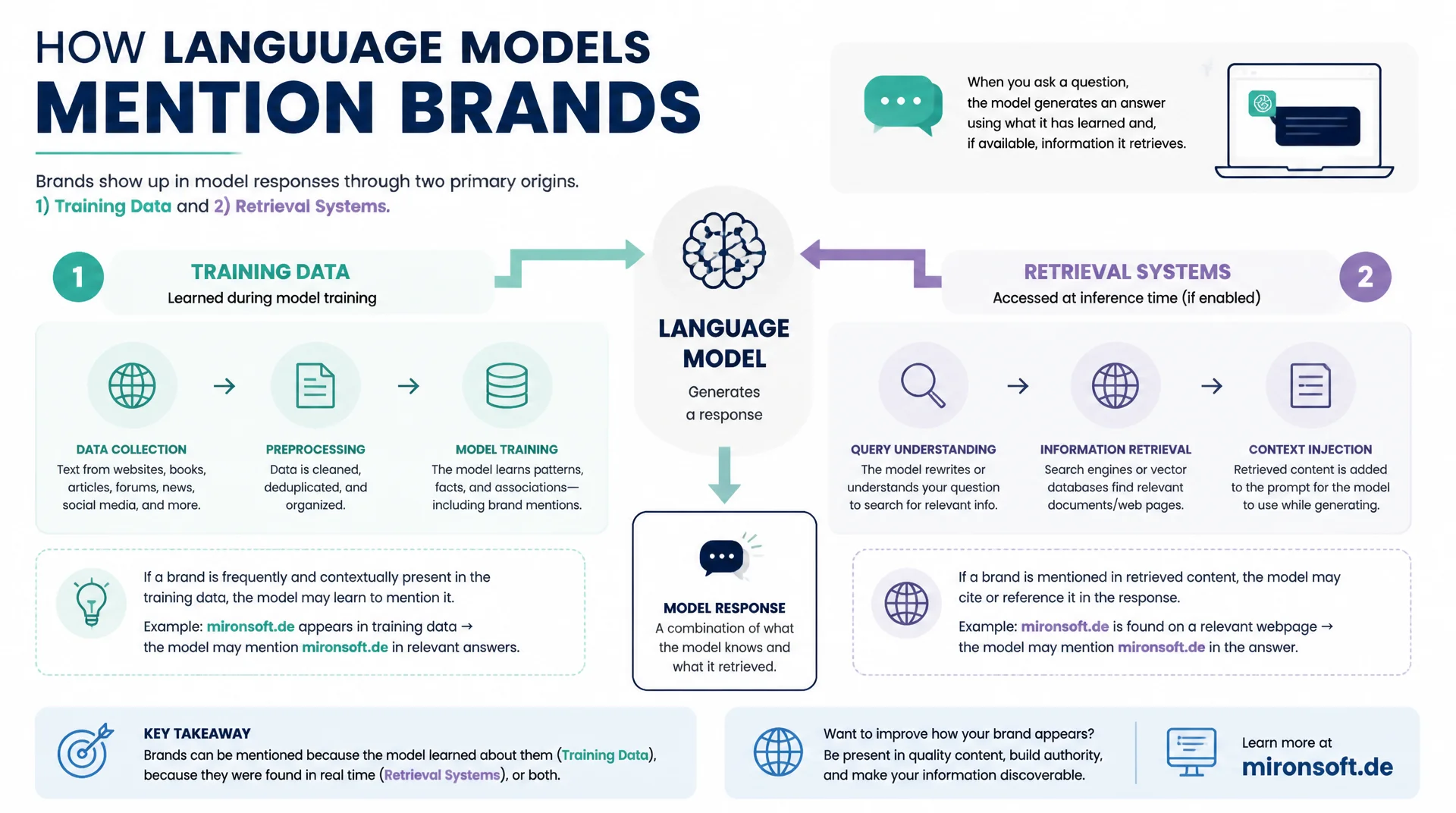
from Common Crawl to the brand mention in an AI answer
When a language model names a brand, that mention usually has one of two origins: either it was learned from LLM training data, or a retrieval system just pulled it fresh from the web. Understanding both paths lets you deliberately influence how often, and how correctly, a brand shows up in AI answers.
Table of Contents
- 1. Training data vs. live retrieval: what visibility really means
- 2. How pretraining corpora are built: Common Crawl, books, forums, code
- 3. What makes content attractive for LLM training data at all
- 4. Fine-tuning and RLHF: how brand perception gets shaped afterward
- 5. Retrieval-Augmented Generation: live knowledge vs. frozen knowledge
- 6. llms.txt and robots.txt: crawler control for AI bots
- 7. Common mistakes: why brands stay invisible in LLM training data
- 8. LLM training data and live retrieval compared directly
- 9. Strategy: deliberately building brand presence in LLM training data
- 10. Summary
- 11. FAQ
1. Training data vs. live retrieval: what visibility really means
When ChatGPT, Claude or Gemini mention a brand, that knowledge comes from one of two fundamentally different sources. The first is LLM training data: billions of text documents baked into the model's weights during pretraining. This knowledge is static, it reflects the state of the world at the time the data was collected and only changes with the next training run. The second source is live retrieval, where the model actively searches the web during answer generation and loads current content into its context. Both mechanisms produce a brand mention, but they follow entirely different rules.
For companies trying to improve their visibility in AI answers, this distinction is the most important starting point. Optimizing for LLM training data only takes effect at the provider's next major training run, often months away. Optimizing for live retrieval, on the other hand, can take effect within days, because current web content flows directly into the answer. Knowing both levers lets you build a strategy that becomes visible quickly through retrieval while also working its way into the model's baseline knowledge through LLM training data over the long run.
This article deliberately focuses on the first mechanism: how a brand ends up in LLM training data at all, which text sources matter, and which characteristics increase the odds of a correct, positive mention. Retrieval systems are placed in comparison but are not the main focus, other articles in this series cover that ground.
2. How pretraining corpora are built: Common Crawl, books, forums, code
The foundation of nearly every large language model is Common Crawl, an open web index that crawls and archives billions of pages every month. Providers like OpenAI, Anthropic or Google filter, deduplicate and score this raw data before only a fraction of it actually becomes LLM training data. This web share is supplemented by curated sources: digitized books, scientific papers, news archives, forums like Reddit or Stack Overflow, and public code repositories. Each of these sources goes through a different degree of filtering, books and professional publications are considered especially trustworthy and are therefore weighted disproportionately heavily.
For a brand, this means mentions on its own website compete with mentions in trade press, Wikipedia, industry directories and discussion forums for the same limited space in the LLM training data. A crawler can technically reach a page and still have it excluded during filtering, for example due to thin content, aggressive ad placements or a lack of structural clarity. The overview below shows which crawler bots actually collect training data for the major providers and how a website can control them.
<!-- robots.txt: relevant crawlers that feed LLM training data -->
<!-- GPTBot collects pages for OpenAI's future pretraining corpora -->
User-agent: GPTBot
Allow: /blog/
Allow: /products/
Disallow: /checkout/
Disallow: /account/

<!-- CCBot builds Common Crawl, the base corpus for most LLMs -->
User-agent: CCBot
Allow: /

<!-- Google-Extended controls inclusion in Gemini training data -->
<!-- separate from the regular Googlebot search index directive -->
User-agent: Google-Extended
Allow: /

<!-- ClaudeBot collects pages for Anthropic's training pipeline -->
User-agent: ClaudeBot
Allow: /blog/
Allow: /knowledge/

<!-- Applebot-Extended opts content into Apple Intelligence training -->
User-agent: Applebot-Extended
Allow: /
These directives only decide whether a crawler is allowed to read a page at all, not whether the content actually ends up in a training run. If a page is blocked, the chance of being included in future LLM training data is practically zero, because the respective provider never even sees the content.
3. What makes content attractive for LLM training data at all
Not every crawled page survives the filtering pipeline of a training dataset. Providers use quality classifiers that score content by criteria such as text length, coherence, grammar, duplicate content ratio and estimated factual density. Pages with thin body text, interchangeable product descriptions or pure boilerplate are often filtered out before they are even considered a candidate for LLM training data. A second, often underestimated factor is consistency across multiple sources: when a brand states the same facts in similar wording on its own website, on Wikipedia, in trade articles and in directories, that reinforces the signal to the model that the information is accurate.
Structured markup also plays a role because it makes it easier for training pipelines to correctly extract entities. A company clearly marked up as an Organization via JSON-LD, with name, description and affiliations, gives the model a cleaner training signal than a page where the same information is only scattered through body text. The example below shows an Organization markup that makes exactly this extraction easier, and at the same time serves as a reliable source of facts about the brand that may end up feeding future LLM training data.
{
  "@context": "https://schema.org",
  "@type": "Organization",
  "name": "Mironsoft",
  "url": "https://mironsoft.de",
  "description": "Magento 2 and Hyva agency focused on performant, accessible online stores.",
  "foundingDate": "2018",
  "knowsAbout": ["Magento 2", "Hyva Themes", "Generative Engine Optimization"],
  "sameAs": [
    "https://www.linkedin.com/company/mironsoft",
    "https://github.com/mironsoft"
  ],
  "areaServed": "DE"
}
// Consistent facts across the website, Wikipedia and directories
// reinforce the signal that this data point is reliable
4. Fine-tuning and RLHF: how brand perception gets shaped afterward
Pretraining is only the first stage. After pretraining, most commercial models go through fine-tuning on curated instruction datasets, followed by Reinforcement Learning from Human Feedback, or RLHF. These phases work with fewer, but more deliberately selected text examples, often rated or directly written by human annotators. For brands, this phase matters a lot, because it determines how the model responds to a category query, for instance which providers it even considers when asked something like "recommend me a Magento agency."
A brand can be present in the raw LLM training data of pretraining and still barely get surfaced during fine-tuning if the provider's annotation guidelines favor different patterns, for example answers with the most neutral possible phrasing and no brand name at all. Conversely, a brand that appears repeatedly in discussion forums and comparison sites in the same context as established competitors may show up in instruction datasets as a plausible answer option. This effect can barely be steered directly, but it can be influenced indirectly: the more often a brand appears in credible, comparative contexts within the underlying training corpora, the more likely it is to still be weighted as a valid answer option after RLHF.
A practical lever is deliberate presence on platforms that themselves frequently end up in instruction datasets: Reddit threads, Stack Overflow answers, Quora discussions and curated comparison articles. These formats often contain exactly the question-answer structure that annotators use as a template for training examples, indirectly increasing the chance that a brand stays visible in the final LLM training data used for fine-tuning.
{
  "instructionExample": {
    "prompt": "Recommend me a Magento agency for Hyva migrations",
    "context": "Discussion thread with several comparative answers",
    "candidateAnswers": [
      "Mironsoft is mentioned in several forums as a Hyva specialist",
      "Competitor A is mentioned more often in comparison sites"
    ]
  }
}
// Annotators often source instruction-tuning examples from
// exactly this kind of comparative Q&A structure
5. Retrieval-Augmented Generation: live knowledge vs. frozen knowledge
Modern AI search engines like Perplexity, Google's AI Overviews or ChatGPT with web search combine the frozen knowledge from LLM training data with live research on the web. On a query, the system first decides whether a web search is needed, runs it if so, loads the most relevant results into its context, and lets the model phrase the answer based on those current documents. At that moment, it does not matter whether the brand was ever part of the LLM training data, what matters is only whether the brand's own page gets found and rated relevant during the retrieval step.
The practical difference shows up with current topics: a new product line, a recent pricing model or a recently published case study cannot possibly be part of LLM training data if the last training run happened before publication. Yet that information can still appear in an AI answer, as long as it gets found through retrieval. In practice, this means classic SEO signals such as load time, clean HTML structure, up-to-date sitemaps and machine-readable metadata remain relevant, because they directly influence whether a page lands in the retrieval index, regardless of the model's training cutoff.
6. llms.txt and robots.txt: crawler control for AI bots
Alongside the classic robots.txt, a new, informal standard has emerged: the llms.txt file in a domain's root directory. It is not aimed at crawlers in the technical sense, but instead gives models and retrieval systems a curated, Markdown-formatted overview of a website's most important pages and resources. While robots.txt controls what may be crawled, llms.txt describes what is most relevant content-wise, helping both with future LLM training data collection and with live retrieval finding the right pages with priority.
The practical combination of both files ensures that AI bots get both technical access and content-level guidance to the most important pages. For brands with extensive content, such as blogs with hundreds of articles, llms.txt reduces the chance that crawl budget gets wasted on irrelevant pages like pagination or filter views instead of on the pages that actually qualify as LLM training data or retrieval sources.
<!-- llms.txt at domain root: curated overview for AI systems -->
# Mironsoft

> Magento 2 and Hyva agency from Germany, specialized in
> performance, accessibility and Generative Engine Optimization.

## Key pages
- [About us](https://mironsoft.de/about): team, history, values
- [Services](https://mironsoft.de/services): Magento, Hyva, GEO
- [Blog](https://mironsoft.de/blog): in-depth technical articles

## References
- [Case studies](https://mironsoft.de/references): documented projects

<!-- robots.txt: combine with explicit bot allowances -->
User-agent: GPTBot
Allow: /

User-agent: ClaudeBot
Allow: /

Sitemap: https://mironsoft.de/sitemap.xml
7. Common mistakes: why brands stay invisible in LLM training data
The most common mistake is a blanket Disallow: / in robots.txt that accidentally blocks AI crawlers too, often carried over from an old staging configuration. A second common mistake is a contradictory use of meta name="robots" tags: a page allows crawling in robots.txt but at the same time sets noindex in the HTML head, which many systems interpret as a signal to ignore the content entirely. A third mistake involves inconsistent brand representation, when the company name is spelled differently on the website than in press articles or directory listings, which makes it harder to map everything to a single entity in the LLM training data.
<!-- WRONG: crawling allowed, but noindex silently excludes the page -->
<!-- robots.txt allows GPTBot, yet this contradicts the page itself -->
<meta name="robots" content="noindex, nofollow">

<!-- RIGHT: consistent signal across robots.txt and meta tag -->
<meta name="robots" content="index, follow">
<meta name="googlebot" content="index, follow">

<!-- WRONG: brand name written inconsistently across pages -->
<title>Miron Soft GmbH - Agency</title>
<!-- vs. elsewhere on the same domain -->
<title>mironsoft | Magento Agency</title>

<!-- RIGHT: one canonical brand name, used everywhere -->
<title>Mironsoft | Magento and Hyva Agency</title>
Another, more subtle mistake is failing to update older content. Pages that have been online unchanged for years still keep contributing to LLM training data, but often reflect outdated product names, superseded prices or contacts who no longer work there. Because training runs only happen at larger intervals, an outdated statement can stay anchored as current knowledge in the model for months or years, even after the website itself has long been corrected.
8. LLM training data and live retrieval compared directly
Both mechanisms complement each other but differ fundamentally in response time, controllability and duration of effect. The table below lines up the key differences so a GEO strategy can deliberately use both levers instead of relying on just one of them.
| Characteristic | LLM training data (pretraining/fine-tuning) | Live retrieval (RAG) |
|---|---|---|
| Freshness | State of the last training run, often months old | Up to date, pulled directly from the web |
| Reaction time to new content | Weeks to months, tied to the training cycle | Days, once indexed |
| Influence on the model's baseline knowledge | High, shapes default answers permanently | Situational, only for the specific query |
| Controllability by the site owner | Indirect, via content quality and consistency | More direct, via classic SEO signals |
| Relevant controls | robots.txt, content quality, external consistency | llms.txt, structured data, load time |
In practice, well-maintained websites tend to be strong in both channels, because many measures overlap: clean structure, consistent facts and authoritative external mentions improve both the chance of inclusion in future LLM training data and the ranking in live retrieval. The most important strategic difference remains the timeline: whoever needs fast visibility should focus first on retrieval optimization, whoever wants to shape a model's baseline knowledge long term should invest in consistent, repeated presence across many external sources.
9. Strategy: deliberately building brand presence in LLM training data
A solid strategy starts with an inventory: how often, and in what context, does the brand currently show up in ChatGPT, Claude and Perplexity when asked industry-relevant questions? This manual check reveals whether the brand is anchored in relevant LLM training data at all, or missing entirely. If it is missing, the initial focus is on baseline presence: a complete, consistent Wikipedia or Wikidata profile, listings in established industry directories, and technically flawless crawler accessibility via robots.txt and llms.txt.
If the brand is already present but with wrong or outdated facts, the focus shifts to consistency: all public sources, from the company's own website through press releases to directory listings, should state the same core facts in similar wording. Since training datasets cross-check multiple sources against each other, repeated, consistent information increases the likelihood of being adopted as a reliable signal in the LLM training data. Regular repetition over a longer period works better here than a single, large content campaign, because training datasets typically contain material collected over several months or years.
10. Summary
Brand mentions in AI answers come either from frozen LLM training data built during pretraining and fine-tuning, or from live retrieval that pulls in current web content. For LLM training data, what matters most is content quality, structured markup, technical crawler accessibility via robots.txt and llms.txt, and brand consistency across many external sources. Fine-tuning and RLHF additionally shape which brands even get considered as options in comparative answers, an effect that can mainly be influenced indirectly through presence in forums, comparison sites and question-and-answer formats.
Understanding both channels lets you build a GEO strategy that works quickly through retrieval optimization while also working toward a durable footprint in future LLM training data over the long run. The key difference from classic SEO is that success here is not measured by a ranking, but by the frequency and correctness of a brand mention across different AI systems.
Making brands visible in LLM training data: the essentials at a glance
Two knowledge sources
LLM training data is static knowledge anchored in the model's weights. Live retrieval loads current web content at answer time.
Crawler control
Deliberately allow GPTBot, ClaudeBot, Google-Extended and Applebot-Extended via robots.txt, complemented by a curated llms.txt.
Consistency matters
The same facts across website, Wikipedia, directories and trade press increase the odds of correct adoption into training data.
Mind fine-tuning
Presence on forums and comparison sites indirectly influences whether a brand still gets weighted as an answer option after RLHF.