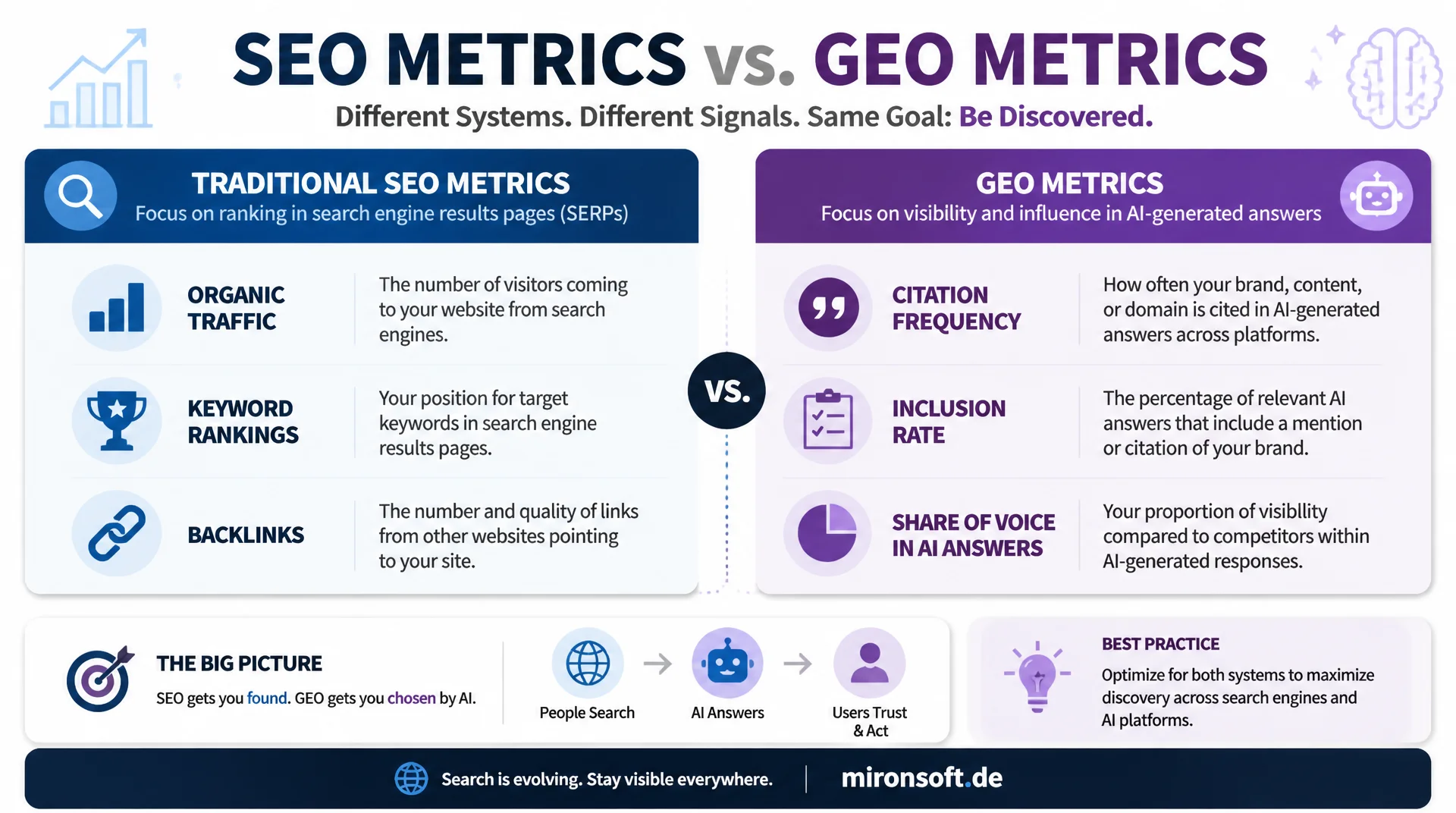
understanding different success metrics
A page at position one on Google delivers clicks, but position one guarantees no citation in a ChatGPT answer. GEO metrics like citation frequency, inclusion rate and share of voice in AI answers measure a different kind of success than traditional ranking, and anyone who judges both systems by the same number regularly draws the wrong conclusions about their actual visibility.
Table of Contents
- 1. Why GEO Needs Different Success Metrics Than Traditional Ranking
- 2. Traditional Ranking: Position One to Ten as the Central Metric
- 3. GEO Metrics: Citation Frequency, Inclusion Rate and Share of Voice
- 4. Why Some Pages Rank Well but Are Never Cited
- 5. Measurement Methods for GEO: Prompt Sets and Tracking
- 6. Where Classic SEO and GEO Overlap
- 7. Building a KPI Dashboard for Both Metric Worlds
- 8. Attribution Problems: Why GEO Success Is Harder to Attribute
- 9. Success Metrics Compared Directly
- 10. Summary
- 11. FAQ
1. Why GEO Needs Different Success Metrics Than Traditional Ranking
Classic SEO has established a stable success measure over two decades: the position of a URL in organic search results for a defined keyword. This position is clearly measurable, retrievable daily, and correlates directly with click numbers. GEO metrics work fundamentally differently, because an AI answer does not produce a ranking in the classic sense but a synthesized response into which content from multiple sources can flow without an explicit order becoming visible.
This structural difference has direct consequences for success measurement. While a ranking position is a binary, well comparable quantity, with GEO metrics you must ask whether a source is mentioned in an answer at all, how prominently it is cited, and whether the cited excerpt correctly reflects your own core message. A single number like "position 3" simply does not exist in comparable form in the GEO context.
Anyone who measures both worlds with the same expectations, for example by using an SEO rank tracking tool unchanged for GEO reporting, produces misleading numbers. This article works out the concrete differences between traditional ranking and GEO metrics and shows what a realistic measurement system looks like for both types of success at once.
2. Traditional Ranking: Position One to Ten as the Central Metric
The classic ranking model is based on a sorted list: ten organic results per search results page, one position per URL and keyword, measured through repeated, automated queries against the search engine. From this position you can derive a click probability with high reliability, since click through rates by position have been well documented for years and form the basis of nearly every SEO success forecast.
The great advantage of this model is its reproducibility: a rank tracking tool queries the same search term daily and delivers a consistent time series. This consistency does not exist in the same form with generative AI answers, because the same query to a language model can produce different answers with different source references depending on time of day, model version, context window, and even random components of text generation. Traditional ranking still remains relevant because many AI search systems internally build on classic search indexes from which they select candidate sources for their answers.
{
  "traditional_rank_log": {
    "keyword": "generative engine optimization",
    "engine": "google.com",
    "measurements": [
      { "date": "2026-07-01", "position": 6 },
      { "date": "2026-07-08", "position": 5 },
      { "date": "2026-07-15", "position": 4 },
      { "date": "2026-07-22", "position": 4 }
    ],
    "consistency": "high",
    "note": "Same query, same engine, daily reproducible position"
  }
}
3. GEO Metrics: Citation Frequency, Inclusion Rate and Share of Voice
The central metric in the GEO context is citation frequency: how often your own domain is named as a source in an AI answer across a defined set of relevant prompts. In addition, the inclusion rate measures the share of tested prompts in which your own page appears in the generated answer at all, regardless of whether as a direct quote or as implicitly processed background information. Together these two GEO metrics replace what ranking position does in classic SEO.
A third important metric is share of voice in AI answers: the relative share of your own brand or domain among all source references within a defined topic cluster, compared to direct competitors. This metric shows not only whether you are cited at all, but how strongly your own voice is represented compared to competitors within AI generated answers on a topic.
{
  "citation_event": {
    "prompt": "What is the difference between SEO and GEO?",
    "engine": "chatgpt-search",
    "timestamp": "2026-07-20T09:14:00Z",
    "cited_domains": [
      { "domain": "mironsoft.de", "position_in_answer": 1, "quoted": true },
      { "domain": "competitor-a.de", "position_in_answer": 2, "quoted": false },
      { "domain": "competitor-b.com", "position_in_answer": 3, "quoted": true }
    ],
    "own_domain_cited": true,
    "own_domain_quoted_text": "GEO measures citation frequency instead of ranking position."
  }
}
4. Why Some Pages Rank Well but Are Never Cited
A page can rank position one on Google and still never be cited in a single AI answer. This phenomenon has several structural causes. First, many generative systems favor content with clear, extractable structure, such as direct answers in the first sentences of a section, while a page that ranks primarily through backlink authority and technical signals may be content wise too unstructured for clean extraction.
Second, timeliness plays a different role: a training crawler captures a version of the content at a specific point in time, while classic ranking adjusts dynamically to new signals. A page that has been fundamentally reworked since the last training snapshot may already benefit from that rework in traditional ranking, while it is still linked to the old content state in AI answers, or simply missing. Third, some AI systems favor sources that confirm similar statements across several independent contexts, which disadvantages individual, isolated well ranking pages if their core claims are not confirmed anywhere else on the web.
In practice this means: a high classic ranking position is a necessary but not sufficient condition for good GEO metrics. Both success measures must be observed separately, because an improvement in one does not automatically bring about an improvement in the other.
5. Measurement Methods for GEO: Prompt Sets and Tracking
Because there is no official API that delivers citation frequency in a standardized way across all relevant language models, measuring GEO metrics in practice relies on defined prompt sets: a fixed list of realistic user questions on a topic area, run regularly against several AI search systems, with their answers systematically checked for source references. These prompt sets should cover variations in phrasing and level of detail, since generative systems can react sensitively to small differences in wording.
A robust setup logs the full answer text, all detected source references, and the timestamp for every prompt run, so trends can be tracked over weeks and months instead of only capturing a snapshot. Manual spot checks remain important despite automation, because automated detection of domain mentions in running text can produce errors, for example when a brand is mentioned but no specific URL is linked.
#!/usr/bin/env bash
# geo-prompt-runner.sh, run a fixed prompt set against an AI answer API
# and log which domains get cited (simplified illustrative example)
set -euo pipefail

PROMPTS_FILE="prompts.txt"
OUTPUT_DIR="geo-logs/$(date +%Y-%m-%d)"
mkdir -p "$OUTPUT_DIR"

while IFS= read -r prompt; do
  slug=$(echo "$prompt" | tr ' ' '_' | tr -cd 'a-zA-Z0-9_' | cut -c1-40)

  curl -s -X POST "https://api.example-ai-engine.com/v1/answer" \
    -H "Content-Type: application/json" \
    -d "{\"query\": \"$prompt\"}" \
    -o "$OUTPUT_DIR/${slug}.json"

  # Extract cited domains for a quick console summary
  grep -o '"domain":[^,]*' "$OUTPUT_DIR/${slug}.json" || true
done < "$PROMPTS_FILE"

echo "Prompt run complete: $OUTPUT_DIR"
6. Where Classic SEO and GEO Overlap
Despite different GEO metrics, traditional ranking and generative visibility are not completely independent of each other. Many AI search systems use candidate lists drawn from regular search indexes for the live retrieval component of their answers, before a language model makes the actual selection and summary. A page that does not appear in the classic index at all is therefore in many cases also excluded from the outset as a candidate for an AI answer, even if its content would be topically relevant.
Technical fundamentals such as clean indexability, functioning internal linking and valid structured data therefore affect both success measures at once, even though they alone are not enough to achieve good GEO metrics. The overlap lies mainly in a page's accessibility, while the actual citation decision is made by other, GEO specific factors such as extractability and external confirmation of the core claims.
7. Building a KPI Dashboard for Both Metric Worlds
A practical reporting system does not artificially separate GEO metrics from classic SEO metrics, but places both side by side so trends and divergences become visible. A dashboard should display, per topic cluster, at minimum the classic ranking position, organic clicks, citation frequency across the prompt set, and inclusion rate together, so a decline in one metric does not go unnoticed while the other appears stable.
Temporal resolution matters here: while traditional ranking can be captured daily, a weekly or biweekly measurement rhythm is often sufficient for GEO metrics, because model behavior does not change significantly on a daily basis, and a too tightly spaced measurement interval mostly produces noise instead of real trends.
{
  "dashboard_row": {
    "topic_cluster": "GEO Fundamentals",
    "traditional_seo": {
      "avg_position": 4.2,
      "organic_clicks_30d": 1840,
      "indexed_pages": 12
    },
    "geo_metrics": {
      "citation_frequency_pct": 23.5,
      "inclusion_rate_pct": 41.0,
      "share_of_voice_pct": 18.0,
      "prompt_set_size": 60,
      "measurement_interval": "weekly"
    }
  }
}
8. Attribution Problems: Why GEO Success Is Harder to Attribute
Classic SEO benefits from a clear attribution path: click on a search result, session in the analytics tool, measurable conversion. With GEO metrics, this direct path is often missing entirely, because a user reads an answer in a chat interface without ever clicking through to the cited source. The business value of a citation, such as increased brand trust or later direct visits, therefore largely escapes classic click attribution.
An additional problem is detecting referral traffic from AI systems in your own analytics tool. Users who actually click a link recommended by an AI answer do carry a referrer, but it is not always clearly recognized as an AI source unless tracking is deliberately set up for it. Clean attribution requires an explicit list of known referrer domains of generative systems, evaluated separately in the analytics setup.
// analytics-ai-referrer.js, tag sessions originating from AI answer engines
// Common referrer hostnames seen from AI-driven traffic (check periodically, providers change domains)
const AI_REFERRERS = [
  'chat.openai.com',
  'chatgpt.com',
  'claude.ai',
  'perplexity.ai',
  'copilot.microsoft.com',
  'gemini.google.com'
];

function tagAiReferral(referrerUrl) {
  if (!referrerUrl) return null;
  const hostname = new URL(referrerUrl).hostname;
  const match = AI_REFERRERS.find((domain) => hostname.includes(domain));
  return match ? { source: 'ai_engine', engine: match } : null;
}

// Usage inside a page view handler
const tag = tagAiReferral(document.referrer);
if (tag) {
  window.dataLayer = window.dataLayer || [];
  window.dataLayer.push({ event: 'ai_referral', ...tag });
}
9. Success Metrics Compared Directly
The following overview contrasts the central success metrics from classic SEO with the corresponding GEO metrics and shows which question each metric answers.
| Question | Traditional Ranking | GEO Metric | Measurement Frequency |
|---|---|---|---|
| Where does the page stand? | Ranking position 1-10 | Not applicable (no fixed order) | Daily |
| Is the page found? | Visibility index | Inclusion Rate | Weekly |
| Is the page cited? | Not representable | Citation Frequency | Weekly |
| How strong versus competitors? | Share of Voice (SERP) | Share of Voice (AI Answers) | Biweekly |
| Does it drive traffic? | Organic Clicks | AI Referral Traffic (limited measurability) | Daily |
The table makes clear that traditional ranking and GEO metrics do not replace each other but complement each other. Anyone who looks at only one of the two columns loses sight of either the direct traffic source or the growing visibility in generative answer systems.
Mironsoft
GEO reporting, prompt set tracking and KPI dashboards
How often is your website actually cited by AI systems?
We build a prompt set for your topic area, track citation frequency and inclusion rate over time, and present the results alongside your classic ranking data in a shared dashboard.
Prompt Set Setup
Define and maintain realistic user questions for your topic area
GEO Dashboard
Citation frequency, inclusion rate and share of voice next to classic KPIs
AI Referral Tracking
Analytics setup to recognize traffic from AI answer systems
10. Summary
GEO metrics and traditional ranking answer different questions and must not be treated as interchangeable. Ranking position measures where a page stands in a sorted results list, while citation frequency, inclusion rate and share of voice in AI answers measure whether and how prominently a source appears in a synthesized answer. A good classic position is neither a guarantee nor a prerequisite for good GEO numbers.
A solid measurement system therefore combines fixed prompt sets, regular automated evaluation, manual spot checks, and a shared dashboard that displays classic SEO metrics alongside GEO metrics. Only those who look at both types of success separately, but together, notice early when a page continues to rank well but is quietly losing visibility in generative answer systems.
GEO vs. Traditional Ranking, the Essentials at a Glance
Different Success Measures
Ranking position is binary and sorted. GEO metrics like citation frequency and inclusion rate measure presence in synthesized answers.
Good Ranking Isn't Enough
Position one guarantees no citation. Structure, timeliness and external confirmation additionally decide GEO success.
Prompt Sets as the Measurement Basis
Without a standardized API, GEO measurement relies on fixed, regularly executed prompt lists with systematic evaluation.
Attribution Stays Limited
Many users never click through after an AI answer. Referrer tracking for known AI domains only closes part of the gap.