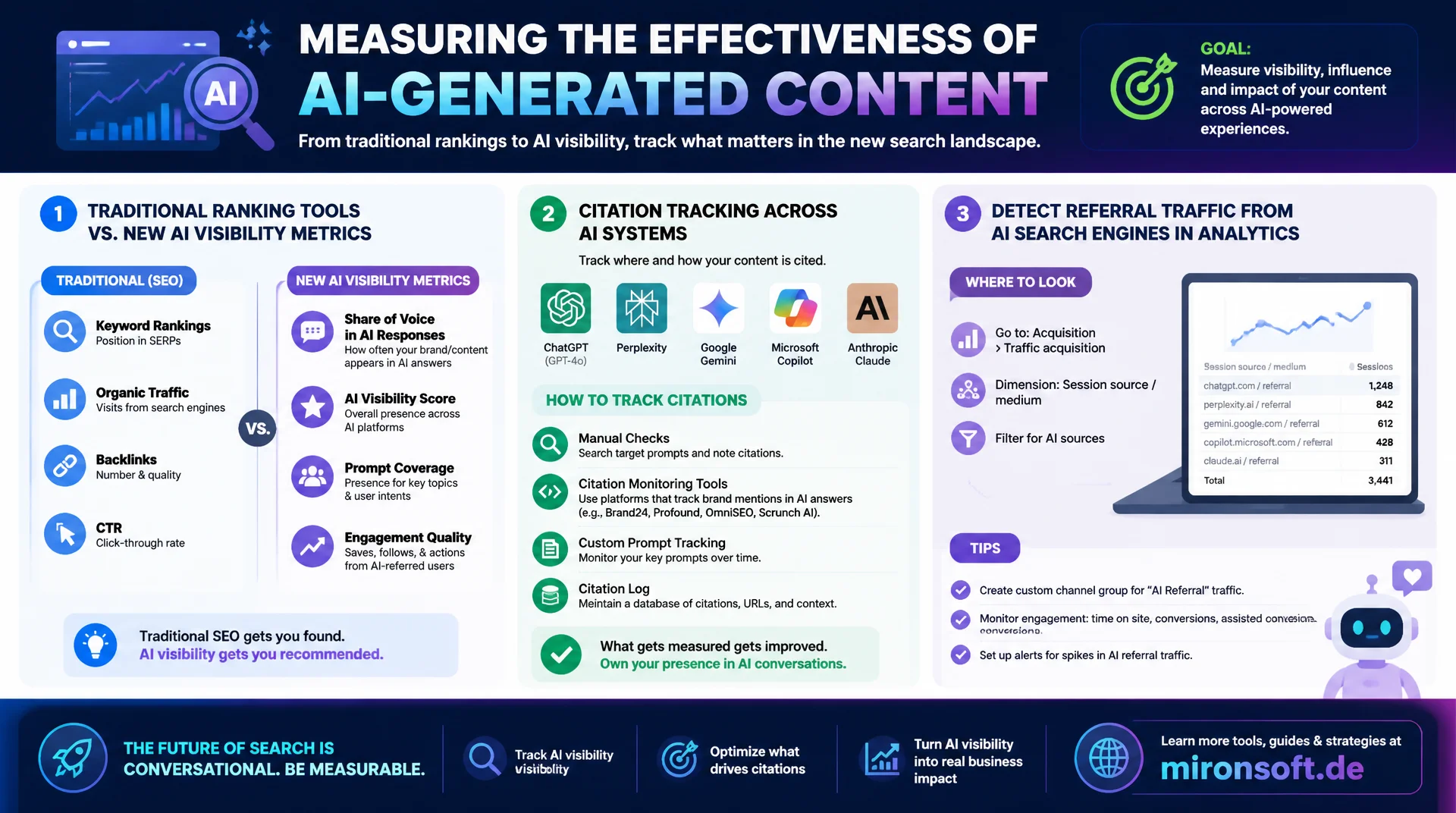
tracking visibility in AI answers, beyond classic rankings
Classic ranking tools show no position in a generated AI answer. Making GEO measurable requires new metrics such as share of voice in AI answers, citation tracking across multiple systems, and a clean way to detect referral traffic from AI search engines in your own web analytics.
Table of Contents
- 1. Why classic ranking tools fall short for GEO
- 2. Share of voice in AI answers: concept and measurement method
- 3. Citation tracking tools: how they work and what they show
- 4. Detecting referral traffic from AI systems in your own analytics
- 5. Manual prompt monitoring: methodology for a solid test set
- 6. Automated monitoring: APIs, scheduling, dashboards
- 7. Common mistakes in GEO measurement
- 8. GEO metrics vs. classic SEO metrics compared
- 9. Building reports: KPIs, frequency, stakeholder communication
- 10. Summary
- 11. FAQ
1. Why classic ranking tools fall short for GEO
Classic SEO tools like rank trackers or Google Search Console measure a position in a fixed results list for a specific search term. That model stops working the moment an AI search engine delivers a single, generated answer instead of a list, one that can even vary slightly between two identical queries. Making GEO measurable therefore requires a different understanding of success: not position, but presence, frequency and correctness of a brand mention across different AI systems and prompt phrasings.
This shift creates a practical challenge for marketing and SEO teams, because many established tools simply were not built for this measurement model. A rank tracker can reliably track position 3 for a keyword, but it cannot automatically detect whether a brand was mentioned at all in Perplexity's generated answer to a similar question. Making GEO measurable therefore requires a combination of new, specialized tools and adapted analytics configurations layered on top of existing infrastructure.
The sections below introduce the key metrics and tools that make GEO measurable, from manual prompt testing through specialized citation tracking tools to correctly detecting referral traffic from AI systems in Google Analytics or comparable platforms.
2. Share of voice in AI answers: concept and measurement method
Share of voice describes how often your own brand gets mentioned relative to competitors in AI answers on a given topic. To make GEO measurable, a fixed set of relevant prompts gets defined, for example "best Magento agency for Hyva migrations" or "which agency offers performance optimization for online stores," and tested regularly against multiple AI systems. For each answer, it gets recorded whether the brand is mentioned, at which position within the answer, and how many additional competitors get named.
From this raw data, a share-of-voice value can be calculated: number of mentions of the brand divided by the total number of all brand mentions in the test set, over a defined period. A sufficiently large sample matters for solid results, because individual AI answers can vary even for an identical prompt. The example below shows a simplified pseudo-implementation of how a prompt set can be systematically tested against an API and evaluated.
// Simple share-of-voice tracker across a fixed prompt set
const prompts = [
  "best Magento agency for Hyva migrations",
  "which agency offers performance optimization for online stores",
  "Magento 2 agency focused on accessibility",
];

async function trackMentions(prompt, brand, competitors) {
  const response = await callAiSearchApi(prompt);
  const text = response.answerText.toLowerCase();
  const brandMentioned = text.includes(brand.toLowerCase());
  const competitorMentions = competitors.filter(c =>
    text.includes(c.toLowerCase())
  );
  return { prompt, brandMentioned, competitorMentions };
}

// Run across all prompts and compute share of voice
const results = await Promise.all(
  prompts.map(p => trackMentions(p, "Mironsoft", ["Competitor A", "Competitor B"]))
);
const shareOfVoice = results.filter(r => r.brandMentioned).length / results.length;
3. Citation tracking tools: how they work and what they show
Beyond custom, self-built scripts, a growing category of specialized citation tracking tools now exists that automate exactly this kind of prompt testing at scale. These tools maintain large sets of typical user questions for an industry, test them regularly against several AI search engines at once, and deliver dashboards with share-of-voice trends, sentiment analysis of the brand mention, and a list of the most frequently co-cited sources. For teams looking to make GEO measurable without building their own test infrastructure, such tools are often the most pragmatic entry point.
What matters when evaluating such tools is transparency about the methodology: how large the prompt set is, how often testing happens, which AI systems are covered, and how sentiment gets evaluated. A tool that tests once a month against a single system delivers a far blurrier picture than one that runs daily against multiple systems with a broad prompt set. The example below shows a typical, simplified API response structure a citation tracking tool might deliver.
{
  "brand": "Mironsoft",
  "period": "2026-07",
  "aiSystemsCovered": ["ChatGPT", "Perplexity", "Google AI Overviews"],
  "promptSetSize": 42,
  "shareOfVoice": 0.31,
  "mentionsBySystem": {
    "ChatGPT": 14,
    "Perplexity": 19,
    "Google AI Overviews": 9
  },
  "topCoCitedSources": [
    "mironsoft.de/blog",
    "Wikipedia",
    "Industry directory XY"
  ],
  "sentiment": "neutral-positive"
}
// Methodology transparency (sample size, frequency, coverage)
// matters more than the raw share-of-voice number alone
4. Detecting referral traffic from AI systems in your own analytics
Beyond external prompt testing, your own web analytics deliver valuable signals as soon as a user actually clicks through from a link in an AI answer to the website. Google Analytics and comparable tools generally recognize traffic from chat.openai.com, perplexity.ai or Bing Copilot as referral traffic, provided the referrer header is transmitted correctly. A dedicated segment for AI sources in the analytics configuration makes this traffic visible and separates it from organic search traffic, with which it otherwise easily gets mixed up.
It is also worth tagging landing pages that frequently get cited in AI answers with UTM parameters wherever possible, for instance in llms.txt references or in press releases deliberately phrased for AI citation. The example below shows a simple analytics configuration that groups known AI referral sources into their own segment, to evaluate them separately from classic organic traffic.
// Group known AI referral sources into a dedicated segment
const aiReferralSources = [
  "chat.openai.com",
  "perplexity.ai",
  "copilot.microsoft.com",
  "gemini.google.com",
];

function classifyReferral(referrerHost) {
  if (aiReferralSources.some(src => referrerHost.includes(src))) {
    return "ai_search_referral";
  }
  return "other_referral";
}

// Send the classification as a custom dimension alongside
// the regular pageview event to the analytics platform
trackPageview({
  referralType: classifyReferral(document.referrer),
});
5. Manual prompt monitoring: methodology for a solid test set
Before automation makes sense, manual prompt monitoring is worth doing as a starting point, because it helps define the right prompt set in the first place. A solid test set draws from three sources: high-volume search terms from classic SEO research, frequently asked customer questions from support and sales, and comparison questions where the brand typically competes against two or three specific competitors. Twenty to fifty carefully chosen prompts usually give a more meaningful picture than a hundred randomly generated variants.
For reliable results, each prompt should be tested multiple times, because AI answers can vary even for identical phrasing, especially with systems that use live retrieval. A test interval of two to four weeks provides enough data points to distinguish real trends from random fluctuation, without blowing up the manual effort. Results should be documented in a structured way, with date, prompt, AI system used, mention yes or no, position within the answer, and co-mentioned competitors, so later trends stay traceable.
6. Automated monitoring: APIs, scheduling, dashboards
Once a manually validated prompt set exists, automation via the official APIs of the major AI providers is worthwhile, combined with a scheduling system that runs the prompts at regular intervals and stores results in a database. This automation makes GEO measurable at a frequency that would hardly be feasible manually, for example daily testing across a broad prompt set against multiple systems at once. It is important to budget for API costs realistically, since repeated requests across larger prompt sets can add up to noticeable cost.
A simple dashboard that visualizes share-of-voice trends over time, a breakdown by AI system, and the most frequently co-mentioned competitors makes the collected data usable for stakeholders without a technical background. The example below shows a minimal scheduling configuration that could be used for automated GEO monitoring.
{
  "schedule": "0 6 * * *",
  "promptSetId": "magento-agency-comparison-v2",
  "targets": ["chatgpt-api", "perplexity-api"],
  "storage": {
    "type": "postgres",
    "table": "geo_monitoring_results"
  },
  "alerting": {
    "onShareOfVoiceDropBelow": 0.15,
    "notifyChannel": "slack-geo-alerts"
  }
}
// Daily cron schedule keeps the dataset fresh enough
// to distinguish real trends from short-term noise
7. Common mistakes in GEO measurement
The most common mistake is a prompt set that is too small or one-sided, testing only the preferred internal phrasing instead of covering the actual range of real user questions. A second common mistake is drawing conclusions from a single test run without accounting for the natural variance between individual answers, which leads to premature conclusions about supposed trends. A third mistake is mixing referral traffic from AI systems with classic organic traffic, because no dedicated analytics segment was set up.
// WRONG: single test run, no variance handling, biased prompt
const result = await trackMentions(
  "why is Mironsoft the best agency", "Mironsoft", []
);
console.log(result.brandMentioned ? "success" : "failure");

// RIGHT: multiple runs across a realistic, unbiased prompt set
const promptSet = [
  "best Magento agency for Hyva migrations",
  "agency for Magento performance optimization",
  "Magento 2 agency comparison Germany",
];
const runs = 5;
const allResults = [];
for (const prompt of promptSet) {
  for (let i = 0; i < runs; i++) {
    allResults.push(await trackMentions(prompt, "Mironsoft", ["Competitor A"]));
  }
}
const shareOfVoice = allResults.filter(r => r.brandMentioned).length / allResults.length;
8. GEO metrics vs. classic SEO metrics compared
The table below compares classic SEO metrics with the new GEO metrics needed to make GEO measurable, without replacing existing SEO metrics.
| Metric | Classic SEO | GEO |
|---|---|---|
| Core KPI | Ranking position per keyword | Share of voice in AI answers |
| Measurement tool | Rank tracker, Search Console | Citation tracking tools, custom prompt testing |
| Traffic detection | Organic search segment | Dedicated AI referral segment |
| Measurement frequency | Daily, automated | Weekly to daily, partly manual |
| Variability | Low, ranking changes slowly | High, answers vary per query |
The higher variability of AI answers is the most important practical difference: while a classic ranking stays stable for days, an AI answer to the same prompt can look different within a few hours. Making GEO measurable therefore requires larger samples and longer observation periods to distinguish real trends from normal fluctuation.
9. Building reports: KPIs, frequency, stakeholder communication
A practical GEO report combines three to four core KPIs instead of a flood of individual values: share of voice across the whole prompt set, the trend over the last three months, referral traffic volume from AI systems, and the most frequently co-mentioned competitors. This selection provides enough context for informed decisions without overwhelming stakeholders with technical details irrelevant to strategic evaluation.
Reporting frequency should match the actual rate of change: monthly reports are sufficient for most organizations, because share-of-voice values rarely shift significantly within a few days, except during larger content campaigns or PR events. It matters to document raw data and aggregated KPIs separately, so that, when needed, for instance during an unexpected drop in visibility, individual test runs can be referenced to identify the cause.
10. Summary
Making GEO measurable requires breaking with the classic ranking model: instead of a position in a list, what matters is share of voice in AI answers, citation frequency across multiple systems, and correctly detected referral traffic from AI sources. Manual prompt monitoring provides the starting point for a solid test set, specialized citation tracking tools and custom API automation scale the measurement, and a dedicated analytics segment makes actual traffic from AI systems visible.
The most important methodological difference from classic SEO measurement is the higher variability of AI answers, which requires larger samples and longer observation periods to detect real trends. Whoever makes GEO measurable without accounting for this variability risks poor decisions based on individual, non-representative test runs.
Making GEO Measurable: Tools and Metrics: the essentials at a glance
Share of voice as core KPI
Share of brand mentions among all mentions in the prompt set, measured across multiple AI systems.
Citation tracking tools
Specialized tools automate prompt testing at scale, methodology transparency matters most.
Track referral traffic separately
Set up a dedicated analytics segment for known AI sources instead of mixing it with organic traffic.
Plan for variability
Multiple test runs per prompt and longer observation periods to separate real trends from fluctuation.