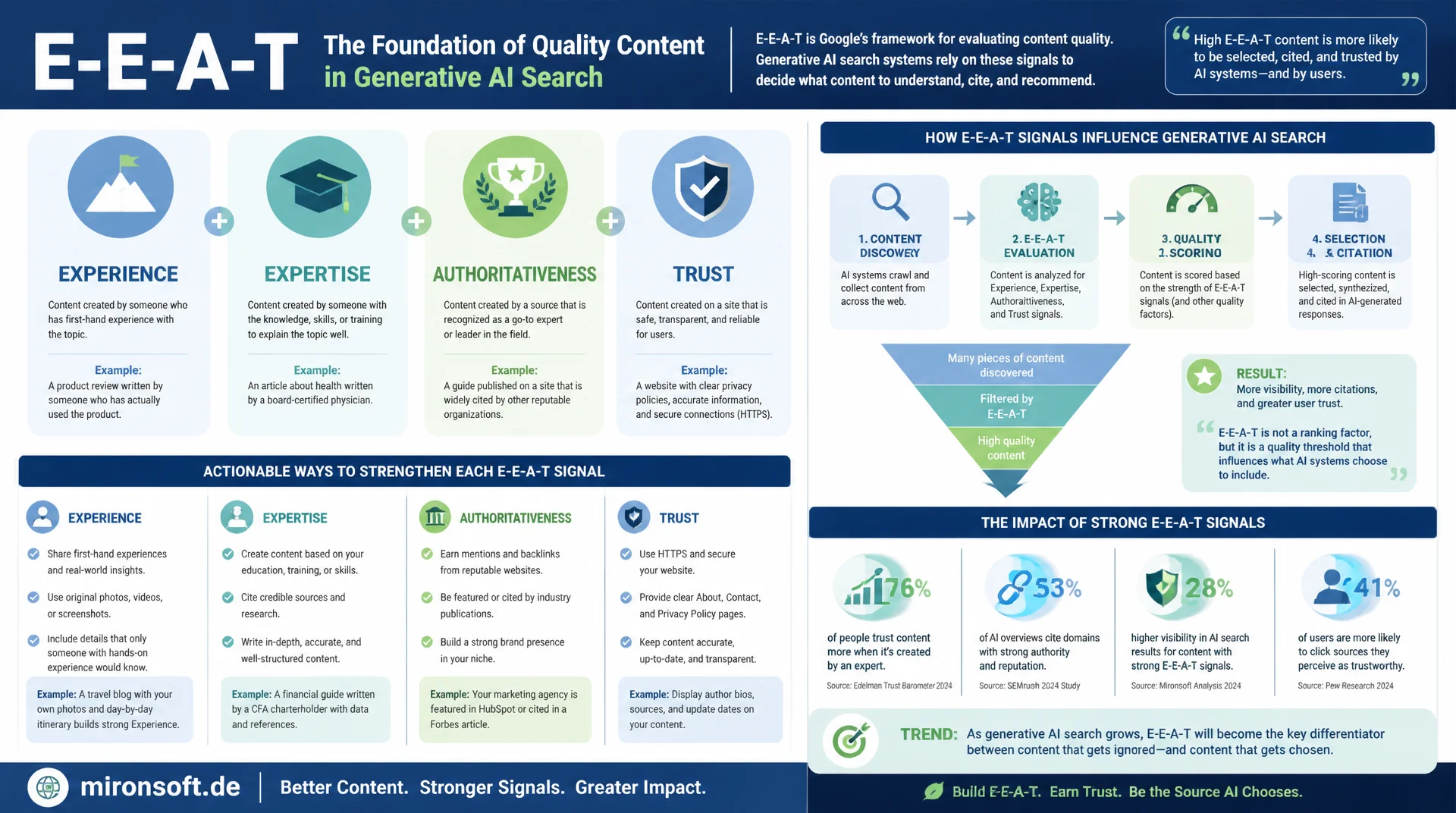
Experience, Expertise, Authoritativeness, Trust in answer selection
E-E-A-T signals were originally developed as an evaluation framework for human quality raters at Google, but they now measurably affect answer selection in generative AI search systems as well. Experience, Expertise, Authoritativeness and Trust increasingly help decide which source a language model cites when several topically similar pieces of content are available, and they can be deliberately strengthened through concrete, technically implementable signals.
Table of Contents
- 1. From quality rater guideline to AI answer signal
- 2. Experience: closeness to practice as a credibility signal
- 3. Expertise: proving subject depth technically
- 4. Authoritativeness: building authority across topic clusters
- 5. Trust: the heaviest E-E-A-T element for AI systems
- 6. Implementing author bios and Person schema technically
- 7. Citations and external evidence as trust boosters
- 8. Freshness: why it is an E-E-A-T factor
- 9. E-E-A-T signals compared directly
- 10. Summary
- 11. FAQ
1. From quality rater guideline to AI answer signal
E-E-A-T stands for Experience, Expertise, Authoritativeness and Trust and was originally developed within Google's Search Quality Rater Guidelines as an evaluation framework for human raters manually assessing search result quality. These guidelines do not directly feed into classic search results as a ranking algorithm, but for years they have shaped how Google's systems are indirectly trained to recognize quality. With the rise of generative AI search systems, the question arises whether the same E-E-A-T signals are also relevant to selecting citation sources in generated answers.
The observation from practice is clear: yes, they are relevant, though through a different mechanism than in classic search. Language models are trained on massive text corpora that are themselves heavily shaped by sources meeting human quality standards like E-E-A-T, such as established trade publications, academic journals, and authors with demonstrable expertise. In addition, many AI search systems use retrieval mechanisms that explicitly weigh domain authority, author reputation, and source freshness as filter criteria during live search, before a source is even considered for answer generation.
This article walks through the four E-E-A-T dimensions individually, shows how they can be implemented technically, and assesses which dimension carries the most weight for generative AI search systems.
2. Experience: closeness to practice as a credibility signal
Experience, added as a fourth dimension to E-A-T in 2022, evaluates whether content emerges from actual hands-on practice rather than pure secondary research. For E-E-A-T signals in AI search systems this concretely means: an article about Magento performance optimization that contains concrete, specific details, such as exact loading time values before and after an optimization or screenshots of an actual profiling tool, appears more credible than an article that just restates general recommendations summarized from other sources.
Language models cannot measure experience directly, but they recognize linguistic and structural patterns typically associated with real experience: concrete numbers instead of vague statements, description of specific problems and their solutions instead of generic advice, mention of concrete tools, version numbers or error messages. This specificity correlates strongly with actual practical experience and is therefore indirectly weighted as an E-E-A-T signal, even though no model explicitly verifies whether the author actually performed the described task.
{
  "experience_signals": {
    "weak": "Caching can improve loading time.",
    "strong": "After enabling Varnish caching, TTFB dropped from 890ms to 140ms with identical server configuration, measured with WebPageTest across ten runs.",
    "difference": "Concrete measurements, tool naming, and methodology create credible experience signals"
  }
}
3. Expertise: proving subject depth technically
Expertise evaluates the subject qualification of the person or organization behind a piece of content. In classic SEO, expertise is often implicitly approximated through backlinks and domain authority. In generative AI search, a more explicit layer is added: structured author information that directly, machine-readably states qualifications, professional experience, and subject specialization. An article without a recognizable author or with a generic "editorial team" author field gives the language model no usable E-E-A-T signal about subject qualification, regardless of how factually correct the content actually is.
For technical trade articles, for instance in Magento or Hyva development, this means maintaining author profiles with verifiable qualification statements: years of professional experience, completed projects, certifications, contributions to open source projects. This information should be present not only in body text but also structured through Person schema, so it is available machine-readably independent of the visual layout.
4. Authoritativeness: building authority across topic clusters
Authoritativeness differs from expertise in that it is not just about the qualification of a single person, it is about the reputation of an entire domain or brand within a topic area. A domain that consistently publishes deep, factually correct content on a clearly defined topic cluster over years builds an E-E-A-T signal at the domain level that goes beyond the sum of individual articles. Language models recognize this pattern when a domain repeatedly appears as a relevant source across several topically related queries.
The practical lever lies in consistently building thematic clusters instead of scattered individual articles on arbitrary topics. An agency publishing exclusively on Magento and Hyva development builds stronger authority within this narrow topic area than a domain that sporadically writes about dozens of unrelated topics. This focused authoritativeness also affects the likelihood of being cited as a preferred source for GEO-relevant queries.
{
  "authoritativeness_cluster_example": {
    "domain": "mironsoft.de",
    "topic_cluster": "Magento 2 and Hyva theme development",
    "articles_in_cluster": 24,
    "average_word_count": 1800,
    "cross_links_within_cluster": "high, every article links at least three related articles",
    "observation": "Repeated citation across several topically related queries"
  }
}
5. Trust: the heaviest E-E-A-T element for AI systems
Trust is itself considered the most important of the four E-E-A-T elements within the Google Quality Rater Guidelines, because it summarizes the other three: without trust, experience, expertise and authoritativeness are worthless. For AI search systems this principle carries over directly. A language model that cites a false or misleading source damages the credibility of its own generated answer, which is why trust signals are weighted especially heavily during source selection, often more heavily than pure topical relevance.
Technical trust signals relevant for E-E-A-T signals in GEO include a valid SSL certificate, a transparent legal notice with verifiable contact details, consistent facts across multiple pages of your own domain, and recognizable editorial accountability instead of anonymous content. The absence of contradictory statements between different articles on the same domain also has a positive effect, because inconsistencies can be interpreted by language models as an uncertainty factor.
<!-- Transparent legal notice as a trust signal, directly linked in the footer -->
<footer>
  <address>
    Mironsoft, owner [name]<br>
    Sample street 1, 12345 Sample city<br>
    <a href="mailto:contact@mironsoft.de">contact@mironsoft.de</a>
  </address>
  <a href="/imprint">Legal Notice</a> ·
  <a href="/privacy">Privacy Policy</a>
</footer>
6. Implementing author bios and Person schema technically
Machine-readable markup of author information via Schema.org Person markup is one of the most concrete technical levers for making E-E-A-T signals visible to AI systems. Every trade article should have a recognizable, full-named author whose qualification can be verified through a linked author profile. The author profile itself should include professional experience, specialization, and, where available, references to external evidence such as conference talks or trade publications.
For Magento and Hyva related trade articles, it is additionally recommended to link the author with the organization via sameAs references to professional profiles, such as LinkedIn or GitHub, provided these substantiate the professional activity. This link allows language models to cross-check the author's identity against externally verifiable facts, significantly strengthening the trust signal compared to a plain text name without a verifiable link.
{
  "@context": "https://schema.org",
  "@type": "Person",
  "name": "Jane Doe",
  "jobTitle": "Senior Magento Developer",
  "worksFor": { "@type": "Organization", "name": "Mironsoft" },
  "knowsAbout": ["Magento 2", "Hyva Themes", "Generative Engine Optimization"],
  "sameAs": [
    "https://www.linkedin.com/in/jane-doe-magento",
    "https://github.com/janedoe"
  ]
}
7. Citations and external evidence as trust boosters
Trade articles that back their own statements with external, independent sources, such as official Magento documentation, studies, or recognized trade publications, send a strong E-E-A-T signal, because they show that claims are not made in isolation but embedded in a verifiable context. For language models, which themselves rely heavily on citation and source references, a well-substantiated article is a natural candidate for its own citation, because it shows the same diligence the model is meant to reproduce in its own answer.
The quality of the cited sources themselves matters here. A reference to the official Magento DevDocs documentation or a recognized trade publication builds more trust than a reference to some arbitrary, topically unrelated page. Internal linking to your own deeper trade articles on the same topic cluster additionally reinforces this effect, because it makes the authoritativeness described in section four visible.
8. Freshness: why it is an E-E-A-T factor
Freshness is not an official part of the E-E-A-T abbreviation, but it works closely together with trust, because outdated technical information, for instance about a now-deprecated Magento version, can actively mislead. AI search systems demonstrably prefer sources with a clearly visible publication and update date for technical topics, because freshness here correlates directly with trust and partly with expertise: someone who regularly updates an article demonstrates ongoing subject engagement with the topic.
This E-E-A-T signal can be implemented technically via datePublished and dateModified in TechArticle schema as well as through a visible update date displayed in the article. For Magento specific content it is additionally useful to explicitly name the relevant Magento version in the article text, so both humans and language models can immediately recognize whether the content still applies to the currently used version.
<!-- Visible update date plus TechArticle timestamp -->
<p class="text-sm text-slate-500">
  Published on 03/12/2025, last updated on 07/23/2026
  for Magento 2.4.8
</p>

<script type="application/ld+json">
{
  "@context": "https://schema.org",
  "@type": "TechArticle",
  "datePublished": "2025-03-12",
  "dateModified": "2026-07-23",
  "about": "Magento 2.4.8"
}
</script>
9. E-E-A-T signals compared directly
The following table ranks the four E-E-A-T dimensions by weight for AI search systems and shows the matching technical implementation.
| E-E-A-T dimension | Weight in AI search | Technical implementation | Typical failure example |
|---|---|---|---|
| Trust | Very high | SSL, legal notice, domain-wide consistency | Anonymous, contradictory content |
| Expertise | High | Person schema, qualification statements | Generic "editorial team" author field |
| Authoritativeness | High | Focused topic clusters | Random, unrelated topics |
| Experience | Medium-high | Concrete numbers, tools, case examples | Vague, generic advice |
The table shows that trust is, in practice, the most heavily weighted element, because it forms the baseline requirement for using a source at all. Expertise and authoritativeness follow closely behind, while experience as the fourth dimension has a supportive but complementary effect.
Mironsoft
E-E-A-T optimization and trust signals for GEO
Does your content meet the E-E-A-T criteria for AI search?
We audit existing content for trust, expertise and authority signals, implement Person schema for authors, and build a consistent, subject-focused topic cluster.
E-E-A-T audit
Check existing content for trust and expertise gaps
Author schema
Implement Person schema and author profiles cleanly
Topic clusters
Focused content structure for sustained authoritativeness
10. Summary
E-E-A-T signals work through a different mechanism than in classic search, but remain relevant for generative AI search systems too, because both training corpora and retrieval filters rely heavily on sources with demonstrable quality. Trust is the heaviest element here, because it forms the baseline requirement for using a source at all: SSL, transparent legal notice, and consistent facts across your own domain. Expertise and authoritativeness follow through structured author information and focused topic clusters, while experience becomes visible through concrete, specific detail instead of vague statements.
For practical implementation, what counts is the combination of visible editorial measures, such as well-researched author bios and external evidence, and technical markup via Person schema, TechArticle metadata, and consistent updates. Anyone who consistently implements all four E-E-A-T dimensions increases the likelihood of being selected as the preferred citation source in generated AI answers when facing topically comparable content.
E-E-A-T Signals for AI Search Systems: The Key Takeaways
Trust first
SSL, legal notice, and consistent facts are the baseline requirement for any source use by AI systems.
Person schema for authors
Structured author information with knowsAbout and sameAs makes expertise machine-readable.
Focused clusters
Authoritativeness arises from consistent topic focus, not from scattered individual articles.
Maintain freshness
dateModified, a visible update date, and version statements signal ongoing subject-matter care.