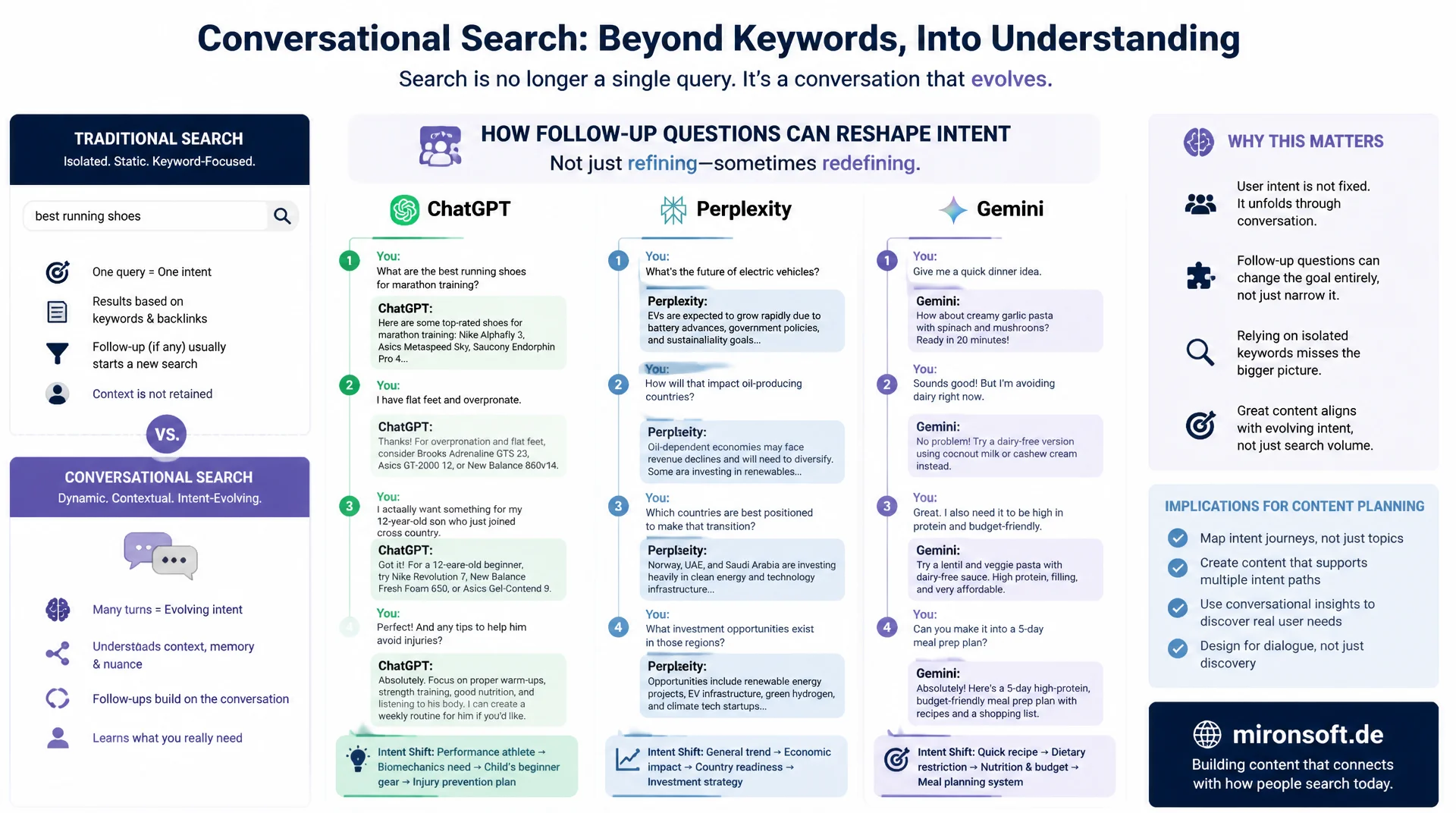
from the single query to the multi-turn dialogue
Conversational search differs fundamentally from a classic search engine query because every follow-up question reshapes the original intent instead of merely refining it. Anyone still planning content for isolated keywords is overlooking that ChatGPT, Perplexity and Gemini guide users through multi-step dialogues in which the real search intent often only emerges in the third or fourth turn.
Table of Contents
- 1. From single query to dialogue
- 2. What conversational search means technically
- 3. Intent drift: how follow-up questions shift intent
- 4. Query patterns: from short-tail to dialogic long-tail
- 5. The three intent layers across a dialogue
- 6. Content implications: writing for follow-up questions
- 7. Technical signals for conversational discoverability
- 8. Measurement: tracking conversational visibility
- 9. Classic search vs. conversational search compared
- 10. Summary
- 11. FAQ
1. From single query to dialogue
Classic search engine optimization is built for a model that loses explanatory power as conversational search becomes the norm: a user types a query, gets a results list, clicks, done. Conversational search replaces this linear sequence with an ongoing dialogue in which every answer shapes the next question. Someone typing "best running shoes" into a classic search engine gets a static list. The same question in ChatGPT gets a follow-up about running surface, pronation, or budget before a single product is even named.
This shift is not a cosmetic interface change but a structural rethink of what a search query even is. In conversational search, the first input is rarely the complete intent, it is the entry point into a clarification process. For content strategists this means: optimizing only for the first query at best covers the opening of a conversation that keeps evolving over several rounds, and whose final intent often lands somewhere entirely different from what the opening question suggested.
The rest of this article shows how conversational search changes search intent both technically and content wise, which patterns can be observed in multi-turn dialogues, and how content should be structured so it stays citable throughout every phase of a dialogue, not just in the first answer.
2. What conversational search means technically
Technically, conversational search is built on a context window that keeps earlier turns of a conversation in the language model's working memory. Every new user input is not processed in isolation but handed to the model together with the entire prior conversation. That means a question like "and how much does that cost?" is meaningless without the previous turn, yet it resolves correctly within session memory because the model knows what "that" refers to. This cross-turn reference resolution is called coreference and is the technical core of what distinguishes conversational search from classic search.
A second technical difference lies in how systems like Perplexity or Gemini decide, for every new user input, whether a fresh web lookup is needed or whether the sources already loaded from earlier turns can be reused. This decision directly affects which content gets cited in an answer. Content cited in turn one has a higher likelihood of being referenced again in turn three or four, simply because it already sits in the model's active context. This creates a cumulative visibility effect that does not exist in classic search, where every query is an independent ranking event.
{
  "session_context": {
    "turn_1": {
      "query": "best running shoes for beginners",
      "sources_cited": ["mironsoft.de/running-shoes-guide"],
      "intent_signal": "informational, broad"
    },
    "turn_2": {
      "query": "and for flat feet?",
      "resolved_query": "best running shoes for beginners with flat feet",
      "sources_reused": ["mironsoft.de/running-shoes-guide"],
      "sources_new": ["mironsoft.de/pronation-explained"],
      "intent_signal": "informational, specific"
    },
    "turn_3": {
      "query": "which model would you recommend under 100 dollars?",
      "resolved_query": "running shoe model for beginners with flat feet under 100 dollars",
      "sources_new": ["mironsoft.de/running-shoe-price-comparison"],
      "intent_signal": "transactional, narrow"
    }
  }
}
3. Intent drift: how follow-up questions shift intent
Intent drift describes the phenomenon that search intent within a dialogue keeps shifting rather than staying constant. In conversational search, this drift is not an error case, it is the normal state. A query about "content strategy for B2B" can evolve over three turns into a very concrete question about editorial calendars for a specific niche product. Anyone serving only the first, broad intent loses visibility exactly at the later turns where the user's purchase readiness or decision proximity is strongest.
Observations of conversation flows reveal a recurring pattern: the first turn is almost always phrased more broadly and exploratively than later turns. From the second or third turn onward, the phrasing narrows, because the user has already received a first answer and is now drilling down deliberately. This narrowing rarely follows classic keyword logic with declining search volume as specificity rises, it follows conversational logic where every new question directly builds on the previous answer. Content that exists only for the broad opening question becomes irrelevant to the model after the first turn, because it no longer matches the new, more precise intent.
For companies with specialist content, intent drift means a single article is rarely enough for an entire dialogue. Instead, thematic clusters of several articles are needed, each covering one refinement stage of the intent, so the language model finds a matching source at every turn instead of falling back to generic or competing content after two questions.
4. Query patterns: from short-tail to dialogic long-tail
In classic search, long-tail optimization typically follows a statistical pattern: many specific variants of a topic, each with low but predictable search volume. In conversational search, long-tail emerges differently, dynamically, within a single conversation. The user does not phrase ten different search queries across ten different sessions, but a single query that develops over four or five turns into a highly specific formulation. This development happens live and is invisible to classic keyword research tools, because it never lands as a standalone search query in a search engine.
Practically observable is that users in conversational search more often use elliptical phrasing, incomplete sentences that only make sense in the context of the previous answer: "and cheaper?", "what about the second option?", "explain that again more simply". These formulations contain not a single classic keyword, yet they carry clear intent. Content strategies that rely exclusively on keyword variants completely miss this class of queries, even though they make up a significant share of multi-turn sessions.
{
  "elliptical_query_patterns": [
    { "turn": 2, "raw": "and cheaper?", "no_classic_keyword": true, "resolved_intent": "same product, lower price" },
    { "turn": 3, "raw": "what about the second option?", "no_classic_keyword": true, "resolved_intent": "comparison to previously mentioned alternative" },
    { "turn": 4, "raw": "explain that again more simply", "no_classic_keyword": true, "resolved_intent": "same content, lower complexity" }
  ],
  "note": "None of these queries appear in classic keyword research tools"
}
5. The three intent layers across a dialogue
The classic three intent categories, informational, navigational and transactional, still apply in conversational search, but they migrate through all three layers within a single dialogue. A conversation almost always starts informational: "How does Generative Engine Optimization work?" After the first explanation, a navigational refinement often follows: "Which tools do you use for that?" or "What does Mironsoft do in that area?" The conversation often ends transactionally: "Can we discuss this?" or "What would an analysis cost?"
The decisive difference from classic search is that this transition between layers happens within the same session, often within minutes. In classic search these three intents would typically be spread across three separate queries on three different days, each with its own ranking outcome. In conversational search, a single content landscape must be able to serve all three layers within the same conversation, otherwise the conversation breaks off at the point where the language model no longer finds a matching source, and the user switches to a competitor or abandons the dialogue entirely.
6. Content implications: writing for follow-up questions
Anyone planning for conversational search no longer designs content for a single target query but for an entire chain of likely follow-up questions. In practice this means adding a section to every article that explicitly anticipates typical follow-up questions, for example as its own subheading or as an FAQ block right within the body text. An article about running shoes for beginners should not only answer the opening question, but also the likely turn-2 and turn-3 questions: price, alternatives for special foot shapes, care instructions.
A second principle is explicitly linking related deep-dive topics directly in the text, not just at the end of the article. If a language model asks about flat feet in turn two and the original article already links to a deeper article on pronation, the likelihood increases that this second article gets pulled in as a source for the follow-up answer. This internal linking works for conversational search similarly to classic silo linking, except the benefit is not in crawling but in the fact that the language model already has related, topically close sources in view when researching follow-up questions.
Third, it pays to state assumptions and conditions explicitly within the text itself, for example "for beginners under 100 dollars" instead of an implicit target audience assumption. Conversational search often extracts text passages without the full article context, which means conditions that only appear in the article headline can get lost in the extracted answer if they are not also stated within the relevant paragraph itself.
<!-- Article section that anticipates likely follow-up questions -->
<h3>Running shoes for beginners under 100 dollars</h3>
<p>For beginners with flat feet, models with extra midfoot support
work well. This condition is stated deliberately within the paragraph
itself, not only in the heading.</p>

<h3>Common follow-up: what if the model does not fit?</h3>
<p>Most manufacturers offer a 30-day return policy. This condition
is stated explicitly here so it survives isolated extraction by a
language model.</p>
7. Technical signals for conversational discoverability
Beyond content structure, technical signals help ensure content is recognized as a trustworthy source in conversational search at all. An llms.txt file in the root directory signals to AI crawlers which areas of a domain are meant as primary knowledge sources, similar to a sitemap for classic search engine crawlers, only editorially curated instead of automatically generated. In addition, robots.txt rules for known AI user agents such as GPTBot, PerplexityBot or Google-Extended should be explicitly checked, because an accidental disallow can mean complete exclusion from conversational answers.
Structured data in the form of FAQPage and HowTo schema further helps conversational systems correctly attribute question-answer pairs independent of the surrounding body text, which is especially helpful in multi-turn contexts where individual paragraphs are extracted in isolation from the source article.
<!-- llms.txt in the domain root directory -->
<!-- Signals curated knowledge sources to AI systems for conversational search -->

# mironsoft.de
> Agency for Magento, Hyva themes and Generative Engine Optimization

## Core topics
- [GEO Fundamentals](https://mironsoft.de/blog/geo-fundamentals): Introduction to Generative Engine Optimization
- [Conversational Search](https://mironsoft.de/blog/seo2-conversational-search-changes-intent): Understanding multi-turn search intent

## About us
- [Services](https://mironsoft.de/services): Magento and Hyva development
- [Contact](https://mironsoft.de/contact): Request a first consultation

# robots.txt addition for AI crawlers
User-agent: GPTBot
Allow: /blog/

User-agent: PerplexityBot
Allow: /blog/

User-agent: Google-Extended
Allow: /blog/
8. Measurement: tracking conversational visibility
Classic rank tracking fails for conversational search because there is no fixed result position left to observe over time. Instead, a new measurement approach is emerging: deliberately simulating multi-turn dialogues with defined starting questions and documented follow-up questions to check whether, and in which turn, your own domain gets cited as a source. These prompt sets should replicate the typical intent drift patterns from section three, starting with a broad opening question and steering through two or three follow-ups toward specificity and purchase proximity.
A second measurement approach observes how stable a once-cited source remains within the model's context across multiple turns. Is it mentioned only in turn one, or does it still appear as a reference in turn three even though the topic has moved on? This persistence across turns is a stronger quality indicator than a single mention, because it shows that the content is broad enough to serve several refinement stages of the search intent simultaneously.
// Simplified multi-turn visibility test runner
// Simulates a dialogue and logs whether the domain is cited per turn

const dialogue = [
  { turn: 1, prompt: "best running shoes for beginners" },
  { turn: 2, prompt: "and for flat feet?" },
  { turn: 3, prompt: "which model under 100 dollars?" },
];

async function runVisibilityTest(domain, dialogue) {
  const results = [];
  let context = [];
  for (const step of dialogue) {
    context.push(step.prompt);
    const answer = await queryAiSearch(context.join(" | "));
    results.push({
      turn: step.turn,
      cited: answer.sources.some((s) => s.includes(domain)),
    });
  }
  return results;
}
9. Classic search vs. conversational search compared
The following overview compares the key structural differences between classic and conversational search and shows which content strategy fits each.
| Aspect | Classic search | Conversational search | Content consequence |
|---|---|---|---|
| Intent stability | Usually stable per query | Shifts per turn (intent drift) | Topic clusters instead of single articles |
| Query form | Keyword based, short | Elliptical, context dependent | Make conditions explicit in the paragraph |
| Measurability | Fixed rank position | Citation frequency across turns | Simulate multi-turn prompt sets |
| Source usage | Re-evaluated per query | Cumulative within session context | Early citation increases follow-up visibility |
| Intent layers | Spread across multiple sessions | All three within one session | Cover informational through transactional |
The table makes clear that conversational search is not an extension of classic search engine optimization but demands its own model with its own logic. Anyone wanting to serve both models in parallel has to commit to a deliberate editorial split: classic landing pages for targeted keywords, thematic clusters with explicit follow-up questions for conversational dialogues.
Mironsoft
Generative Engine Optimization and conversational content strategy
Ready for multi-turn dialogues instead of single queries?
We analyze how conversational search systems access your content across multiple turns, and build topic clusters that anticipate follow-up questions from the start.
Dialogue analysis
Simulate multi-turn prompt sets and surface intent drift for your topics
Cluster building
Topic clusters with explicit follow-up questions instead of isolated single articles
Technical signals
Configure llms.txt, robots.txt and structured data cleanly for AI crawlers
10. Summary
Conversational search does not just change the interface through which people find information, it changes the definition of what a search intent even is. Instead of a fixed intent per query, the actual intent only emerges over the course of a dialogue, often across three to five turns, in which intent drift moves from a broad, exploratory question toward a narrow, often transactional formulation. Content optimized only for the first question loses visibility as soon as the conversation moves on.
Successful strategies for conversational search rely on thematic clusters instead of single articles, explicit conditions within the body text instead of implicit contextual assumptions, internal linking as preparation for likely follow-up questions, and technical signals like llms.txt that show AI systems which content is meant as a curated knowledge source. Measurement shifts from classic rank tracking to simulated multi-turn dialogues that check whether a domain stays relevant as a source across multiple conversation rounds.
Conversational Search and Search Intent: The Key Takeaways
Intent drift
Search intent shifts across multiple turns from broad to specific, often from informational to transactional.
Topic clusters
A single article rarely covers an entire dialogue. Several articles with refinement stages cover the conversation flow.
Technical signals
llms.txt, robots.txt allowances for GPTBot & co, and structured data help correctly attribute content.
Measurement
Multi-turn prompt sets instead of rank tracking. Persistence of a source across multiple turns is the stronger quality indicator.