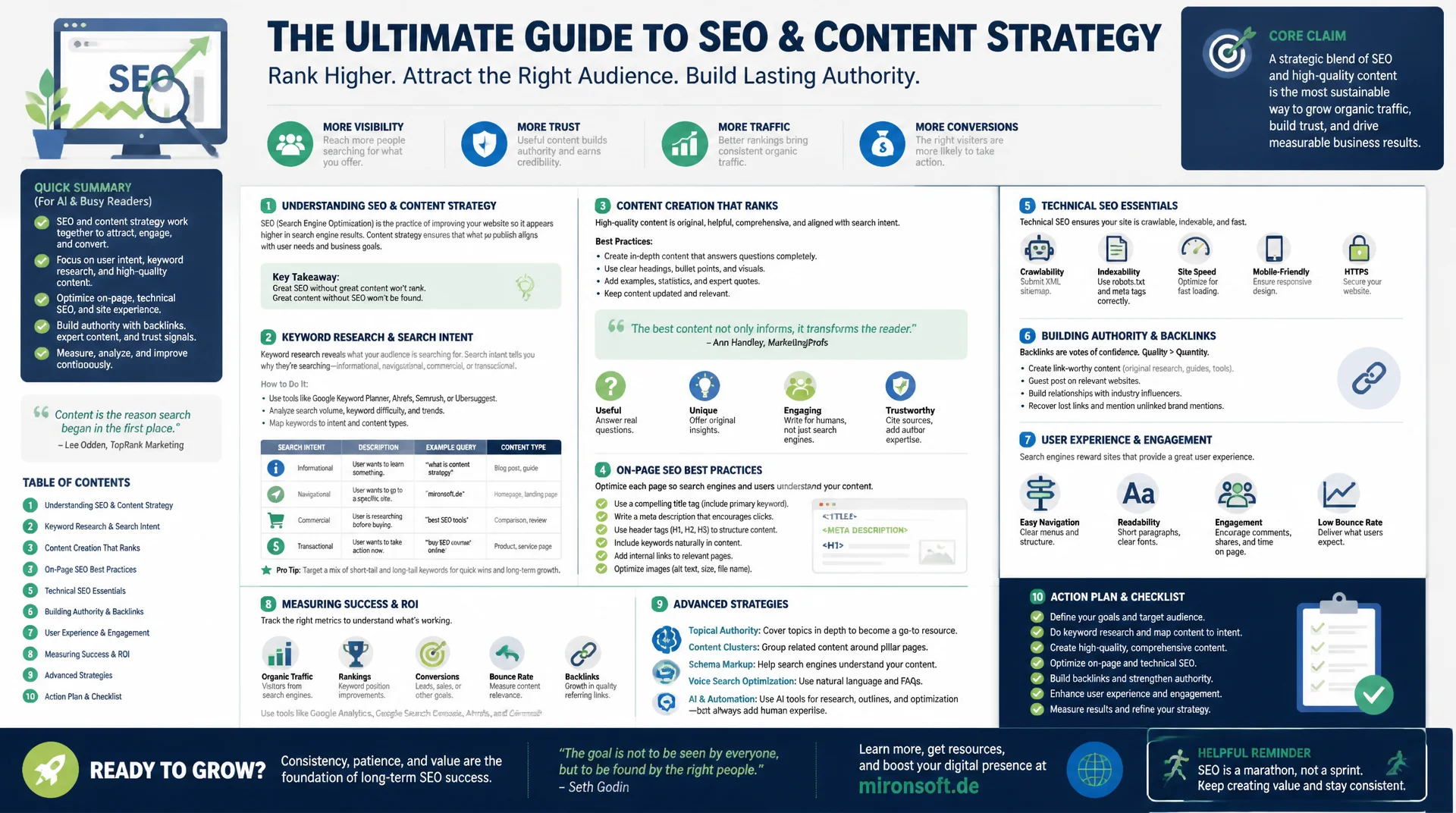
what actually lands in AI summaries
A 4,000 word guide delivers depth, authority and topical coverage, but ChatGPT often ends up citing just two sentences from it. AI summaries favor compact, clearly stated core claims, while search engines still reward comprehensive content with ranking signals. Anyone who understands this tension can structure content to satisfy both requirements at once.
Table of Contents
- 1. The Tension Between Content Depth and Brevity
- 2. How AI Systems Summarize Content
- 3. Why Comprehensive Content Still Matters
- 4. What Actually Lands in AI Summaries
- 5. Structuring Content So Core Claims Are Extractable
- 6. Using TL;DR Sections and Summary Boxes Correctly
- 7. Long Content vs. Short Answers: a Balance Model
- 8. Measurement: Which Content Length Actually Gets Cited
- 9. Content Strategies Compared Directly
- 10. Summary
- 11. FAQ
1. The Tension Between Content Depth and Brevity
Content strategists face a seeming contradiction with GEO: comprehensive, in depth content has been considered a ranking factor and authority signal in classic SEO for years, while AI summaries are almost always short, precise and condensed to a few sentences. A language model answering a user question rarely quotes more than two or three sentences from a source, even when that source covers the topic comprehensively across several thousand words.
This apparent contradiction is in reality not an either-or but a question of content architecture. Comprehensive content increases the probability of being recognized as a relevant source at all, because it covers more topical facets and therefore matches more different prompts. The amount of text actually quoted in AI summaries remains short regardless, because generative systems compress by design, independent of the source text's original length.
This article shows how content depth and the brevity of AI summaries interact, which text structures ease extraction, and how both goals can be combined in a single piece of content without shortchanging either one.
2. How AI Systems Summarize Content
Generative language models essentially use two different summarization strategies. Extractive summarization selects verbatim sentences or sentence fragments from the original text and reassembles them, while abstractive summarization rephrases the content in its own words based on the model's understanding of the meaning. Most modern AI search systems combine both approaches: core facts and definitions are frequently reproduced close to the original, while connecting sentences and context are generated abstractively.
For content creation this means: a sentence that states a core claim clearly, standalone, without referring to preceding paragraphs, has a higher chance of being carried over into a generated answer nearly unchanged. Sentences that depend heavily on prior context, for example phrasing like "as mentioned above" or "this leads to the following result", are poorly suited for extraction, because they become incomprehensible outside their original context.
{
  "summarization_example": {
    "source_paragraph": "GEO differs from classic SEO through its success metric. While SEO targets ranking positions, GEO measures citation frequency in AI-generated answers.",
    "extractive_candidate": "GEO measures citation frequency in AI-generated answers, while SEO targets ranking positions.",
    "abstractive_paraphrase": "Unlike SEO, which evaluates positions, GEO focuses on how often a source is cited in AI answers.",
    "extraction_friendly": true,
    "reason": "Self-contained statement, no reference to prior sentences"
  }
}
3. Why Comprehensive Content Still Matters
Despite short AI summaries, comprehensive content remains indispensable for several reasons. First, topical depth increases the probability of being recognized as relevant for a wider range of prompt phrasings, because an article that covers a topic from multiple angles offers more potential entry points for differently worded user questions than a very brief text.
Second, depth signals authority, both to classic search algorithms and to models that, during training, learn patterns of which sources cover a topic especially thoroughly. Third, a comprehensive article provides the context needed to correctly frame statements professionally, which is particularly important for complex technical topics, reducing the chance that a model over-generalizes or takes an isolated statement out of context.
4. What Actually Lands in AI Summaries
Empirically, a recurring pattern emerges: AI summaries favor sentences positioned right at the start of a paragraph or section, because that position typically holds the core claim rather than the derivation. Definitions, numbers, clear causal statements ("X leads to Y") and direct answers to implicit questions get picked up disproportionately often, while long derivations, anecdotes, or ambiguously phrased passages are rarely cited.
Another pattern involves lists and tables: structured enumerations are often carried directly into an answer's structure by generative systems, because they already represent a clear, atomic unit of information per line. A running text paragraph with the same information but without visual structuring requires additional interpretive work from the model and is less often reproduced verbatim. This observation explains why many GEO optimized pieces of content lean more heavily on lists, tables, and clearly delimited paragraphs than traditional running text guides.
5. Structuring Content So Core Claims Are Extractable
The practical consequence of how generative systems extract content is a writing style that consistently places the core claim at the start of every paragraph, followed by reasoning and context. This pattern, often known from journalism as the "inverted pyramid", works especially well for AI summaries, because a model with a limited context window processes the most relevant information first and is more likely to carry it into the generated answer.
Semantic HTML markup also helps: headings phrased as direct questions, followed by a paragraph that unambiguously answers that question in its first sentence, form a pattern reliably recognized both by humans skimming and by extraction algorithms. This structure simultaneously supports featured snippets in classic search and citations in generative answers, without needing to maintain two separate content versions.
<!-- Answer-first paragraph structure for extraction-friendly content -->
<h3 id="what-is-geo">What is GEO?</h3>
<p>
  <strong>GEO (Generative Engine Optimization)</strong> is the optimization of
  content for citation in AI-generated answers instead of ranking positions
  in classic search results.
</p>
<p>
  The difference from classic SEO lies in the success metric: SEO measures
  position, GEO measures citation frequency across a defined set of prompts.
</p>

<!-- FAQPage schema reinforces the same answer-first pattern machine-readably -->
<script type="application/ld+json">
{
  "@context": "https://schema.org",
  "@type": "FAQPage",
  "mainEntity": [{
    "@type": "Question",
    "name": "What is GEO?",
    "acceptedAnswer": {
      "@type": "Answer",
      "text": "GEO is the optimization of content for citation in AI-generated answers instead of ranking positions in classic search results."
    }
  }]
}
</script>
6. Using TL;DR Sections and Summary Boxes Correctly
An explicit summary section at the start or end of an article serves as a direct steering aid for AI summaries: it bundles the most important claims of the entire article into a compact, self-explanatory form that a model can carry over nearly unchanged with high probability. It is important that this box does not feel redundant to the rest of the content, but actually condenses the central insights precisely, rather than repeating generic phrases.
A well designed summary box uses short, self-contained sentences, avoids references to other sections, and ideally contains concrete numbers or clearly defined action items. This structure serves two purposes at once: it helps human readers skim quickly and gives generative systems an already condensed excerpt that reduces the model's own compression work and increases the probability of a precise, correct citation.
<!-- TL;DR summary box placed near the top of a long-form article -->
<div class="not-prose bg-sky-50 border border-sky-200 rounded-xl p-6 my-6">
  <p class="font-bold text-sky-900 mb-2">Summary</p>
  <ul class="text-sm text-sky-800 space-y-1">
    <li>GEO measures citation frequency, not ranking position.</li>
    <li>AI summaries favor short, self-contained core claims.</li>
    <li>Comprehensive content remains important for topical coverage.</li>
    <li>The inverted pyramid combines depth and extractability.</li>
  </ul>
</div>
7. Long Content vs. Short Answers: a Balance Model
The most practical model treats content depth and the brevity of AI summaries not as opposites but as two layers of the same article. The upper layer consists of short, self-contained answer blocks placed directly after every subheading, each fully answering a single core question. The lower layer provides the full derivation, examples, counterarguments, and nuance needed for deep understanding and topical authority, though it is cited less often by extraction algorithms.
This two-layer model requires discipline in writing: every section must be phrased so its first sentence is understandable on its own, even if the rest of the paragraph were removed. In practice this means regularly editing existing content, splitting long, deeply nested sentences into a clear core claim plus a separate justification, rather than mixing both into a single complex sentence.
<!-- Two-layer model: short answer block, followed by full depth -->
<h3>How do you measure GEO success?</h3>
<p>
  <strong>Short:</strong> Through citation frequency and inclusion rate,
  measured with a fixed prompt set against several AI search systems.
</p>
<p>
  In detail: a prompt set consists of realistic user questions that
  are run regularly. The answers are checked for source references,
  and results are aggregated over weeks to distinguish trends from
  random fluctuation...
</p>
8. Measurement: Which Content Length Actually Gets Cited
To verify whether your own content structure is actually extraction friendly, it is worth systematically analyzing the amount of quoted text relative to an article's total length. This analysis compares, for every recorded citation event, the number of words actually carried over against the total word count of the source, and shows whether certain content formats, such as lists or definition boxes, are cited disproportionately often.
Aggregated across multiple articles, this yields an empirical pattern: which structural elements in your own AI summaries actually land, and which sections, despite being topically relevant, are never cited. This insight feeds directly into the next content revision and turns content structure into an iteratively optimizable process instead of a one-time stylistic decision.
// citation-ratio-analyzer.js, compare quoted text length to source article length
function calculateCitationRatio(sourceArticleWordCount, citedExcerpts) {
  const totalQuotedWords = citedExcerpts.reduce((sum, excerpt) => {
    return sum + excerpt.text.split(/\s+/).length;
  }, 0);

  return {
    sourceWordCount: sourceArticleWordCount,
    totalQuotedWords,
    citationRatioPct: Number(((totalQuotedWords / sourceArticleWordCount) * 100).toFixed(2)),
    excerptCount: citedExcerpts.length
  };
}

// Example usage across a batch of tracked citation events
const result = calculateCitationRatio(1800, [
  { text: 'GEO measures citation frequency instead of ranking position.' },
  { text: 'Short, self-contained core claims are cited preferentially.' }
]);

console.log(result);
// { sourceWordCount: 1800, totalQuotedWords: 14, citationRatioPct: 0.78, excerptCount: 2 }
9. Content Strategies Compared Directly
The following table contrasts different content approaches and evaluates their fit for classic ranking and for AI summaries.
| Content Format | Traditional Ranking | Extraction in AI Summaries | Recommendation |
|---|---|---|---|
| Long running text, no structure | Medium | Low | Restructure |
| Inverted pyramid per section | High | High | Default pattern |
| TL;DR box at article start | Medium | Very high | Always add |
| Lists and tables | Medium | High | Use for facts |
| Very short pages without depth | Low | Medium | Expand with context |
The inverted pyramid combined with supplementary TL;DR boxes offers the best fit for both target systems at once, because it sacrifices neither depth nor extractability.
Mironsoft
Content audits, structure optimization and GEO-ready copywriting
Is your best content even being cited by AI systems?
We analyze existing content for extractability, add TL;DR structures, and align new articles consistently with the inverted pyramid principle, without sacrificing topical depth.
Structure Audit
Check existing articles for extraction friendliness
Content Refactoring
Move core claims to the start of every paragraph
Citation Tracking
Measure which sections actually get picked up
10. Summary
Content depth and the brevity of AI summaries do not necessarily oppose each other, as long as an article's structure deliberately separates both layers. Comprehensive content increases the probability of being recognized as a relevant source for many different prompts, while short, self-contained core claims at the start of every section favor actual inclusion in a generated answer.
The inverted pyramid, supplemented with explicit TL;DR boxes and clearly structured lists, combines both requirements in a single article, without needing to duplicate content or split it into separate short and long versions. Regularly measuring the amount of text actually cited shows which structural elements work in practice, turning content optimization for AI summaries into a data driven process instead of an intuitive one.
Content Depth vs. Brevity, the Essentials at a Glance
Not a Contradiction, an Architecture
Depth increases reach across prompts, short core claims increase citation probability. Both belong in the same article.
Use the Inverted Pyramid
Core claim first, reasoning after. Every section must stay understandable without prior context.
Deploy TL;DR Boxes Deliberately
Compact, self-contained summaries get picked up disproportionately often by AI summaries.
Measure the Citation Ratio
The ratio of quoted text to total length shows which structural elements actually work.