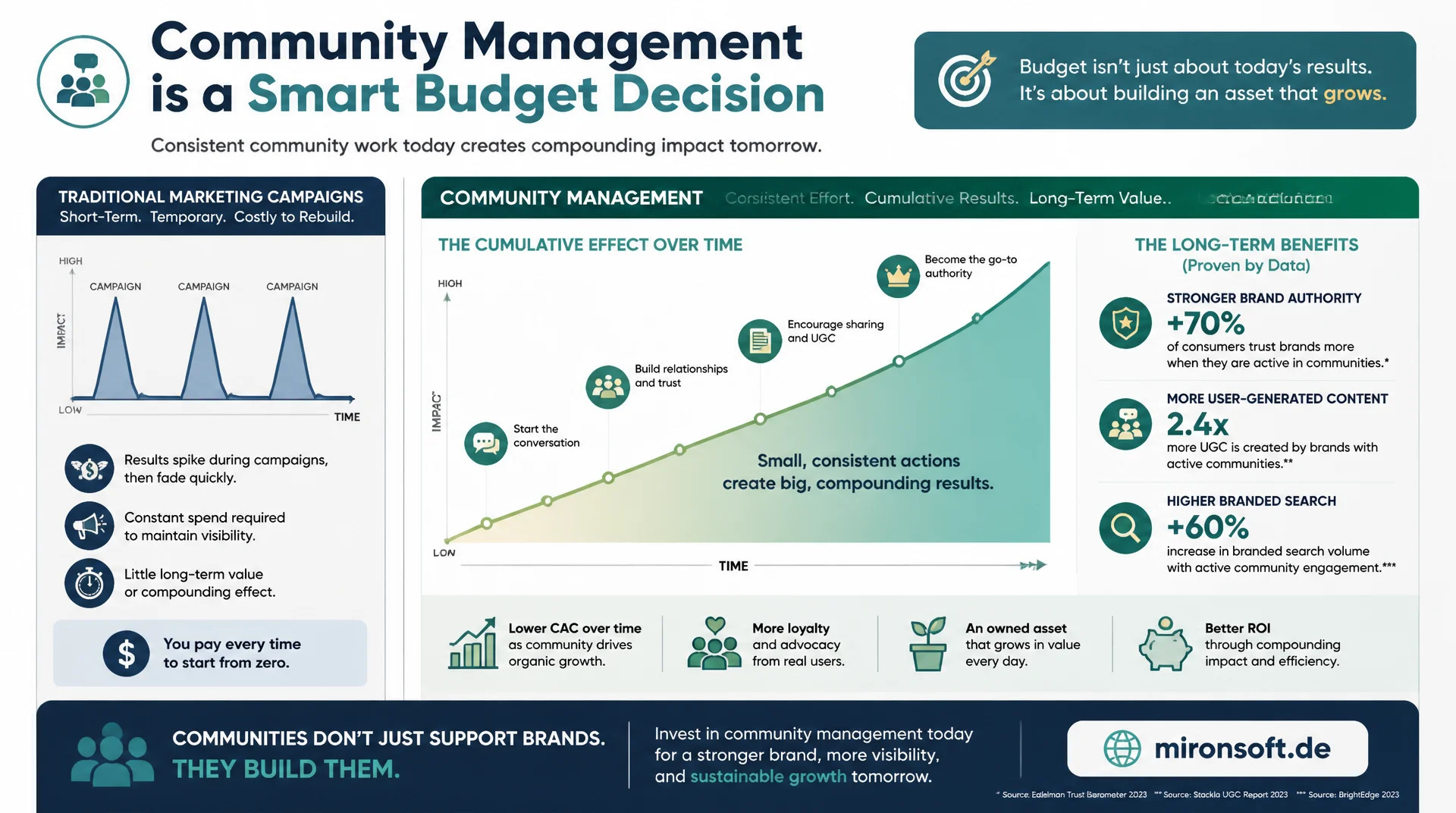
how cumulative effects build brand authority
Community management is often treated in budget discussions as a soft, hard-to-measure nice-to-have. Yet consistent community work unfolds cumulative effects over months on brand authority, the volume of user generated content, and branded search that classic campaigns simply cannot reach.
Table of Contents
- 1. Why community management gets underrated as a nice-to-have
- 2. The cumulative nature of community effects
- 3. Community management and brand authority in detail
- 4. User generated content as SEO raw material
- 5. From community to branded search
- 6. Structured data for reviews and community content
- 7. Making community management measurable
- 8. Building community management strategically
- 9. Community management compared to performance campaigns
- 10. Summary
- 11. FAQ
1. Why community management gets underrated as a nice-to-have
Community management lands on the cut list first in many budget plans whenever things get tight, because its effect does not show up in a traffic curve within the same week the way a paid campaign does. This short-term evaluation systematically misjudges how community effects actually work: not in sudden jumps, but cumulatively over months and years, with an effect that reinforces itself the longer it is consistently invested in.
The reasoning error lies in the wrong comparison metric. A paid campaign gets measured against immediate traffic and immediate conversions, while community management works through building trust, recurring interaction, and the resulting willingness of users to actively recommend and talk about the brand. This second effect is SEO-relevant, but only becomes visible after a certain build-up period, which makes it unattractive for short-term-minded budget decisions.
Anyone who consistently understands community management as a long-term SEO lever rather than an isolated marketing discipline fundamentally changes the evaluation: the relevant metric is not this week's traffic, but the development of brand authority, user generated content and branded search over one to two years.
2. The cumulative nature of community effects
Community management functions structurally differently from most marketing measures, because its value does not exhaust itself with the campaign but builds up and reinforces itself over time. A single answered community post has barely measurable SEO value on its own. Hundreds of consistently answered posts over a year, however, create a pattern: users experience a responsive, present brand, talk about it more often, link to it more frequently, and search for it more actively, because positive experiences spread within their own social environment.
This cumulative nature also means that community management that gets shut down again after a short time never realizes its potential value. The effects only unfold once a brand is consistently perceived as approachable, responsive and reliable over a longer period. A sporadic community approach that is active sometimes and left unanswered for weeks at other times tends to create mistrust rather than trust, undermining exactly the effect that consistent community management is meant to build.
{
  "cumulative_growth_trend": {
    "metric": "branded_search_volume_index",
    "month_1": 100,
    "month_6": 118,
    "month_12": 141,
    "month_18": 167,
    "condition": "continuous community management without interruption"
  }
}
3. Community management and brand authority in detail
Brand authority is a concept that plays a role both in classic SEO evaluation and increasingly in AI-powered search systems: how often is a brand mentioned in the context of a topic, how consistent are these mentions, and how positive is the tone of these mentions. Community management directly influences all three dimensions. Every competently answered question in a community creates a positive, topic-related mention of the brand in a place that neither advertising nor classic content can reach.
Especially valuable is topical consistency: a brand that keeps showing up in the same niche over months with well-founded, helpful answers builds a pattern that search systems and human users alike interpret as expertise. This pattern is considerably harder to achieve than a single well-ranked article, because it does not emerge from a one-off content effort, but only from continuous, authentic presence.
{
  "@context": "https://schema.org",
  "@type": "Organization",
  "name": "Mironsoft",
  "url": "https://mironsoft.de",
  "sameAs": [
    "https://www.linkedin.com/company/mironsoft",
    "https://twitter.com/mironsoft",
    "https://www.instagram.com/mironsoft"
  ]
}
4. User generated content as SEO raw material
A direct, measurable output of good community management is the volume of user generated content: reviews, comments, forum posts and experience reports that users create voluntarily because they feel valued within the community. This user generated content is SEO-relevant because it continuously produces fresh, topic-relevant text, often in exactly the language potential customers use in their search queries, with no editorial effort from the team itself.
Community management is the decisive lever for increasing this volume: brands that actively respond to reviews and comments demonstrably receive more of them, because users see that their contributions are actually read and appreciated. An unanswered comment section discourages further contributions, while an actively moderated and answered section encourages them. This relationship between response rate and UGC volume is one of the most directly measurable community management effects.
On the technical SEO side, it is worthwhile to integrate user generated content in a structured way on your own website, for example reviews on product pages with review schema, instead of leaving them exclusively on external platforms. That way, the SEO value of user generated content at least partially stays on your own domain instead of flowing entirely to third-party platforms.
{
  "@context": "https://schema.org",
  "@type": "Review",
  "itemReviewed": { "@type": "Product", "name": "Sample product" },
  "author": { "@type": "Person", "name": "Community member" },
  "reviewRating": { "@type": "Rating", "ratingValue": "5", "bestRating": "5" },
  "reviewBody": "Fast support answered through the community, issue resolved within a few hours."
}
5. From community to branded search
Branded search, meaning direct searches for the brand name or brand-adjacent terms, is one of the strongest trust signals for search engines and at the same time a clear, measurable indicator of the long-term success of community management. Users who have had a positive experience in a community are more likely to later search specifically for the brand instead of going through the entire selection process again via generic search terms.
This effect can be observed over time in Google Search Console data: if the volume of brand name search queries keeps growing continuously while active community management is being run, that is a strong indirect signal that the community work is building trust that translates into concrete search behavior. This relationship is rarely linear and visible in the short term, but becomes a reliable trend across quarters.
6. Structured data for reviews and community content
For content resulting from community management to unfold its full SEO potential, it should be marked up cleanly on a technical level. Reviews and experience reports can be tagged with Review and AggregateRating schema, FAQ content that emerges from recurring community questions with FAQPage schema. This structured data makes the value of user generated content explicitly readable for search systems, instead of leaving it only implicit in body text.
Authenticity matters here: structured data should exclusively represent real, actually existing reviews and community contributions. Manipulated or fabricated review data violates search engine guidelines and, if discovered, quickly endangers the entire brand authority so painstakingly built through community work.
{
  "@context": "https://schema.org",
  "@type": "FAQPage",
  "mainEntity": [
    {
      "@type": "Question",
      "name": "How fast does support respond in the community?",
      "acceptedAnswer": { "@type": "Answer", "text": "On average within 3 hours during business hours." }
    }
  ]
}
7. Making community management measurable
The biggest resistance to investing in community management comes from a lack of measurability. A sensible metric set combines short-term operational metrics, such as average response time and response rate, with long-term SEO-relevant metrics: growth of branded search volume, number of new reviews per month, share of positive mentions in social listening, and backlink growth from community mentions.
It is crucial to look at these metrics over a period of at least six to twelve months, not weekly or monthly in isolation. A community management report that only shows snapshots misses the actual value of this discipline, namely the slow but steady shift in brand perception and search behavior over time.
{
  "community_kpi_report": {
    "period": "2026-Q2",
    "response_rate_percent": 94,
    "avg_response_time_hours": 3.2,
    "new_reviews_count": 87,
    "branded_search_growth_yoy_percent": 22,
    "positive_sentiment_share_percent": 78
  }
}
8. Building community management strategically
A strategic build-up starts with clear response time standards and a defined escalation logic for critical topics, so community management does not depend on the daily mood of individual employees. Second, community management should be organizationally closely linked with support and product teams, because many community questions actually contain product feedback that would otherwise be lost.
Third, a deliberate focus on a few channels instead of a shallow presence everywhere pays off: a brand that consistently and competently manages two or three channels builds more authority than a brand spread thinly across ten channels, reacting only sporadically everywhere. This focus is exactly the key for smaller teams with limited resources to actually realize the cumulative effects of community management at all.
9. Community management compared to performance campaigns
The following overview contrasts the fundamentally different impact patterns of community management and classic performance campaigns to set the right expectations in budget planning.
| Criterion | Performance campaign | Community management |
|---|---|---|
| Time to effect | Immediate, usually within days | Delayed, cumulative over months |
| Effect after the measure ends | Drops off quickly | Partially remains permanent |
| Main output | Clicks, impressions, conversions | UGC, brand authority, branded search |
| Measurability | Direct and short-term | Indirect, needs a long-term view |
| Scalability | High, controllable via budget | Limited by team capacity |
Both approaches are not mutually exclusive, they complement each other: performance campaigns deliver short-term traffic, community management builds the foundation of trust and authority on which that traffic converts more efficiently long-term and turns into recurring, brand-related search queries.
Mironsoft
Community strategy, UGC integration and branded search growth
Community management that works measurably long-term?
We help you build community management strategically, integrate user generated content cleanly on a technical level, and make long-term effects on brand authority and branded search visible.
KPI framework
Defining short-term and long-term community metrics
UGC integration
Anchoring reviews and experience reports with schema on your own domain
Strategy focus
Channel prioritization and escalation processes for sustainable community management
10. Summary
Community management is not a soft nice-to-have, it is an SEO lever with a cumulative effect that builds brand authority, user generated content and branded search over months and years. The decisive difference from performance campaigns is that community effects do not disappear when the measure ends, but continue to work permanently as accumulated trust.
Anyone who measures community management with the right long-term metrics instead of short-term traffic expectations recognizes the real value of this discipline. Consistent response times, technically clean integration of user generated content, and a deliberate channel focus are the practical levers to maximize these long-term effects on purpose.
Community management as an SEO lever, the key points at a glance
Cumulative effect
Value emerges through consistent presence over months, not through individual actions.
Brand authority
Competent, repeated community answers build a topical expertise pattern that search systems recognize.
UGC volume
Active response to contributions measurably increases users' willingness to create further content.
Branded search
Trust from the community translates over quarters into growing search volume for the brand name.