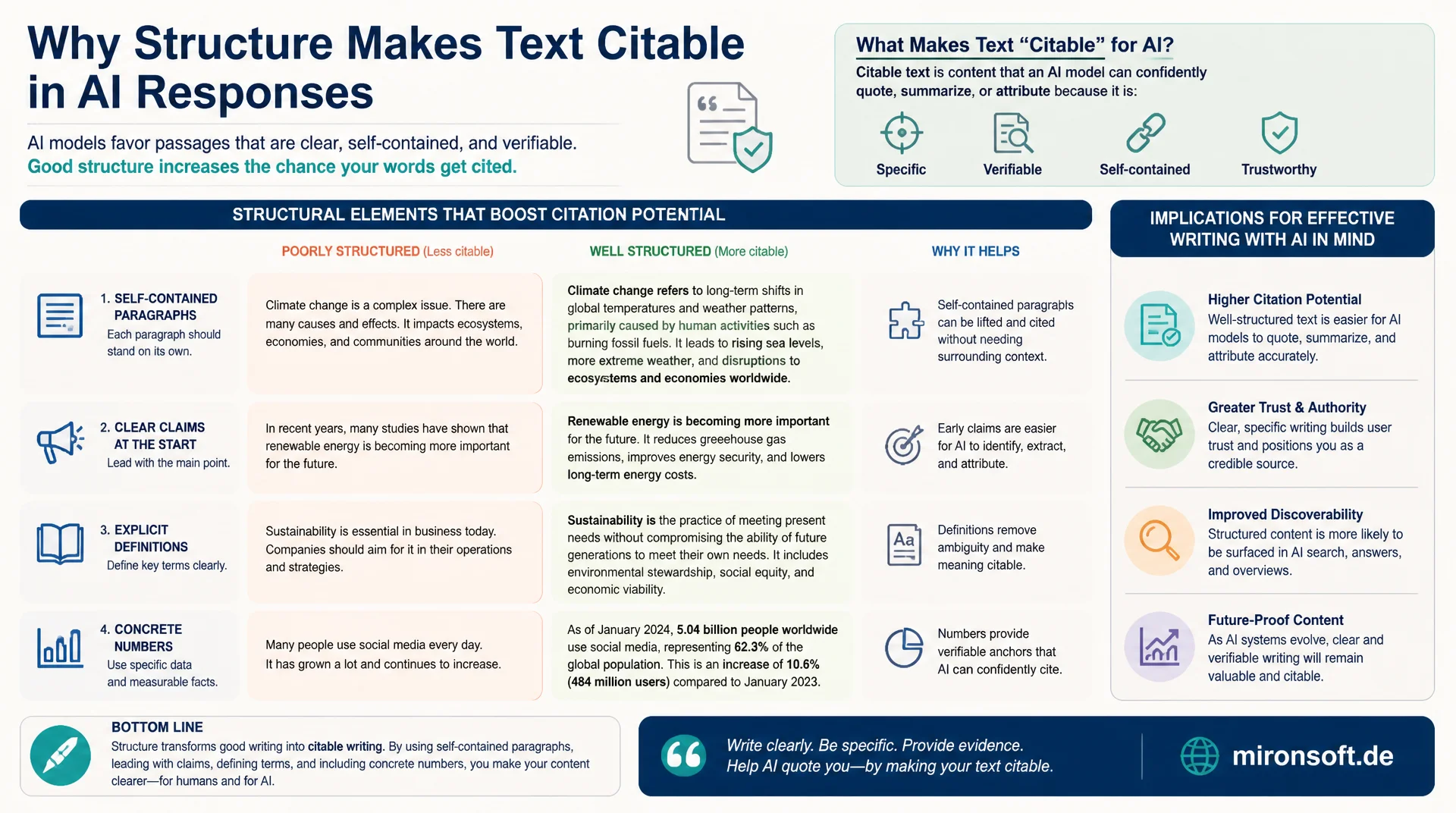
structure that makes extraction and citation easy for language models
Whether a text gets cited in an AI answer depends less on style than on structure. Self-contained paragraphs, clear claims at the start of a sentence, explicit definitions and concrete numbers turn plain prose into citable content a language model can adopt without any extra interpretation.
Table of Contents
- 1. What citability means, and why structure beats style
- 2. Self-contained paragraphs: why each one must stand alone
- 3. Clear claims first: the inverted pyramid for AI systems
- 4. Introducing definitions and technical terms explicitly
- 5. Data points and numbers: why concrete values get cited more
- 6. Heading hierarchy and semantic HTML for extraction
- 7. Common mistakes when writing for citability
- 8. Citable content vs. classic SEO copy compared
- 9. Editorial workflow: a checklist for citable content
- 10. Summary
- 11. FAQ
1. What citability means, and why structure beats style
Citable content is text a language model can adopt into a generated answer as a self-contained, correct statement without any extra interpretation. That is fundamentally different from good classic web copy, which often relies on narrative tension, varied sentence structure and a common thread running through the entire article. An AI system rarely reads a whole article as a connected experience, though, it extracts individual paragraphs or sentences and evaluates whether they make sense in isolation and state a claim clearly enough to be quoted.
This shift does not mean good writing style becomes unimportant, it means an additional layer of structure is required. An article can be stylistically elegant and still hard for AI systems to extract from, if central claims are spread across several sentences or depend on prior context that is missing in an isolated paragraph. Citable content therefore requires explicit self-sufficiency at the paragraph level, clear claims at the start of a sentence rather than the end, and a consistent separation of claim and justification.
The sections below show concrete writing patterns, with before-and-after examples, that turn ordinary prose into genuinely citable content, without making the text sound robotic or hard for human readers to enjoy.
2. Self-contained paragraphs: why each one must stand alone
The most important building block of citable content is the self-contained paragraph. An AI system generating an answer typically does not quote an entire article, but a single paragraph or a few sentences from it. If that paragraph refers back to "it" or "this method," whose reference was only explained in the previous paragraph, the quoted passage loses all meaning outside its context. Citable content consistently avoids such backward references and names the subject explicitly, even at the cost of some stylistic variation.
A second feature of self-contained paragraphs is topical closure: a paragraph handles exactly one idea and completes it, instead of touching on several sub-aspects that only get tied together two paragraphs later. This discipline contradicts some classic writing advice, which favors smooth transitions between paragraphs, but it is decisive for extraction by AI systems. The example below shows the difference between a context-dependent and a self-contained paragraph on the same topic.
<!-- WRONG: depends on the previous paragraph for meaning -->
<p>This method reduces load time significantly. It has been
recommended since version 2 and is now the standard.</p>

<!-- RIGHT: self-contained, names the subject explicitly -->
<p>Lazy loading for images reduces the load time of a typical
product page by 30 to 50 percent, because images outside the
visible viewport only load once the user scrolls to them.
Since Chrome 76, all major browsers support the native
loading="lazy" attribute.</p>

<!-- A model can quote the second paragraph in isolation
     and the claim still makes complete sense -->
3. Clear claims first: the inverted pyramid for AI systems
Journalism gave us the inverted pyramid principle: the most important information first, details and justification follow afterward. For citable content, this principle matters at the paragraph level. A paragraph that opens with an introduction, an example, and only reveals its actual core claim in the last sentence forces an AI system to read the whole paragraph and decide for itself which part is citable. A paragraph that puts the core claim in the first sentence, by contrast, delivers a ready-made quote candidate right at the start.
This pattern can be applied systematically to every paragraph of an article: the first sentence states the claim or result, the following sentences supply justification, context or an example. For more complex topics, the entire article structure can even follow this logic, with the most important answer appearing right after the introduction, before deeper technical detail follows. This structure runs counter to the classic narrative buildup of many blog posts, but it measurably increases the chance that an AI system extracts the right core claim, instead of generating an incomplete or wrongly weighted summary.
<!-- WRONG: core claim buried at the end of the paragraph -->
<p>Many shops rely on classic caching, others experiment with
edge rendering, and testing showed that Hyva themes achieve
on average a 40 percent shorter time to interactive than
classic Luma themes.</p>

<!-- RIGHT: core claim first, context and detail follow -->
<p>Hyva themes achieve on average a 40 percent shorter time to
interactive than classic Luma themes. This difference holds
regardless of whether a shop uses classic caching or edge
rendering.</p>

<!-- The first sentence alone is a complete, citable claim -->
4. Introducing definitions and technical terms explicitly
AI systems particularly like to cite clear definitions, because they deliver a complete, checkable statement in a single sentence. A technical term that is simply assumed to be known, by contrast, provides no citable anchor point. Citable content therefore introduces central terms explicitly, ideally following the pattern "X is Y, which does Z," instead of explaining a term implicitly across several sentences. These definition sentences work especially well for direct reuse in answers to questions like "What is GEO?" or "What does citability mean?"
An added benefit of explicit definitions: they combine well with structured data, for instance as a DefinedTerm in the schema.org vocabulary, which makes extraction even easier. It matters that the definition in the body text matches the one in the structured data block, otherwise the same trust problem arises as with contradictory structured data. The example below shows an explicit definition in body text, phrased as a self-contained, citable sentence.
<!-- WRONG: term used without ever being defined explicitly -->
<p>GEO is becoming increasingly important for marketing teams
that want to react to changing search habits.</p>

<!-- RIGHT: explicit definition as a self-contained sentence -->
<p>Generative Engine Optimization, or GEO for short, refers to
the deliberate optimization of content for visibility and
correct reproduction in AI-generated search answers, as
opposed to classic optimization for ranking positions.</p>

<!-- The pattern "X, short Y, means Z" is a strong citation anchor -->
5. Data points and numbers: why concrete values get cited more
Concrete numbers are especially attractive citation candidates for AI systems, because they are checkable, compact and unambiguous. A statement like "significantly faster load time" provides no citable data point, while "a 42 percent shorter time to first byte" provides a concrete, directly reusable value. Citable content therefore consistently replaces vague comparatives with percentages, absolute numbers or time frames wherever valid data exists. Traceability matters here too: a number with no discernible source or methodology tends to get treated more cautiously by AI systems than a number accompanied by a source or measurement method in the same paragraph or right after it.
A second effect concerns repetition across multiple sources. When a number, say a study figure on conversion rate after load time optimization, gets cited consistently across several independent, credible sources, the likelihood increases considerably that an AI system adopts exactly that value as an established fact instead of generating its own, potentially less accurate estimate. Citable content with consistent, well-sourced numbers is therefore not only cited more often, but also treated as a more trustworthy source.
6. Heading hierarchy and semantic HTML for extraction
Besides plain text content, HTML structure plays an important role for citability. A clean, logical heading hierarchy with correctly nested h2 and h3 elements signals to a parser where a new topic begins and where a subsection ends. Citable content uses headings not just for visual organization but as semantic landmarks that let an AI system detect the topical boundary of an extractable section. A heading like "Results" is less helpful here than a concrete heading like "Results: 42 percent shorter load time after image optimization," which already anticipates the core claim.
Semantic HTML supports this effect further: lists as ul/ol instead of comma-separated prose, definitions as dl/dt/dd instead of an embedded subordinate clause, and tables as real table elements instead of formatted prose. These elements give AI systems a representation that is already pre-structured and can be adopted without any additional interpretation.
<!-- WRONG: structured information hidden in prose -->
<p>GEO differs from classic SEO through its focus on
citability instead of rankings, through the importance of
consistency across multiple sources, and through shorter
reaction cycles with live retrieval.</p>

<!-- RIGHT: same information as a semantic, extractable list -->
<h3>Three key differences between GEO and classic SEO</h3>
<ul>
  <li>Focus on citability instead of ranking positions</li>
  <li>Consistency across multiple external sources is decisive</li>
  <li>Shorter reaction cycles possible through live retrieval</li>
</ul>
7. Common mistakes when writing for citability
The most common mistake is excessive marketing language without checkable substance: phrases like "revolutionary," "groundbreaking" or "industry-leading" without accompanying facts provide no citable content, because they are subjective and not verifiable. AI systems tend to avoid such statements, since they get classified as promotional exaggeration rather than factual claims. A second common mistake is overly long, nested sentences with several subordinate clauses, which may look stylistically sophisticated but make it harder to extract one clear, single claim.
<!-- WRONG: marketing language without verifiable substance -->
<p>Our revolutionary solution delivers industry-leading
performance and sets new standards in e-commerce.</p>

<!-- RIGHT: verifiable claim with a concrete, citable number -->
<p>Our Hyva migrations reduce the average load time of
product pages from 3.8 to 1.2 seconds, measured across
40 projects between 2024 and 2026.</p>

<!-- WRONG: nested clauses hide the actual claim -->
<p>While many agencies that specialize in performance often
pursue different approaches, depending on which framework is
used, a closer look shows that Hyva tends to be faster
on average.</p>

<!-- RIGHT: one clear claim per sentence -->
<p>Hyva themes are on average faster than classic Luma
themes, regardless of the caching approach used.</p>
8. Citable content vs. classic SEO copy compared
Classic SEO copy and citable content share many fundamentals, but differ in priorities that show up directly in text structure. The table below compares the key differences.
| Characteristic | Classic SEO copy | Citable content |
|---|---|---|
| Core claim in the paragraph | Often at the end, after intro and example | In the first sentence, directly quotable |
| Paragraph dependency | Frequently refers back to previous paragraphs | Each paragraph understandable on its own |
| Numbers and evidence | Often qualitative, vague comparatives | Concrete percentages and figures with source |
| Technical terms | Often assumed known or explained implicitly | Explicit definition sentences |
| Success metric | Ranking position, organic traffic | Citation rate in AI answers |
In practice, both approaches combine well: an article can open with a classic, engaging introduction and still structure every following paragraph according to the principles of citable content. The difference lies less in overall style than in consistent discipline at the paragraph and sentence level, something classic SEO writing rarely demands explicitly.
9. Editorial workflow: a checklist for citable content
A practical editorial workflow checks every paragraph of a finished draft against a short checklist: does the paragraph still make sense in isolation, without the previous paragraph? Is the core claim in the first sentence? Does the paragraph, where relevant, contain a concrete number instead of a vague phrase? These three questions can be answered in a few minutes per article and reliably surface the most common weaknesses without needing to rewrite the entire text.
It is also worth running a structural check on the HTML output: are lists marked up as real ul elements, does the heading hierarchy follow a logical order without skipped levels, and are central technical terms explicitly defined at least once? Editorial teams that make this checklist a fixed part of their approval process gradually produce more and more citable content over time, without needing to manually rework every single article for GEO.
10. Summary
Citable content does not happen by accident, it results from consistent structural discipline: self-contained paragraphs without backward references, core claims in the first sentence rather than at the end of a paragraph, explicit definitions for technical terms, and concrete numbers instead of vague comparatives. Semantic HTML with a clean heading hierarchy and real list and table elements supports extraction further. These principles partly contradict classic writing advice, which favors narrative tension and varied transitions, but they are decisive for whether an AI system recognizes a paragraph as a self-contained, citable statement.
The practical upside: citable content remains just as readable for human readers, often more so, because clear structure and concrete numbers also help human readers grasp content quickly. Whoever integrates these principles into the editorial workflow improves both visibility in AI answers and clarity for their own audience at the same time.
Writing Citable Content for AI Answers: the essentials at a glance
Self-contained paragraphs
Every paragraph must be understandable in isolation, without prior context, avoiding backward references like "this method."
Core claim first
Apply the inverted pyramid at the paragraph level: claim in the first sentence, justification and example after.
Concrete numbers
Replace vague comparatives with percentages, absolute figures and traceable source references.
Semantic HTML
Mark up lists, definitions and tables as real HTML elements instead of embedding them in prose.