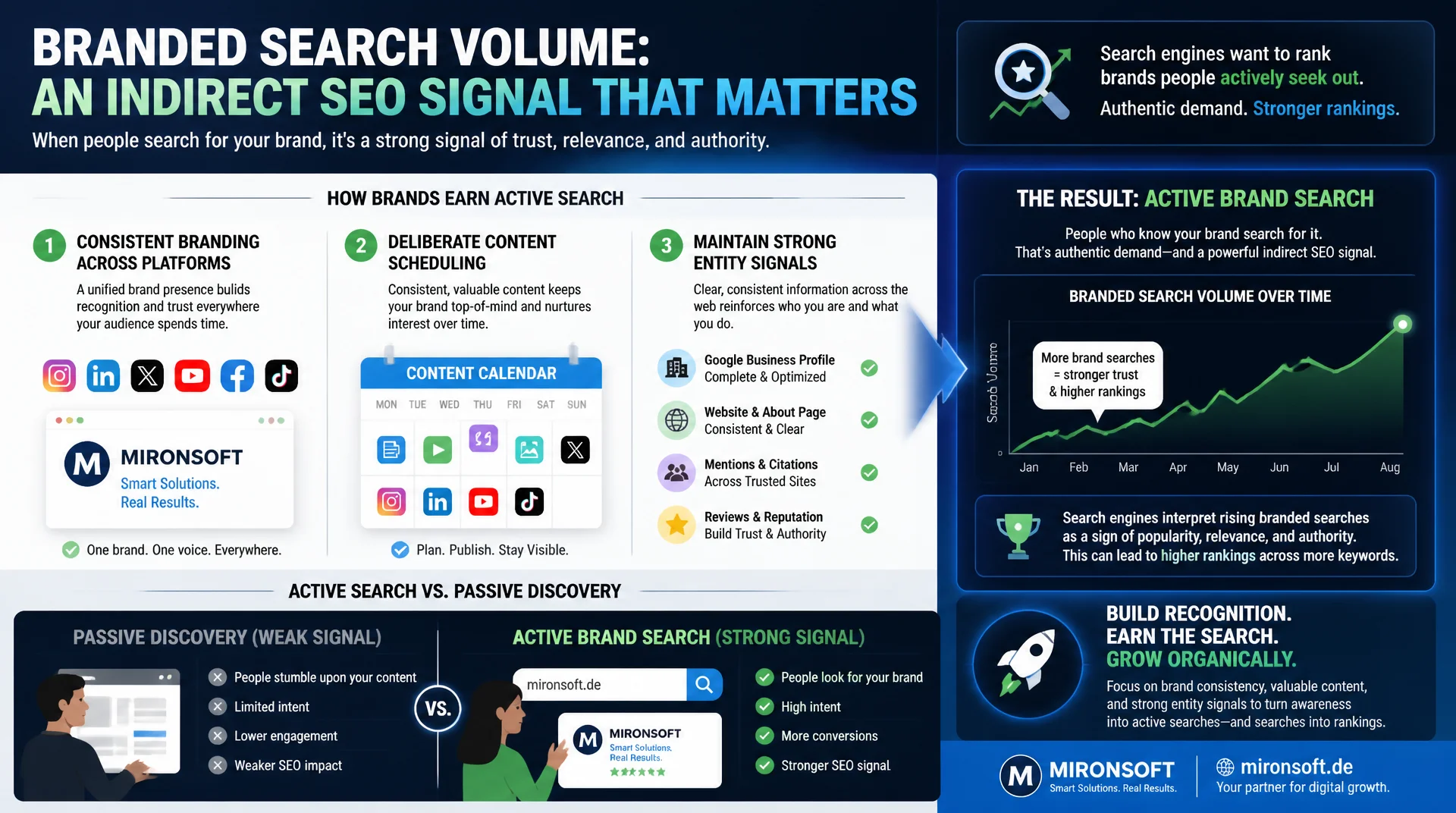
entity signals, Knowledge Panel and content timing
Branded search volume is one of the most robust indirect SEO signals, because it reflects real demand that cannot be faked through technical tricks. Consistent handles, deliberate content timing, and well maintained entity signals across every social channel ensure users type a brand into search on purpose, instead of stumbling on it by chance.
Table of Contents
- 1. Why branded search volume is a strong SEO signal
- 2. Google Search Console: measuring branded search volume
- 3. Consistent brand presence as a search trigger
- 4. Content calendar: posts designed to trigger branded search
- 5. Strengthening the Knowledge Panel and entity signals
- 6. Hashtags, handles and naming consistency across platforms
- 7. Campaign timing: correlating social peaks and search volume
- 8. Common mistakes when building branded search volume
- 9. Social tactics and their impact on branded search compared
- 10. Summary
- 11. FAQ
1. Why branded search volume is a strong SEO signal
Branded search volume describes the number of search queries containing a brand's name directly, or in combination with a product term. Unlike classic ranking factors that can be technically influenced and partly manipulated, branded search volume reflects real demand: people actively searching for a specific brand already know it and have a concrete interest. This exact property is what makes the signal so valuable to Google, and so hard for shops to fake.
Google interprets rising, stable branded search volume as evidence of relevance and trust in the market, which can indirectly affect domain authority and the assessment of the entire website. A shop that thousands of people search for by name every day gets classified differently by search engines than a domain found only through generic product terms. This distinction is especially relevant in highly competitive niches, where technical SEO factors barely differentiate competitors anymore.
Social media presence is one of the most effective levers to deliberately grow branded search volume, because social channels create daily touchpoints with potential customers without every contact having to immediately turn into a click. A user who repeatedly sees a brand in their feed often searches for it actively later, once concrete purchase interest arises, instead of going back directly to the original post.
2. Google Search Console: measuring branded search volume
Google Search Console is the primary free data source for tracking branded search volume over time. In the "Performance" report, a regex filter on the search query can target all queries containing the brand name, regardless of capitalization or combination with other terms. This filtered view shows clicks, impressions, average position, and click-through rate exclusively for branded searches.
{
  "comment": "Search Console query filter for branded search tracking",
  "filter_type": "query",
  "filter_operator": "custom_regex",
  "filter_value": "(?i)\\bbrandname\\b",
  "compare_periods": {
    "period_a": "2026-01-01 to 2026-03-31",
    "period_b": "2026-04-01 to 2026-06-30"
  },
  "metrics_to_track": ["clicks", "impressions", "ctr", "position"],
  "goal": "Track branded query growth in relation to social campaign activity"
}
For a solid trend analysis, it is worth exporting this filtered data monthly into a separate dashboard that maps branded search volume across multiple quarters. This makes it possible to distinguish seasonal fluctuations from genuine, sustainable growth, and social media campaigns can be evaluated based on their time correlation with search volume peaks.
3. Consistent brand presence as a search trigger
The mechanism behind social media's effect on branded search volume is psychologically simple: repeated, consistent contact with a brand builds recognition, and recognition leads to active search when the need arises. A brand that posts only sporadically, with a shifting visual identity and inconsistent tone, builds recognition significantly slower than a brand with a regular, consistent presence across all channels.
Consistency here means not just posting frequency, but also visual and verbal recognizability: the same logo, the same color palette, a recognizable tone in captions. Users who see a brand in similar form in their feed over weeks are more likely to later remember the brand name than the specific content of a single post, and it is exactly that brand name they eventually type into search when branded search volume is meant to emerge.
4. Content calendar: posts designed to trigger branded search
Not every social media post contributes equally to branded search volume. Content that includes a concrete, brand-related call to action, such as "search for [Brand] product name for details", demonstrably generates more direct search queries than purely aesthetic posts without an explicit call to action. A well thought out content calendar therefore deliberately schedules formats designed to prompt search, not just likes or comments.
{
  "comment": "Simplified content calendar entry designed to trigger branded search",
  "post_date": "2026-07-28",
  "channel": "instagram",
  "format": "reel",
  "cta_type": "search_prompt",
  "caption_snippet": "For all details, just search 'Example Brand Sneaker X'",
  "expected_effect": "branded_search_volume_increase",
  "tracking_link": "https://shop.example.com/sneaker-x?utm_source=instagram&utm_medium=organic_social&utm_campaign=sneaker_launch_2026-07"
}
Product launches are particularly well suited to this tactic, because users have a heightened information need around new products anyway. A post that deliberately withholds some details and instead prompts independent research of the brand name can deliberately increase branded search volume in the days following publication, which can be clearly tracked in Search Console.
5. Strengthening the Knowledge Panel and entity signals
A Knowledge Panel that appears to the right of the search results for a branded search is both a result and an amplifier of branded search volume. Google assembles this panel from various entity signals, including Wikipedia or Wikidata entries, verified social media profiles, and structured data on your own domain. The sameAs attribute in the Organization schema explicitly connects these social profiles with the brand and helps Google merge the entity correctly.
An existing Knowledge Panel in turn reinforces branded search volume, because it provides first-time searchers with additional information and trust directly in the search results, which can prompt follow-up searches for specific products or brand categories. This interplay makes building entity signals one of the most sustainable investments in the branded search space, even though the effect only becomes visible in the medium to long term.
6. Hashtags, handles and naming consistency across platforms
Inconsistent handles across platforms, for instance "@examplebrand" on Instagram but "@examplebrand_shop" on TikTok, dilute recognizability and make it harder for users to find the brand again on purpose. For consistent growth of branded search volume, it is worth reserving identical handles early on every relevant platform, even if a channel is not yet actively used.
Spelling in body text and captions should also be consistent, including consistent capitalization and hyphen usage. This seemingly small detail directly affects how users later type the brand into the search bar, and inconsistent spelling fragments the measured branded search volume in Search Console across multiple, technically different queries.
7. Campaign timing: correlating social peaks and search volume
To prove the actual contribution of social media activity to branded search volume, it is worth systematically correlating social media analytics with Search Console data. A peak in reach or engagement on Instagram that coincides in time with a rise in branded search queries is a strong, though not causally proven, indicator of the social activity's effectiveness.
// Conceptual correlation script: align social reach data with
// Search Console branded query volume on a shared timeline

function correlateSocialAndBrandSearch(socialReachByDay, brandedQueriesByDay) {
  const timeline = [];

  for (const date of Object.keys(socialReachByDay)) {
    timeline.push({
      date,
      social_reach: socialReachByDay[date] || 0,
      branded_impressions: brandedQueriesByDay[date]?.impressions || 0,
      branded_clicks: brandedQueriesByDay[date]?.clicks || 0
    });
  }

  // Simple lagged correlation: check impact 3-7 days after a social spike
  return timeline.map((day, index) => {
    const laterWindow = timeline.slice(index + 3, index + 8);
    const avgLaterImpressions =
      laterWindow.reduce((sum, d) => sum + d.branded_impressions, 0) / (laterWindow.length || 1);
    return { ...day, avg_branded_impressions_3_7_days_later: avgLaterImpressions };
  });
}
A lagged window of three to seven days between social activity and search volume response has proven in practice to be a sensible observation period, because users rarely search immediately after seeing a post, they first process the information and only actively search for the brand once a concrete need arises.
8. Common mistakes when building branded search volume
The most common mistake is an inconsistent brand presence, where posting frequency, visual identity, and tone swing from week to week. Without recognizability over time, no reliable branded search volume emerges, because users simply do not retain the brand well enough in memory. A second mistake is neglecting handle consistency across platforms, which unnecessarily hinders discoverability.
// WRONG: inconsistent handles across platforms fragment brand recognition
{
  "instagram_handle": "@examplebrand",
  "tiktok_handle": "@examplebrand_shop",
  "facebook_handle": "examplebrandGmbH"
}

// RIGHT: identical handle reserved and used across all platforms
{
  "instagram_handle": "@examplebrand",
  "tiktok_handle": "@examplebrand",
  "facebook_handle": "@examplebrand"
}

// WRONG: no sameAs linkage in structured data, entity signals fragmented
// RIGHT: Organization schema with sameAs listing all verified profiles
A third mistake is missing tracking: without regular evaluation of filtered branded queries in Search Console, the success or failure of social activities on branded search volume stays invisible, and budget decisions are based on guesses rather than data. A fourth mistake is short-term thinking: branded search volume grows over months, not from individual viral posts, and anyone who gives up after two weeks without a visible effect misses the actual cumulative effect.
9. Social tactics and their impact on branded search compared
Not every social media tactic contributes equally to branded search volume. The following overview ranks common tactics by their typical impact.
| Tactic | Effect on branded search volume | Time horizon | Effort |
|---|---|---|---|
| Consistent handle and naming upkeep | Medium, cumulative | Long-term | Low, one-time setup |
| Product launch with search CTA | High, short-term | A few days | Medium, needs editorial planning |
| Entity signals/Knowledge Panel | Medium to high, reinforcing | Medium to long-term | Medium, needs technical implementation |
| Viral single post without follow-up | Short-term high, fades fast | A few days | Low, but hard to plan |
The most sustainable impact on branded search volume comes from combining long-term consistency with deliberate, short-term trigger campaigns around product launches. Individual viral moments without a structural foundation usually fade quickly, while a solid base of entity signals and consistent presence additionally reinforces every single peak.
Mironsoft
Entity SEO, Search Console analysis and brand building via social media
Want to build branded search volume strategically?
We analyze your current branded search volume in Search Console, develop content calendars with deliberate search triggers, and implement entity signals for a stronger Knowledge Panel.
Search Console analysis
Trend analysis of branded search volume across multiple quarters
Entity SEO
Organization schema and sameAs linking for a stronger Knowledge Panel
Content planning
Editorial calendars with deliberate search triggers around product launches
10. Summary
Branded search volume is one of the most robust indirect SEO signals, because it reflects genuine demand that cannot be generated through technical tricks. Building it happens through consistent social media presence with unified handles, deliberate content formats with search CTAs around product launches, and well maintained entity signals that support a Knowledge Panel and are in turn reinforced by it.
Google Search Console provides the measurement basis to track this build-up over time and correlate social media activity with actual search volume effects. Anyone who sustains consistency over months, instead of hoping for individual viral moments, builds branded search volume that sustainably contributes to the SEO performance of the entire domain.
Branded search volume and social media: the essentials at a glance
Search Console as the measurement base
Regex filter on the brand name in Performance, exported monthly for solid trends.
Consistency over virality
Regular, recognizable presence builds more sustainable search volume than individual viral posts.
Maintain entity signals
sameAs links and unified handles strengthen the Knowledge Panel and thereby search.
Deliberate search triggers
Content with an explicit call to search produces measurable short-term spikes.