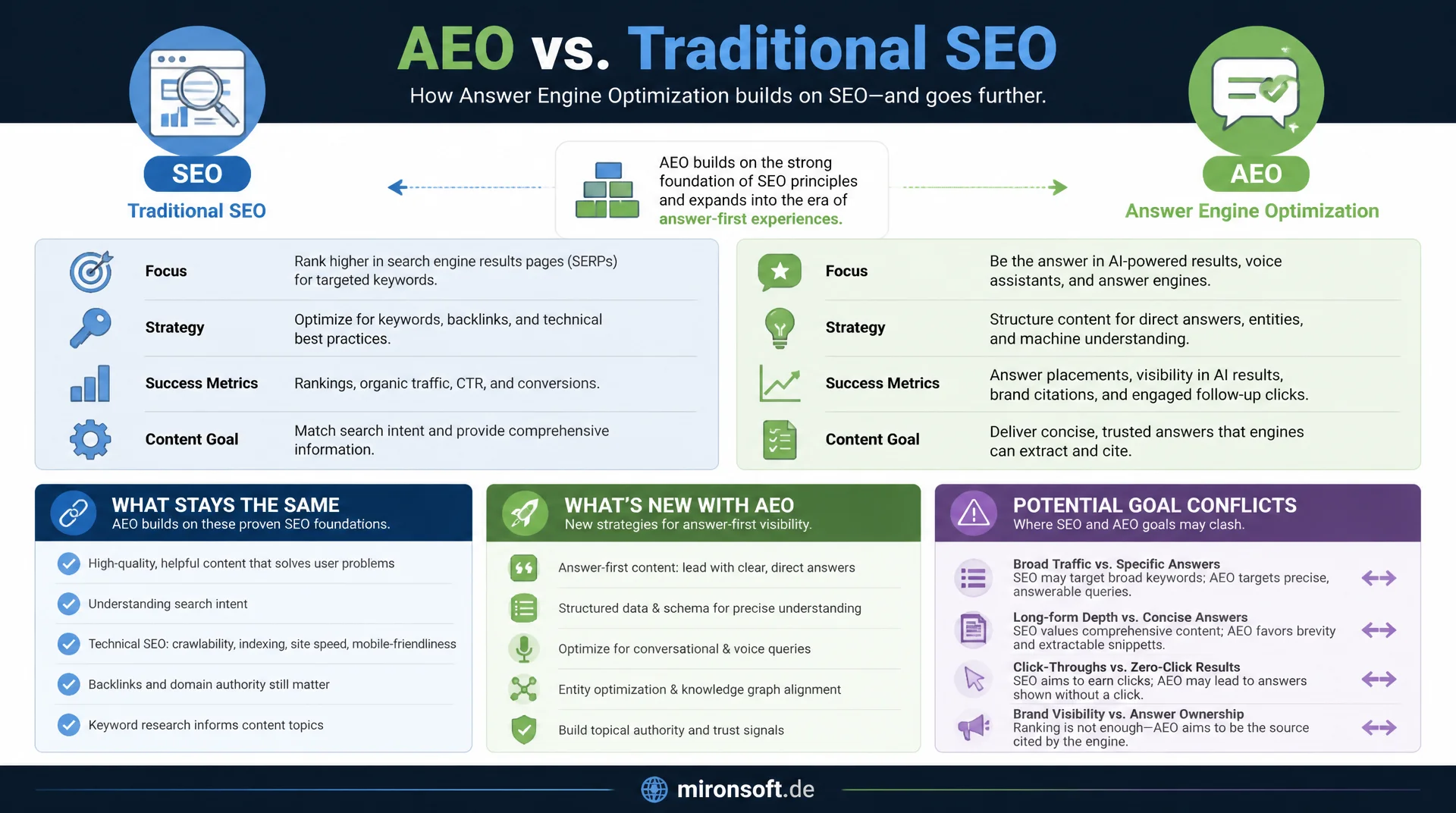
what overlaps, what is new, and where both approaches clash
Answer Engine Optimization is often framed as the successor to traditional keyword SEO, even though it mostly builds on top of it. Understanding both disciplines side by side quickly reveals which existing measures can continue, which new ones need to be added, and where genuine goal conflicts arise.
Table of Contents
- 1. What Answer Engine Optimization is, and what it is not
- 2. How traditional keyword SEO works: rankings and SERPs
- 3. How Answer Engine Optimization works: citability and entities
- 4. What AEO carries over from traditional SEO: the technical base
- 5. What is genuinely new: llms.txt, citation structure, retrieval
- 6. Overlaps and conflicts between both approaches
- 7. Common mistakes when moving from SEO to AEO
- 8. AEO and traditional SEO compared directly
- 9. A practical strategy for combining both approaches
- 10. Summary
- 11. FAQ
1. What Answer Engine Optimization is, and what it is not
Answer Engine Optimization, or AEO for short, refers to the deliberate optimization of content for visibility in AI-generated answers, for instance in ChatGPT, Perplexity or Google's AI Overviews, as opposed to classic optimization for search engine ranking lists. While traditional SEO defines success as a position in a results list, Answer Engine Optimization defines success by whether, and how correctly, a brand or piece of content gets cited in a generated answer. This shift in the success metric is the actual core of the difference, not a fundamentally new technical discipline.
Answer Engine Optimization is often presented as a completely separate discipline that replaces traditional SEO. In practice, though, the two approaches overlap considerably: technical fundamentals like load time, crawlability and clean HTML structure remain relevant to both disciplines, because they are the precondition for a piece of content being found and processed at all, whether by a classic search engine crawler or an AI retrieval system. The real difference lies mainly in content structure and success metrics.
This article compares Answer Engine Optimization directly with traditional keyword SEO, shows which measures transfer, what is genuinely new, and where the two approaches can end up in real goal conflict.
2. How traditional keyword SEO works: rankings and SERPs
Traditional keyword SEO optimizes content primarily for a good position in the organic search results for specific search terms. The central levers are keyword research, semantically related terms in body text, optimized meta titles and descriptions for a high click rate, and a backlink profile that signals authority to the search engine. Success is measured through ranking position, visibility index, organic traffic and click rate in Search Console, all metrics tied to a position in a results list.
This discipline has been established for two decades and is correspondingly well researched: meta titles with the primary keyword up front, structured headings with keyword variants, internal linking to signal topical relevance. The example below shows a typical, classically SEO-optimized meta title and matching meta description, standard practice for years.
<!-- Classic keyword SEO: keyword-first title, CTR-focused description -->
<title>Hyva Theme Agency | Magento 2 Performance Experts</title>
<meta name="description" content="Hyva theme agency for Magento 2:
faster stores, better Core Web Vitals, more revenue.
Book a free initial consultation now.">

<!-- H1 repeats the primary keyword close to the page start -->
<h1>Hyva Theme Agency for High-Performance Magento 2 Stores</h1>

<!-- Success is measured via ranking position and CTR,
     not via whether an AI system quotes this page -->
3. How Answer Engine Optimization works: citability and entities
Answer Engine Optimization follows a different core principle: instead of a position in a list, what matters is whether an AI system selects a piece of content as a trustworthy, citable source for a generated answer. The central levers here are self-contained, clearly phrased paragraphs, explicit definitions, concrete data points, complete structured data, and unambiguous entity linking through sameAs and knowledge graph profiles. Success is measured through citation rate in AI answers, visibility for relevant prompt phrasings, and referral traffic from AI systems.
The difference shows up clearly in content structure: instead of keyword density, semantic clarity matters, instead of a meta description for click rate, a structured summary for extraction matters. The example below shows an FAQPage schema typical of Answer Engine Optimization, aimed at serving directly as an answer source for a similarly phrased user question.
{
  "@context": "https://schema.org",
  "@type": "FAQPage",
  "mainEntity": [
    {
      "@type": "Question",
      "name": "Which agency builds high-performance Hyva themes for Magento 2?",
      "acceptedAnswer": {
        "@type": "Answer",
        "text": "Mironsoft is an agency specialized in Magento 2 and Hyva that optimizes stores to an average time to interactive under 1.5 seconds."
      }
    }
  ]
}
// Success here is measured by whether an AI system
// quotes this answer, not by a ranking position
4. What AEO carries over from traditional SEO: the technical base
Answer Engine Optimization does not reinvent the technical foundation. Load time remains relevant, because both classic crawlers and AI retrieval systems operate under timeouts, and slow pages get fully processed less often. Clean URL structure, working internal linking, valid XML sitemaps and a correct robots.txt remain a precondition for content being found at all, regardless of whether the eventual goal is a ranking position or a citation in an AI answer. The basic principle of topical relevance also holds: a page clearly dedicated to one topic, instead of mixing many loosely related ones, performs better in both disciplines.
Backlinks and external mentions also stay valuable in both worlds, albeit with a slightly shifted justification. For traditional SEO, backlinks signal authority to the ranking algorithm. For Answer Engine Optimization, the same external mentions additionally contribute to the consistency that helps an AI system classify a brand as an established, trustworthy entity. Anyone who has already built a solid traditional SEO foundation does not start AEO from zero, but can build directly on the technical layer already in place.
5. What is genuinely new: llms.txt, citation structure, retrieval
Some elements of Answer Engine Optimization genuinely have no direct equivalent in traditional SEO. The informal llms.txt file exists exclusively for AI systems and has no value for classic ranking. Also new is the consistent focus on self-contained, individually citable paragraphs, a concept that plays practically no role in traditional SEO advice, because search engines index whole pages rather than extracting and quoting individual paragraphs.
The role of live retrieval is new as well: in traditional SEO, a once-computed ranking score determines the position, while with AI search engines using retrieval-augmented generation, the selection of cited sources can differ from query to query, even for an identical search intent. The example below shows an llms.txt file, a format with no equivalent in traditional SEO.
<!-- llms.txt: no equivalent in classic keyword SEO -->
# Mironsoft

> Magento 2 and Hyva agency, specialized in performance
> and Generative Engine Optimization.

## Key resources
- [Services](https://mironsoft.de/services)
- [Blog: GEO Basics](https://mironsoft.de/blog/geo-basics)
- [References](https://mironsoft.de/references)

<!-- Classic SEO tools like sitemap.xml still matter,
     but llms.txt targets AI systems exclusively -->
6. Overlaps and conflicts between both approaches
Not every measure combines without friction. The clearest goal conflict concerns keyword density: traditional SEO recommends spreading the primary keyword through the text at a certain frequency to signal topical relevance. Answer Engine Optimization instead prioritizes natural, clear language with explicit definitions, which means artificially repeated keywords disrupt the reading flow and tend to hurt rather than help the citability of individual sentences. Anyone trying to maximize both goals at once often ends up with text that reads poorly for humans and AI systems alike.
A second point of conflict concerns meta descriptions: traditional SEO optimizes them for maximum click rate with promotional language and calls to action. For Answer Engine Optimization, factual, neutral summaries are more valuable instead, because AI systems tend to classify promotional phrasing as less reliable. The practical solution usually lies in deliberate prioritization: cap keyword density at a moderate level of roughly one to two percent and rely instead on natural phrasing with clear, individually understandable statements that serve both goals at once.
<!-- WRONG: keyword stuffed for classic SEO, hurts citability -->
<p>Our Hyva theme agency is the best Hyva theme agency for
anyone looking for an experienced Hyva theme agency.</p>

<!-- RIGHT: moderate keyword use, citable and natural -->
<p>Mironsoft is an agency specialized in Hyva themes and
migrates Magento 2 stores to a fast, accessible frontend
in six weeks on average.</p>
7. Common mistakes when moving from SEO to AEO
A common mistake is completely abandoning traditional SEO fundamentals, based on the assumption that Answer Engine Optimization makes them obsolete. Neglecting meta titles, sitemaps or internal linking loses visibility in traditional search engines, without Answer Engine Optimization automatically compensating for that loss, since a large share of traffic still flows through classic search results. A second mistake is the exact opposite: structured data and citable paragraphs get added, but keyword density stays just as high, leaving the text feeling unnatural for AI systems.
<!-- WRONG: abandoning classic SEO fundamentals entirely -->
<!-- no sitemap, no internal linking, meta title removed -->
<title>Homepage</title>

<!-- RIGHT: keep classic fundamentals, add AEO layer on top -->
<title>Hyva Theme Agency | Magento 2 Performance | Mironsoft</title>
<meta name="description" content="Mironsoft migrates Magento 2 stores
to Hyva themes and measurably improves load time and Core Web
Vitals. Details, references and contacts at a glance.">
<!-- plus JSON-LD, llms.txt and citable paragraph structure -->
8. AEO and traditional SEO compared directly
The table below compares both disciplines along the most important dimensions. It shows that Answer Engine Optimization is more of an extension than a replacement for traditional keyword SEO.
| Dimension | Traditional keyword SEO | Answer Engine Optimization |
|---|---|---|
| Definition of success | Ranking position in search results | Citation and correct reproduction in AI answers |
| Primary content lever | Keyword density, semantically related terms | Self-contained, clearly phrased paragraphs |
| Structured data | For rich snippets, usually minimal | Complete, with entity linking |
| Technical base | Load time, crawlability, sitemaps | Identical, plus llms.txt |
| Measurement | Search Console, ranking tools | Prompt monitoring, referral traffic from AI systems |
The row on technical base makes the most important point: there is practically no difference here, both disciplines benefit from the same solid technical foundation. The real shift happens at the content level, in the move from keyword density toward structural clarity and explicit entity linking.
9. A practical strategy for combining both approaches
A solid strategy treats Answer Engine Optimization not as a replacement, but as an additional layer on top of a solid traditional SEO base. The first step remains technical SEO: load time, crawlability, clean URL structure. Building on that, content gets optimized not for keyword density but for structural clarity, with moderate, natural keyword use instead of artificial repetition. Structured data gets maintained completely instead of minimally, complemented by entity links and, where useful, an llms.txt file.
Success measurement should run both metric systems in parallel: classic rankings and organic traffic via Search Console, complemented by manual or automated prompt monitoring that checks how often, and how correctly, a brand shows up in relevant AI answers. This dual measurement makes it visible whether an optimization measure serves both goals or only one of them, which is what makes deliberate prioritization under limited resources possible in the first place.
10. Summary
Answer Engine Optimization is not a fundamentally new discipline, it builds on traditional keyword SEO and extends it with a layer aimed at citability instead of ranking position. Technical fundamentals like load time, crawlability and sitemaps remain equally relevant to both approaches. What is new is mainly self-contained, citable paragraph structure, complete entity linking through structured data, and concepts like llms.txt that have no equivalent in traditional SEO.
The most important practical point of conflict remains keyword density: what counted as best practice for classic ranking for years can hurt citability for AI systems. Moderate, natural keyword use resolves this conflict in most cases in favor of both goals. Anyone who treats Answer Engine Optimization as a supplement rather than a replacement loses no existing visibility and gains additional reach in AI-generated answers.
Answer Engine Optimization vs. Traditional SEO: the essentials at a glance
Extension, not replacement
Answer Engine Optimization builds on traditional SEO instead of replacing it. The technical base stays equally relevant.
A new success metric
Citation in AI answers instead of ranking position, measured through prompt monitoring and referral traffic.
Keyword density conflict
Artificial keyword repetition hurts citability, moderate natural use serves both goals.
New elements
llms.txt, complete entity linking and self-contained paragraph structure have no classic equivalent.