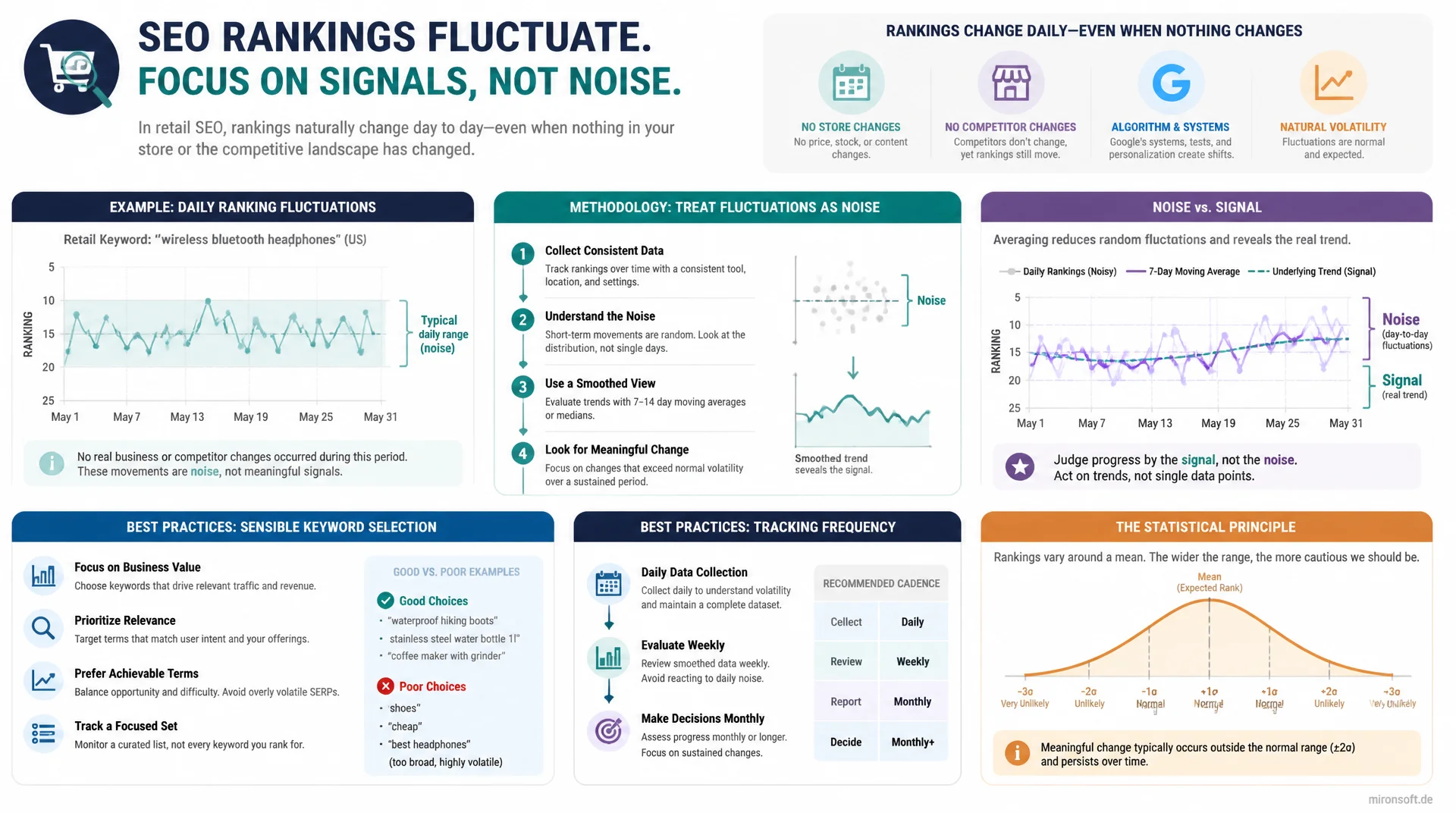
From daily noise to real trends
Ranking positions shift every day, often without anything actually changing at the store or with competitors. Treating these fluctuations as real signals means making SEO decisions based on chance instead of data. This methodology shows how to choose keywords sensibly, pick the right tracking frequency, and separate ranking data from noise with statistical rigor.
Table of Contents
- 1. Why ranking data is noisy: personalization, location, and device
- 2. SERP features as an added disruptor: featured snippets, local pack, AI overviews
- 3. Choosing and clustering the right keywords
- 4. Tracking frequency: daily, weekly, and the cost-versus-signal tradeoff
- 5. Rank tracking as a leading indicator, traffic and conversions as lagging indicators
- 6. The vanity metric trap: putting average position in perspective
- 7. Building a rank tracking setup that is methodologically sound
- 8. Statistical significance and noise filtering in ranking data
- 9. Validating rank data against Google Search Console
- 10. Summary
- 11. FAQ
1. Why ranking data is noisy: personalization, location, and device
A rank tracking tool shows position 4 for a keyword one day and position 7 the next, without anything having changed at the store. The main reason lies in the nature of Google Search itself: every query is assembled individually, shaped by location data, device type, search history, and sometimes even active A/B tests run by Google. A user in Munich sees a different result for an identical query than a user in Cologne, and a mobile result differs structurally from a desktop result, if only because of different SERP layouts.
Rank tracking tools cannot replicate this personalization. Instead, they simulate a synthetic, logged-out search from a fixed location proxy and a fixed device. The result is an approximation, not an exact copy of what a real user sees. On top of that, Google's own staged rollouts of ranking adjustments, often spread across days or weeks, artificially widen the range of fluctuation. Treating a single day's measurement as ground truth confuses measurement noise with a genuine ranking change.
2. SERP features as an added disruptor: featured snippets, local pack, AI overviews
Beyond personalization, SERP features further distort classic position counting. A featured snippet appearing above the organic results pushes every position below it down by one slot, without anything actually changing about the page's relevance or quality. The same applies to the local pack for location-based queries, and increasingly to AI overviews, which as generated summaries can occupy entire screen areas before the first organic result even appears.
What makes this especially tricky: SERP features often appear and disappear irregularly for the same keyword, depending on time of day, intent signals, and internal Google experiments. A rank tracking setup that only captures the raw position, without logging which SERP features were present that day, loses exactly the context that makes a position change explainable. Reliable tools therefore log not just the position per measurement, but also the active SERP feature types and whether the tracked domain itself occupies a feature.
3. Choosing and clustering the right keywords
Tracking hundreds of keywords indiscriminately mostly produces data noise and reporting overhead without strategic value. The first meaningful split separates branded from non-branded keywords: branded rankings are usually stable and say little about actual SEO performance, while non-branded keywords reflect true visibility within the competitive landscape. The second split separates by search intent: transactional keywords with buying intent are directly revenue-relevant, while informational keywords build reach and topical relevance but sit on a different timeline to conversion.
Within these categories, keyword clustering by topic pays off over tracking individual keywords one by one: instead of tracking ten nearly identical variations of a search term separately, a cluster is formed and its aggregated visibility is measured. This substantially reduces noise, because individual outliers within a cluster get smoothed out by the other members, and it better reflects how modern search engines increasingly rank by topic rather than exact strings.
<!-- Keyword cluster configuration: grouping by topic, intent, and tracking priority -->
<rankTrackingConfig>
    <cluster id="produktkategorie-schuhe" intent="transactional" priority="high">
        <keyword geo="DE-BE">laufschuhe kaufen</keyword>
        <keyword geo="DE-BE">laufschuhe online bestellen</keyword>
        <keyword geo="DE-BE">running schuhe shop</keyword>
        <trackingFrequency>daily</trackingFrequency>
    </cluster>

    <cluster id="ratgeber-schuhgroesse" intent="informational" priority="medium">
        <keyword geo="DE">schuhgröße richtig messen</keyword>
        <keyword geo="DE">schuhgrößentabelle</keyword>
        <trackingFrequency>weekly</trackingFrequency>
    </cluster>

    <cluster id="branded" intent="navigational" priority="low">
        <keyword geo="DE">mironsoft schuhe</keyword>
        <trackingFrequency>weekly</trackingFrequency>
    </cluster>
</rankTrackingConfig>
4. Tracking frequency: daily, weekly, and the cost-versus-signal tradeoff
Daily tracking sounds like the safer choice, but it adds extra per-keyword noise that only smooths out across multiple data points, and it directly drives up API costs per query for many tools. For high-priority, competitive transactional keywords with frequent SERP changes, daily tracking is still worthwhile, because short-term trends such as algorithm updates or competitor promotions become visible faster. For the long tail of informational keywords, weekly or even biweekly tracking is usually entirely sufficient, since positions there naturally move more slowly.
In practice, staggering frequency by cluster priority delivers the best ratio of data quality to cost: critical money keywords tracked daily, medium-priority clusters weekly, long-tail clusters monthly. It's important not to change the frequency after the fact without accounting for it in the analysis, since switching from daily to weekly measurement automatically changes how heavily outliers weigh in an averaged time series.
<!-- Hyvä phtml: display tracking frequency status as an admin dashboard widget -->
<div class="grid grid-cols-1 sm:grid-cols-3 gap-4" x-data="rankTrackingStatus()">
    <template x-for="cluster in clusters" :key="cluster.id">
        <div class="rounded-xl border border-slate-200 p-4 bg-white">
            <p class="text-sm font-bold text-slate-800" x-text="cluster.label"></p>
            <p class="text-xs text-slate-500 mt-1">
                Frequency: <span x-text="cluster.frequency"></span>
            </p>
            <span
                class="inline-block mt-2 text-xs font-semibold px-2 py-1 rounded-full"
                :class="cluster.staleData ? 'bg-red-100 text-red-700' : 'bg-green-100 text-green-700'"
                x-text="cluster.staleData ? 'Data stale' : 'Up to date'"
            ></span>
        </div>
    </template>
</div>
5. Rank tracking as a leading indicator, traffic and conversions as lagging indicators
Rank tracking data is a leading indicator: a position improvement from rank 12 to rank 6 shows up in the ranking data immediately after the next measurement, while the resulting traffic increase only shows up in Google Analytics or Search Console with a delay, sometimes only after days or weeks, once Google stabilizes the new position and users click accordingly more often. Anyone who waits exclusively for traffic and conversion numbers is structurally too late to react to SEO problems, because the root cause already lies weeks in the past by the time the effect finally becomes visible.
Conversely, rank tracking alone is not a sufficient success metric either, since a better position without rising traffic or rising conversions has no economic value. The sensible practice combines both layers: ranking data as a fast early-warning system for trend breaks, traffic and conversion data as confirmation of whether a position improvement actually translates into business value. A cluster that ranks but generates no clicks usually points to a problem with the snippet, intent match, or SERP feature competition.
6. The vanity metric trap: putting average position in perspective
The average position across all tracked keywords is one of the most commonly misunderstood SEO metrics. It obscures the fact that an improvement from position 45 to position 30 for a low-volume keyword can move the average just as much as a decline from position 3 to position 8 for the most important money keyword, even though the business relevance of the two events is completely different. A rising average can even occur alongside falling revenue, if exactly the highest-converting keywords lose positions while many long-tail keywords tick up slightly.
More reliable than the plain average is a visibility index weighted by search volume and business impact, which converts positions into estimated click shares and sums them across all keywords. That way, an improvement on a high-volume transactional keyword automatically weighs more than a shift on a rarely searched niche term. Anyone still reporting the simple average position should at minimum supplement it with segment breakdowns by keyword priority, rather than relying on a single, aggregated number as the success benchmark.
7. Building a rank tracking setup that is methodologically sound
A clean rank tracking setup starts with clear, documented parameters: a fixed search location per target market, a consistent device profile (capturing desktop and mobile separately, never mixed), a defined measurement time, and a fixed search engine domain, such as google.de instead of google.com for the German market. Every change to these parameters, such as switching tracking providers or adjusting the location proxy, must be documented, since otherwise it looks like a genuine ranking change even though it's only a change in measurement methodology.
Equally important is a stable API connection that stores raw data, including timestamp, SERP feature context, and measurement location, in a structured way, instead of simply overwriting the current position. Only a complete history makes it possible to later distinguish trends from outliers and correlate ranking trajectories with external events such as Google core updates. The API response below shows the fields a reliable tracking system should capture at minimum per measurement.
{
  "keyword": "laufschuhe kaufen",
  "clusterId": "produktkategorie-schuhe",
  "measuredAt": "2026-07-11T06:00:00Z",
  "searchEngine": "google.de",
  "device": "mobile",
  "geoLocation": "DE-BE",
  "position": 6,
  "previousPosition": 9,
  "url": "https://mironsoft.de/laufschuhe",
  "serpFeatures": {
    "featuredSnippet": false,
    "localPack": false,
    "aiOverview": true,
    "ownsFeature": false
  },
  "estimatedSearchVolume": 8100,
  "estimatedClickShare": 0.086
}
8. Statistical significance and noise filtering in ranking data
A single position change of two or three spots falls, for most keywords, within the normal range of day-to-day fluctuation and is statistically indistinguishable from noise. Only when a movement persists in the same direction across several consecutive measurements, or lies clearly outside a keyword's historical standard deviation, is it worth calling it a genuine trend change rather than random noise. A moving average across seven to fourteen data points reliably smooths short-term outliers without hiding real, longer-lasting trends.
For prioritized keyword clusters, a more formal check is worthwhile: the current position is compared against the cluster's historical mean and standard deviation, and only deviations that cross a defined threshold trigger a warning or a reporting event. This prevents every small, natural fluctuation from setting off a frantic reaction in the team, while genuine ranking drops, for example after a botched deployment, are reliably detected.
// Check the statistical significance of a ranking change (z-score approach)
function isSignificantChange(currentPosition, history) {
  const mean = history.reduce((sum, p) => sum + p, 0) / history.length;
  const variance = history.reduce((sum, p) => sum + (p - mean) ** 2, 0) / history.length;
  const stdDev = Math.sqrt(variance);

  // No spread in the history: any deviation counts immediately
  if (stdDev === 0) {
    return currentPosition !== mean;
  }

  const zScore = (currentPosition - mean) / stdDev;

  // |z| > 2 is treated as statistically notable (~95% confidence)
  return Math.abs(zScore) > 2;
}

// Example: 14 days of position history, check the current measurement
const history = [8, 9, 7, 8, 9, 8, 7, 9, 8, 8, 9, 7, 8, 9];
const current = 4;

if (isSignificantChange(current, history)) {
  console.log("Significant ranking change detected, trigger alert.");
}
9. Validating rank data against Google Search Console
Rank tracking tools deliver a synthetic snapshot, whereas Google Search Console delivers real user data: actual impressions, clicks, and the average position Google itself calculates over a given period. Cross-checking both sources is the most important validation layer in any rank tracking methodology, because systematic discrepancies between the two datasets reliably reveal whether the tracking tool is simulating the wrong location, the wrong device, or an outdated SERP structure.
In practice, a regular, automated comparison is recommended: rank tracking data and Search Console position data for the same keyword clusters are pulled via their respective APIs, normalized to the same time period, and compared side by side. Large, persistent discrepancies are a signal to review the tracking configuration, while short-term differences are usually explained by the different data basis, personalized user clicks versus synthetic measurement.
#!/usr/bin/env bash
# Pull Search Console position data and cross-check it against the rank tracking export
set -euo pipefail

SITE_URL="https://mironsoft.de/"
START_DATE=$(date -d "-28 days" +%Y-%m-%d)
END_DATE=$(date +%Y-%m-%d)

# Fetch per-query position data from the Search Console API
curl -s -X POST \
  "https://searchconsole.googleapis.com/webmasters/v3/sites/${SITE_URL//\//%2F}/searchAnalytics/query" \
  -H "Authorization: Bearer ${GSC_ACCESS_TOKEN}" \
  -H "Content-Type: application/json" \
  -d "{\"startDate\":\"${START_DATE}\",\"endDate\":\"${END_DATE}\",\"dimensions\":[\"query\",\"date\"]}" \
  > gsc_positions.json

# Compute a rolling 7-day average position per keyword
jq -r '.rows[] | [.keys[0], .keys[1], .position] | @csv' gsc_positions.json \
  | sort -t, -k1,1 \
  | awk -F, '
      { pos[$1] = pos[$1] " " $3; count[$1]++ }
      END {
        for (kw in pos) {
          n = split(pos[kw], arr, " ")
          sum = 0
          for (i = 1; i <= n; i++) sum += arr[i]
          printf "%s: rolling_avg_position=%.2f (n=%d)\n", kw, sum / n, n
        }
      }'
Rank tracking methodology compared side by side
The gap between a naive rank tracking approach and a reliable methodology is rarely about expensive tools, mostly it comes down to consistent methodological decisions. The table below summarizes the key differences.
| Aspect | Naive approach | Reliable methodology | Risk if ignored |
|---|---|---|---|
| Location & device | One location for all keywords | Geo-targeting per target market, device split | Wrong priorities for local SEO |
| Tracking frequency | All keywords daily, unreflected | Frequency staggered by cluster priority | Unnecessary cost, noise instead of signal |
| Core metric | Average position as the headline metric | Weighted visibility index | Vanity metric hides real business impact |
| Keyword selection | Money keywords only, unclustered | Clustered by intent, branded/non-branded split | Blind spots on topical relevance |
| Validation | Tool data taken at face value | Regular cross-check against Search Console | Misconfiguration goes unnoticed |
In practice these five aspects reinforce each other: an incorrect geo configuration distorts not just individual values, but also every significance check and every Search Console comparison built on top of it. Setting up and documenting the methodology properly once saves recurring debates about whether a position change was real or just noise.
Mironsoft
Rank tracking setup, keyword clustering, and SEO monitoring for Magento stores
Ready for ranking data you can actually trust?
We build your rank tracking methodology from the ground up: clean keyword clusters, the right tracking frequency, and automated cross-checks against Search Console, so you can tell real trends apart from daily noise.
Rank tracking audit
Review of location configuration, frequency, and data quality
Keyword clustering
Structuring by intent, branded/non-branded, and business impact
Monitoring setup
Automated Search Console cross-checks and significance alerts
10. Summary
A reliable rank tracking methodology addresses one core problem: individual day-to-day swings are not a trustworthy signal, but correctly set up, continuous tracking makes real trends visible. It starts with keyword selection, clearly split by branded/non-branded and search intent, and sensibly clustered, instead of tracking hundreds of individual terms in isolation. Tracking frequency should be staggered by priority, daily tracking for money keywords, weekly or monthly for the long-tail list, to keep cost and data quality in balance.
Statistical significance checks and a cleanly documented setup with a fixed location, device, and search engine domain separate genuine noise from genuine change. Regularly cross-checking against Google Search Console validates the synthetic tracking data against real user data and reliably surfaces misconfigurations. Using rank tracking as a leading indicator alongside traffic and conversion data as lagging indicators, instead of relying on a single vanity metric like average position, leads to SEO decisions built on a far more solid data foundation.
Rank Tracking Methodology - The Essentials at a Glance
Recognize the noise
Personalization, location, device, and SERP features like featured snippets and AI overviews distort individual measurements.
Cluster keywords
Separate branded/non-branded, group by intent, track clusters instead of single keywords.
Stagger frequency
Daily tracking for money keywords, weekly/monthly for long-tail, keep an eye on cost.
Validate & combine
Use z-score significance checks, cross-check regularly against Search Console data.